Memory
 Call Kai
 Learn
 Practice Test
 Spaced Repetition
 Match
 Flashcards
 Knowt Play
1/70

There's no tags or description
Looks like no tags are added yet.
71 Terms
Where is the hippocampus located?
On medial portion on the temporal lobe (not on the midline)
What evidence do we have of the function of the hippocampus in memory?
Patient HM (1950s) → discovered hippocampus (anterograde amnesia)
HM could remember a number for 15 minutes by continuously repeating, but forgot it within 1 minute of stopping and had no recollection of attempting it (Milner, 1971)
Clive Wearing
Baddeley + Warrington (1970) → tested 6 amnesics + 6 non-amnesics with peripheral nerve damage → normal ST retention of word triads + random digits

What is anterograde amnesia?
Impaired encoding (consolidation) of episodic memory (can't form new LTM)
Spared/normal functions → STM, procedural (non-declarative → can't verbalise), semantic (conceptual)
Bilateral hippocampus damage

In amnesia, what is there a deficit in?
Consolidation = process of translating moment-to-moment changes in brain activity into permanent structural changes
Anterograde loss = if memories aren't consolidated, they aren't maintained
Retrograde loss = need to assume that old memories aren't fully consolidated at the time of injury

Why is consolidation needed?
Want fast learning, minimal interference/forgetting, efficient + organised memory storage
Need space BUT not efficient → conflicting tensions → 2 complimentary learning systems (solves this)
What are the 2 complimentary learning systems?
Fast learning = hippocampus
Slow learning = cortex (consolidated into this LT system)
What is the fast learning system?
Acquire new knowledge quickly
Fast forgetting (catastrophic interference)
Requires lots of space
Poor generalisation (isolated knowledge)
What is the slow learning system?
Integrate new info with existing knowledge
Slow/limited forgetting
Efficient space usage
Good generalisation
Requires many interleaved repetitions -> slow
Which type of memories does amnesia affect?
Declarative (episodic memories) → hippocampus temporarily links together different kinds of info in many regions of the brain (perceptual, affective, conceptual etc) → this temp link lasts long enough to support slow learning
What improves learning and recall? What evidence supports this?
Sleep
Use scalp EEGs when sleeping → find spindles (bursts of activity) → links to consolidation process
Hippocampus drives memory reactivation for interleaved learning in cortex (replay memories for slow learning changes that happen in the cortex)
Sleep disruption interferes with this process + can eliminate hippocampal LTP
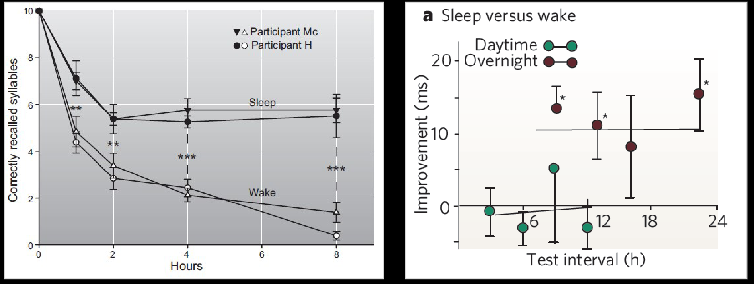
How do Jenkins and Dallenbach (1924) support the role of sleep in learning?
Recall of recently learned info is greater immediately after sleeping than after the same amount of time spent awake
Argued that being asleep passively protects us from encountering info that interferes with our ability to remember NOT that sleep strengthens/consolidates memory
How can memory consolidation during sleep be enhanced?
By presenting sounds during sleep that reactivate specific memories → targeted memory reactivation (TMR; Cellini + Capuozzo, 2018; Oudiette + Paller, 2013)
Before sleep PPTs learned to associate an object with a particular location on a screen
During a subsequent period of sleep, researchers played the sounds of some of the studied objects
When tested after awakening, PPTs showed more accurate memory for the location of the objects whose characteristic sounds were presented during sleep than for the locations of objects whose characteristic sounds were not presented
How do Schreiner and Rasch (2015) support the role of sleep in learning?
Native German speakers who learned a series of Dutch words in late evening
Some of the PPTs then slept for 3 hours
1 group received TMR → some of the previously studied Dutch words were presented auditorily
Other group wasn’t exposed to the studied Dutch words while sleeping
Given vocab test
Exposure to the Dutch words during sleep improved learning of the German translation during subsequent waking
Hu et al. (2020) → TMR effects are statistically significant across experiments BUT only when TMR is administered during stage 2 + slow-wave sleep (effects aren’t observed during REM)
What is massed practice?
All practising is done in 1 block on time
What is spaced practice?
Same amount of practising spaced out over time
Which type of practice facilitates consolidation?
Spaced practice

Is repeated studying or repeated testing more effective?
Repeated testing

Retrieval practice research (results)

What actions are performed on memories?
Encoded
Initial, temp storage of info
Consolidated
Converting temp storage info into LT, stable storage
Retrieved
Recovery/activation of the info when it is needed
Retrieval practice
What is encoding?
The process by which we transform what we perceive, think or feel into an enduring memory
what did Bartlett argue about encoding and schemas?
Story was unfamiliar to the readers → raided their stores of general info + patched together a reasonable recollection of what probably happened
PPTs encode + construct memories via schemas (mental models of the world that contain knowledge that helps us to encode new info into a meaningful context)
Distort memory
Memories are made by combining info we know with new info that comes through our senses -> are constructed not recorded
Encoding = transforming what we perceive, think or feel into an enduring memory
What is elaborative encoding?
Craik + Tulving (1975)
Semantic judgements required the participants to think about the meaning of the words – ‘Is hat a type of clothing?’
Had better memory for the words
Rhyme judgements required the participants to think about the sound of the words – ‘Does hat rhyme with cat?’
Visual judgements required the participants to think about the appearance of the words – ‘Is HAT written uppercase or lowercase?’
LT retention is greatly enhanced by elaborative encoding = actively relating knew info to info already in memory
Uniquely associated with increased activity in the inner part of the left temporal lobe and the lower left part of the frontal lobe
More activity → more likely they'll remember
What is visual encoding?
Storing new info by converting it into mental pictures
Method of loci = memory aid that associated info with mental images of locations
Schnorr + Atkinson (1969)
PPTs who studied lists of words by creating visual images of them later recalled 2x as many items as PPTs who just mentally repeated the words
Paivio (1969)
Found similar results for people who studied lists composed of concrete words that are easily visualised (e.g. tree, battleship or sun) compared to abstract words (e.g. idea, democracy or will)
Dresler et al. (2017)
Contemporary ‘memory athletes’ (who compete in increasingly popular memory championships) typically rely on visual imagery encoding to accomplish astounding feats of memorisation
Relates info to what you already know
When you use visual imagery to encode words + other verbal info, you end up with 2 different mental ‘placeholders’ for the items (visual + verbal) → more ways to remember them (Paivio, 1971, 1986)
Activates regions in the occipital lobe → enlist the visual system when forming memories based on mental images
What is organisational encoding?
Categorising information by noticing the relationships between a series of items
Servers group/categorise orders or put them into sequences that match the layout of the kitchen (Stevens, 1988)
Bower et al (1969)
Hierarchy
Improved their recall of individual items by organising them into multiple-level categories (general category → intermediate categories → specific examples)
Encourages you to focus on the similarities + differences between items
Type of mnemonic = a device for reorganising information into more meaningful patterns to remember (provide an overarching structure that makes it easier to reconstruct the constituent parts)
Activates the upper surface of the left frontal lobe
What is encoding of survival-related information?
Memory mechs that help us to survive + reproduce should be preserved by natural selection
Memory systems should be built in a way that allows us to remember especially well-encoded info that’s relevant to our survival
Survival encoding draws on elements of elaborative, imagery + organisational encoding, (advantage over other 3) OR thinking about info with regard to its survival value is more interesting or emotionally arousing than other kinds of encoding
Superior recall observed for planning
What did Nairne (2007) argue about encoding of survival-related information?
Survival encoding condition
Asked to imagine they were stranded in the grasslands of a foreign land without any survival materials + that over the next few months they would need supplies of food + water + would also need to protect themselves from predators
The researchers then showed PPTs randomly chosen words (e.g. stone, meadow, chair) + asked them to rate on a 1–5 scale how relevant each item would be to survival in the hypothetical situation
Moving encoding condition
Asked to imagine that they were planning to move to a new home in a foreign land
Rate on a 1–5 scale how useful each item might be in helping them to set up a new home (doesn’t involve thinking about survival)
Pleasantness encoding condition
Shown the same words + asked to rate on a 1–5 scale the pleasantness of each word
Used a pleasantness encoding task taken from previous research that was proven to involve deep, elaborative encoding of the kind we have already seen is beneficial to later retention
PPTs recalled more words after the SET than the other tasks
Survival encoding resulted in higher levels of recall than several other non-survival encoding tasks involving elaborative encoding, imagery encoding or organisational encoding (Nairne et al., 2008)
What is storage?
The process of maintaining info in memory over time
Sending a neurotransmitter across a synapse changes the connectivity of the communicating neurons (strengthens connection → easier to transmit to each other)
LT storage involves the growth of new synaptic connections between neurons (Abel, 1995; Squire + Kandel, 1999)
Kandel + Aplysia → learning in Aplysia is based on changes involving the synapses for ST storage (enhanced neurotransmitter release) + LT storage (growth of new synapses)
Bliss and Lømo (1973)
Applied a brief electrical stimulus to a neural pathway in a rabbit’s hippocampus
The electrical current produced a stronger connection between synapses that lay along the pathway + strengthening lasted for hours or even weeks
What is LTP? Why doe sit enhance our memory?
Enhanced neural processing that results from the strengthening of synaptic connections
Enhances memory because:
Occurs in several pathways within the hippocampus (which we discuss next)
Can be induced rapidly
Can last for a long time
What is an NMDA receptor?
Influences the flow of info from one neuron to another across the synapse by controlling the initiation of LTP in most hippocampal pathways
Hippocampus contains an abundance of NMDA receptors
Initiates LTP → increases synaptic connections by allowing neurons that fire together to wire together
Genes (in mice)
Make protein that assists NMDA receptor
Mice bred to have extra copies of this gene showed more activity in their NMDA receptors, more LTP + improved performance on several different memory tasks
How do NMDA receptors become activated?
Presynaptic neuron releases glutamate → attaches to NMDA receptor site on postsynaptic neuron
Excitation takes place in the postsynaptic neuron
How is the hippocampus involved in memory?
Involved in spatial memory = rep that encodes where something is
Maguire et al (2000) → posterior hippocampus was larger + positively correlated with more experiences taxi drivers
What is retrieval?
The process of bringing to mind information that has been previously encoded and stored
Different aspects of memory can be recovered depending on how the retrieval is structured, with some memories more elaborated than others
Roediger + Karpicke (2006) → retrieval produced much higher levels of recall than did an extra study exposure
What are the ways in which retrieval can occur?
Recall = capacity to spontaneously retrieve info from memory
Recognition = the capacity to correctly match info presented with the contents of memory
BUT not sure where the info we retrieve is a true memory
What are retrieval cues?
External info associated with stored info + helps bring it to mind
Tulving + Pearlstone (1966)
Info is sometimes available in memory even when it’s momentarily inaccessible
Retrieval cues help us bring inaccessible info to mind
What is the encoding specificity principle?
Retrieval cue can serve as an effective reminder when it helps re-create the specific way in which info was initially encoded (Tulving + Thomson, 1973)
State-dependent retrieval = tendency for info to be better recalled when the person is in the same state during encoding + retrieval
Person’s physio or psych state at the time of encoding is associated with the info being encoded
Godden + Baddeley (1975)
What is transfer-appropriate processing?
Memory is likely to transfer from one situation to another when we process info in a way that is appropriate to the retrieval cues that will be available later
What is the cognitive interview?
CI increases the number of accurate details people remember about an event (Memon et al., 2010), including stressful real-world events (Dodier et al., 2021)
During a contact tracing interview (conducted to stop the spread of an infectious disease), the CI boosted the number of contacts retrieved (Mosser + Evans, 2019)
Useful in early Covid stages → CI could be a useful tool to help control the spread of the virus (Evans et al., 2022)
What does the fact that people can be changed by past experiences without having any awareness of those experiences suggest?
There must be at least 2 types of memory
What is explicit memory?
People consciously retrieve past experiences
Semantic
Episodic
What is semantic memory?
Network of associated facts + concepts that makeup our general knowledge about the world
hippocampus is not necessary for acquiring new semantic memories (London’s Institute of Child Health → Beth, Jon, Kate)
What is episodic memory?
Collection of past personal experiences that occurred at a particular time + place
Only form of memory that allows us to engage in ‘mental time travel’ (projecting ourselves into the past + revisiting events that have happened to us) → can connect our pasts + our presents + construct a cohesive story of our lives
Form autobiographical memory = personal record of significant events of one's life
Flashbulb memories = detailed recollections of when and where we learned about shocking events
Emotional arousal caused by shock of events increase memory for detail (Kensinger + Schacter, 2005)
Brain regions involved in episodic memory (including hippocampus) shows similarly increased activity when people remember the past + imagine the future
Flexible system that allows us to recombine elements of past experience in new ways → can mentally ‘try out’ different versions of what might happen
Divergent creative thinking = generating creative ideas by combining different types of info in new ways (Guilford, 1967) → alternate uses task)
People with hippocampal amnesia reveal that they have difficulty imagining new experiences (Patient KC)
What is implicit memory?
Past experiences influence later behaviour even though people aren't trying to recall them + aren't aware they are remembering them (not consciously recalled, but their presence is ‘implied’ by our actions)
Procedural
Priming
What is procedural memory?
Gradual acquisition of skills as a result of practice/knowing how to do things
The things you remember are automatically translated into actions
Amnesiacs can acquire new procedural memories → hippocampal structures that are usually damaged in these people may be necessary for explicit memory (BUT aren’t needed for implicit procedural memory)
Brain regions outside the hippocampal area (including areas in the motor cortex) are involved in procedural memory
What is priming?
Enhanced ability to think of a stimulus (e.g. word or object) as a result of a recent exposure to the stimulus (Tulving + Schacter, 1990)
Makes some info more accessible
Tulving et al. (1982)
Graf et al (1984)
Showed PPTs with + without amnesia a list of words → given 2 different types of tests
1 tested their explicit memory → provided them with the 1st 3 letters of a word + asking them to remember a word from the list that began with those letters
Amnesiac patients remembered fewer words than the volunteers in the control group
Identical 2nd test BUT people were given the 1st 3 letters of a word + asked to write down any word that came to mind
Amnesiacs produced words from the study list just as often as the volunteers without amnesia did
Priming doesn't require hippocampal structures
Associated with reduced activity in various regions of the cortex that are activated when people perform an unprimed task
PPTs shown the word stem ‘hot’ or ‘tab’ + asked to provide the 1st word that comes to mind → parts of the occipital lobe involved in visual processing + parts of the frontal lobe involved in word retrieval become active
BUT if people perform the same task after being primed by seeing hotel + table, there’s less activity in these same regions (Buckner, 1995; Schacter, 2004; Wiggs + Martin, 1998)
What is collaborative memory important for? What is a weakness of this?
Social function BUT retrival infuced forgetting
What is associationism?
Different behavioural/cognitive functions are associated with different parts of the brain (championed by phrenologists + others)
What is holism?
Cognitive functions are not decomposable, brain works as a whole to support them
Decomposing cognitive functions creates artificial snapshots (lacks ecological validity)
What is double dissociation?
Broca (1860s)
Reported 2 patients with damage to left inferior frontal lobe who had impaired speech production, but could comprehend speech
Wenicke (1874)
Reported that a patient with posterior temporal damage had fluent but disordered speech + impaired comprehension of speech
Has been dissociated from other functions → functional specialisation
What is dissociation in LTM?
Impaired episodic memory → anterograde amnesia
Semantic dementia (semantic variant primary progressive aphasia)
What is semantic dementia?
Impaired semantic (conceptual) memory/knowledge
Spared: STM, episodic + procedural memory, speech fluency
Bilateral ATL damage

What type of memory is the hippocampus needed for?
Episodic
What type of memory are anterior temporal lobes needed for?
Semantic memory
What are the 2 types of brain stimulation (virtual lesions)?
Transcranial magnetic stimulation (TMS) → non-invasive
Direct stimulation during surgery → invasive

What are cadavers?
Studying brains after death → can be fully studied BUT no longer active
What are lesions?
Damages to brain (e.g. result of strokes, falls, automobile accidents, tumours)
Draw inferences about likely functions
Can observe any loss of brain function that may occur
Describe the Phineas Gage case study
Iron rod entered through lower left jaw + exited through middle top of head
Personality: mild-mannered, quiet, conscientious, hard worker → irritable, irresponsible, indecisive, given to profanity
Allow researchers to investigate the hypothesis that the frontal lobe is involved in emotion regulation, planning + decision making
Scientists were able to better understand how the amygdala, hippocampus + related brain structures interacted with the cerebral cortex because the connections between the frontal lobe + the subcortical structures of the limbic system were affected (Damasio, 2005)
After Phineas Gage’s accident, what abilities were attributed to the frontal lobe? What other evidence supports this?
Moral reasoning abilities
Koenigs (2007)
Asked PPTs with lesions in frontal lobe (or other places) to respond to scenarios that involved doing harm to a person, even though the harm ultimately saved the lives of others (e.g. killing one person to let 5 live)
Individuals with lesions in the frontal lobe were significantly more likely to agree to do the harm than were individuals from the other group + control
What did Hebb (1977) argue about localisation?
Complex activities are integrated throughout the frontal lobe region (not localised)
What is the prefrontal cortex involved in?
Executive functions
Planning
Memory
Inhibition
Attention
What did Zelaxo and Carlson (2012) argue about eh difference between hot and cool executive functions?
Hot = impulses + urgers that are bio imperatives or emotionally charged drives that threaten to take over control of our thoughts + actions
Interrupt ongoing events + make us switch priorities
When danger signs are detected, these swing into action to protect us
Cool = logical choices one has to make when presented with a problem to solve that requires rationality (e.g. remembering a phone number)
Keep focus on the problem
What is the Stroop task?
Prototypical executive function task
One needs to inhibit the tendency to produce a more dominant/automatic response (to name the colour word) that has been linked to the frontal lobe function
Word + colour conflict → interference → harder to respond quickly because of tendency to automatically read the work
How can electrical activity in the brain be recorded?
Place detectors in brain to study response of specific neurons
Specific neurons (feature detectors) in the visual cortex that detect movement, lines + edges, + faces (Kanwisher, 2000)
EEG (less invasive)
What are EEGs?
Records electrical activity produced by the brain’s neurons through the use of electrodes that are placed around PPT’s head
Can show if a person is asleep, awake, or anesthetized (brainwave patterns are known to differ during each state)
Track waves produced when reading, writing, speaking → useful for understanding brain abnormalities (e.g. epilepsy)
PPT can move around whilst recording are being taken → useful for children
By following electrical impulses across the surface of the brain, researchers can observe changes over very fast time periods
BUT no clear picture of the structure of the brain → measure large areas
What are 2 examples of neuroimaging techniques?
fMRI
TMS
What is fMRI?
Uses magnetic field to create images of brain activity in each brain area (detects blood glow in each brain region → indicator of neural activity)
Clear + detailed pictures of brain structures
Images often take the form of cross-sectional “slices” (obtained as the magnetic field is passed across the brain)
Images of these slices are taken repeatedly + superimposed on images of the brain structure itself to show how activity changes in different brain structures over time
Can perform a task whilst doing this
Non-invasive
Most commonly used method
What is TMS?
Magnetic pulses are applied to the brain of a living person with the goal of temporarily and safely deactivating a small brain region
PPT is scanned in an fMRI → determine exact location of brain area to be tested
Electrical stimulation is provided to the brain before or while the PPT is working on a cognitive task → effects are assessed
If PPT’s ability to perform the task is influenced by the presence of the stimulation, the researchers can conclude that this particular area of the brain is important to carrying out the task
Draw causal conclusions about the influence of brain structures
Used as a treatment for a variety of psychological conditions, (migraine, Parkinson’s disease, MDD)
When the TMS pulses are applied, the brain region becomes less active → this deactivation is expected to influence the research PPT’s responses
What is epilepsy?
Seizures that begin in one hemisphere cross the corpus callosum to the opposite hemisphere → starts a feedback loop that results in a kind of firestorm in the brain
What is commissurotomy?
Split brain operation → info remains in og hemisphere (has no way to reach the other) → lateralised perception
Seizure that starts in one hemisphere is isolated in that hemisphere since there is no longer a connection to the other side
Hemispheres perform different functions + can work together seamlessly as long as the corpus callosum is intact
Split brain patients can adapt to these deficits by moving their eyes → same info independently enters both hemispheres
What type of control do the hemispheres exert over the body?
Contralateral control (opposite sides of the body)
What was Levy’s (1972) research into split-brain patients?
Chimeric face → assembled from half-face components of full figures
When asked to indicate which face was presented, a split-brain person would indicate that they saw both faces
Info about the face on the left is recorded in the right hemisphere + info about the face on the right is recorded in the left hemisphere