PI w13 - Patient Relation
 Call Kai
 Learn
 Practice Test
 Spaced Repetition
 Match
 Flashcards
 Knowt Play
1/14

There's no tags or description
Looks like no tags are added yet.
15 Terms
Patient Relations
why does BCCOHP have patient relations prog?
• Supports the BCCOHP's public protection mandate
• Promotes safe, ethical, patient-centred care
• Prevents sexual misconduct and boundary violations
• Supports respectful interactions with patients and colleagues
• Reinforces professional boundaries and accountability
• Helps maintain public confidence in the profession
connection to professional practice
principle 6 = build & maint public trust
act professionally
maint approp boundries
foster safe & respectful therapeutic relationships
Sexual Misconduct & The DH
BCCOHP Philosophy
• Patients have the right to receive dental hygiene care in a
safe, respectful, and professional environment.
• Sexual misconduct exploits the trust inherent in the
therapeutic relationship.
• Professional misconduct of a sexual nature is a serious breach
of professional and ethical obligations.
• Protecting patients and maintaining public trust are
fundamental responsibilities of every Licensed Dental
Hygienist.
Principle 6 = Build & Maint Public Trust
“patient asked me on date, should I go?”
• Entering into another relationship with a current patient creates a dual relationship.
• A dual relationship can impact your ability to provide objective and unbiased care, and it can influence your patient’s autonomy to make decisions, disclose personal info, and raise concerns.
• With the noted exceptions for your spouse or intimate partner, you must not engage in a sexual relationship with a current patient.
• If you wish to engage, you appropriately end your clinical relationship prior to entering a sexual relationship with a former patient and you must ensure continuity of care where reasonable.
• Patients expect that their oral health professional will maintain appropriate boundaries in order to provide safe, objective care.
Treatment of Spouses, Partners, Family Members, & Others with Dual Relationships
DHs must identify & address actual or perceived conflicts of interest when treating family members, spouses, partners, or others with whom they have a dual relationship.
The DH must consider whether the relationship could affect professional judgment, objectivity, informed consent, or patient autonomy.
Where appropriate, referrals or consultation with another practitioner should be considered.
Patient safety, public trust, and prof accountability must remain the primary consideration.
What’s Prof Sexual Misconduct?
Professional sexual misconduct includes any action, behaviour, or comment of a sexual nature
including sexualized language or innuendo, whether intentional or unintentional, perceived by the Patient and made by a dental hygienist in the course of their professional work, and would reasonably be expected to be unwelcome, inappropriate, or to cause discomfort to a patient.
DH / Patient Relationship
The dental hygienist–patient professional relationship begins with the first interaction in the practice setting and continuesfor the duration of care.
Professional relationships must remain professional at all times.
Personal, social, or sexual relationships with patients are not appropriate, as they compromise professional boundaries and patient safety.
Dental hygienists are expected to use professional judgment, respect, and ethical decision-making at all times.
The practice setting must be respected, and only the highest standard of professional behaviour is acceptable.
Why?
Power imbalance: Health professionals hold specialized knowledge, authority, and influence that may affect a patient's decisions.
Patient vulnerability: Patients may be physically, emotionally, psychologically, or financially vulnerable when receiving care.
Compromised objectivity: A personal or sexual relationship can impair professional judgment and clinical decision-making.
Conflict of interest: The professional's personal interests may conflict with the patient's best interests.
Impact on informed consent: Patients may feel pressure—real or perceived—to continue the relationship or treatment.
Public trust: Regulators have a duty to maintain confidence in the profession and ensure patients feel safe seeking care.
Risk of exploitation: Even when a relationship appears consensual, regulators recognize that the inherent power differential creates a risk of exploitation.
Which statement best describes the primary purpose of the BCCOHP Patient Relations Program?
A. To increase membership in professional associations
B. To promote safe, ethical, patient-centred care and protect the public
C. To provide legal representation for dental hygienists
D. To regulate dental fees in British Columbia
A dental hygienist begins dating a current patient. According to professional standards, why is this problematic?
A. Patients are not allowed to socialize with health professionals
B. It creates a dual relationship that may affect objectivity and patient autonomy
C. It is acceptable if the patient initiates the relationship
D. It is only a concern if treatment outcomes are affected
Which of the following is the best example of professional sexual misconduct?
A. Explaining a treatment procedure using clinical terminology
B. Asking a patient about their medical history
C. Making a sexually suggestive joke that causes patient discomfort
D. Obtaining informed consent before treatment
Which action best demonstrates a professional dental hygienist–patient relationship?
A. Sharing personal problems with the patient to build rapport
B. Maintaining appropriate boundaries while acting in the patient's best interests
C. Accepting expensive gifts from patients to show appreciation
D. Socializing regularly with patients outside the clinical setting
Which of the following situations would most likely be considered a boundary violation?
A. Explaining treatment options and obtaining informed consent
B. Providing emotional support during a difficult appointment
C. Sharing personal contact information to develop a social relationship with a patient
D. Referring a patient to a specialist when needed
Which of the following may be a potential outcome of professional misconduct of a sexual nature?
A. Mandatory continuing education only
B. Increased patient trust and confidence
C. Regulatory investigation and disciplinary action by the BCCOHP
D. Automatic reinstatement following an apology
LDH Reprimand in Toronto
In Ontario, DH Alexandru Tanase found to have committed professional misconduct after providing dental hygiene treatment to his partner while they were engaged in a consensual sexual relationship.
The matter was reported to the regulator, referred to Discipline, and his registration was revoked. The case eventually reached the Ontario Court of Appeal.
A Discipline Committee of the College of Dental Hygienists of Ontario found that Marlene Mizzau developed a personal and sexual relationship with an individual while he was her patient.
The committee determined that this constituted sexual abuse and professional misconduct. Her registration was revoked.
The Panel rec that any future panel of the Discipline Committee approve her application for reinstatement provided that she successfully complete a refresher course acceptable to the Registrar within an 18-month period prior to returning to active practice.
A future Panel, of course, is not bound by what the Panel recommended, and must itself determine whether it is then appropriate to reinstate her certificate of registration.
wont test on case studies ^
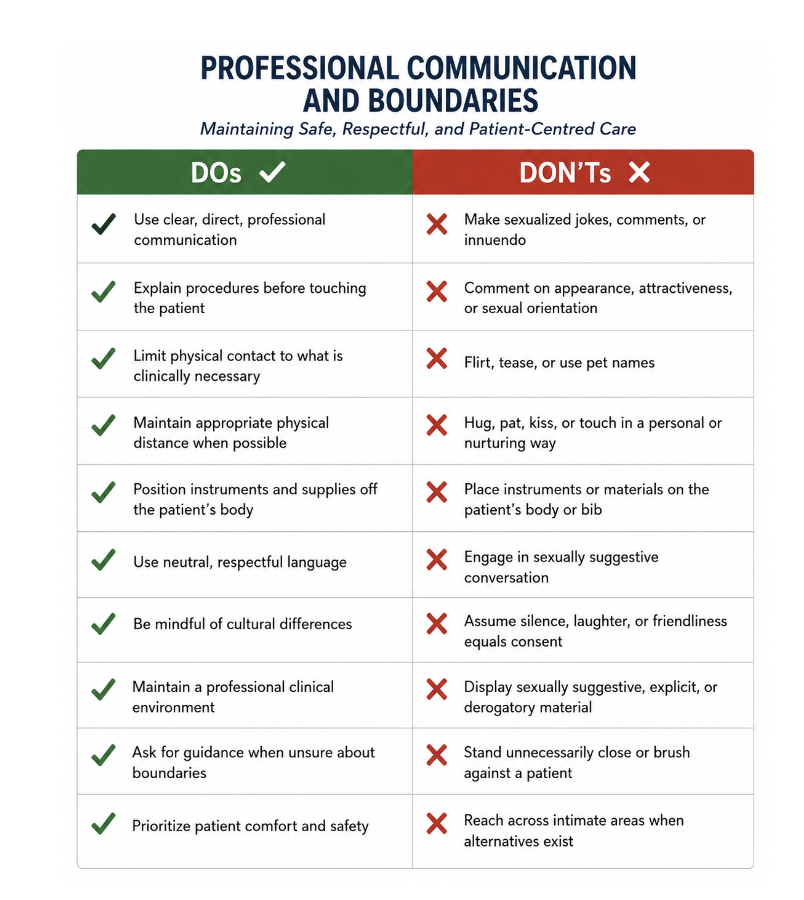
Professional Conduct w Patients
Be mindful of words and actions that could reasonably be interpreted as sexual or inappropriate
Use clear, direct, and professional communication at all times
Limit physical contact to what is clinically necessary
Cultural differences may affect how behaviour is perceived
Do not place dental anything on a patient’s body or bib
Do not comment on a patient’s sexual orientation, gender identity, or sexual life
No jokes, comments, or conversations of a sexual or suggestive nature
Examples of Professional Misconduct
Sexually demeaning gestures or expressions
Leering or staring, particularly at intimate areas of the body
Sexually suggestive remarks, innuendo, jokes, or laughter that cause discomfort, awkwardness, or embarrassment
Lewd or suggestive comments or questions about a person’s sexual life, sexual habits, appearance, or sexual attractiveness
Verbal threats with sexual overtones
Sexual flirtation, advances, or propositions
Implied or explicit promises of reward, or threats of reprisal, in exchange for compliance with a sexual request
didnt add all
Obligation to Report
• As stated in the BCCOHP Code of Ethics, a registered dental hygienist has a professional obligation to report illegal, unethical, or unsafe professional conduct by dental hygienists or other health professionals.
This obligation includes reporting their own actions or comments that are, or could reasonably be perceived as, professional misconduct of a sexual nature*
• Reports to the College must be made in writing
• Reports are handled confidentially, but not anonymously
• The College determines how the information will be used or investigated
BCCOHP - Complaint Process (Review)
Complaints may be submitted to the BCCOHP in writing.
The BCCOHP reviews and assesses all complaints.
Complaints are managed through established regulatory processes.
Investigations are conducted fairly, objectively, and confidentially.
The primary goal is protection of the public and maintaining confidence in the profession.
Managing Innaprop Patient Behaviour
could be bc of…
– Misunderstanding professional boundaries
– Effects of medications, substances, or medical conditions
– Cognitive impairment or developmental disabilities
– Anxiety, emotional distress, or confusion
– Intentional or unintentional behaviour
Responding to Innaprop. Patient Behaviour
Immediate Response
• Set clear professional boundaries using calm, direct, respectful language
• Redirect the interaction back to patient care
• Do not debate, over-justify, or apologize for maintaining boundaries
• Reschedule care if a language barrier prevents informed consent.
Documentation
• Record the behaviour or comments
• Document your response
• Record any actions taken
Seek Support
• Involve a colleague or third party when discussing expectations
• Notify an instructor, supervisor, employer, or clinic manager as needed
Escalate When Necessary
• Prioritize personal safety if behaviour becomes threatening
• End care if professional boundaries cannot be maintained
• Withdraw from the professional relationship and refer the patient according to workplace policy
• Seek guidance from BCCOHP or legal counsel if required
review
According to the BCCOHP philosophy, patients have the right to receive dental hygiene
care in a practice environment that is:
A. Efficient, profitable, and convenient
B. Healthy, safe, and respectful
C. Friendly, informal, and flexible
D. Independent of regulatory oversight
What is the primary purpose of the BCCOHP complaint process regarding professional
misconduct of a sexual nature?
A. To protect registrants from legal action
B. To resolve workplace disputes between colleagues
C. To investigate complaints fairly and protect the public
D. To determine compensation for patients
Which of the following may contribute to unwanted attention from a patient?
A. Only intentional inappropriate behaviour
B. Only cognitive disabilities
C. A variety of factors including medications, mental health conditions, and emotional
distress
D. Poor communication by the dental hygienist
Family Violence & DH Role
Family violence
abuse occur within home/family
may include…
- child abuse
- spousal abuse
- elder abuse
- abuse of persons w disabilities
- abuse in care settings
why matter to DH?
may be among first HC providers to recog warning signs
early recog, documentation, referral, & reporting can help protect them
Child Neglect
Neglect
failure to provide basic needs at adequate lvl of care
may be phys, emotional, medical, educational, or supervisory
most often represents an act of omission rather than comission
Dental Neglect (child)
willful failure of parent/caregiver to seek/follow thru w dental treatment nec to
- relieve pain
- treat infection
- prev signif oral disease
- maintain an adequate lvl of oral health
Abuse
any phys, sexual, or emotional act or failure to act, directed against a child
- cause harm or endanger/impair childs well being
types
phys
sexual
emotional/psycho
neglect (fail provide basic needs)
Warning Signs of Abuse
Behavioural indicators
– Withdrawal or extreme quietness
– Behaviour inappropriate for age (e.g., sexualized behaviour, aggression, excessive fearfulness)
– Noticeable change in behaviour or acting differently in the presence of a parent or caregiver
– Delayed social or emotional development
– Excessive compliance, anxiety, or fear of making mistakes
Overall appearance & hygiene
– Poor hygiene or consistently unclean appearance
– Malnutrition or failure to thrive
– Clothing that is inappropriate for weather or appears intended to hide injuries
Parental Attitude
WARNING SIGNS OF ABUSE
• Overly critical, belittling, or demeaning behaviour toward the child
• Lack of interest or follow-through in the child’s dental treatment or oral health needs
• Consistently unavailable for consultation, consent, or follow up
• Socially isolated families with limited support systems
• Inconsistent or changing explanations regarding injuries, trauma, or the child’s condition

Protective Stabilization
• A child behaviour guidance technique in pediatric dental care
may involve protective stabilization, such as limiting a child-patient’s movement only when clinically justified, used as a last resort, and with informed consent from the parent or legal guardian.
• If appropriate informed consent is not obtained, or if the
restraint is not clinically justified, dental providers may be
accused of technical assault or technical battery, even if no
injury occurs.
CFCSA (child family & community service act)
Mandatory reporting in BC
Under Section 14 of the CFCSA, any person who has reason to believe a child:
• Has been harmed or is at risk of harm
• Has been abused, neglected, or sexually exploited
• May otherwise be in need of protection
Important Legal Points
• The duty to report applies even when information is confidential.
• Professional confidentiality does not override child protection obligations.
• Proof is not required.
• Reasonable grounds for concern are sufficient.
Suspect → Report. Do not investigate. Do not wait for proof.
Duty to Report: Child abuse & neglect
2 articles testable on final*
1st
extends beyond oral health
we also assess h&n, overall health, important to recog warning signs & know when to report
sometimes most important thing you can do for patient isnt dental care
why are dh in position to recog abuse? we/re assessing adpie,
for adult getting abused
recognizing signs
bruising cuts
missing hair
chipped teeth
burns
mobility from trauma
swelling (color of tissue)
STDs
when in bite force against the occlusion and jaw relation
dh oblig to report, why would one not report?*
1) lack of knowledge
2) uncertainty abt what constitutes mal-treatment
3) not knowing how or when to report
4) fear of repercussions
documentation
lets say u suspect & doc > u report
patient behaviour/interaction
objective, factual, free of assumption
child = under 19 but can get consent from them without parental (in school u do)
when read article or smt read dos and donts
do - stay calm and listen allow them to say it at their own pace
-
dont - pressure for additional details
don’t make promises of keeping the secret
dont make promises abt what happens next
read handbook as hw
q in class next week
will test