VLE papers notes to be memorised
 Call Kai
 Learn
 Practice Test
 Spaced Repetition
 Match
 Flashcards
 Knowt Play
1/17

There's no tags or description
Looks like no tags are added yet.
18 Terms
What is Public law
.
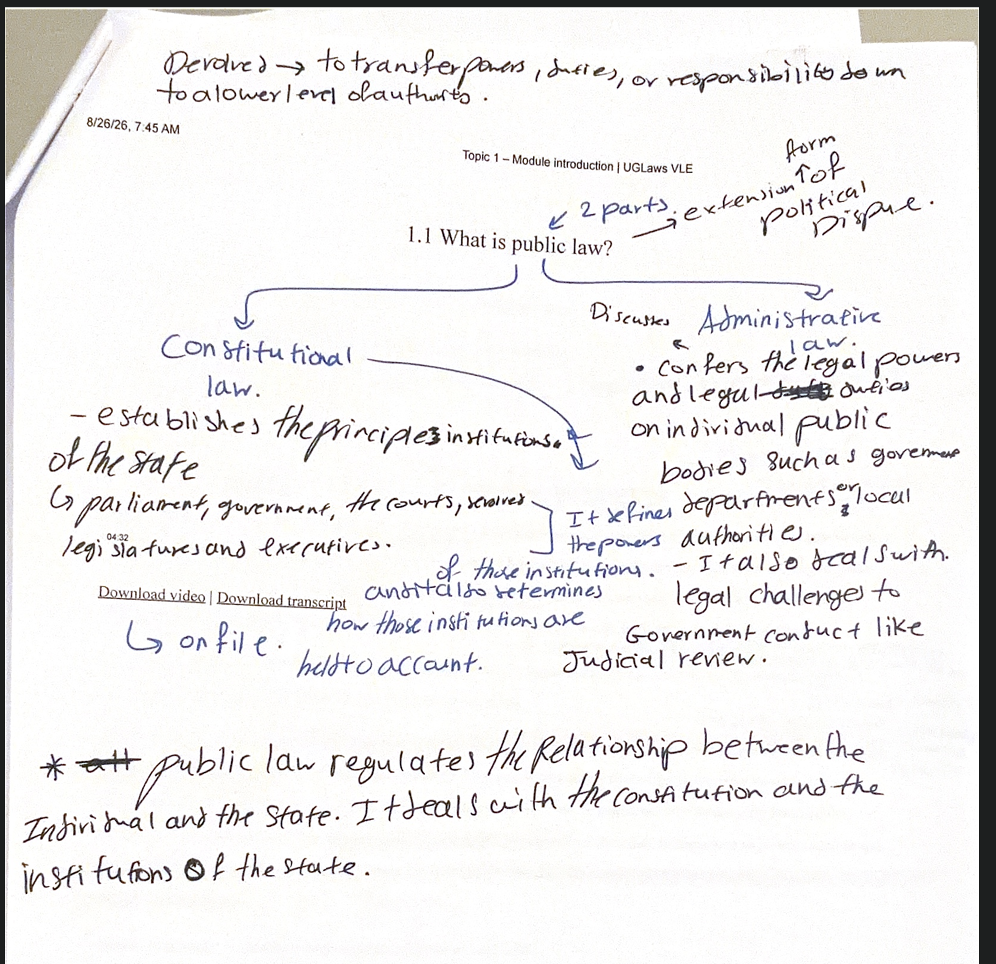
theme of public law
power and accountability
in scotland criminal cases dont go to the supreme court the highest court is..
the high court of the justiciary in edinburgh
what is the principle of legality?
The principle of legality is a fundamental legal rule stating that no one can be accused, convicted, or punished for an act unless a clear, written law made it a crime before it happened. [1, 2]
ultra vires (latin word) means…
beyond the powers: describes any act done in excess of one’s legal authority or official power.
read mini lectures 1 and 2 of topic 2
….
3 Uncodified constitutions (countries)
1- UK
2- Israel
3- New zealand
In 2001, the House of Lords Select Committee on the Constitution defined the constitution as: (memorise this one for the definition of constitution and say the house of lords….)
the set of laws, rules and practices that create the basic institutions of the state, and its component and related
parts, and stipulate the powers of those institutions and the relationship between different institutions and
between those institutions and the individual.
according to the uk parliaments a referendum is…
A referendum is when a question is decided by putting it to a public vote. Referendums are an example of direct
democracy. In the UK, most decisions are made by Parliament on behalf of the public which is known as
indirect or representative democracy.
the constitution of a state is usually drafted as a result of a fundamental event….
a so called ‘constitutional moment’
the notion of constitutionalism means:
The notion of constitutionalism means that ‘[a]ll institutions of the
country – the executive, legislature, and judiciary – are confined by the terms of the constitution’ (Le Sueur, Sunkin and
Murkens).
Narrow vs wide definition of constitution
A narrow view
would be that of a single document that has special legal status and embodies the principal rules concerning the government of
the country,
whereas a wide view
would be that of a collection of rules which govern the institutions of the state.
check notes of mini lecture 3
….
In the UK,
‘constitutional’ law is not distinct from ‘other’ law in the way that it is in many countries. In the words of Turpin
and Tomkins: (quote it)
‘we find constitutional rules mingled with the rest of the law, in statutes and subordinate legislation, in the common law and decisions of judges’ (Turpin, C. and A. Tomkins British government and the constitution.
what did Sir Ivor Jennings (a law scholar) say about constitutional conventions?
For Jennings, the constitutional conventions ‘provide the flesh which clothes
the dry bones of the law; they make the legal constitution work; they keep it in touch with the growth of ideas’.
There are several points to note when learning about conventions:
1. They are not laws or legal rules and so cannot be enforced in the courts.
The consequences of breaching a convention are various and not easy to predict. However, any sanctions which follow or result from a breach will be political rather than legal.
In Miller v Secretary of State for Exiting the European Union [2017] UKSC 5 the UK Supreme Court clarified that
judges ‘are neither the parents nor the guardians of political conventions; they are merely observers’: while they can
‘recognise the operation of a political convention in the context of deciding a legal question’, they cannot ‘give legal
rulings on its operation or scope, because those matters are determined within the political world’.
2. Those bound by them (the constitutional actors) feel a sense of obligation to follow the convention – indeed, it is the
obligatory nature of the convention that sets it apart from a mere habit or custom.
Traditionally, conventions were a largely unwritten part of the constitution, but today the majority are recorded in written
form, such as the conventions of ministerial responsibility in the Ministerial Code and many others in The Cabinet manual.
What is the Jennings’ tripartite test?
Jennings’ tripartite test is often cited as a guide for identifying a convention. His three questions were: ‘first, what are the
precedents; secondly, did the actors in the precedents believe that they were bound by a rule; and thirdly, is there a reason for
the rule?’.
this test is for figuring out whether something has actually become a binding constitutional convention (in a political sense)
what is a constitutional convention?