Chemistry Chapter 1: Matter and Measurement
 Call Kai
 Learn
 Practice Test
 Spaced Repetition
 Match
 Flashcards
 Knowt Play
1/38

There's no tags or description
Looks like no tags are added yet.
39 Terms
Chemistry
The scientific study of matter, its properties, and its interactions with other matter and energy
Law
Describes some aspect of the natural world and has no exceptions
Theory
Explain observations and laws
A theory that is not 100% correct can still be useful
Domains of Chemistry
Symbolic Domain
Macroscopic Domain
Microscopic Domain
Symbolic Domain
The specialized language used to represent components of the macroscopic and microscopic domains
Chemical symbols, chemical formulas, chemical equations, graphs, drawings, and calculations
Macroscopic Domain
The realm of everyday things that are large enough to be sensed directly by human sight or touch
Everyday and laboratory chemistry
Microscopic Domain
Aspects of chemistry that are often visited in the imagination or through standard optical microscopes
Biological cells
Mass
A measure of the quantity of matter within it
Doesn’t depend on gravity
Weight
A measure of the gravitational pull on that matter
Depends on gravity
States of Matter
Solid - Definite shape and volume
Liquid - No definite shape, definite volume
Gas - No definite shape or volume
Pure Substances
Have a constant composition and two types: elements and compounds
Element
A type of pure substance
Cannot be decomposed chemically into simpler substances
O2, H2, Au, Diamond (C)
Made up of one type of molecule
Compound
A type of pure substance
Can be broken down into elements
H2O, CO2
Homogeneous Mixture
Also called a solution
Have visibly indistinguishable parts
Bronze, diamond
Heterogeneous Mixture
Can visibly see the components, which can be separated
Trail mix, amber, oil and vinegar
Physical Change
A substance changes form, not chemical composition
Ice melting
Chemical Change
Reactants become products with different compositions and properties
Rust
Marshmallow burn
Physical Property
One that a substance displays without changing its composition
Characteristic odor of gasoline
Chemical Property
One that a substance displays only through changing its composition
Flammability of gasoline
Extensive Property
Mass dependent
A physical quantity that changes depending on the size of a system or the amount of matter present
Ex. Mass, Volume, Length, Energy/Enthalpy, Heat Capacity, surface area, moles, entropy
Intensive Property
Mass independent
Ex. Pressure temperature density concentration melting point boiling point odor color luster conductivity flammability hardness
SI Base Units
Second
Kilogram
Meter
Kelvin
Mole
Candela
Ampere
Derived Units
Metric units that are combinations of base units
7 SI Base Units
Ex. Newton
Temperature
Moles of an ideal gas = PV/RT
Only use K in this class unless calculating deltaT

Red Light
A typical wavelength of red light is 0.0000007 m.
0.0000007 m = 7 × 10^-7 m = 700 nm
Memorize Metric Unit Prefixes

Volume
Volume, the amount of space something occupies, is the most common derived unit.
Liters are defined in terms of length:
1 dm3 = 1 L = 1000 cm3 = 1000 mL
1 cm3 = 1 mL
Density
Another common derived unit
density = mass per unit volume
d = m/V
units often g/cm or g/mL
The density of H2O at 25 °C is 0.998 g.
Significant Figure Rules
Non-zeros are always significant.
There are three types of zeros, some are significant.
Leading zeroes (left of nonzero digits) are not significant
0.0221 - 3 sf
0.000004 - 1 sf
Captive zeros (between nonzero digits) are always significant.
108 - 3 sf
30.01 - 4 sf
0.904 - 3 sf
Trailing zeros (to the right of nonzero digits) are significant if the number has a decimal point.
20.000 - 5 sf
200 - 1 sf
30. - 2 sf
Exact numbers have no effect on the number of significant figures
Counted objects (3 experiements),
Defined amounts within the same measurement system (1kg=1000g; 1ft=12in, $1=100c)
Formula numbers (volume of a cone = 1/2pir²h
Significant Figure Rules - Addition and Subtraction
The result has the same number of decimal places as the least precise measurement used in the calculation
Possible to gain sig figs by addition and lose them by subtraction
70.2 + 70.4 = 140.6
20.9 = 15.1 = 5.8

Significant Figure Rules - Multiplication and Division
The result has the same number of significant figures as the least precise measurement used in the calculation.

Combined Calculations
In a series of calculations, don't round (to adjust the significant figures) until the end.
For different kinds of operations, evaluate the sig figs in the intermediate answer then do the remaining steps.
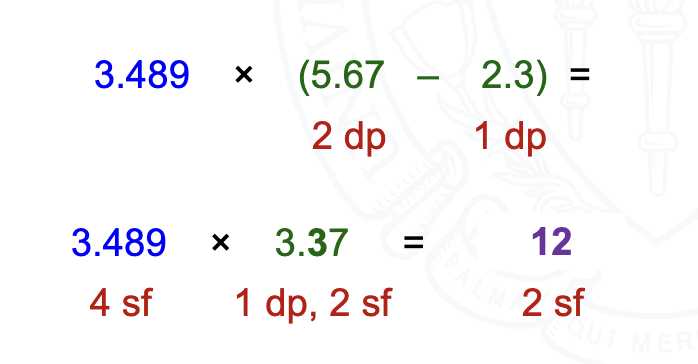
Celsius to Kelvins with Sig Figs

Exact vs Inexact Units
A unit is never exact if it exists in decimal amounts.
2 cups (drinking vessels) = ∞ sig figs
2 cups (unit of volume) = 1 sig fig
Pi is inexact but measured out ot so many decimals that it’s like an exact number “∞”
V=4/3pir³ has ∞

Law of Multiple Proportions
Atoms only combine in whole number ratios
Accuracy
How close a particular value is to the true or accepted value

Precision (reproducibility)
How close several measurements are to each other

Dimensional Analysis
For measurements, change the unit and the value changes.
Units can be cancelled, divided, multiplied or exponentiated.
Conversion factors are relationships between two different units (e.g., 1 inch = 2.54 cm).
Multiplying by a conversion factor is like multiplying by 1.
Arrange conversion factors so the given unit cancels to the desired unit.
Combine as many conversion factors as necessary, but all units must cancel except the desired unit.

Dimensional Analysis Practice Problem
