Oral Cavity & Pharynx
 Call Kai
 Learn
 Practice Test
 Spaced Repetition
 Match
 Flashcards
 Knowt Play
1/310

There's no tags or description
Looks like no tags are added yet.
311 Terms
Which bones form the hard palate?
Palatine process of the maxilla (anterior) and horizontal plate of the palatine bone (posterior)
What does the incisive canal connect?
The oral cavity to the nasal cavity
What passes through the greater palatine foramen?
Palatine nerves to the hard palate (greater palatine n.)
What passes through the lesser palatine foramina?
Palatine nerves to the soft palate (lesser palatine n.)
What passes through the mandibular foramen?
Inferior alveolar nerve, artery, and vein
What exits through the mental foramen?
The mental nerve
What attaches to the genial spines?
Tongue and floor-of-mouth muscles (e.g., genioglossus, geniohyoid)
What type of growths are mandibular tori and torus palatinus?
Benign bony (osseous) overgrowths
Location of mandibular tori
Usually bilateral, near the roots of the canine teeth (lingual mandible)
Location of torus palatinus
Midline of the hard palate
Which torus is more common?
Torus palatinus (~20%) vs. mandibular tori (8-15%)
What marks the boundary between the oral cavity and oropharynx?
The palatoglossal arch
Which arches frame the palatine tonsil?
Palatoglossal arch (anterior) and palatopharyngeal arch (posterior)
Pterygomandibular fold (raphe)
A visible mucosal landmark lateral to the palate
Why are palate and lip prints useful forensically?
Palate rugae (palatoscopy/rugoscopy) and lip prints (cheiloscopy) are fixed for life, like fingerprints
3 classifications of palatal rugae patterns
Vertical, reticular, branched
Sensory innervation of the hard palate
Greater palatine n. (mostly) + nasopalatine n. (around the incisive canal); both V2
Sensory innervation of the soft palate
Lesser palatine n. (V2)
How does the nasopalatine nerve reach the palate?
Through the incisive canal
Nasopalatine nerve block anesthetizes:
The anterior hard palate (around the incisive papilla)
Greater palatine nerve block anesthetizes:
The posterior hard palate (often reaching the lesser palatine n./soft palate too)
Nerves to the maxillary teeth
Posterior, middle, and anterior superior alveolar nn. (V2), descending from the infraorbital n.
Why do maxillary teeth require regional injections?
They're supplied by many separate V2 nerves (PSA, MSA, ASA, infraorbital blocks)
What does "alveolar" mean in a nerve name?
It refers to the bony tooth sockets, so all alveolar nerves supply teeth
Nerve to the mandibular teeth
Inferior alveolar n. (V3)
Territory of the buccal (long buccal) nerve
Inner and outer surfaces of the cheek (V3)
Territory of the mental nerve
Chin and the inner and outer lower lip (branch of the inferior alveolar n.)
Territory of the auriculotemporal nerve
Skin of the temple/ear region (V3)
Why does an inferior alveolar nerve block numb the tongue and lower lip?
The nearby lingual and mylohyoid nn. are usually affected, and the mental n. (from the IAN) numbs the lower lip
Does an IANB numb both sides?
No, only the injected side (there are 24 cranial nerves, 12 per side)
What can teeth sense?
Only pain (bimodal: pain or no pain); no temperature, touch, or pressure
5 cranial nerves innervating the oral cavity and pharynx
V (trigeminal), VII (facial), IX (glossopharyngeal), X (vagus), XII (hypoglossal)
CN IX's only somatic motor target
Stylopharyngeus
What marks the boundary between the anterior 2/3 and posterior 1/3 of the tongue?
The vallate papillae and sulcus (terminalis)
Tongue innervation summary: general sensation and taste
Anterior 2/3: general = lingual n. (V3), taste = chorda tympani (VII); posterior 1/3: both = CN IX
What minor role does CN X play in tongue sensation?
The far posterior tongue/epiglottic region
How many cranial nerves carry tongue sensation, counting both sides?
6 (3 per side: V3, VII, IX)
Where are the sensory cell bodies for general sensation from the anterior 2/3 tongue?
Trigeminal ganglion
Where are the sensory cell bodies for taste from the anterior 2/3 tongue?
Geniculate ganglion (CN VII)
What does the chorda tympani carry besides taste?
Preganglionic parasympathetics to the submandibular ganglion
4 parasympathetic ganglia of the head
Ciliary (CN III), pterygopalatine (CN VII), submandibular (CN VII), otic (CN IX)
Are any autonomic ganglia in the head sympathetic?
No; all are parasympathetic (sympathetics already synapsed at the superior cervical ganglion)
Sensory ganglia of the head (no synapses)
Trigeminal (V), geniculate (VII), superior and inferior ganglia of IX and X
What are sensory ganglia analogous to?
Dorsal root ganglia
Origin of the genioglossus
Superior genial tubercles (spines)
Origin and insertion of the styloglossus
Styloid process -> posterior tongue (near hyoglossus)
Origin and insertion of the hyoglossus
Greater horn of the hyoid -> lateral tongue
What innervates the intrinsic tongue muscles?
CN XII
Is tongue MOTOR innervation divided into anterior 2/3 vs. posterior 1/3?
No; all tongue muscles are CN XII (except palatoglossus, CN X)
Course of CN XII
Exits via the hypoglossal canal, turns anteriorly, passes deep to mylohyoid and superficial to hyoglossus, enters the tongue from below
Which way does the tongue deviate with hypoglossal nerve damage?
Toward the damaged side (ipsilateral)
Why does the tongue deviate ipsilaterally in CN XII damage?
The intact genioglossus on the healthy side pushes the tongue forward and across toward the weak side
Tongue vs. uvula deviation
Tongue (CN XII): toward the damaged side; uvula (CN X): away from the damaged side
Location of the parotid gland
External to the ramus of the mandible
Where does the parotid duct open?
Near the 2nd maxillary molar
Location of the submandibular gland
Just anterior and mostly medial to the angle of the mandible
Where does the submandibular duct open?
Sublingual caruncle
Location and drainage of the sublingual gland
Floor of the mouth, posterior to the anterior mandible; drains via small ducts in the floor of the mouth
How many minor salivary glands are there?
Up to 1,000 (labial, palatine, pharyngeal)
Rule of thumb for parasympathetic innervation of head glands
All are CN VII EXCEPT the parotid (CN IX); sweat glands excluded
Parasympathetic pathway to the submandibular and sublingual glands
Superior salivatory nucleus -> CN VII -> chorda tympani (petrotympanic fissure) -> lingual n. (V3) -> submandibular ganglion -> glands
Parasympathetic pathway to the parotid gland
Inferior salivatory nucleus -> CN IX -> tympanic n. -> lesser petrosal n. (foramen ovale) -> otic ganglion -> auriculotemporal n. (V3) -> parotid
Which nucleus starts the CN VII salivary pathway? The CN IX pathway?
CN VII: superior salivatory nucleus; CN IX: inferior salivatory nucleus
Pathway to the palate, nasal, and lacrimal glands
CN VII -> greater petrosal n. -> Vidian n. -> pterygopalatine ganglion
3 sets of tonsils and their locations
Pharyngeal (nasopharynx); palatine (between the palatoglossal and palatopharyngeal arches); lingual (posterior tongue)
Most common serious complication of tonsillectomy
Delayed hemorrhage (2-4% of patients)
Arteries supplying the tonsils
Descending palatine, ascending palatine, ascending pharyngeal, dorsal lingual, tonsillar aa.
How many soft palate muscles are innervated by CN X?
4 of 5; tensor veli palatini is the exception (V3)
Why is tensor veli palatini innervated by V3?
It's considered an accessory muscle of mastication
Course of the tensor veli palatini
Two bellies arise at the scaphoid fossae; the tendon hooks around the pterygoid hamulus (medial pterygoid plate)
What does tensor veli palatini do besides tensing the soft palate?
Opens the Eustachian tube to equalize middle ear pressure
Origin of the levator veli palatini
near skull base
Action of the palatopharyngeus
Shortens the oropharynx during swallowing
Action of the musculus uvulae
Shortens and widens the uvula; helps close the nasopharynx during swallowing
Which way does the uvula deviate with unilateral CN X damage?
Away from the damaged side (contralateral); e.g., right CN X damage -> uvula deviates left
Why does the uvula deviate contralaterally in CN X damage?
The intact side's levator veli palatini pulls the uvula toward itself
Boundaries of the oropharynx
Soft palate (uvula) to the epiglottis; palatoglossus anteriorly to the superior/middle constrictors posteriorly
Contents of the oropharynx
Palatine and lingual tonsils, palatopharyngeus, superior and middle constrictors
Where do the 3 constrictors unite posteriorly?
Pharyngeal raphe
Anterior attachment of the superior constrictor
Pterygomandibular raphe (also pterygoid hamulus)
Anterior attachment of the middle constrictor
Greater horn of the hyoid
Anterior attachment of the inferior constrictor
Oblique line of the thyroid cartilage
In what order do the constrictors contract?
Sequentially: superior -> middle -> inferior
Origin of the stylopharyngeus
Styloid process
Origin of the salpingopharyngeus
Eustachian (auditory) tube
Origin of the palatopharyngeus
Palate
Rule for pharyngeal muscle innervation
All CN X EXCEPT stylopharyngeus (CN IX)
Incisive canal
Identify the structure at #1

Alveolar bone
Identify the structure at #2

Horizontal plate (of palatine bone)
Identify the structure at #3

Medial and lateral pterygoid plates
Identify the structure at #4

Palatine process (of maxilla)
Identify the structure at #5

Greater, lesser palatine foramina
Identify the structure at #6

Hamulus
Identify the structure at #7

Mandibular foramen
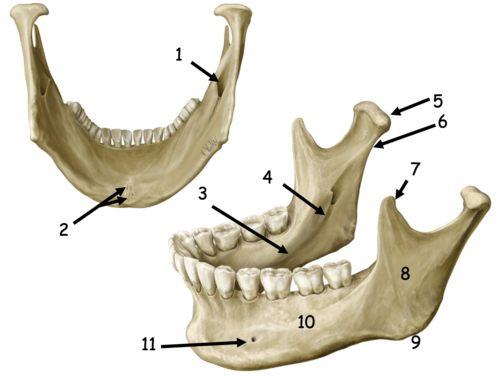
Identify the structure at #1

Genial spines
Identify the structure at #2
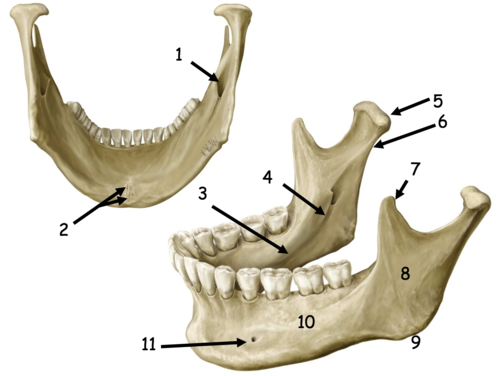
Mylohyoid line
Identify the structure at #3

Mylohyoid groove
Identify the structure at #4

Head
Identify the structure at #5

Neck
Identify the structure at #6