Measuring Disease Frequency in Populations
 Call Kai
 Learn
Learn Practice Test
 Spaced Repetition
 Match
Match Flashcards
 Knowt Play
1/71

There's no tags or description
Looks like no tags are added yet.
Name | Mastery | Learn | Test | Matching | Spaced | Call with Kai | Chat |
|---|
No analytics yet
Send a link to your students to track their progress
72 Terms
How do we measure diseases
• Routine surveillance (e.g., most prevalent diseases in your clinical practice or region of practice).
• Observational studies
• Outbreak investigations
What are the two main categories of events for which frequency measures are calculated
Morbidity and mortality
Morbidity and mortality
• Study period- the time over which the epidemiologic study was conducted.
• Risk period- the time during which the individual could develop the disease
What is Morbidity:
any departure, subjective or objective, from a state of physiological or psychological well-being.
Morbidity includes what
disease, injury or disability
Measures of morbidity characterize by what
number of individuals in a population who are sick at a given time (prevalence) or who become sick (incidence).
What does Mortality mean
number of deaths (deaths occurring during a given time period)
• Measures of mortality characterize number of deaths.
Measures of disease frequency can be any of the different mathematical forms below:
Count
Ratio
Proportion
Odds
Risk
Rate
What do we mean by count
• Most basic measure of disease frequency.
• Simple enumeration of the number of cases of a disease/events in a population
What do we mean by Ratio:
Value obtained by dividing one number/quantity by another
Dimensionless, has no unit
What do we mean by Proportion:
Ratio in which numerator is part of (subset of) the denominator
Can be expressed as decimal points, fractions or percentages
What do we mean by Odds:
This is a ratio in which the numerator is not a subset of the denominator.
What do we mean by Risk:
Is a proportion; that expresses the likelihood/probability that something will occur
What do we mean by Rate:
• An expression of an event occurrence in a defined population in a specified period; measures ‘speed’
• It is a ratio in which the denominator is the number of person/animal-time units at risk.
However, “rate” should only be used to
refer to measures based on the concept of person/animal-time units.
It is also common for people to say that animals with a “high chance” of having or getting a disease have a “high risk”, even when
the underlying measure of frequency is not a risk.
The frequently used measures of morbidity include
Incidence and prevalence
What is Incidence:
This relates to the number of new events (e.g., new cases of a disease) in a defined population within a specified period.
Incidence can be expressed in 4 ways:
Incidence times
Incidence count
Incidence risk
Incidence rate
What is Incidence times:
are the times at which incident cases of a disease occur.
What is Incidence count:
a simple count of the number of new cases of disease observed in a population
What is Incidence risk:
is the probability that an individual animal will contract or develop a disease in a defined time period.
What is Incidence rate:
is the number of new cases of disease in a population per unit of animal- time during a specified period.
Incidence relates to the number of
new events (new cases) of a disease in a defined population within a specific period.
Incidence Requires 2 (or more) observations or tests
• First one to establish which individuals are disease-free
• Second one to identify which ones have become diseased in the intervening period
Two types of incidence are commonly used:
incidence risk and incidence rate.
Incidence risk (R) is calculated as follows:
R = number of newly affected individuals in a defined time period / population at risk
Counting new cases of a disease can be
challenging, & estimating the population at risk is even more difficult.
What do we mean by Population at risk:
Composed of only animals free of the disease at the start of the investigation/study period.
The population at risk may be considered
open (dynamic) or closed (fixed)
What is Closed (fixed) population:
is one in which there are no additions to the population for the duration of the study/investigation and few to no losses.
The duration of investigation may be expressed:
• in terms of some life event e.g., all cows in a dairy herd followed for the first 2 months to determine the risk of ketosis
• In terms of calendar time e.g., a herd of dairy cows followed for the next 1 year
• Animals which are lost to follow-up during the study period are called withdrawals.
• When computing incidence risk; you subtract half of the number of withdrawals from the population at risk.
So, the modified formula taking into account withdrawals is

What do we mean by Open population:
Is one in which animals are leaving and entering the population throughout the study period.
Incidence risk can not be calculated by
can not be calculated directly from an open population but can be estimated from incidence rate.
Incidence risk can be expressed as a
proportion (or percentage)
What is the smallest value for population risk
Its smallest value is 0 (0%)
What is the largest value for population risk
the largest is 1 (100%)
Population at risk It is interpreted as
the probability of new occurrence within a specified time
period.
also has no units
Incidence rate divides the
number of new cases by a measure of time
Incidence rate (I): Is calculated as follows:

Animal-time units is defined as
as the total time at risk experienced for the subjects followed.
The smallest possible value of incidence rate is
zero, and the greatest possible value is infinity.
The equivalent of animal-time unit is
in human health is person-time unit.
Incidence rate calculation can be defined as
• Exact calculation of incidence rate requires that the exact amount of animal- time contributed by each group member is known.
• if unknown it can be estimated.
What is the definition for Prevalence
relates to cases of disease existing at a specific point in time rather than new cases occurring over a period of time.
Remember prevalence is not a
rate!
If prevalence is not a rate so what is it
It is a proportion. Calling prevalence “prevalence rate” is wrong, but you will see that all the time
Prevalence is a measure of
disease status, it does not measure disease onset.
The simplest way of considering disease status is to consider
disease as being either present or absent.
The prevalence proportion is the proportion of
individuals (animals/humans) in a population who have a disease or health-related event of interest.
Prevalence differs from incidence in that
prevalence includes all cases, both new and pre-existing in the population at the specified time while incidence is limited to new cases only.
Prevalence is categorized as:
Point prevalence
Period prevalence
What is Point prevalence:
It is prevalence measured at a particular point in time.
• It is the proportion of individuals with a particular disease or health-related event at a
What is Period prevalence:
Prevalence measured over an interval of time
• It is the proportion of individuals with the disease or health-related event at any time during a specified period or interval of time e.g.
What are examples of Period prevalence:
• Annual prevalence
• Life-time prevalence
• One-year prevalence
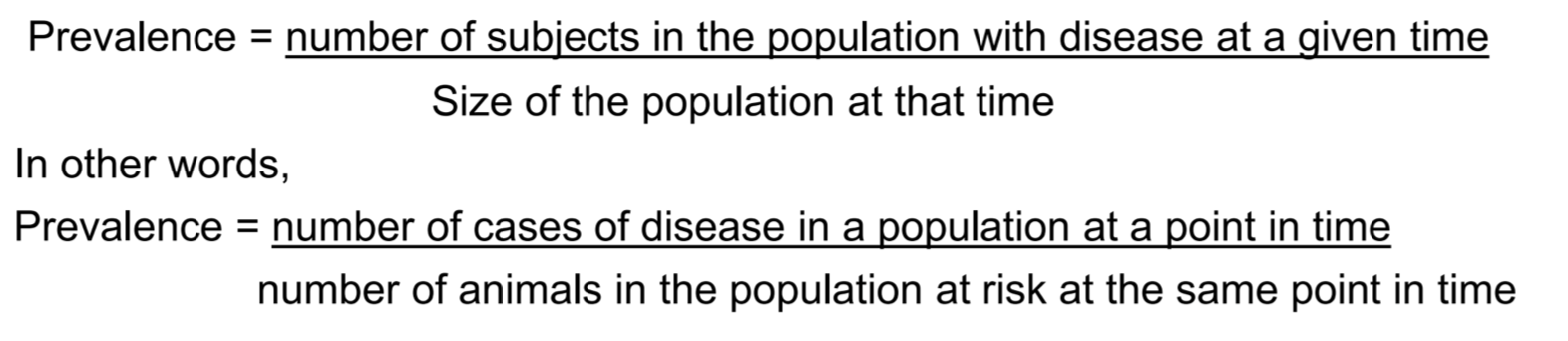
What is the formula for prevalence
What is the attack rate
It is used to describe the frequency of disease in outbreak situations.
• It is the incidence proportion or risk of contracting a disease during an epidemic period among susceptible individuals who have been exposed to the pathogen.
Attack rate = what

Attack rate (AR) is often used in
food-borne outbreaks.
What is Secondary attack rate:
Is a measure of the incidence risk among individuals who have come into contact with primary cases or index cases.
Are secondary attacks easier to measure ?
yes, Secondary attack rates are often easier to measure than attack rates.
What is the formula for secondary attack rate

Attack rate and secondary attack rates can be compared between/among what
groups using a ratio measure (attack rate ratio) or difference measures (attack rate difference)
What is Case fatality rate (CFR):
Describes the proportion of animals with a specific disease that die from it
Case fatality rate measures the?
impact of epidemic type diseases or the severity of acute diseases for affected individuals.
What is Mortality rate:
is a measure of the frequency of the occurrence of death
in a defined population during a specified interval.
What is Crude mortality (death) rate:
This is the overall mortality or unadjusted mortality. It does not take into consideration factors like age, breed, sex
What is Cause-specific mortality rate:
This describes the number of animals that die from or with a specific disease during a defined time period.
What is the formula for Cause-specific mortality rate:

What is Proportionate mortality:
Proportion of deaths in a specified population over a given period of time attributable to different causes.