Reproductive Disorders Active Learning - lecture 1 exam 3
 Call Kai
 Learn
 Practice Test
 Spaced Repetition
 Match
 Flashcards
 Knowt Play
1/25

There's no tags or description
Looks like no tags are added yet.
26 Terms
Testicular Torsion
sudden scrotal pain, swelling, emergency sx needed
PCOS
pain, infertility (hormone imbalance), ↑ risk CVD, DM
Prostatitis
frequency, nocturia, fever, dysuria, pain w/ ejaculation
Vaginal Fistula
tunnel forms between vagina and rectum and bladder
BPH
frequency, nocturia , hesitancy, urinary retention, frequent utis
Endometriosis
pain with menstruation and sex, depression, infertility
Uterine prolapse
uterus protrudes out of the vagina
Varicocele
scrotal pain, heaviness, feels like worms in scrotum
Hysterectomy **
most common procedure on women
Surgical removal of the uterus to treat cancer, dysfunctional uterine bleeding, endometriosis, nonmalignant growths, persistent pain, pelvic relaxation and prolapse, and previous injury to the uterus
Total hysterectomy (uterus, cervix) - (laparoscopic/vaginal)
Radical hysterectomy (only for cancer, uterus, vagina, ovaries, fallopian tubes, lymph nodes, tissue) - (most invasive - not laparoscopic)
Types of approaches
- Laparoscopic
- Vaginal
- Abdominal (open) - risk for infection
pre operative management
stop anticoagulants (when is the last time you took it? hysterectomies have a high risk of hemorrhage, any NSAIDS (aspirin, ibuprofen, naproxen))
pregnancy test (all females need one before surgery but especially for hysterectomy)
prophylactic antibiotics (nurse will pull the meds but most likely wont give them, that is someone elses job)
VTE risk assessed (blood clot risk)
post op management
1. prevent and monitor for hemorrhage
- perineal pads, check incisions, monitor vital signs, CBC
2. prevent and monitor for infection
- CBC, temp, check incisions, administer antibiotics
3. prevent and monitor for DVT
- ted hose, ambulation, SCD
4. assess and treat bladder dysfunction
- foley care, bladder scans, in and out cath
(if there is not pee after 4-6hrs be concerned)
5. pain: prior to ambulation, PO prior to discharge, give pain meds before ambulation
patient education
limitations/restrictions (resume actions gradually, shouldnt sit/stand in one area for a long time, take showers, NOT BATHS)
incisional care (monitor site, clean gently with soap and water, pat dry, avoid straining and lifting. will lightly bleed for 6 weeks. if the pt stops bleeding but starts again this could indicate endometrial cancer. do not insert anything into the vaginal - no sex, no tampons, no douches for 6 weeks/clearance from Dr.)
what to report (vaginal discharge if abnormal. symptoms of DVT. bleeding once initial 6 week light bleeding is over)
importance of hydration
d.The importance of early ambulation following surgery
Jane Thompson is a 47-year-old female with a medical history of uterine fibroids, and hypertension. She is being admitted to same day surgery for a laparoscopic total hysterectomy. Prior to surgery, which topic will the nurse include in the preoperative teaching for a patient admitted for an abdominal hysterectomy?
a.Adverse effects of systemic chemotherapy
b. Decrease in vaginal sensation after surgery
c.The need for hormone replacement therapy after surgery
d.The importance of early ambulation following surgery
C. Monitor vital signs and perineal pads.
The patient is in surgery until 10am, goes to PACU for 2 hours and is then admitted back to your unit, where you resume care. Below is your initial assessment:
Vital Signs: stable
Neuro: AAOx4, drowsy but arousable
Cardio/Respiratory: S1, S2 identified, breath sounds clear throughout.
Incision Site: 5 abdominal lap sites closed with skin glue, minimal dried blood on 3 sites, closed, with no signs of infection. Pain rated 6/10. Bladder: Foley removed in PACU (6 hours ago). Abdomen: Present bowel sounds but decreased in all quadrants, gas passed.
•What is the most important intervention to prevent post-operative complications in Mrs. Thompson?
A. Monitor CMP and INR.
B. Administer prescribed pain medications q4h.
C. Monitor vital signs and perineal pads.
D. Ensure patient follows a low sodium diet.
a. No urine output since foley removal 6 hours ago.
Which finding requires contacting the health care provider?
a. No urine output since foley removal 6 hours ago.
b. Decreased bowel sounds in all four abdominal quadrants.
c. Report of increased abdominal pain at the incision site with coughing.
d.Minimal bloody drainage on the laparoscopic sites.
B.Pain 3/10 after IV morphine administered
CAN NOT DISCHARGE IF THEY ARE STILL ON IV
After a bladder scan, you note 450 mL in the bladder. You educate the patient on the need to place a catheter if she is unable to void. Mrs. Thompson does not want a catheter and asks to ambulate to the restroom. She is able to void 400 mL clear yellow urine. You now suspect the patient is ready to be discharged. Which finding below indicates the patient is not ready to be discharged?
A.Changed perineal pad once since surgery
B.Pain 3/10 after IV morphine administered
C.Nausea controlled with po ondansetron
D.Vital signs stable
C."I should take baths instead of showers until I see the surgeon again."
The patient's pain is now being controlled with po pain medication and discharge education is given. Which of the following statements indicates a need for further education?
A."I need to report bloody vaginal discharge that lasts more than a few days."
B."I need to avoid sex and heaving lifting until I see my surgeon again."
C."I should take baths instead of showers until I see the surgeon again."
D."I should check my incision daily for redness, swelling, drainage, and warmth."
Prostate Cancer
Second most common cancer amongst men
Risk factors - African American Descent, increasing age >50, family history, diet high in red meat, dairy products, and fat.
Symptoms - usually symptoms do not present until the disease is advanced and urinary obstruction occurs, this is why screening is so important.
- Dysuria, frequency, urinary retention, low force of stream, dribbling, blood in the urine, painful ejaculation*****, sexual dysfunction
- Spread to lymph nodes
diagnosis - PSA (high doesnt necessarily mean cancer: could mean BPH), TRUS with biopsy (transrectal ultrasound), TURP, EPCA 2 (specific to prostate cancer)
treatment - watchful waiting (risk for surgery is too high), cancer vaccine, radical prostatectomy (most common), radiation, chemo
immunotherapy: target cancer cells and kills it, extends life for probably 4 months, used for terminal cases
hormonal injections: decrease testosterone to slow growth
prostate surgery
TURP, suprapubic prostatectomy, perineal prostatectomy, retropubic prostatectomy, TUIP, and laparoscopic radical prostatectomy and robotic-assisted laparoscopic radical prostatectomy
Complications - hemorrhage (incision in bladder), clot formation (occur if hemorrhage in bladder), catheter obstruction (build up of pressure=more hemorrhaging), sexual dysfunction (ED and retrograde ejaculation), transurethral resection syndrome: super rare
stop clot to prevent hemorrhage and prevent catheter obstruction
pre op management
reduce anxiety (due to area it can make it a little stressful for prostate surgery)
relieve discomfort
education (catheter for several weeks)
prep the patient (Ted hose, lithotomy, enema night before to empty colon, and no straining. NO BLOOD THINNERS, NEVER DO A BLOOD THINNER THE DAY OF)
Post-op Management
Manage Pain
- Determine cause of pain
- Bladder spasms - oxybutynin, belladonna and opium suppositories, sitz baths.
- Stool softeners to ease bowel movements
Prevent Infection
- Monitor for infection, administer Abs
Monitor For/Prevent DVT
- Early ambulation, TED hose
manage complications
Transurethral Resection Syndrome
- Rare but serious complication
- Caused by absorption of irrigation solution during surgery
- Neurological, cardiovascular, and electrolyte imbalances
- Symptoms - collapse, headache, hypotension, lethargy, confusion, muscle spasms, nausea, vomiting, seizures, tachycardia.
- Interventions - DC irrigation replace with NS, diuretics, I and Os, VS, LOC, patient safety, breath sounds for pulmonary edema.
manage complications
Prevent/Manage Hemorrhage****
- Prostate is highly vascular
- Bleeding can lead to clots which cause urinary obstruction which then can lead to worsening hemorrhage
- Rectal thermometers, rectal tubes, and enemas are avoided because of the risk of injury and bleeding
- Bright red blood with lots of clots = arterial bleeding needs surgery
- Darker and less viscous = venous blood
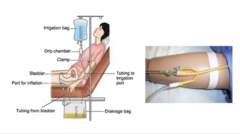
- Closely monitor VS, monitor I and Os, manage CBI (continuous bladder irrigation)
monitor urine if clots/red: arterial. if dark but no clots: venous
MONITOR I AND O VERY CLOSELY
clots increase risk for bleeding
image:
top port - stop site from clotting
middle port - foley urine/fluid
bottom port - balloon inflation
every 15 minutes check what is going in and coming out irrigation wise
give fluid fast after PACU to flush a lot
give fluid slow as long as it stays light pink.... if it is dark and has clots this is super bad ... speed it back up
assess urine color, output, clots
- adjust rate as needed - increase rate if bloody, decrease if light pink
- document input/output
- perform manual irrigation if needed
- notify surgeon if clots cant be removed or urine is still bloody
manual irrigation
unhook clot catheter, put in sterile container, get basin and normal saline, shoot in irrigation and pull out fast and hard to remove/break up clot. very painful for patient
use if really red or not coming out (pt is retaining fluid)
surgeon can come in and do foley traction
hemorrhage, bright red blood, decrease BP/increase HR
A.CBC
C.Fluid Bolus
E.Oxygen administration
The patient is most likely experiencing ____________ as evidenced by ____________.
Which of the following orders do you expect?
A.CBC
B.Remove Foley Catheter
C.Fluid Bolus
D.Enema
E.Oxygen administration
F.Monitor urinary output q1h

·Administer 500mL 0.9% NS IV bolus
·Administer oxygen to keep O2 sat above 94%
The physician applies traction to the catheter and the following orders are given
·Maintain traction to catheter
·Continuous bladder irrigation titrate to keep urine pink to clear
·Administer 500mL 0.9% NS IV bolus
·Administer oxygen to keep O2 sat above 94%
·Obtain blood for Hg and Hct
·Notify primary care provider (PCP) promptly with lab results
•Which two orders should be implemented first?