Unit 16 - Basic Concepts of Metabolism
 Call Kai
 Learn
 Practice Test
 Spaced Repetition
 Match
 Flashcards
 Knowt Play
1/75

There's no tags or description
Looks like no tags are added yet.
76 Terms
start to use and play with the metabolic map on blackboard
got it
what is a requirement of living organisms?
living organisms require an input of free energy
why do living organisms need an input of free energy?
to be able to do mechanical work (muscle contraction; cellular movements)
for active transport of ions and molecules
for synthesis of macromolecules from simple precursors
free energy comes from the ___________
environment
where do phototrophs obtain their energy from?
sunlight
where do chemotrophs obtain their energy from?
through oxidation of carbon fuels
what type of structures build living organisms?
complex structures
building complex structures that are _____ in entropy is only possible when ____ is spent in the process
low, energy
ultimate source of energy for all life on earth is…
sunlight

identify the process that is represented by the blue circle
citric acid cycle

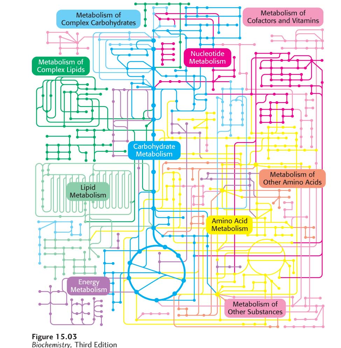
metabolism is composed of…
many interconnected reactions

Glucose → pyruvate is called…
pyruvate → lactate + acetyl CoA is called…
glycolysis, pyruvate oxidation + lactic acid fermentation
fuels are ________ and large molecules are ________ in a series of linked reactions called _________ ____________
degraded, constructed, metabolic pathways
glucose is ______ to pyruvate in ____ linked reactions, this whole process can be described as __________
metabolized, 10, glycolysis
pyruvate can then be metabolized into what two things?
acetyl CoA and lactate
different metabolic pathways have many common ________ used in multiple reactions that occur at the same _______
intermediates, time
metabolism consists of ______-_________ and ______-___________ reactions
energy-yielding, energy-requiring
what is catabolism?
the breakdown of complex molecules in living organisms to form simpler ones, together with the release of energy
catabolic processes are _____ in nature while anabolic processes are ______ in nature
oxidative, reductive
this makes sense!! catabolic processes break down molecules, and as a result, energy sources like ATP are released, therefore, catabolic processes must LOSE these electrons so that they can be USED to create energy sources like ATP
catabolism produces energy in the forms of…
ATP and ion gradients

what is occurring in the two circles?
proton transfer
what is anabolism?
the set of metabolic pathways that construct bigger molecules from smaller units
_______ processes power ________ processes
catabolic, anabolic
what do anabolic reactions require?
an input of energy
reductive processes require electron ________ while oxidative processes require electron ________
sources, carriers
give examples of electron sources
NADPH, NADH, FADH2
give examples of electron carriers
NAD+, NADP+, FAD
give examples of catabolism
glycolysis, citric acid cycle, fatty acid oxidation
give examples of anabolism
synthesis of fatty acids from acetyl-CoA, proteins from amino acids, complex carbs from simple sugars
which molecules are energy rich and which are energy poor?
reduced molecules are energy rich and oxidized molecules are energy poor (reduction = gain of electrons → they have all that energy!!!!)
the more reduced carbon is to begin with…
the more free energy is released by oxidation

why is fatty acid a more efficient fuel compared to glucose?
the carbons in fats are more reduced than the carbons in glucose
what is the primary mechanism that occurs to obtain energy by non-photosynthetic organisms?
OXIDATION (catabolic processes are oxidative in nature)
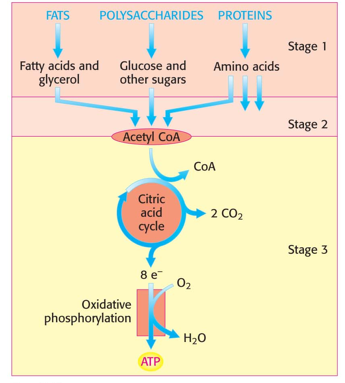
describe the first stage of catabolism
fuels → broken down into smaller bits → no useful energy captured

describe the second stage of catabolism
small molecules degraded into simple units → these simple units play a key role in metabolism
most molecules are converted into acetyl CoA
a small amount of ATP is generated
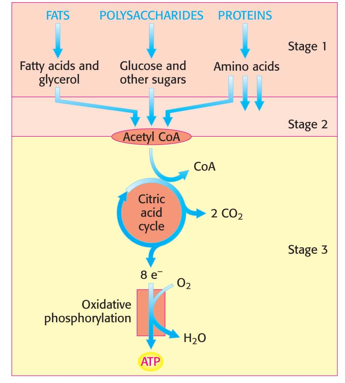
describe the third stage of catabolism
ATP is produced due to complete oxidation of acetyl CoA → occurs during citric acid cycle and oxidative phosphorylation
what is a thermodynamically unfavorable reaction?
a non-spontaneous reaction that requires an input of energy
thermodynamically unfavorable reactions can be driven by…
thermodynamically favorable reactions
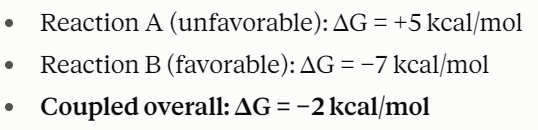
“thermodynamically unfavorable reactions can be driven by favorable reactions” describe this concept
thermodynamically unfavorable reactions have a positive delta G and won’t proceed on their own
however, cells need unfavorable reactions to build large molecules
sooooo unfavorable reactions will couple with favorable reactions (that have a negative delta G) so that the overall reaction is favorable (look at the image)
give an example of a favorable reaction that often couples with unfavorable reactions
ATP hydrolysis
ATP is the _________ currency of free energy
universal
ATP hydrolysis drives metabolism by shifting…
the equilibrium constants of coupled reactions
what two criteria must be met to construct a metabolic pathway?
individual reactions must be specific
the pathway in total must be thermodynamically favorable
what is a specific reaction?
a reaction that yields only one particular product or set of products from its reactants
how can a thermodynamically unfavorable reaction in a pathway be made favorable?
if it is coupled with a more favorable reaction

identify the favorable reaction, the unfavorable one, and the intermediate
favorable: second one
unfavorable: first one
intermediate: B
energy derived from fuels for chemotrophs or light for phototrophs is converted into…
adenosine triphosphate (ATP)
why is ATP an energy rich molecule?
it’s triphosphate unit has two phosphoanhydride linkages
ADP stands for…
adenosine diphosphate
AMP stands for…
adenosine monophosphate
this is a fundamental mode of energy exchange in biological systems
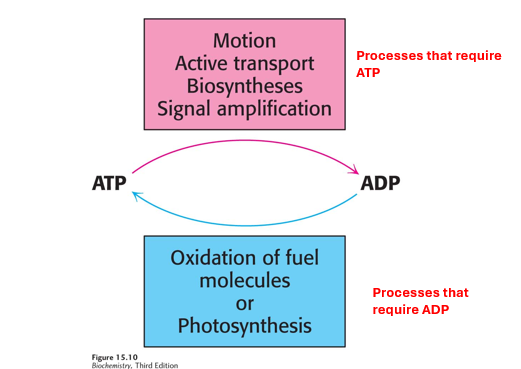
ATP - ADP cycle
ATP hydrolysis products…
ADP + Pi
AMP + PPi
list processes that require ATP
motion
active transport
biosyntheses
signal amplification
list processes that require ADP
oxidation of fuel molecules
photosynthesis

fill in the boxes
ATP is incredibly important, list some reasons why
it is the immediate donor of free energy
it is consumed within a minute of its formation (EVERYBODY WANTS IT)
it must be constantly recycled to power the cell
the generation of ATP is one of the primary roles of catabolism
phosphate can be transferred from compounds with ________ delta G to those with ________ delta G
higher, lower
what are the molecules that have higher energy phosphates than can be transferred to ATP?
phosphoenolpyruvate (PEP)
1,3-Biphosphoglycerate (1,3-BPG)
Creatine phosphate
PEP (Phosphoenolpyruvate) + ADP →
Pyruvate + ATP (phosphate from PEP is donated to ADP, ATP is created, PEP is left with pyruvate)


this reaction is ______ and can be used to synthesize _____
favorable, ATP
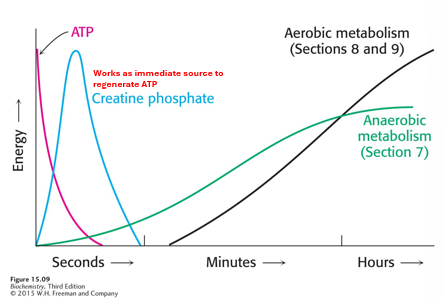
exercise depends on various means of generating ____
ATP
muscle contains only enough ATP to power muscle contraction for how long?
less than a second
what compound can regenerate ATP from ADP, allowing a short burst of activity during exercise?
creatine phosphate
what enzyme helps creatine phosphate regenerate ATP from ATP?
creatine kinase (kinases are transferases, the reaction transfers a phosphate molecule from creatine phosphate to ADP to create ATP)

after the creatine phosphate stores are depleted, how is ATP generated?
through metabolic pathways
what is an activated carrier?
a small molecule to which a chemical group or electrons have been added, which can then be donated to another molecule
ATP is an _________ ________ of ________ _______
activated carrier, phosphate groups
why is ATP an activated carrier of phosphate groups?
b/c phosphoryl transfer from ATP is an energetically favorable (exergonic) process
coenzyme A is also referred to as…
CoA
coenzyme A is a carrier of…
acyl groups
coenzyme A consists of…
two carbon fragments

NADH/NAD+
identify the oxidized form of the carrier and the reduced form
oxidized: NAD+ (lost an electron so it’s more positive)
reduced: NADH
which is often an electron acceptor: NAD+ or NADH?
NAD+
what are the major electron carriers in oxidation?
NAD+, FAD
identify the reduced and oxidized form: FADH2 and FAD
reduced: FADH2
oxidized: FAD
what is the activated carrier of electrons for the synthesis of biomolecules?
NADPH