Physics Electric Fields flashcards

0.0(0)
Studied by 0 people
call kaiCall Kai
learnLearn
examPractice Test
spaced repetitionSpaced Repetition
heart puzzleMatch
flashcardsFlashcards
GameKnowt Play
Card Sorting

1/33

encourage image

There's no tags or description

Looks like no tags are added yet.

34 Terms

1
New cards

Electric field

the field in which an electric charge attracts or repels

  • Can be both radial and uniform


2
New cards

Electric charge

certain elementary particles, such as electrons and protons, that cause them to interact with reach other

3
New cards

Coulomb

unit of electric charge 

  • One coulomb is equivalent to the charge transported by 1 ampere of current in a second 

  • Protons charge - 1.6 x 10⁻¹⁹ C

  • Electrons have an electric charge of -1.6 x 10⁻¹⁹ 


4
New cards

Static electricity

build up of electric charge on the surface of an object due to the removal or addition of electrons, commonly caused by friction

5
New cards

Electric field

a region where a charged particle will experience a force

  • All charged objects surrounded by one

  • Direction of the lines represents the direction of the field, where it shows the direction a positive charge would move in the field

  • The concentration of field lines represent the strength of the field, the more concentrated the lines, the stronger the field


<p><span style="background-color: transparent;">a region where a charged particle will experience a force</span></p><ul><li><p><span style="background-color: transparent;">All charged objects surrounded by one</span></p></li><li><p><span style="background-color: transparent;">Direction of the lines represents the direction of the field, where it shows the direction a positive charge would move in the field</span></p></li><li><p><span style="background-color: transparent;">The concentration of field lines represent the strength of the field, the more concentrated the lines, the stronger the field</span></p></li></ul><p></p>
6
New cards

Coulomb's law / Force between two point charges equation

F= 1/4πε0 x Q1Q2/r2

  • Magnitude of F is proportional to the product of q1 and q2 

  • Inversely proportional to the square of the distance between them 

  • 1/(4πε0) - coulombs constant

    • ε0  - permittivity of free space - 8.85 x 10⁻¹² C2N-1m-2 or Fm-1


<p><span style="background-color: transparent;">F= 1/4πε<sub>0</sub> x Q<sub>1</sub>Q<sub>2</sub>/r<sup>2</sup></span></p><ul><li><p><span style="background-color: transparent;">Magnitude of F is proportional to the product of q1 and q2&nbsp;</span></p></li><li><p><span style="background-color: transparent;">Inversely proportional to the square of the distance between them&nbsp;</span></p></li><li><p><span style="background-color: transparent;">1/(4πε<sub>0</sub>)<strong><sub> </sub>- </strong>coulombs constant</span></p><ul><li><p><span style="background-color: transparent;">ε<sub>0</sub><strong><sub> </sub><sup>&nbsp;</sup></strong>- permittivity of free space - 8.85 x 10<sup>-12</sup> C<sup>2</sup>N<sup>-1</sup>m<sup>-2 </sup>or Fm<sup>-1</sup></span></p></li></ul></li></ul><p></p>
7
New cards

Radial electric field

Pointing in the direction which a positive test charge would go

<p><span style="background-color: transparent;">Pointing in the direction which a positive test charge would go</span></p>
8
New cards

Uniform electric field

  • Pointing in the direction which a positive test charge would go

  • Only in between two charged plates

  • electric field between two parallel plates, 

  • Charge will experience same force wherever it is placed between the plates 

  • Depends on the voltage between the plates and the distance between them

  • Typically measured in NC-1, but can also be in Vm-1

  • NC-1 typically for point charge and Vm-1 for parallel plates


<ul><li><p><span style="background-color: transparent;">Pointing in the direction which a positive test charge would go</span></p></li><li><p><span style="background-color: transparent;">Only in between two charged plates</span></p></li><li><p><span style="background-color: transparent;">electric field between two parallel plates,&nbsp;</span></p></li><li><p><span style="background-color: transparent;">Charge will experience same force wherever it is placed between the plates&nbsp;</span></p></li><li><p><span style="background-color: transparent;">Depends on the voltage between the plates and the distance between them</span></p></li><li><p><span style="background-color: transparent;">Typically measured in NC<sup>-1</sup>, but can also be in Vm<sup>-1</sup></span></p></li><li><p><span style="background-color: transparent;">NC<sup>-1 </sup>typically for point charge and Vm<sup>-1</sup> for parallel plates</span></p></li></ul><p></p>
9
New cards

Test charge

A small enough charge that does not impact the shape of a field

10
New cards

Fields around a pair of charges

Field on the side without the other charge behaves as a normal electric field

<p>Field on the side without the other charge behaves as a normal electric field</p>
11
New cards

Electric field strength

The electrostatic force experienced per unit of positive test charge placed at a specific point in an electric field

12
New cards

Electric field strength equations

E = F / Q

  • All fields

  • E - Electric field strength

  • F - Force

  • Q - Charge

E = 1/(4πε0) x Q/r2

  • Radial fields only

  • E - Electric field strength

  • 1/(4πε0) - coulombs constant

    • ε0  - permittivity of free space - 8.85 x 10⁻¹² Fm-1

  • Q - Charge

  • r - distance between charges


<p><span style="background-color: transparent;">E = F / Q</span></p><ul><li><p><span style="background-color: transparent;">All fields</span></p></li><li><p><span style="background-color: transparent;">E - Electric field strength</span></p></li><li><p><span style="background-color: transparent;">F - Force</span></p></li><li><p><span style="background-color: transparent;">Q - Charge</span></p></li></ul><p><span style="background-color: transparent;">E = 1/(4πε<sub>0</sub>) x Q/r<sup>2</sup></span></p><ul><li><p><span style="background-color: transparent;">Radial fields only</span></p></li><li><p><span style="background-color: transparent;">E - Electric field strength</span></p></li><li><p><span style="background-color: transparent;">1/(4πε<sub>0</sub>)<sub> </sub>- coulombs constant</span></p><ul><li><p><span style="background-color: transparent;">ε<sub>0 </sub><sup>&nbsp;</sup>- permittivity of free space - 8.85 x 10<sup>-12</sup> Fm<sup>-1</sup></span></p></li></ul></li><li><p><span style="background-color: transparent;">Q - Charge</span></p></li><li><p><span style="background-color: transparent;">r - distance between charges</span></p></li></ul><p></p>
13
New cards

Uniform electric field strength equation

E = V/d

  • E - Electric field strength

  • V - P.D. / voltage

  • d - distance


14
New cards

Electric Potential

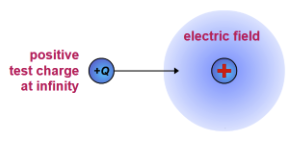
  • If a positive test charge is moved from infinity to a position in an electric field, the electric potential energy of the charge will change.

  • Work is done on the charge

  • In an electric field the Ep is at infinity when it is around a point charge. 

  • The strength of the field would be zero at infinity.

<ul><li><p><span style="background-color: transparent;">If a positive test charge is moved from infinity to a position in an electric field, the electric potential energy of the charge will change.</span></p></li></ul><ul><li><p><span style="background-color: transparent;">Work is done on the charge</span></p></li><li><p><span style="background-color: transparent;">In an electric field the E<sub>p</sub> is at infinity when it is around a point charge.&nbsp;</span></p></li><li><p><span style="background-color: transparent;">The strength of the field would be zero at infinity.</span></p></li></ul><p></p>
15
New cards

Work done from Electric potential equation

∆W = Q∆V 

  • W - work done to move a charge

  • Q - Charge 

  • V - Electric potential


16
New cards

Electric potential equation for a point charge (radial field)

V =  Q / (4πεor)

17
New cards

Potential gradient

the rate of change of electric potential per unit change of distance in a certain direction within that field

  • Also known as the the electric field strength at a point

  • The gradient in a V-r graph 


18
New cards

Potential gradient equation

E = ∆V/∆r 

  • E - Electric field strength

  • ∆V - change in potential

  • ∆r - change in distance


19
New cards

Capacitor

a pair of plates with an insulator between them that store charge

  • Only works in a dc circuit (as charge needs to build up)

  • AC will remove and add charge to each plate resulting in an overall neutral charge

  • The electric field around capacitors is uniform


<p><span style="background-color: transparent;">a pair of plates with an insulator between them that store charge</span></p><ul><li><p><span style="background-color: transparent;">Only works in a dc circuit (as charge needs to build up)</span></p></li><li><p><span style="background-color: transparent;">AC will remove and add charge to each plate resulting in an overall neutral charge</span></p></li><li><p><span style="background-color: transparent;">The electric field around capacitors is uniform</span></p></li></ul><p></p>
20
New cards


Capacitance

the amount of charged stored per unit potential difference between the plates

21
New cards

Capacitance equation

Q=CV

  • Q - Charge, measured in Coulombs

  • C - Capacitance, measured in Farads

    • Coulomb per volt = farad

  • V - Potential difference, measured in Volts


22
New cards

Charged stored factors

  • Distance between plates - Greater distance, hence less charge stored

  • Voltage - Greater voltage, hence more charge stored 

  • Capacitance - Greater Capacitance, hence more charge stored 

  • Size of plates - Greater area of plates, hence more charge stored 


23
New cards

Work done from capacitance

  • The area under a Q-V graph

  • W = ½ QV

    • W is not proportional to V due to Q changing when V is changed so Q cannot be made constant while V varies with W

  • W = ½ CV2

    • W is proportional to V2

  • W = Q2 / 2C

    • W is proportional to Q2


<ul><li><p><span style="background-color: transparent;">The area under a Q-V graph</span></p></li><li><p><span style="background-color: transparent;">W = ½ QV</span></p><ul><li><p><span style="background-color: transparent;">W is not proportional to V due to Q changing when V is changed so Q cannot be made constant while V varies with W</span></p></li></ul></li><li><p><span style="background-color: transparent;">W = ½ CV<sup>2</sup></span></p><ul><li><p><span style="background-color: transparent;">W is proportional to V<sup>2</sup></span></p></li></ul></li><li><p><span style="background-color: transparent;">W = Q<sup>2</sup> / 2C</span></p><ul><li><p><span style="background-color: transparent;">W is proportional to Q<sup>2</sup></span></p></li></ul></li></ul><p></p>
24
New cards
25
New cards


Capacitor charging

  • Increasing the potential difference between the two plates of the capacitor

  • This stores charge within the capacitor


<ul><li><p><span style="background-color: transparent;">Increasing the potential difference between the two plates of the capacitor</span></p></li><li><p><span style="background-color: transparent;">This stores charge within the capacitor</span></p></li></ul><p></p>
26
New cards


Capacitor discharging

  • Decreasing the potential difference between the two plates of the capacitor by using the potential difference to power a component

  • This decreases/uses charge within the capacitor


<ul><li><p><span style="background-color: transparent;">Decreasing the potential difference between the two plates of the capacitor by using the potential difference to power a component</span></p></li><li><p><span style="background-color: transparent;">This decreases/uses charge within the capacitor</span></p></li></ul><p></p>
27
New cards

Capacitor charging graphs

  • The gradient of a charge time graph is the current 

  • The area under a current time graph is the charge


<ul><li><p><span style="background-color: transparent;">The gradient of a charge time graph is the current&nbsp;</span></p></li><li><p><span style="background-color: transparent;">The area under a current time graph is the charge</span></p></li></ul><p></p>
28
New cards

Capacitor discharging graphs

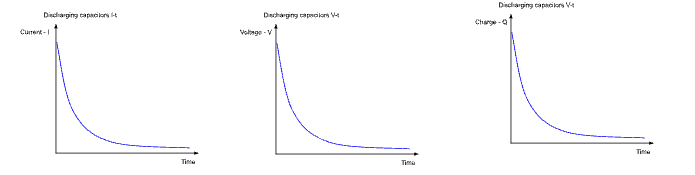
  • The gradient of a charge time graph is the current 

  • The area under a current time graph is the charge

<ul><li><p><span style="background-color: transparent;">The gradient of a charge time graph is the current&nbsp;</span></p></li><li><p><span style="background-color: transparent;">The area under a current time graph is the charge</span></p></li></ul><p></p>
29
New cards

Factors for time take for capacitor discharge

  • Time constant

    • Resistance of the resistor in the circuit

    • capacitance of capacitor


30
New cards

Time constant (𝛕)

the time taken for the charge on the capacitor to discharge to 1/e (~ 37%) of its initial value or the time taken to charge to 63%

  • 1 time constant drops by 37% of its previous / initial value

  • The charge drops by the same proportion each time


31
New cards

Time constant equation

𝛕 = RC

  • 𝛕 - time constant [s]

  • R - resistance [Ω]

  • C - capacitance [F]


32
New cards

Rate of removal of charge

Proportional to the amount of charge remaining 

33
New cards

Half life of a discharging capacitor

the time taken for the charge, current or voltage of a discharging capacitor to reach half of its value

34
New cards

Half life of capacitor equation

t1/2  = 0.69𝛕 = 0.69RC



