ch6
 Call Kai
 Learn
 Practice Test
 Spaced Repetition
 Match
 Flashcards
 Knowt Play
1/43

There's no tags or description
Looks like no tags are added yet.
44 Terms
Nominal Interest Rate (i)
Interest rate expressed in terms of units of the national currency (dollars).
Real Interest Rate (r)
Interest rate expressed in terms of goods or purchasing power (r ≈ i - πᵉ).
Nominal Policy Interest Rate (i / ī)
The short-term nominal rate set directly by the central bank (Federal Reserve).
Real Policy Interest Rate (r / r̄)
The real interest rate targeted by the central bank, equal to the nominal policy rate minus expected inflation (r = i - πᵉ).
Nominal Borrowing Interest Rate (i + x)
The total nominal interest rate paid by risky borrowers, combining the policy rate and a risk premium.
Real Borrowing Interest Rate (r + x)
The total real interest rate faced by firms and consumers when making investment spending decisions.
Expected Inflation (πᵉ)
The expected percentage change in the overall price level.
Zero Lower Bound (ZLB)
The constraint that the nominal policy interest rate cannot drop below zero (i ≥ 0), putting a floor on the real policy rate at r = -πᵉ.
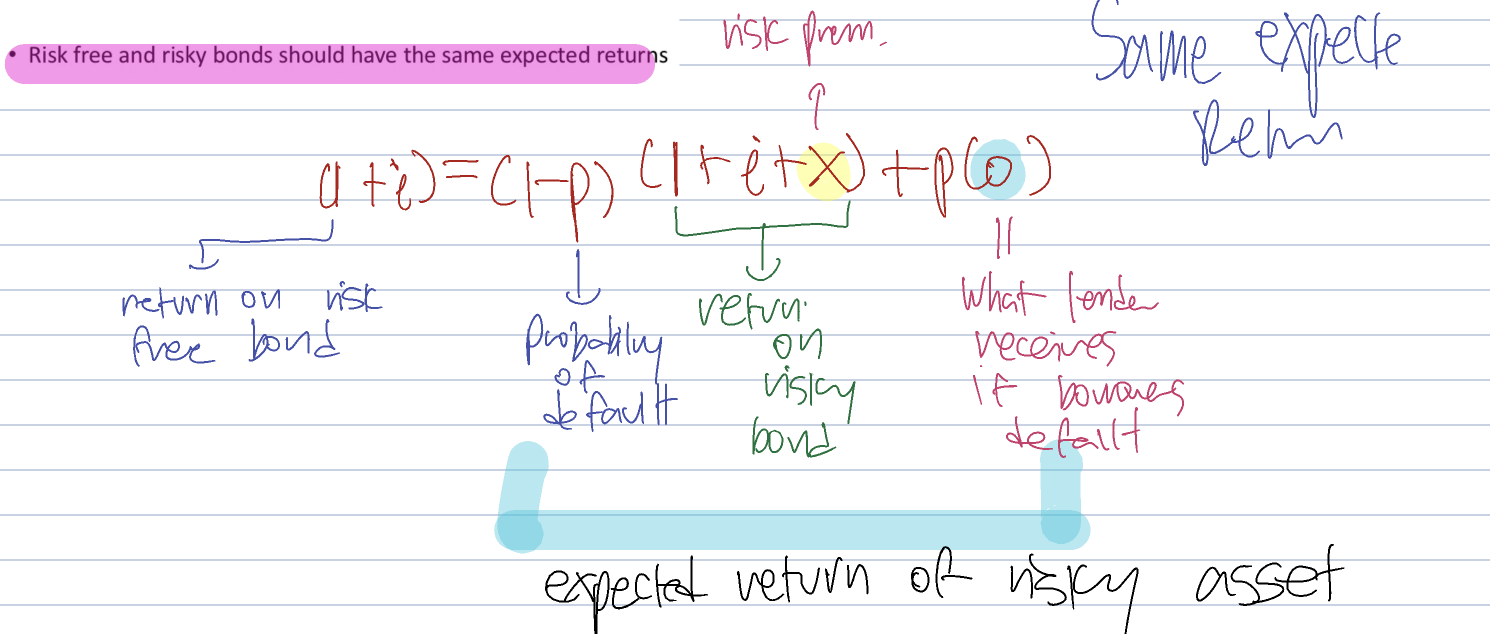
Risk Premium (x)
The extra yield/return demanded by lenders to hold a risky asset over a safe risk-free asset, calculated as x = [(1+i)p]/(1-p).
Probability of Default (p)
The statistical probability that a borrower will fail to repay their debt.
Risk Aversion
The degree to which investors dislike taking on financial risk.
Treasury Bills / Treasury Bonds
Safe government-issued debt securities (e.g., 6-month, 1-year, and 10-year Treasuries).
Corporate Bonds (AAA / BBB)
Debt issued by private corporations, carrying credit ratings based on default risk (AAA = safer, lower yield; BBB = riskier, higher yield).
Financial Intermediary
A financial institution (such as a bank, mortgage company, or mutual fund) that collects funds from investors/depositors and uses them to buy financial assets or make loans.
Bank Capital
The owner-contributed funds in a financial institution, equal to total assets minus total liabilities (Capital = Assets - Liabilities).
Capital Ratio
The ratio of a bank's capital to its total assets (Capital / Assets).
Leverage Ratio
The ratio of total bank assets to bank capital (Assets / Capital).
Insolvent
The condition when a bank's total assets fall below its total liabilities (Assets < Liabilities).
Liquidity
The degree of ease with which an asset can be bought or sold quickly without a loss in value.
Fire Sale Prices
Severely discounted prices at which illiquid assets must be sold when an institution is forced to liquidate rapidly to repay investors.
Subprime Mortgages
Mortgages extended to higher-risk borrowers who have a elevated likelihood of default.
Securitization
The practice of bundling individual financial assets (like home loans) into marketable financial securities.
Mortgage-Backed Securities (MBS)
Debt securities created by bundling individual home mortgages.
Collateralized Debt Obligations (CDOs)
Structured asset-backed securities derived from a portfolio of underlying credit assets.
Senior Securities
Securities that hold first claim on cash flows generated by an underlying asset bundle.
Junior Securities
Securities that absorb losses first and pay out only after senior securities have been satisfied.
Structured Investment Vehicle (SIV)
Nonbank financial entities that borrow via short-term debt to fund purchases of long-term securities.
Toxic Assets
Non-performing financial assets that suffer extreme declines in market value and become difficult to trade or sell.
Federal Deposit Insurance (FDIC)
Government guarantee protecting account deposits (increased to $250,000 during the crisis) to stop bank runs.
Troubled Asset Relief Program (TARP)
Crisis program through which the US government purchased toxic assets and stock in financial institutions.
American Recovery and Reinvestment Act (ARRA)
Large-scale fiscal stimulus program ($780 billion) involving tax cuts and government spending increases.
IS LM extended

equal risk free and risky bonds