Study Strategies and Memory Techniques
 Call Kai
 Learn
 Practice Test
 Spaced Repetition
 Match
 Flashcards
 Knowt Play
1/13

There's no tags or description
Looks like no tags are added yet.
14 Terms
learning style hypothesis
view that different people learn info in different ways
Most popular: the visual vs. verbal learner
Students tend to believe they have a certain learning styl
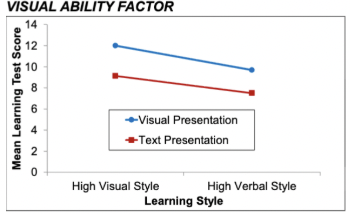
Massa and Myer (2006)
Participants learn about electronics
Given visual help screens (diagrams) or verbal (text) in nature
Participants were also assessed on a variety of measures of preference and verbal/visual ability
All participants take the same final test on knowledge of electronics
Nilsson (1987): motivation
3 groups:
Motivation-Study: told before studying that they could win money based on memory
Motivation-test: told before the test that they could win money based on memory
Control: given no motivation
Performed better than those motivated
Common misconceptions of motivation
We can’t rely on feelings and intuition
We can rely on science
science of learning
Research-based practices for improving memory
elaboration rehearsal: deeper meaning
maintanence rehearsal: simple repetition
Palmere et al. (1983): example and memory
Method: manipulated number of examples
Results: more examples = greater memory
the generation effect
a memory phenomenon where people remember information better when they create it themselves rather than just reading it passively
flashcards
self-explanation
working though problems by memory instead of study guides
Foos et al. (2004): participants read a 2,250 word text
Half of the participants generated their own study questions
Half of the participants read study questions that someone else made
participant who made their own performed better
encoding specificity
When we learn anything, we are also encoding context–the surrounding environment and our own state
Classroom research
Effect less reliable
Lots of same elements in classrooms
Small changes don’t seem to drive this effect
Applications for studying
Match what you do on
Ex: details vs conceptual understanding
Match time pressure
Match state/mood (as much as possible)
role of testing
Roediger & Karpicke (2006): participants read prose passages on scientific topics
Main comparison: participants either studied the passages twice (study-study) or studied and then took a test (study-test)
All participants take a final free recall test
Given either 5 minutes, 2 days, or 1 week after the learning session
those who were tested performed better
The power of testing: do testing effects hold up in the classroom?
Roedinger et al. (2011): looked at quizzing in a middle school classroom
Students were given a quiz after a lesson and two days later
Retention measures via:
Chapter exam: 2 weeks after the lesson
Semester exam: 1-2 months after lesson
Influences how a professor designs a curriculum and how frequent they test
Testing: the implication is that practice tests don’t just assess learning; they also boost learning
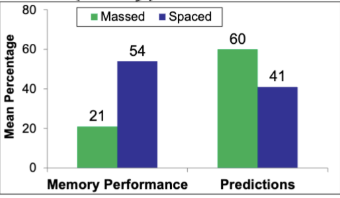
massed studying
studying it all shortly before test
spaced studying
studying in intervals days before test
Kornell (2009): asked people to predict their own learning following massed vs. spaced practice
Showed that participants predicted the opposite pattern when it came to spacing
Memory greater for spacing
Predictions higher for massing
high utility strategies for studying
Dunlocky et al.(2013): looked at 10 different learning techniques and ranked them according to their utility
The two high utility strategies were spacing and testing