molecular basis of drug action - week 4
 Call Kai
 Learn
 Practice Test
 Spaced Repetition
 Match
 Flashcards
 Knowt Play
1/31

There's no tags or description
Looks like no tags are added yet.
32 Terms
what can medicines interact with?

four major protein target families
receptors → receive chemical signals
enzymes → catalyze reactions
ion channels → control ion movement
transporters → move substances across membranes
ligand
A signalling molecule, drug, hormone, or cofactor that reversibly binds to a macromolecule (such as a protein, DNA strand, or cell receptor).
what is a receptor
commonly a protein that recognizes a ligand and initiates or alters a biological response
the endogenous ligand may be a neurotransmitter, hormone, cytokine or growth factor
receptor activation is followed by signalling or direct change in cell behaviour
G proteins
G proteins (guanine nucleotide-binding proteins) are molecular switches inside cells that transmit signals from surface receptors to internal targets
four receptor classes
G-protein-coupled receptors (GPCRs) activate G proteins and downstream effectors
ligand-gated ion channels: ligand binding changes ion flow
enzyme-linked receptors: activate intrinsic or associated enzymes
intracellular/nuclear receptors: often regulate gene expression
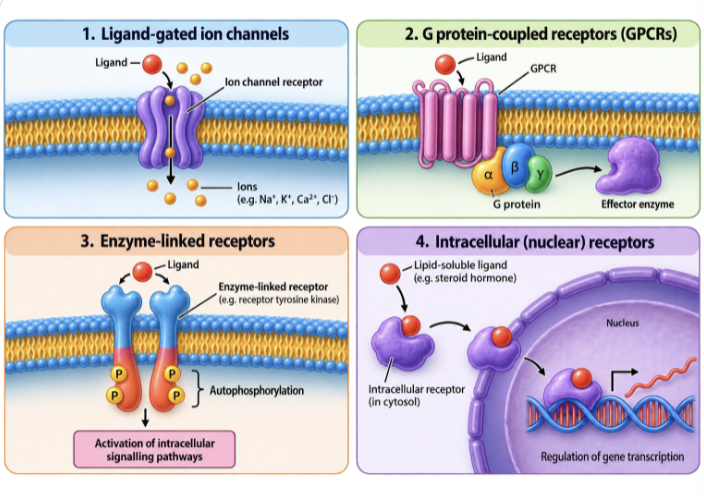
cell-surface signalling
an extracellular ligand binds to a receptor at the membrane
the receptor activates intracellular signalling proteins
effectors alter enzymes, transcription or cytoskeletal processes
these changes become physiological response

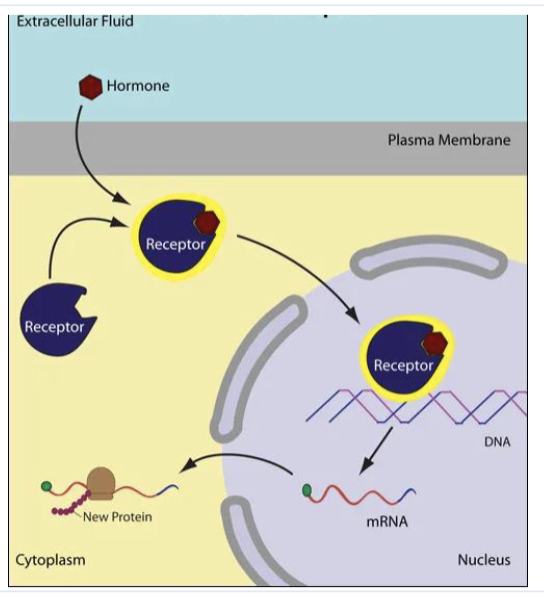
intracellular receptors
lipophilic ligands may cross cell membranes to reach intracellular receptors
the ligand-receptor complex can influence transcription and protein synthesis
effects may develop over hours because new gene products are needed
Agonist
activating the receptor
agonist binds a receptor (affinity) and activates it (efficacy)
a drug can mimic an endogenous ligand or be natural ligand itself

Agonist in everyday clinical practice
Salbutamol (agonist) activates β₂-adrenoceptors,
promoting bronchodilation in asthmaInsulin activates the insulin receptor, an
enzyme-linked receptor, helping regulate
glucose uptake and metabolismThese are different receptor classes but
share the idea of activation.
nasal decongestants
Oxymetazoline, xylometazoline and
phenylephrine are α-adrenoceptor agonists.They cause vasoconstriction in the nasal
mucosa and temporarily reduce congestion.Clinical caution: excessive or prolonged
topical use can cause rebound congestion.
antagonists
binding without activation
antagonists bind receptors but do not activate them as a agonists do
a reversible competitive antagonist competes with the agonist at the same site
non-competitive antagonism can arise by several mechanisms, including irreversible or allosteric interference

receptor antagonists in practice
Propranolol blocks β-adrenoceptors; used
for selected cardiovascular and other
conditions.Tamoxifen is a selective oestrogen receptor
modulator used in hormone-sensitive breast
cancer.The same word “receptor” does not imply
identical signalling or clinical effects.
Antihistamines: H₁ receptor effects
Chlorphenamine and loratadine oppose
histamine actions at H₁ receptors.Used for allergic symptoms such as
sneezing, itching and hay fever.Clinical comparison: chlorphenamine is
more sedating than loratadine for many
patients.
ion channels
blockers stop ion flow; modulators change the probability of a channel opening
ion channels as drug targets
Ion channels are membrane proteins that
permit selected ions to cross down
electrochemical gradients.Opening or closing a channel changes
electrical and cellular function.Some drugs block conduction; others
change channel gating.

channel blockers
stopping permeation
A pore blocker reduces the passage of ions
through an ion channelBlocking Na⁺, Ca²⁺ or K⁺ movement can alter
neuronal or cardiac signalling.Mechanism explains both benefit and
toxicity of some medicines and toxins.

Calcium-channel blockers in cardiovascular care
Amlodipine and nifedipine preferentially
relax vascular smooth muscle.Verapamil and diltiazem also affect cardiac
conduction and contractility.Members of the class can treat hypertension
and angina; some can treat selected
arrhythmias.

channel modulation: changing gating
A modulator alters how likely a channel is to
open or close.Changing ion movement changes
excitability, secretion or muscle function.Channel modulation and channel pore
blockade are not identical mechanisms.

Gliclazide: a channel drug for diabetes
Sulfonylureas such as gliclazide close ATP-
sensitive K⁺ channels in pancreatic β-cells.This triggers depolarisation, calcium entry
and insulin release.Clinical consequence: insulin release can
lead to hypoglycaemia, especially if meals
are missed.
enzymes
biological catalysts
Enzymes accelerate reactions by converting
substrates into products.Drug molecules may bind enzymes and
change the reaction rate.Enzyme activity can be altered without the
enzyme being a receptor.

enzyme inhibition: core patterns
Competitive inhibitors typically bind at the
substrate binding site.Non-competitive and allosteric inhibition
change activity without simply competing for
substrate binding.Inhibition may be reversible or irreversible;
these distinctions are separate.

Cyclooxygenase Inhibition: Aspirin & Ibuprofen
Cyclooxygenase (COX-1/COX-2) enzymes
participate in prostaglandin synthesis.Ibuprofen is a reversible COX inhibitor;
reduced prostaglandins explain analgesic
and anti-inflammatory effects.Aspirin irreversibly acetylates COX; its
antiplatelet action is especially important
clinically.

prodrugs
activation happens later
A prodrug requires chemical or enzymatic
conversion to yield its active form.Prodrug design may improve absorption,
distribution or tolerability.Do not confuse an enzyme that activates a
prodrug with the final pharmacological
target.
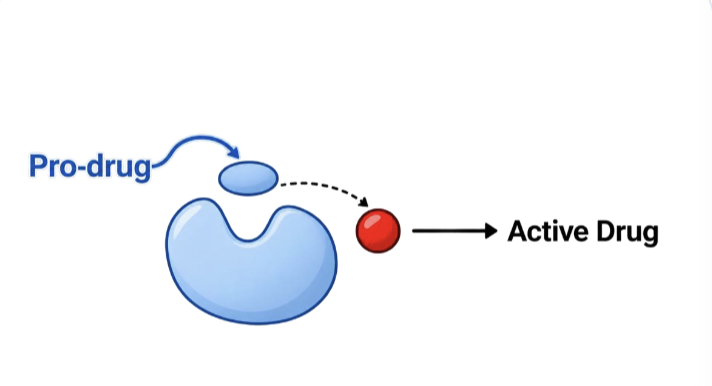
Enalapril And Codeine: Activation Matters
Enalapril is converted by esterases to
enalaprilat, the active ACE inhibitor.Codeine is partly converted by CYP2D6 to
morphine.Genetic variation in CYP2D6 can lead to
altered codeine response and toxicity risk.

false substrates: different strategy
A false substrate is processed by an enzyme
into a product that changes a downstream
pathway.The enzyme need not be inhibited by the
drug itself.

methyldopa
unusual pharmacology pathway
Methyldopa is converted to α-
methylnoradrenaline by metabolic enzymes.The active product acts centrally at α₂-
adrenoceptors, reducing sympathetic
outflow.This provides an example of a false substrate/ converted product, rather than simple
enzyme inhibition.

transporters as targets
Transporters move ions and organic
molecules across membranes.Many transporters couple movement to
concentration gradients or ATP.Inhibiting uptake can increase extracellular
transmitter availability.

transport inhibitors
blocking uptake
A transporter inhibitor decreases movement
through a transporter.This differs from receptor antagonism: the
transporter moves a substance rather than
detecting a signal.The final effect may still arise because more
transmitter stimulates receptors.

fluoxetine
Fluoxetine is a selective serotonin reuptake
inhibitor (SSRI).It inhibits the serotonin transporter (SERT) on
presynaptic neurons.Less serotonin is taken back up, increasing its
availability in the synaptic cleft.Clinical antidepressant response develops over
time; do not equate immediate SERT inhibition
with immediate mood improvement

amphetamines
Amphetamine-like compounds interact with
monoamine transporters and can increase
extracellular monoamines.These agents act differently from simple
reuptake inhibition and can also promote
transmitter release.Clinical relevance includes selected ADHD
treatments; misuse carries cardiovascular
and psychiatric risks.