Experiment 1: Density of Liquids: Measurement and Error in Chemical Analysis
 Call Kai
 Learn
 Practice Test
 Spaced Repetition
 Match
 Flashcards
 Knowt Play
1/31

Earn XP
Description and Tags
Chem 105a Lab
32 Terms
Purpose
To determine the mass % concentration of an unknown NaCl (aq) solution by comparing the density of the unknown to the densities of a series of solutions of known mass % concentration
How did we compare these solutions? What equation did we use?
Measured the mass and volume of the solutions to compare and calculate density

Lab Objectives
Understand the concepts of accuracy, precision, random error and systematic error and how they apply to lab measurements and results
Learn how to properly measure and dispense liquids using graduated pipets and burets
Learn proper use of analytical and top loading balances
Understand that results of an experiment must be repeatable.
Understand the relationship between solute concentration and solution density
What are the two types of mass balances that can be used in lab, and what are their pros and cons?
Analytical - More precise; measures up to 0.001g
Top-Loading - Easier to use and can weigh larger samples; measures up to 0.01g
What glassware did we use to measure volume in this experiment?
Compared results between using:
Graduated pipet
Buret
What glassware is acceptable for more imprecise volume measurements?
Graduated cylinder
What is random error and what does it affect?
Error that has an equal and arbitrary chance of happening
Last digit of measuring instrument changing
Affects precision
What is systematic error and what does it affect?
Error that is skewed in one direction and can be attributed to to experimental design, poorly calibrated instruments, or user error
Can be eliminated
Affects accuracy
How do you calculate absolute error vs relative error?
Absolute error is the magnitude of the difference between a measured value and the actual value
Keeps units
Usually given in problem (what comes after the ±)
Relative error divides that absolute error by the actual value to show error size relative to the scale of the measurement
Unitless
Absolute error/Measured

If you estimate that the relative error in the mass is negligible compared to the relative error in the volume, will your reported error in the density, E(d) change? Is it always possible to make this type of approximation?
No, it will not change significantly because the relative error in mass is small compared to the relative error in volume in this problem. However, you cannot always make this approximation because you can only neglect an error when it is much smaller than the other errors. If the relative errors are comparable, neglecting one could greatly change the final uncertainty.
Accuracy
A measure of how close your value is to the true or accepted value
How can we quantify accuracy if we know the true value?
By calculating percent error

What true values are we given for this experiment/are well known?
Density of water at different temperatures
What are the two definitions of precision? Which one are we concerned with in experiment 1?
The number of sig figs an instrument can measure
The measure of repeatability of results
- Concerned with #2
How can we quantify the precision of results?
By calculating standard deviation or percent standard deviation

What must a quantitative result always be reported with?
An estimate of the error in the result

Error Propagation
Understanding how the errors from multiple measurements is combined
What kind of error propagation was used to find the error in the measurements of the graduated pipet and beaker?
Mixed operations error propagation
Procedure Overview
You will determine the density of 6 solutions -
5 known solutions and 1 unknown - by measuring the mass and volume, in 2 trials:
The five known solutions you will measure are:
DI water
2% NaCI(aq)
4% NaCI(aq)
6% NaCI(aq)
8% NaCI(aq)
Each trial will use a different type of glassware to measure the volume:
Graduated Pipet
Buret

What measurements did we need for this lab?
1. Mass of beaker
2. Mass of sample + beaker
3. Mass of sample
4. Initial Pipet/Buret Reading
5. Final Pipet/Buret reading
6. Volume delivered
7. Temperature (water)
In this experiment, could you use different balances for each mass measurement in each trial?
No; you had to use the same balance for each mass measurement in each trial
How was the mass of the solution determined?
Through weighing by difference
Could use either type of balance; had to be to at least the hundredths place though
Approximately what volume of each solution should you obtain from the bottle containing the stock solution?
~5mL
What do you do if you accidentally take an excess of a stock solution?
DO NOT pour it back into the stock bottle, as this will contaminate the stock solution
Share with another student to get rid of your excess
If not able to share, dispose into appropriate waste container
What is the mass % of NaCl in DI water?
0%
How did we dispose of the NaCl?
Poured down the drain and rinsed with water
What relationship was plotted/graphed for the postlab?
Density (g/mL) - y-axis, vs % concentration - x-axis
What was the relationship between percent concentration and density for DI water and the known concentrations?
As % concentration increased, density increased
How did we determine the mass % concentration of the unknown?
y = mx + b
LINEST information
y = density
m = slope
x = % concentration
b = y-intercept
Reading LINEST Data
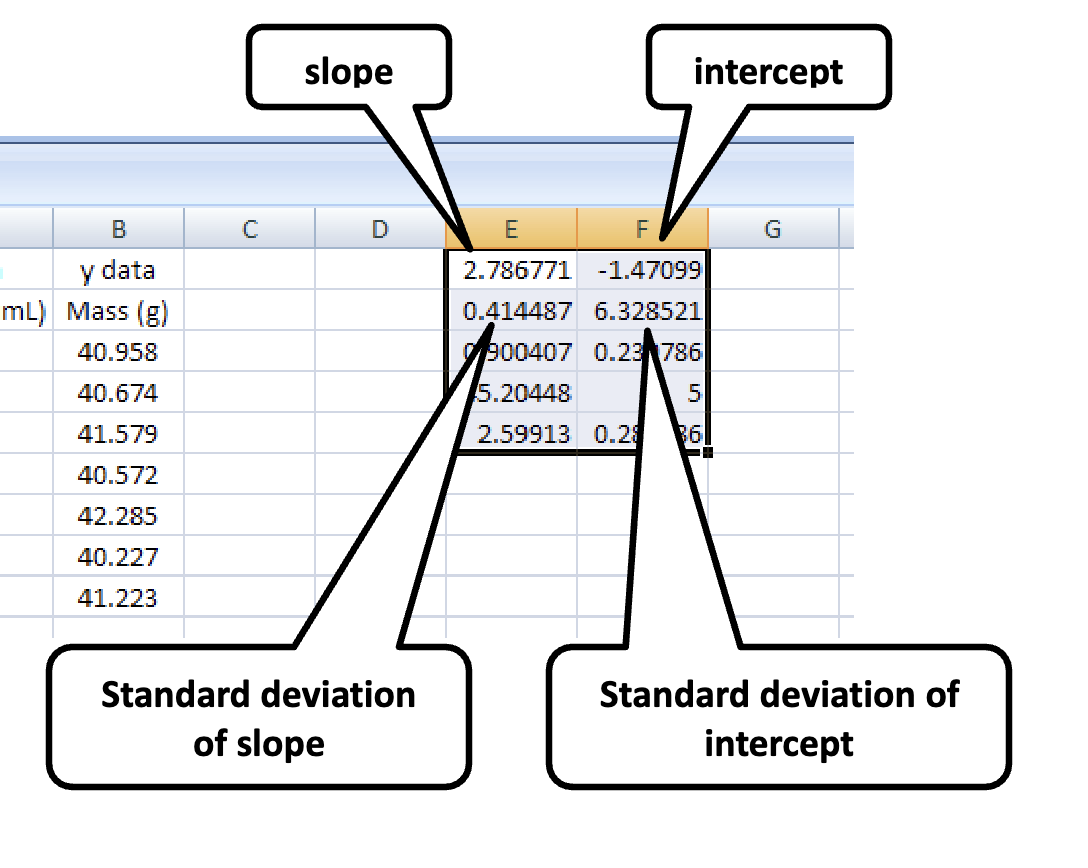
Which method did we find yielded the best results for density?
Buret method
- Both more accurate and more precise
What were some possible sources of error?
Mostly systematic error
Water leftover in the beaker between trials which could have diluted the next solution
drops of water remaining on the outside of the container could increase the measured mass
Incorrectly reading the meniscus or not delivering the full intended volume could decrease the measured volume.
Density that is too low could result from water being lost during transfer or from recording a volume that is too large.