Test 3- Ch. 11 Continued
 Call Kai
 Learn
 Practice Test
 Spaced Repetition
 Match
 Flashcards
 Knowt Play
1/75

There's no tags or description
Looks like no tags are added yet.
76 Terms
trigger zone
threshold graded current at ______ causes action potentials
continuous conduction
action potential in one site causes action potential at the next location.
cannot go backwards because initial action potential site is depolarized due to Na+ flooding in through voltage gates as Na+ goes down the axon yielding one-way conduction of impulse
occurs in unmyelinated axons
saltatory conduction
myelinated axons employ ______
Na+ must go through the myelin sheath before the node of ranvier where voltage gates are located.
think jumping
AP propogation in an unmyelinated axon
when an action potential is produced, the inside of the membrane becomes more positive than the outside. On the outside of the membrane, Na+ from the adjacent area is attracted to the negative charges at the site of the AP. once inside the cell, Na+ diffuses away from the entry point, and this diffusion is called a LOCAL CURRENT
as a result of the local current, the part of the membrane immediately adjacent to the AP depolarizes
if an action potential is intiated at one end of an axon, it is propagated in one direction down the axon. the absolute refractory period ensures one-way propogation of an action potential because it prevents the local current from stimulating the production of an action potential in the reverse direction
local current
step 1 in AP propogation in an unmyelinated acon
when an action potential is produced, the inside of the membrane becomes more positive than the outside. on the outside of the membrane, Na+ from the adjacent area is attracted to the negative charges at the site of the action potential. Once inside the cell, Na+ diffuses away from the entry points. This diffusion of Na+ is called a ______
depolarizes
step 2 in AP propagation in an unmyelinated axon
as a result of the local current, the part of the membrane immediately adjacent to the action potential ______
absolute refractory period
step 3 of AP propagation in an unmeylinated axon
if an action potential is initiated at one end of an axon, it is propagated in one direction down the axon. The ______ ensures one-way propogation of an AP because it prevents the local current from stimulating the production of an AP in the reverse direction.
saltatory conduction steps
an action potential at a node of ranvier generates local currents. The lipids within the membranes of the myelin sheath act as a layer of insulation, forcing the local currents to flow from one node of Ranvier to the next
voltage-gated Na+ channels are highly concentrated at the node of Ranvier. Therefore, the local current quickly flows to the next node and stimulates the voltage-gated Na+ channels to open, resulting in the production of an action potential
the action potential seems to jump from node to node, increasing the speed of conduction
insultation
step 1 in saltatory conduction
an action potential at a node of Ranvier generates local currents. The lipids within the membranes of the myelin sheath acts as a layer of ______, forcing the local currents to flow from one node of Ranvier to the next
highly
step 2 in saltatory conduction
voltage-gated Na+ channels are _____ concentrated at the nodes of Ranvier. Therefore, the local current quickly flows to the next node and stimulates the voltage-gated Na+ channels to open, resulting in the production of an action potential
increasing
step 3 of saltatory conduction
the action potential seems to jump from node to node, ______ the speed of conduction
Speed of Conduction
faster in myelinated axons than in non-myelinated due to jumping from node to node
in myelinated, speed is affected by thickness of myelin sheath (Type A-C)
diameter of axons: large-diameter conducts more rapidly small-diameter. Large have greater surface area and more voltage-gated Na_ channels
Type A
large-diameter, myelinated
conduct at 15-120 m/s
motor neurons supplying skeletal and most sensory neurons
keep you alive during emergencies
more space for Na+ to move, so it’s faster
Type B
nedium-diameter, lightly myelinated
condusct at 3-15 m/s
part of ANS
same amount of Na+ as other types, but less room to move Na+ inside so it’s slower
Type C
small-diameter, unmyelinated
conduct at 2 or less m/s
part of ANS
Synapse
junction gap between 2 cells
site where action potentials in one cell cause action potential in another
types of cells in synapse: presynaptic and postsynaptic
types of synapses
electrical
chemical
presynaptic (presynapse)
cell that transmits signal toward the synapse
postsynapstic (postsynapse)
target cell receiving the signal
electrical synapses
cells connected by gap junctions that allow graded current (Na+) to flow between adjacent cells
connexons: protein tubes in cell membrane
found in cardiac muscle and many types of smooth muscle
important where contractile activity among a group of cells occurs
example of electrical synapse
due to gap junctions, sodium can zip through the heart with no diffusion so the whole heart can contract at one time
Connexon
protein tube in cell membrane
Electrical synapse Explained
an action potential in one cell produces a local current as Na+ from once cell flows to the adjacent part of the plasma membrane and through the gap junction
the movement of Na+ generates an action potential in the adjacent cell almost as if the 2 cells had the samem membrane.
as a result, action potentials are conducted rapidly between cells, allowing the cells to be synchronized
chemical synapse components
presynaptic terminal- end of the presynaptic cell axon
synaptic cleft- space between the presynaptic terminal and postsynaptic membrane
postsynaptic membrane- membrane of other neurons, muscle cells, or glial cells
neurotransmitters
in chemical synapses _______ are released by action potentials in presynaptic terminal
how neurotransmitters work in chemical synapses
synaptic vesicles: action potential cause calcium to enter the cell that causes neurotransmitters to be released from vesicles
diffusion of neurotransmitters across the synapse
Postsynaptic membrane: when neurotransmitters bind to the receptor, ligand-gated ion channels open
step 1 in chemical synapses
action potentials arriving at the presynaptic terminal causes voltage-gated calcium channels to open
step 2 in chemical synapses
Ca2+ diffuses into the cell and causes synaptic vesicles to release neurotransmitter molecules. Most neurophysiologists agree that synaptic vesicle membranes have a calcium sensor, such as synaptotagmin.
Once calcium binds to the vesicle, the vesicle interacts with membrane-trafficking proteins proteins that guide the vesicle to the presynaptic terminal. The vesicle fuses with the membrane of the presynaptic terminal and releases its contents into the synaptic cleft
step 3 in chemical synapse
neurotransmitter molecules diffuse from the presynaptic terminal across the synaptic cleft
step 4 in chemical synapse
neurotransmitter molecules bind reversibly to specific receptors, such as ligand-gated ion channels, in the postsynaptic membrane. Depending on the ion channel type, this binding produces a depolarization or hyperpolarizing graded potential in the postsynaptic membrane.
Ex) the binding of the neurotransmitter to ligand-gated Na+ channels causes the gates to open, allowing Na+ to diffuse into the postsynaptic cleft. If the resulting depolarizing graded potential reaches the threshold, an action potential is produced.
on the other hand, the opening of K+ and Cl- channels result in a hyperpolarizing graded potential
neurotransmitter removal
method depends on neurotransmitter/synapse
neurotransmitters have short-term effects in postsynaptic membranes because they are rapidly destroyed or removed from the synaptic cleft
Removal of Neurotransmitter from Synaptic Cleft: ACh
acetylcholine molecules are released from their receptors
acetylcholinesterase splits acetylcholine into choline and acetic acid, which prevents acetylcholine from binding to its receptors again
choline is taken up by the presynaptic terminal and combines with acetyl-CoA to reform acetylcholine
other acetylcholine molecules diffuse into extracellular fluid away from the synaptic cleft
released
acetylcholine molecules are _______ from their receptors
step 1 to removing ACh from synaptic cleft
acetylcholinesterase
_______ splits acetylcholine into chlorine and acetic acid, which prevents acetylcholine from binding to its receptors again
step 2 in removing ACh from synaptic cleft
reform
choline is taken up by the presynaptic terminal and combines with acetyl-CoA to _____ acetylcholine
choline is transported with a sodium molecule, so it uses a symporter (2 molecules in 1 direction at the same time)
step 3 in removing ACh from synaptic cleft
extracellular fluid
other acetylcholine molecules diffuse into _______ away from the synaptic cleft
step 4 in removing ACh in synaptic cleft
Removal of Neurotransmitter from Synaptic Cleft: NE
norepinephrine is released into the synaptic cleft
norepinephrine is taken up by the presynaptic terminal, which prevents NE from again binding to the receptor
norepinephrine is repackaged into synaptic vesicles
the enzyme monoamine oxidase (MAO) breaks down some of the NE molecule
terminal
NE uses the same symporter, but no enzyme like ACH to break it down into 2
instead, norepinephrine goes back up into the presynaptic ______, but not all of it is used and some escapes and is used as a waste product
Receptor Molecules in Synapses
neurotransmitter only “fits” into one receptor
neurotransmitter affects only the cells with receptors for the neurotransmitter
neurotransmitters are excitatory in some cells and inhibitory in others
some neurotransmitters (for ex, Norepinephrine) can also attach to the presynaptic terminal and modulate its own release
body
our ____ releases norepinephrine, which increases your BP and HR but too much will kill you, so NE will modulate itself to stop by attaching to its own presynaptic terminal
graded potential
stimulation of neurons initiates a _______ in the cell body. This is often the result of opening of ligand-gated channels. If the degree of stimulation is great enough, the _____ reaches a threshold
Depolarization at axon hillock
when the membrane potential reaches threshold, voltage-gated Na+ channels open allowing an influx of Na+. This results in rapid ______
repolarization
Na+ channels become inactive and K+ channels open, allowing K+ to move out of the cell so cell can become negatively charged again. This results in the _____ of the plasma membrane
action potentail propagation
the action potential at the axon hillock results in local currents, which bring the next area of the axon to threshold. This leads to the ________ along the axon toward the presynaptic terminal
synaptic communication
an action potential at the presynaptic terminal results in the release of neurotransmitters that will alter the activity of the postsynaptic cleft
neurotransmitters and neuromodulators
chemical messangers secreted by neurons
neurons can secrete more than one typer
at least 100 types
criteria to be a neurotransmitter
must be synthesized by a neuron and stored within synaptic vesicles in the presynaptic terminals
an action potential must stimulate its release (exocytosis) in the synaptic cleft
it must bind to a specific receptor on the postsynaptic membrane
must evoke a response in the postsynaptic cell
classification of neurotransmitters
_______ based on:
chemical structure
their effect on the postsynaptic membrane
the mechanism of action at their target
variety
neurotransmitters can have an excitaroy or inhibitory effect in a _____ of ways
ionotropic effect
metabotropic effect
ionotropic effect
binding to ion channels
metabotropic effect
binding to G-protein-linked receptors
function
the ____ of a particular neurotransmitter is determined by its receptor in the target cell (postsynapse)
Major Chemical classes of Neurotransmitters
Acetylcholine (ACh)
Biogenic Amines
Amino Acids
Purines
Neuropeptides
Gases and Lipids
Acetylcholine (ACh)
best understood and most common
Biogenic amines
catacholamines and indoleamines; examples include serotonin, dopamine, and norepinephrine
amino acids
examples include GABA, glycine and glutamate
Purines
nitrogen-containing compounds derived from nucleic acids; examples include adenosine and ATP
neuropeptides
short chains of amino acids; include Substance P and endorphines
Gases and Lipids
examples include the gasotransmitters nitric oxide (gas) and carbon monoxide (gas), and endocannabinoids (lipid-derived)
Responses at the Postsynaptic Cleft
Excitatory postsynaptic potential (EPSP)
Inhibitory postsynaptic potentail (IPSP)
excitatory postsynaptic potential (EPSP)
depolarization occurs and response is stimulatory
depolarization might reach threshold producing an action potential and cell response
easier for AP to hit threshold- depolarization occurs due to Na+ rushing in so it helps AP occur
Inhibitory postsynaptic potential (IPSP)
hyperpolarization and response is inhibitory
decrease likelihood of action potential by moving membrane potential farther from the threshold
ex: endorphines are great at stimulating IPSP because the make you happy, helps take pain away so you can function by stoping AP from reaching brain
Neuromodulators
influence likelihood of an action potential being produced in postsynaptic cell
many synaptic types
Axoaxonic synapse
Presynaptic inhibition
Presynaptic facilitation
Axoaxonic Synapses
axon of one neuron synapses with the presynaptic terminal of another
common in CNS
Presynaptic inhibition
reduction in the amount of neurotransmitter released from the presynaptic terminal
endorphins can inhibit pain sensation
endorphins kick in and stop AP from continuing to the nect AP/axon
Presynaptic facilitation
amount of neurotransmitter released from presynaptic terminal increases
Glutamate facilitating nitric oxide production
more Na+ gates open, allowing more Na+ to come in
Spatial and Temporal Summation
a single postsynaptic potential is not sufficient to reach threshold
many postsynaptic potentials combine in summation at the trigger zone. If threshold is reached, an action potential is triggered
2 types of summation:
spatial and temporal
Spatial Summation
Action Potentials 1 and 2 cause the production of graded potentials at 2 different dendrites. These graded potentials summate at the trigger zone to produce a graded potential that exceeds threshold, result in an action potential
add up AP of Na+ already there at the same time to get this

temporal summation
two action potentials arrive in close succession at the presynaptic membrane. the 1st AP causes the production of a graded potential that does not reach threshold at the trigger zone. The 2nd AP results in the production of a second graded potential that summates with the first to reach threshold, resulting in the production of an action potential
occurs overtime
ex: gate opens, +1 Na+, gate close, gate open +1 Na+ until AP

produced
an action potential is ____ at the trigger zone when the graded potentials produced as a result of the EPSPs and IPSPs summate to reach

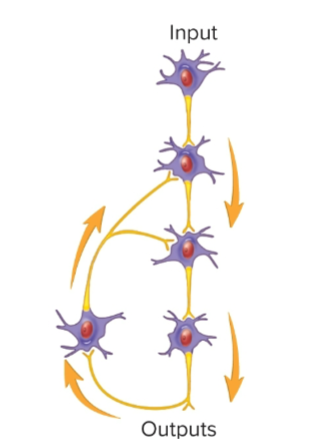
Neuronal Pathways and Circuits
organization of neurons in CNS varies in complexity
serial pathway
convergent pathways
divergent pathways
reverbrating circiut
parallel after-discharge circuit
serial pathway
input travels along one pathway
convergent pathways
many converge and synapse with small number of neurons. Ex: synthesis of data in brain
multiple neurons of input make 1 outpus.
ex: multiple neurons in brain make 1 output of grabbing your cup

Divergent pathways
small number of presynaptic neurons synapse with large number of postsynaptic neurons. For example, important information can be transmitted to many parts of the brain
1 input w/ several outputs
ex: vision but many pathways to process what you see

Reverberating Circuit
outputs cause reciprocal activation. For example, rhythmic activities such as breathing
EPSP easy here
ex) brain sets rhythm (1 signal), heart beats w/ that signal and neurons will stimulate each other until brain says otherwise
Parallel After-Discharge Circuit
neurons stimulate several neurons in parallel organization, which converge upon a common output cell. Ex: complex data processing in brain
1 input runs parallel to the brain and 1 outpus
ex: reading a question, lots of thinking to the question, output is writing A for the answer to the question
