Phil 413 Science
 Call Kai
 Learn
 Practice Test
 Spaced Repetition
 Match
 Flashcards
 Knowt Play
1/24

There's no tags or description
Looks like no tags are added yet.
25 Terms
Outline cell theory
-Cells are the basic unit of life in all organisms. -All living things are composed of one or more cells. -All cells arise from pre-existing cells.
name the first time stamp on timeline and what happened
1690- Hans and Zacharias Jassen- invented the first compound microscope
2nd time stamp
1655- Robert Hooke calls corks in space “cells”
3rd time stamp
1680s- Anton Van Leeuwenhoek observed living cells through a microscope
4th time stamp
1838 Mathias Schleiden (discovered that plants were made up of cells)
5th time stamp
1839 Theador Schwann (discovered animals are made up of cells)
6th time stamp
1855- Rudolph virchow- Discovered that all cells arise fro, pre-exisitng cells
label the parts of a microscope

Identify the steps required to use a microscope
-Carry the microscope by the base and arm and lay on a clear, flat surface
-Adjust the mirror or lamp so light passes through the hole in the stage.
-Place the microscope slide with the specimen onto the stage and under the clips.
-Position the objective lens with the lowest magnification above the specimen. If the lens is going to hit the stage, use the coarse focusing knob to lower the stage first.
Whilst looking through the eye eye, adjust the stage left and right until the organism
First use the coarse focus knob to raise the stage until it is cclose to the specimen, however not touching it
use the fine focus to get a clearer image
Repeat for more levels on higher levels of magnification
When finished, use the coarse focus knob to lower the stage, go back to lowest magnification level, bemove slide wrap the cord around, cover and pack.
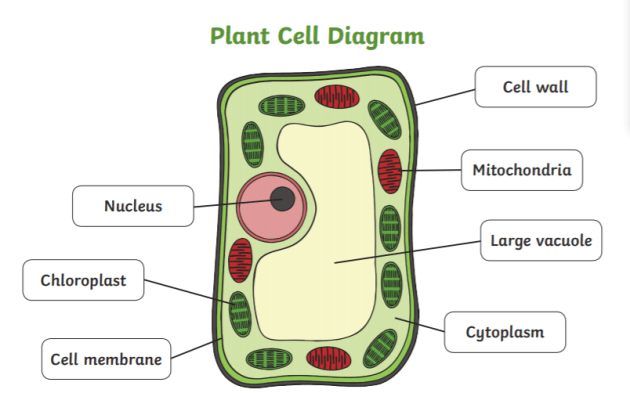
dentify which cell structures and organelles are common in plant and animal cells |
Plant: Animals: Mitochondria, nucleus, cell membrane, cytoplasm, vacuole, chloroplast, cell wall
Animals: Mitochondria, nucleus, cell membrane, cytoplasm, vacuole
draw and label a plant cell
draw and label animal cell

Describe functions of organelles
Nucleus: Control centre for the cell, holds genetic information(DNA)
Mitochondria: Powerhouse of the cell! Turns sugar and fat into energy
Cell Membrane:Surrounds and protects the cell by controlling what comes in and out
Vacuole: Membrane-bound sac containing water, nutrients, and waste. It helps to keep the cell’s shape
Cytoplasm: A gel-like mixture surrounded by cell membrane. Other organelles “float” in it. Contains nutrients and waste.
Chloroplast:Contains green chlorophyll. Where photosynthesis takes place. Produces sugars using carbon dioxide water and light.
Cell Wall: Rigid structure around cell which supports and protects the cell. Made of cellulose
Describe the role of specialised cells in multicellular organisms and explain why they are needed
Multicellular organisms are more complex, meaning that they need multiple different cells to carry out different funtions. It helps the body to work more efficiently.
Examine the relationship between structure and function for a range of specialised cells
Form example: nerve cells have a branch-like shape to send messages from brains to other body parts
For example: Red blood cells have a bi-concave shape with no nucleus, and haemoglobin to carry oxygen.
Represent the arrangement of specialised cells in tissues and in organs
Cells Tissues Organs Organ Systems Organism
cellular respiration
Cellular respireation is an important process that takes place in the mitochondria. It turns glucose from food and oxygen from the atmosphere. It then turns this into carbon dioxide and water which both gets let out into the air, and energy which helps us to grow, repair and reproduce. Word equation:
oxygen+glucose=carbon dioxide, water, energy
photosynthesis
Photosynthesis is the the process by which plants make their on food in the form of glucose. This process takes place in the chloroplast. Word equation:
Carbon dioxide, water -sunlight chlorophyll- oxygen+glucose
Use the particle model to explain the properties of solids, liquids and gases |

Link the physical behaviour of solids, liquids and gases to the particle model: shape, volume, compressibility
Solid: | Liquid: | Gas | |
Compressibility | No | Very hard | Yes |
Shape | Fixed shape | Not fixed | Not fixed |
Volume | Fixed | fixed | Not fixed |
measure and graph the temperature of water to identify the changes of state as heated over time

Flowchart of states of water

relate changes of states to heat
Heat fosters kinetic energy in particles, leading them to move futher apart this changes states
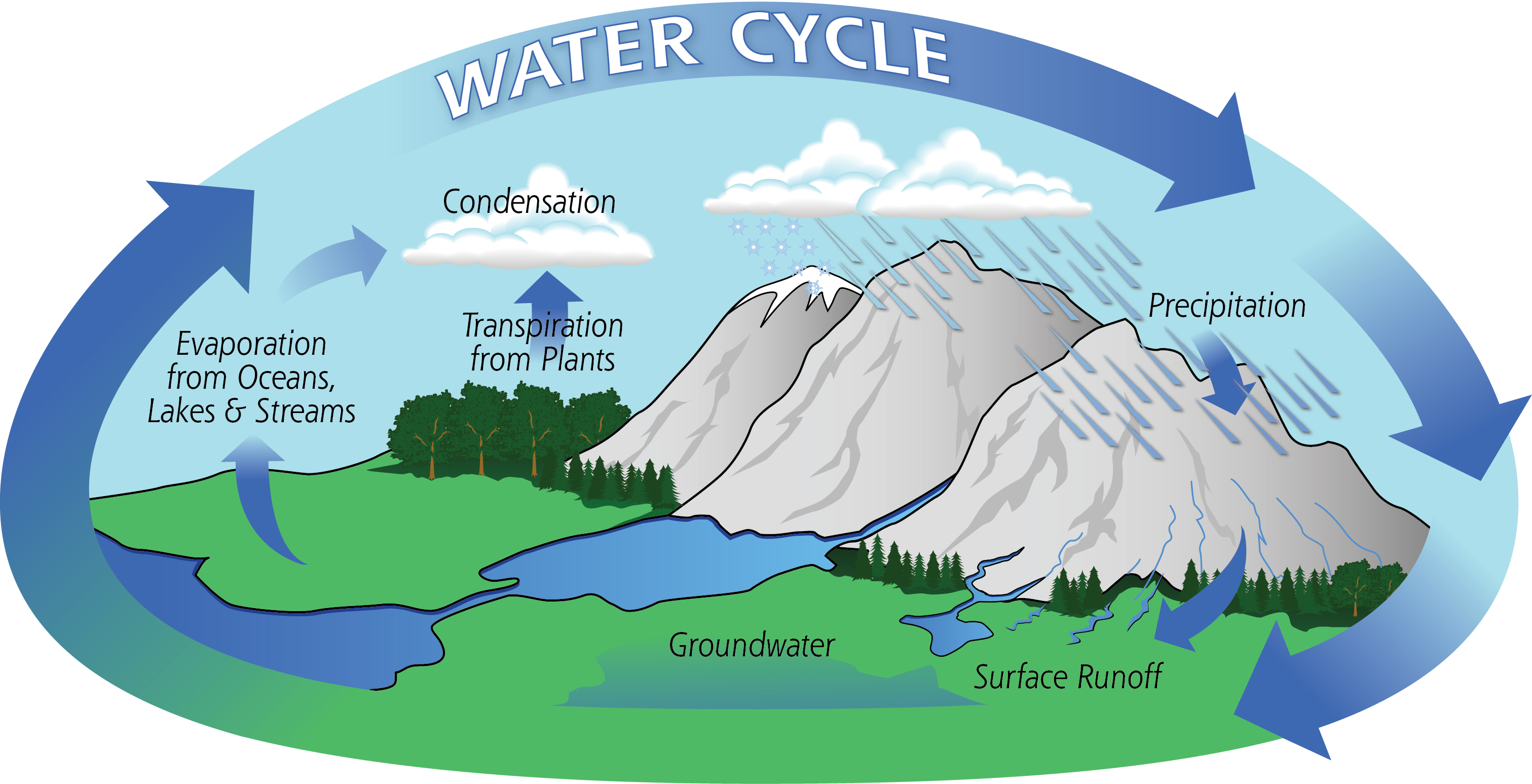
describe the water cycle using a flowchart
i can do..
ALL THINGS THROUGH CHRSIT WHO STRENGTHENS ME!