PSY220 midterm
 Call Kai
 Learn
 Practice Test
 Spaced Repetition
 Match
 Flashcards
 Knowt Play
1/107

There's no tags or description
Looks like no tags are added yet.
Name | Mastery | Learn | Test | Matching | Spaced | Call with Kai | Chat |
|---|
No analytics yet
Send a link to your students to track their progress
108 Terms
What is social psychology?
The study of how our social surroundings and other external factors influence our behaviour, attitudes, and emotions, alongside factors within us.
What questions do social psychologists ask?
Why, how, and when people think, feel, and act as they do. They consider multiple internal and external factors.
What does it mean that we actively construct our reality?
We theorize, predict and generate conclusions all the time
We all seek to make sense of human behaviour
What is around us, constructs us as well
Our surroundings and experiences influence the way we interpret situations and understand ourselves and others.
What is social intuition?
We don’t realize it but our uncouncious mind, our expectations and our beliefs influence our perception.
We engage in
Conscious/deliberate processing
Nonconscious/automatic processing
Conscious/deliberate vs nonconscious/automatic processing?
Conscious/deliberate processing involves intentional thought.
Nonconscious/automatic processing happens without deliberate awareness and can influence our judgments.
How do social influences shape behaviour?
The urge to feel like we belong, feel connected, see, understood and accepted is a basic human need
This need can influences how we feel and behave, even if it goes against our beliefs.
What does the basic need to belong involve?
Wanting connection, acceptance, understanding, and to feel seen by others. This need influences emotions and actions.
Can small or seemingly harmless social factors influence us?
Yes. Even seemingly benign features of a situation can affect what we say, think, and do.
Internal dispositions & external factors interact
Personality, identity, and individual tendencies —→ interact in social situations to influence behaviour.
Context is important
Cognition?
A tendency to enjoy and engage in effortful thinking. People high in this trait are more inclined to think deeply about information.
Cognitive & overthinking people
Humans are biopsychosocial organisms?
We inherit genetic tendencies, but environmental conditions can influence how genes are expressed and how we behave.
Our mind and bodies are connected
Oxytocin increases trust
Self-compassion boosts our immune system
When rejected by others, our BP responds to it
Are social pain and physical pain related?
Eisenberger, Lieberman, and Williams (2003) to show that social rejection and physical pain involve similar brain bases.
How do relationships influence our actions?
Relationships can bring joy, sorrow, pain, and happiness. Our need for connection helps shape social behaviour.
Why is interpreting social psychological data not entirely objective?
Researchers, like everyone else, interpret findings through mental models, expectations, and current states of mind.
Why is social psychology described as an approach to understanding behaviour?
It encourages examining several interacting social, psychological, and biological influences instead of assuming one simple cause.
Internal dispositions vs. external social influences?
Internal dispositions = characteristics within a person, such as personality, identity, and need for cognition.
External influences = features of the social environment, such as other people, social expectations, and situations.
Both interact to shape behaviour.
How does self-compassion illustrate the mind-body connection?
The lecture states that engaging in self-compassion can boost immune function, showing a connection between psychological experience and the body.
What are the major themes in social psychology?
Social Thinking —→ We construct our social reality & our social intuitions are often power
Social Influences —→ Social influences shape behaviour & dispositions shape behaviour
Social relations —→ Social behaviour is also biological behaviour & relating to others is a basic need
They organize observations into theories
We generate hypotheses
Use research methods to test predictions.
We just can’t use variables like Love, Anger, Political perspective and anxiety, etc
A way to assign a definition to how a vague variable is going to be measured or manipulated for a study.
Example: We are interested in studying he role of social media on attraction
Define variables as social media and attraction
What do we mean by attraction? What do we mean by social media?
Correlational vs. experimental research?
Correlational research measures naturally occurring relationships between variables, such as sleep hours and well-being.
For correlation research, you mainly focus on surveys
Survey responses are usually on a 5-point scale\
Results can be distorted by unrepresentative samples, question order, response/social desirability bias, and leading or differently worded questions (e.g., “forbid” vs. “not allow”).
Experimental research manipulates an independent variable, such as sleep hours, and measures its effect on well-being to test causation.
We try to recreate the world so that we can test or measure it

What is a correlation coefficient?
Correlation coefficient = r
The direction and strength of a relationship between two variables.
r ranges from -1 to +1
Positive means variables increase together
Negative means one tends to decrease as the other increases
Near zero means little or no linear relationship.
Correlation alone cannot establish causation.

Positive: more X is associated with more Y.
Negative: more X is associated with less Y.
Zero: no linear association.
The closer |r| is to 1, the stronger the linear relationship.
Independent variable (IV): what the experimenter manipulates
e.g., amount of sleep (2 vs. 4 hours).
Dependent variable (DV): what they measure,
e.g., self-reported well-being or muscle tension.
What are key critical factors to consider when designing an experiment?
Independent variable (ex. sleep)
Dependent variable (ex. Perception of well-being)
Random Assignment
Control group (ex. no manipulation of sleep)
Each participant has an equal chance of entering any experimental condition.
It helps create comparable groups to eliminate the chance that observed effects are due to extraneous differences.
What makes up you?
You:
Who am I? —→ Self-concept
Your sense of self-worth —→ Your self-esteem
How you organize, explain and predict yourself —→ Your self-knowledge
Your social roles / your group identities —→ Your social self
Your understanding of who you are:
Self-schemas, traits, roles, identities, and states of being.
Different parts of the self may become prominent in different situations.
What is the spotlight effect? What example was mentioned?
The tendency to overestimate how much other people notice our appearance or behavior.
The tendency to see ourselves as the center of others perceptions
Lawson (2010) —→ 40% predicted others would remember a prominent sweatshirt logo, but only 10% recalled it.
What is the illusion of transparency?
The tendency to overestimate how clearly others can detect our internal feelings, such as nervousness, even when those feelings are less visible than we assume.
Savitsky & Gilovich (2003) —→ Forty university participants spoke in pairs for 3 minutes and rated nervousness. Speakers rated their own nervousness, 68% were convinced that they appeared more nervous than their partner
Main conclusion: Learning about the illusion of transparency can help people feel and appear more composed during public speaking.
What were the three conditions in the illusion-of-transparency speech experiment?
In Savitsky and Gilovich (2003), 77 students gave 3-minute speeches after 5 minutes of preparation.
Control received no extra instructions
Reassured were told to relax and not worry
Informed learned about the illusion of transparency.
Rated themselves better
What are self-schemas?
Mental models of what we believe ourselves to be, such as “I am compassionate” or “I am a writer.”
They help form self-concept and influence how we interpret and interact with others.
Made up of multiple social identities and traits (Iranian, student, sister)
Both stable and always shifting
How can the self-concept change across situations?
We have multiple social identities, traits, and states that can become more or less salient depending on context.
At a student-fee protest you may think of yourself as a student/activist; at a family gathering as a relative.
What is social comparison? Upward and downward comparisons.
Evaluating ourselves against other people as benchmarks.
Upward comparison compares us with someone doing better;
Downward comparison compares us with someone doing worse.
Comparisons can help or hurt self-evaluation.
Lockwood and Kunda (1997): Social comparison can have positive and negative effect on self:
First and fourth year student reads article about “superstar”
First year —→ Someone they could be
Fourth year —→ Too far out of reach
The effect depends on whether success seems attainable.
DV = Measure of self-evaluation
How can social media influence social comparison?
People often share selective highlights of their lives.
Comparing ourselves to those posts can create the impression that others are happier or more successful.
What would be the effects of limiting social media to 30 min/day?
Individualistic and collectivistic cultures?
Individualistic cultures: emphasize personal goals, attributes, autonomy, and an independent self-concept.
"I am ambitious, independent, and hardworking."
Collectivistic cultures: emphasize relationships, group identity, harmony, interdependent goals, and an interdependent self-concept.
Asia, Africa, Central and South America, Indigenous Communities
"I am a daughter, a member of my community, and someone who supports my family."
Cultural differences can influence ways of thinking and perceiving (cognition):
Nisbett and colleagues:
Japanese and American shown underwater scene and given recall memory test
Japanese: 60% remembered more of the background and relationships among elements
Americans: Remembered focal objects
Remember that individualism and collectivism describe cultural orientations, while independent and interdependent self-concepts describe how people understand themselves.
What is an independent versus interdependent self-construal?
Independent: understanding yourself as autonomous and distinct, defined mainly by personal qualities and goals.
Interdependent: understanding yourself through relationships, group membership, and shared responsibilities.
Describes how people understand themselves
Studies demonstrating cultural differences
US–Taiwan Facebook selfie study:
US students’ selfies were more likely to be close-ups of the person
Taiwanese students’ selfies included more visible background.
The example illustrates cultural variation in how people visually represent the self.
Shows differences in culture
Pen Study:
When choosing among pens:
77% of Americans versus 31% of Asians chose the uncommon colour.
The finding illustrates cultural differences in preference for uniqueness versus conformity.
What is the planning fallacy?
The tendency to underestimate the time needed to complete tasks.
In Buehler and colleagues’ study, honours students underestimated thesis completion time by about 3 weeks even using their best guesses.
Your reduce planning fallacy by:
Break a project into smaller steps and estimate the time needed for each, rather than guessing only the total time.
What is affective forecasting + Impact bias?
Predicting how we will feel in the future.
People struggle to predict the intensity and duration of their future emotions
"How happy will I feel if I get accepted into medical school?"
We tend to show an impact bias
Overestimate the long-lasting emotional impact of a future event
We always desire to feel goof about ourselves.
Global self-esteem: is overall self-worth
Domain-specific self-esteem is how you value yourself in a particular area.
Domain-specific self-esteem better predicts performance in that area.
Example: confidence in math can predict math performance better than overall self-worth.
We emphasize desirable traits when speaking with peers
though this can make us less liked (Canevello & Crocker, 2011) —→ narcissist
After rejection, we may seek approval from others.
Example: talking up your achievements to impress new friends.
Low self-esteem in youth is associated with later depression, anxiety, and loneliness.
It can function like a schema, shaping memory and perceptions:
someone may recall a partner’s worst actions and doubt their love (Murray et al., 2002).
High SE: Blame others or circumstances when fail
Focus and savor good moments + resilient
Can be obnoxious, entitled or interrupt
The pursuit of high SE can be problematic despite it being linked to high well-being
Low SE: Blame themselves and give up
What is self-efficacy?
Self-efficacy is belief in your competence to perform a task, rather than your overall worth.
It predicts persistence, lower anxiety, and academic success
a review of 241 studies linked performance self-efficacy strongly with GPA.
Example: believing you can solve a difficult problem.
Self-efficacy increases self confidence
Feedback that builds self-efficacy:
encourages persistence and accomplishment, which increases confidence.
Feedback on your self-efficacy is more impactful than feedback on your self-esteem
Example: “You tried really hard!” focuses on effort and action rather than “You’re really smart!” which focuses on a trait.
Self-compassion = treating yourself kindly during difficulty without needing to feel above average.
It involves LESS self-evaluation and self-enhancement than self-esteem
Example: responding to a poor grade with kindness and a plan.
Self-esteem = needing to be special and above average
Self compassion leads to:
Stress regulation: directly supporting stronger performance outcomes
Positive academic variables: enhances learning motivation, resilience and engagement
Acts as a buffer: reduces damaging effects of failure, perfectionism and academic pressure
Stronger mental health: lower anxiety and burnout creating psychological safety
A tendency to protect self-image by crediting success to our abilities and blaming failure on external circumstances.
Example: “I got an A because I’m skilled,” but “I failed because the professor wrote a bad test.”
Can impact relationships:
It can contribute to relationship and workplace dissatisfaction.
People may blame ex-partners for breakups or believe they do more housework than their spouse.
We also tend to deny having the bias ourselves.
Self-serving bias vs high self-esteem
The main difference is that high self-esteem = how positively you view yourself
Self-serving bias = how you explain events to protect that positive view of yourself.
What is unrealistic optimism?
Believing you are more likely than others to experience good outcomes and less likely to experience bad ones.
Examples: expecting greater success or lower heart-attack risk; during COVID, assuming others were more likely to spread the virus than oneself.
BUT optimism has its benefits:
Optimism associated with longer lifespan, greater happiness, and less depression.
The problem is unrealistic estimates of personal risk, not optimism in general.
Overestimating how much other people share our beliefs, preferences, or feelings.
Examples: assuming most people agree with your political views or that someone shares your romantic interest.
Might occur due to:
Information-processing or memory errors
Can also be motivated —→ Protecting a positive self-image and confirming our existing self-concept can give us a sense of stability.
Presenting a desired image of ourselves to other and to ourselves
They may be conscious or automatic.
Example: emphasizing professionalism during a job interview.
Creating obstacles that provide an excuse for poor performance, protecting self-image.
Examples: partying before an interview or procrastinating on an assignment.
It can be highly self-protective BUT very damaging long-term (low GPA)
What distinguishes System 1 from System 2 thinking?
System 1 = fast, automatic, and unconscious
Makes us realize we know more than we know
Priming: Our perceptions are influenced by factor we are not conscious of
See Soap or Soup depending on priming
Priming one word or thought influences subsequent thoughts and actions
Subliminal priming:
Subliminal priming involves exposure without conscious awareness (not reading a list)
After reading a sexually explicit passage —→ Catholic women shown a subliminal frowning Pope rated their self-esteem lower than comparison conditions.
System 2 = requires attention and deliberate thought.
Example: instantly recognizing a familiar face versus carefully solving a hard problem.
What is embodied cognition?
Bodily states and sensations influence judgments.
Sitting in a wobbly chair led people to rate relationships as less stable (Kille et al., 2013)
Feeling hopeless made a room seem darker (Dong et al., 2015).
What is intuition?
Intuition is rapid judgment without deliberate reasoning.
Expertise can improve it: master chess players recognize patterns and choose moves at a glance.
However, intuitive judgments can still be wrong.
What is overconfidence? What is overconfidence vs self-esteem?
Overconfidence is being more certain than correct.
In a COVID forecasting example, 18 experts expressed 80% certainty; only 3 estimates were close. Average predicted cases were 20,000 versus 122,653 actual.
High self-esteem: You believe you're intelligent and capable. Even if you perform poorly, you still value yourself.
Overconfidence: You barely study because you're convinced you already know everything, but your actual knowledge is much lower than you think.
What is the Dunning–Kruger?
Kruger and Dunning (1999) found that students with the lowest scores on humor, grammar, and logic were especially likely to overestimate their abilities.
Overestimation is more likely on easy than complex tasks.

Self-serving bias vs overconfidence vs high self esteem
High self-esteem: "I feel good about myself."
Overconfidence: "I think I'm better at this than I actually am."
Self-serving bias: "I succeeded because of me, but I failed because of something else."
Ask yourself what the person is doing.
Feeling positively about themselves? High self-esteem
Explaining success or failure in a biased way? Self-serving bias
Overestimating how good or accurate they are? Overconfidence
What is confirmation bias?
Preferring information that supports existing beliefs and avoiding challenges.
Examples: reading articles that agree with your views, avoiding opposing political opinions, and selecting news aligned with your beliefs.
Why do we do this? —→ It can protect self-image and is highly adaptive
What are heuristics? What are the two types?
Heuristics are mental shortcuts that allow quick judgments without evaluating every detail.
They help us navigate complex social information, but can produce errors.
Representativeness heuristic:
Judging whether someone or something belongs to a category by how closely it matches a typical example.
Example: assuming someone is a librarian because they are quiet and love books.
Availability heuristic:
Judging how likely something is based on how easily examples come to mind.
Vivid or memorable events feel more common.
Example: after hearing about a plane crash, overestimating how likely flying is to be dangerous.
Imagining alternative outcomes that could have happened but did not, often after near misses.
Often happens when we just barely escaped something bad
Example: “If I had left five minutes earlier, I would have caught my flight,” or regretting a changed exam answer.
Illusory correlation: perceiving a relationship where none exists or exaggerating it
e.g. treating coincidences as a pattern, lucky shirt
Illusion of control: believing you can influence chance events
e.g. thinking a lucky ritual controls gambling outcomes.
Our initial beliefs can be strong and we hold onto it tight
Continuing to hold an initial belief even after contradictory evidence appears.
Once a belief forms, a solid contradicting element cant alter it
Example: believing a classmate is dishonest even after learning the original accusation was false.
What is the misinformation effect?
When your memory of an event changes due to misleading information you encounter afterwards.
Later misleading information alters how people reconstruct a memory.
Asking how fast cars “smashed” rather than “hit” each other can change recall.
A question about ice on a cold night can also suggest a detail that was absent.
We reconstruct past feelings to match our current views.
In a study of 373 newlyweds, those who separated two years later denied having reported such happiness early in marriage.
Current feelings shaped recall.
What is attribution theory?
Attribution theory is the study of how we explain peoples behavior and if it comes from internal factor like their personality or traits; or external factors like the situation they are in
Whole and neutral idea for explaining behavior
FAE is overestimating others’ dispositions (internal traits) and underestimating situational causes of their behavior.
Example: calling a late student lazy without considering a delayed train.
Cutting someone off in traffic but the person is late
Ex. Pro/anti-Castro speech study:
Participants inferred that speakers believed their pro- or anti-Castro speeches, even when speakers had been assigned a position rather than choosing it.
They underweighted the situational constraint.
Why does the FAE happen?
When observing someone, the person stands out while the situation fades into the background
When we are in the scenario, we notice our surroundings.
Culture shapes what we notice and value, in collectivist culture they emphasize context and roles —→ FAE is less common in collectivist cultures
Girl not talking in class —→ collectivist culture will say the girl is to shy to speak in front of the teacher specifically
What is a self-fulfilling prophecy?
When a belief about someone changes your behavior in ways that makes that belief come true.
Teachers expecting high achievement from a particular student may smile, call on students more, give harder work and allow more response time, helping produce better performance (Cooper, 1983).
Behavioral confirmation is a type of self-fulfilling prophecy in which expectations change how you treat others, prompting them to confirm the expectation.
Example: assuming someone dislikes you, acting coldly, and receiving a cold response.
Self-fulfilling prophecy: The general term, the whole sequence from belief to outcome
Behavioral conformation: specific interactions which drive the self-fulfilling prophecy
What is an attitude? What are three components of attitude?
Attitude is our evaluation of something and influences our behaviour:
Described by:
Valence = whether the evaluation is positive or negative
Strength = how firmly it is held.
Example: strongly loving Instagram vs mildly disliking it.
Three components of attitude:
Cognitive = what you think or believe about it
“Instagram helps me stay informed”
Affective = emotional response and how you feel about it
“I enjoy it”
Behavioral = what you tend or plan to do
“I open it daily”
No. Wicker (1969) found weak attitude–behaviour links across many variables.
People may report against to racial slurs but respond indifferently when one occurs (Kawakami et al., 2009).
What is moral hypocrisy?
Moral hypocrisy is wanting to appear moral while behaving selfishly.
Ex. only 1 in 20 thought assigning themselves a rewarding task was moral, yet 80% gave themselves that task instead of the dull one.
What three conditions make our attitudes predict our behaviour?
Attitudes predict behaviour better:
When competing social/situational influences are minimal
Its tough to get at peoples true attitude
When our attitude is specific to the behavior
When the attitude is strong.
Example: a strong attitude about morning jogging predicts tomorrow’s run.
What are the different attitude measures?
Explicit measures: directly ask for conscious evaluations
e.g. a survey about liking Instagram.
Use likert scales —→ a set of belief statements and you indicate your degree of agreement or disagreement with a set of statements
Implicit measures: infer automatic associations indirectly, often from response speed to stimuli.
Our attitudes vary in strength
Strength is measured by how fast or accessible an attitude is
Speed = strength of association and determines the strength of their attitude towards something
Fazio et al. (1995) face priming study: Participants classified positive or negative adjectives after seeing faces. White participants responded faster to negative adjectives after Black-face primes, illustrating automatic evaluative associations measured by reaction time.
The IAT (Greenwald et al., 1998) measures relative automatic associations by timing how quickly people sort categories and positive/negative words.
Example: faster sorting when one social category shares a key with positive words.
Both can predict behaviour, and using both may improve prediction.
Concerns about IAT reliability compared with other implicit measures.
Many temporary factors influence any one act.
A general attitude toward religion may not predict attendance at worship this week, but may predict overall religious behaviour across many occasions.
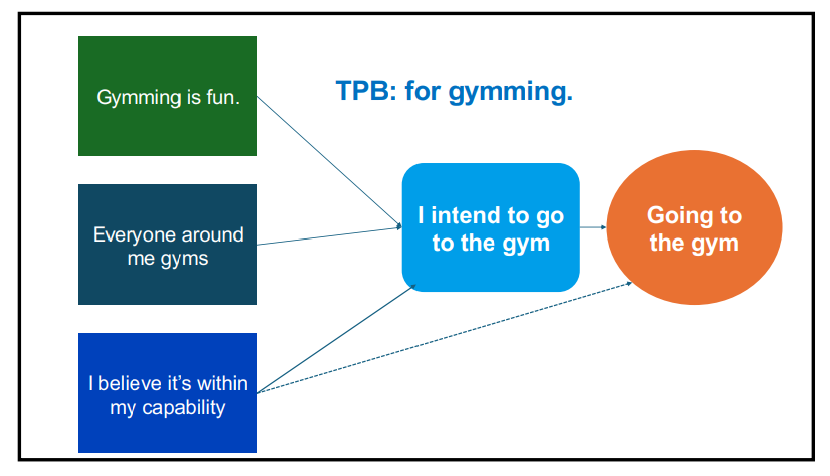
TPB (Ajzen, 1proposes that attitude toward the behaviour, subjective norms and perceived behavioural control shape intention, which predicts behaviour. Example: enjoying the gym + friends going + feeling capable → intending to go → going.
What are subjective norms and perceived behavioural control in TPB?
Subjective norms are perceived social expectations (“Everyone around me goes to the gym”). Perceived behavioural control is believing you can perform the action (“I can fit gym sessions into my schedule”). Both influence intention.