Immunoprophylaxis, Infection, Immunity and Protection

0.0(0)
Studied by 0 people
call kaiCall Kai
learnLearn
examPractice Test
spaced repetitionSpaced Repetition
heart puzzleMatch
flashcardsFlashcards
GameKnowt Play
Card Sorting

1/30

encourage image

There's no tags or description

Looks like no tags are added yet.

31 Terms

1
New cards
What is the main goal of vaccination?
To generate and maintain sufficient numbers of antigen-specific B and T cells against a particular pathogen or antigen to provide protection.
2
New cards
Why is understanding the immune mechanisms of vaccines important?
It helps explain how vaccines produce protection and guides the design of more effective vaccines.
3
New cards
Which microorganisms are most successful vaccines directed against?
Small organisms, particularly viruses and bacteria.
4
New cards
What mechanisms do microorganisms use to interfere with immune responses?

- Molecular mimicry: resembling host molecules to avoid immune recognition

.

-- Interference with antigen processing: disrupting the presentation of antigens to immune cells

.


- Prevention of apoptosis: keeping infected cells alive to support pathogen survival

5
New cards

What happens during the primary immune response following vaccination?

The vaccine antigen activates a specific B lymphocyte, which multiplies into identical clones. These differentiate into plasma cells that produce antibodies and memory B cells that provide future protection

<p>The vaccine antigen activates a specific B lymphocyte, which multiplies into identical clones. These differentiate into plasma cells that produce antibodies and memory B cells that provide future protection</p>
6
New cards

How does the secondary immune response protect someone previously vaccinated?

Memory B cells recognise the pathogen rapidly, multiply and differentiate into plasma cells, producing large amounts of antibodies to quickly control the infection

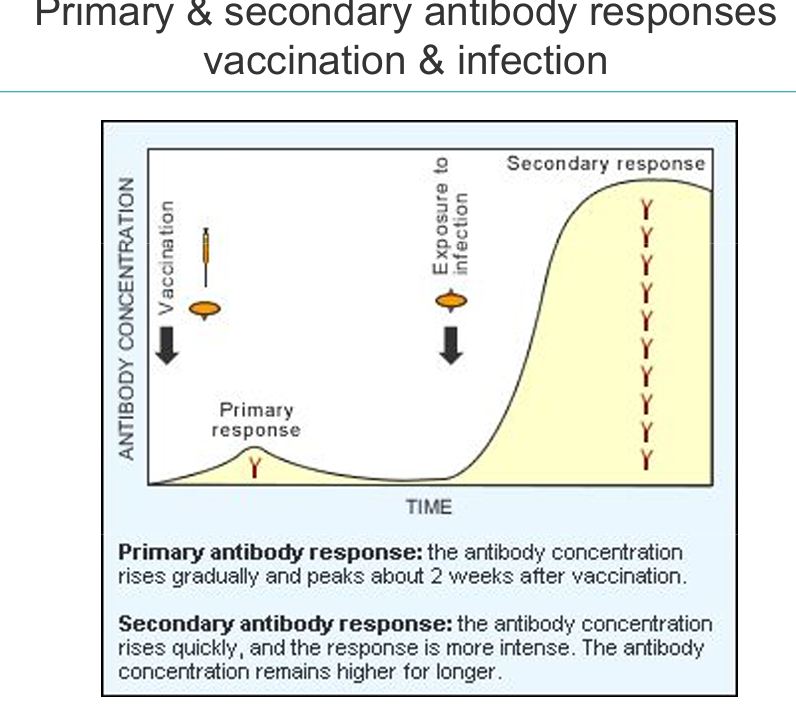
<p>Memory B cells recognise the pathogen rapidly, multiply and differentiate into plasma cells, producing large amounts of antibodies to quickly control the infection</p>
7
New cards
What is the difference between the primary and secondary antibody responses?
The primary response occurs after the first exposure and is generally slower; the secondary response occurs after re-exposure and is faster and stronger because memory cells have already been formed.
8
New cards

What are the properties of an ideal vaccine?

- Provides lifelong immunity

.

-- Protects against all variants of the organism.

.

-- Prevents disease transmission.

-- Rapidly induces immunity

.

-- Effective in all age groups, including the very young and elderly

.

-- Transmits maternal protection to the foetus

.

-- Requires few immunizations

.

-- Allows non-injection administration

.

- Stable, inexpensive and safe

9
New cards
What should be considered when designing a vaccine against an intracellular pathogen?
The vaccine should induce immune effector mechanisms that destroy the intracellular pathogen without activating responses that favour its survival.
10
New cards

4 types of vaccination

-Toxoids

.

-subunits

.

-live attenuated micro-organisms

.

-killed microorganisms

11
New cards
What are killed microorganism vaccines?
They contain previously virulent microorganisms that have been killed using chemicals or heat; because the organisms are no longer alive, they cannot replicate.
12
New cards
What are live attenuated vaccines?
They contain live microorganisms whose virulence has been reduced by cultivation under specific conditions; they typically produce more durable immune responses and are preferred for healthy adults.
13
New cards
What are toxoid vaccines and when are they used?
They contain inactivated toxins produced by microorganisms; they are used when the toxin, rather than the microorganism itself, causes the disease.
14
New cards
What are subunit vaccines?

They contain selected fragments of a microorganism that stimulate an immune response rather than the entire organism

.

ie:It contains hepatitis B surface proteins produced in yeast; these proteins act as antigens and stimulate an adaptive immune response.

15
New cards
knowt flashcard image
16
New cards
What is an mRNA vaccine?

A vaccine that delivers molecules of antigen encoding messenger RNA into cells, providing instructions for the cells to produce a foreign protein that stimulates an adaptive immune response.

<p>A vaccine that delivers molecules of antigen encoding messenger RNA into cells, providing instructions for the cells to produce a foreign protein that stimulates an adaptive immune response.</p>
17
New cards
How do mRNA vaccines stimulate adaptive immunity?
Cells use the delivered mRNA as a blueprint to produce antigen proteins, which stimulate the immune system to recognize and respond to the corresponding pathogen or cancer cells.
18
New cards
What are the three stages of the immune response considered when designing vaccines?

-Initiation of the immune response

.

-development of immunological memory

.

-selection of an appropriate immune response for protection.

19
New cards
What is the main challenge in developing future vaccines?
Achieving strong immunogenicity, meaning a strong immune response, without increasing the incidence of adverse events.
20
New cards
What factors can limit the duration of immunological memory?

T lymphocyte clones have a limited number of cell divisions before becoming senescent,

.

lack of antigen re-exposure may reduce memory duration

.

limited space in the memory pool requires some cells to die as new cells expand.

21
New cards
How do the initial strength of antigen stimulation and antigen persistence affect immunological memory?
Large initial stimulation can make memory persist longer, while continued antigen persistence can also help memory cells remain present.
22
New cards
What is the difference between the Th2 and Th1 responses in vaccine protection?
Many current vaccines mainly generate high antibody titres through a Th2 bias, whereas natural protection against many organisms, especially intracellular parasites, depends on Th1 cell-mediated immunity.
23
New cards
How can vaccines be designed to produce a Th1 and cytotoxic response?
Cellular vaccines can stimulate MHC class I presentation of intracellular antigens, activating cell-mediated immunity and cytotoxic T lymphocytes.
24
New cards
How do DNA vaccines generate a cell-mediated immune response?
DNA plasmids carry antigen-encoding genetic information into cells; the resulting proteins are degraded by proteasomes into peptides, which bind MHC class I and are presented to cytotoxic CD8+ lymphocytes.
25
New cards
How do mRNA vaccines generate antigens inside cells?
Dendritic cells take up synthetic mRNA fragments through phagocytosis, read the mRNA and produce the encoded viral antigens; the mRNA fragments are degraded within a few days.
26
New cards
How do mRNA vaccine-derived peptides stimulate both cellular and humoral immunity?
The peptides bind MHC class I and class II molecules; MHC I complexes are presented to CD8+ cytotoxic T lymphocytes to stimulate cell-mediated immunity, while MHC II complexes are presented to CD4+ helper T lymphocytes to stimulate humoral immunity.
27
New cards
What lymphocyte processes are necessary for successful immunization and vaccine efficacy?
T and B lymphocytes must undergo activation, replication and differentiation, leading to the formation of memory cells that support future protection.
28
New cards
Why do many vaccines require multiple immunizations?
Repeated doses help maintain effective immunity by reinforcing the immune response and sustaining protective levels of antigen-specific cells and antibodies.
29
New cards
How does live infection compare with immunization using attenuated or subunit vaccines in producing antigen-specific cells?
Live infection induces a greater frequency of antigen-specific cells than immunization with attenuated or subunit vaccines.
30
New cards

What principle guides vaccination strategies, and what are the routes of vaccine administration?

Vaccination aims to mimic a pathogen without causing disease or to devise formulations which mimic its characteristics

31
New cards
term image
knowt flashcard image



