inslun n shit
 Call Kai
 Learn
 Practice Test
 Spaced Repetition
 Match
 Flashcards
 Knowt Play
1/61

There's no tags or description
Looks like no tags are added yet.
62 Terms
What are insulin and glucagon?
Protein hormones synthesized, stored, and released by the pancreas that regulate blood glucose concentrations.
which pancreatic cells produce insulin
β (beta) cells
which pancreatic cells produce glucagon
α (alpha) cells
What stimulates the release of glucagon?
Low blood glucose (hypoglycemia).
Typically occurs during fasting.
Promotes glucose production and energy mobilization.
What stimulates the release of insulin?
High blood glucose (hyperglycemia).
Typically occurs after eating.
Promotes glucose uptake and energy storage.
How do insulin and glucagon maintain blood glucose homeostasis?
Insulin decreases blood glucose,
glucagon increases blood glucose.
Insulin = IN: Bring glucose into cells.
Glucagon = Glucose gone: Make or release more glucose.
What metabolic pathways are stimulated by insulin and glucagon?
Pathway | Insulin | Glucagon |
|---|---|---|
Fatty acid synthesis | ↑ | ↓ |
Fatty acid oxidation | ↓ | ↑ |
Ketogenesis | ↓ | ↑ |
Glycogen synthase
Creates α(1→4) bonds
Glycogen synthase does NOT create α(1→6) bonds. That is the branching enzyme's job.
Branching enzyme
Creates α(1→6) bonds
Glycogen phosphorylase
Cleaves α(1→4) bonds
Debranching enzyme
Removes branches
What is the difference between reducing and nonreducing ends?
Feature | Reducing end | Nonreducing end |
|---|---|---|
Anomeric carbon | Free in an unattached carbohydrate | Locked in a glycosidic bond |
Number in a branched polymer | One reducing-end position | Multiple |
Glycogen elongation | No | Yes |
Glycogen breakdown by phosphorylase | No | Yes |
In cellular glycogen, the reducing-end position is normally attached to glycogenin.
How to identify them: Look for the anomeric carbon (C1), rather than assuming the left side is always nonreducing.
Why is UDP-glucose required for glycogen synthesis?
UDP-glucose is an activated form of glucose that allows glucose to be transferred onto an existing glycogen chain.
What is the role of UTP in glycogen synthesis?
UTP reacts with G1P to produce UDP-glucose and pyrophosphate (PPi).
Glucose-1-P + UTP → UDP-glucose + PPi
Why is pyrophosphate hydrolyzed?
PPi + H20 → 2Pi
Hydrolysis releases free energy and helps drive UDP-glucose formation forward.
Regulation of glycogen metabolism
When is glycogen phosphorylase active?
When phosphorylated.
It promotes glycogenolysis, releasing G1P from glycogen.
Regulation of glycogen metabolism
How do insulin and glucagon affect phosphorylation?
Hormone | Effect on glycogen-regulating enzymes |
|---|---|
Insulin | Promotes dephosphorylation |
Glucagon | Promotes phosphorylation |
Regulation of glycogen metabolism
What happens to glycogen metabolism when glucagon increases?
Glycogen phosphorylase is activated, and glycogen synthase is inhibited.
Consequently:
Glycogen breakdown increases.
Glycogen synthesis decreases.
Glucose release from the liver increases.
Regulation of glycogen metabolism
Does phosphorylation always activate enzymes?
Enzyme | Phosphorylated | Dephosphorylated |
|---|---|---|
Glycogen phosphorylase | ON | Less active |
Glycogen synthase | OFF | ON |
ACC | OFF | ON |
PDH (previous lecture) | OFF | ON |
Glucose transporters (GLUT)
What are GLUT proteins?
Glucose transporters.
Located in cell membranes.
Transport glucose across membranes.
Use facilitated diffusion.

Glucose transporters (GLUT)
What type of transport does GLUT perform?
Characteristic | GLUT |
|---|---|
Transport type | Facilitated diffusion |
Requires ATP directly? | No |
Requires membrane protein? | Yes |
Direction | High → Low concentration |
Active or passive? | Passive |
Glucose transporters (GLUT)
How does insulin increase glucose uptake?
Insulin promotes the movement of GLUT4 transporters to the cell membrane in skeletal muscle and adipose tissue, increasing glucose uptake.
Glucose transporters (GLUT)
What happens to GLUT-mediated glucose uptake during insulin resistance?
Cells respond poorly to insulin.
Insulin-stimulated glucose uptake decreases.
More glucose remains in the blood.
Contributes to hyperglycemia.
Exam trap: GLUT is a glucose transporter, not an insulin receptor.
Fatty acid synthesis and regulation
What is acetyl-CoA carboxylase (ACC)?
Rate-limiting enzyme in fatty acid synthesis.
Converts acetyl-CoA into malonyl-CoA.
Activated by insulin.
Inhibited by fasting-associated phosphorylation.

Fatty acid synthesis and regulation
What are the two functions of malonyl-CoA?
Building material for fatty acid synthesis.
Inhibits CPT1.
Therefore decreases fatty acid oxidation.

Fatty acid synthesis and regulation
What is CPT1?
Carnitine palmitoyltransferase 1.
Involved in transporting long-chain fatty acyl groups into mitochondria.
Allows fatty acids to undergo β-oxidation.
Inhibited by malonyl-CoA.
Fatty acid synthesis and regulation
What happens when CPT1 is inhibited?
Fatty acid transport into mitochondria ↓
β-oxidation ↓
Fatty acid-derived acetyl-CoA production ↓
Ketogenesis ↓
Fatty acid synthesis and regulation
When is ACC active or inactive?
Phosphorylated → inactive.
Dephosphorylated → active.
ACC builds fat. During fasting, turn ACC OFF to burn fat instead.
Fatty acid synthesis and regulation
How does insulin regulate fatty acid metabolism?

Fatty acid synthesis and regulation
How does glucagon regulate fatty acid metabolism?

Fatty acid synthesis and regulation
Why does increased fatty acid synthesis inhibit fatty acid breakdown?
Prevents unnecessary energy expenditure.
Prevents opposing pathways from operating at high rates simultaneously.
Coordinates energy storage versus energy utilization.
Malonyl-CoA = building fat, so stop burning fat.
Type I and Type II diabetes
Normal range (lecture)
70–105 mg/dL
For clinical reference, normal fasting glucose is generally below 100 mg/dL
Type I and Type II diabetes
Diabetes threshold (fasting)
126 mg/dL or above
Type I and Type II diabetes
What are the symptoms of hypoglycemia?
Weakness.
Sweating.
Rapid heartbeat.
Mental confusion.
Convulsions or coma in severe cases.
Type I and Type II diabetes
What are the long-term effects of uncontrolled hyperglycemia?
Cardiovascular disease.
Kidney disease.
Blindness.
Difficulty with wound healing
Type I and Type II diabetes
What is diabetes mellitus?
Chronic metabolic condition.
Insufficient insulin production and/or ineffective insulin action.
Results in elevated blood glucose (hyperglycemia).
Type I and Type II diabetes
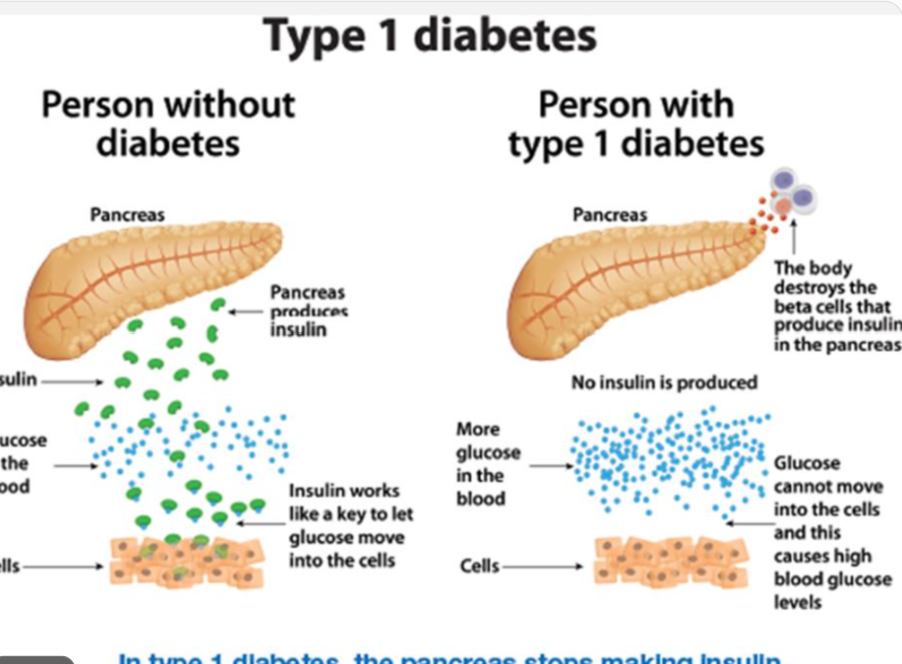
What is Type I diabetes?
Autoimmune disease.
Immune system destroys pancreatic β cells.
Little or no insulin production.
Approximately 5–10% of diagnosed diabetes cases.
Treated with insulin injections or pumps.
Type I and Type II diabetes
What is Type Il diabetes?
Begins with insulin resistance.
Cells respond poorly to insulin.
Pancreas may gradually lose insulin-producing ability.
Approximately 90% of diabetes cases.
Managed with lifestyle changes, medications and/or insulin.

Type I and Type II diabetes
What is the difference between Type I and Type II diabetes?
Feature | Type I | Type II |
|---|---|---|
Cause | Autoimmune destruction | Insulin resistance |
Insulin production | Little or none | Often present initially |
Main problem | Insulin deficiency | Reduced insulin response |
Blood glucose | High | High |
Type I = Insulin missing.
Type II = Insulin ignored.
Type I and Type II diabetes
Why is blood glucose elevated in uncontrolled diabetes?
Insufficient or ineffective insulin.
Insulin-stimulated glucose uptake ↓
Glycogen synthesis ↓
Liver glucose production may remain elevated.
Glucose accumulates in the blood.
Type I and Type II diabetes
Why can fat breakdown increase despite high blood glucose in uncontrolled diabetes?
insufficient insulin signaling.
Reduced insulin-stimulated glucose uptake.
Reduced suppression of fat breakdown.
Increased reliance on fatty acids for energy.
Increased risk of excessive ketone body production.
Ketone bodies
What are ketone bodies?
Alternative energy sources.
Produced primarily by the liver.
Derived from acetyl-CoA.
Increase during prolonged fasting or insulin deficiency.
Ketone bodies
acetoacetate
Ketone + carboxylate
Ketone bodies
β-hydroxybutyrate
Hydroxyl + carboxylate
Ketone bodies
acetone
Ketone between two methyl groups
Ketone bodies
Where are ketone bodies produced?
Liver.
Primarily in mitochondria.
Ketone bodies
Under what conditions does ketogenesis increase?
Prolonged fasting.
Starvation.
Uncontrolled diabetes.
Low insulin availability.
Increased fatty acid oxidation.
Ketone bodies
Why are ketone bodies important?
Provide an alternative energy source.
Reduce reliance on glucose.
Can supply energy to the brain during prolonged fasting.
Ketone bodies
Why does gluconeogenesis increase ketone body formation?
Gluconeogenesis diverts oxaloacetate.
Less oxaloacetate is available for the citric acid cycle.
Fatty acid oxidation produces excess acetyl-CoA.
Excess acetyl-CoA is diverted toward ketogenesis.

Ketone bodies
Why does decreased oxaloacetate slow the citric acid cycle?
Oxaloacetate is required for the first step of the TCA.
Combines with acetyl-CoA to form citrate.
Decreased availability limits acetyl-CoA utilization. Memory trick: Oxaloacetate is acetyl-CoA's entry ticket into the citric acid cycle.

Ketone bodies
Why does ketogenesis allow β-oxidation to continue?
Converts excess acetyl-CoA into ketone bodies.
Releases free coenzyme A (CoA).
CoA becomes available for continued β-oxidation.
Diabetic ketoacidosis (DKA)
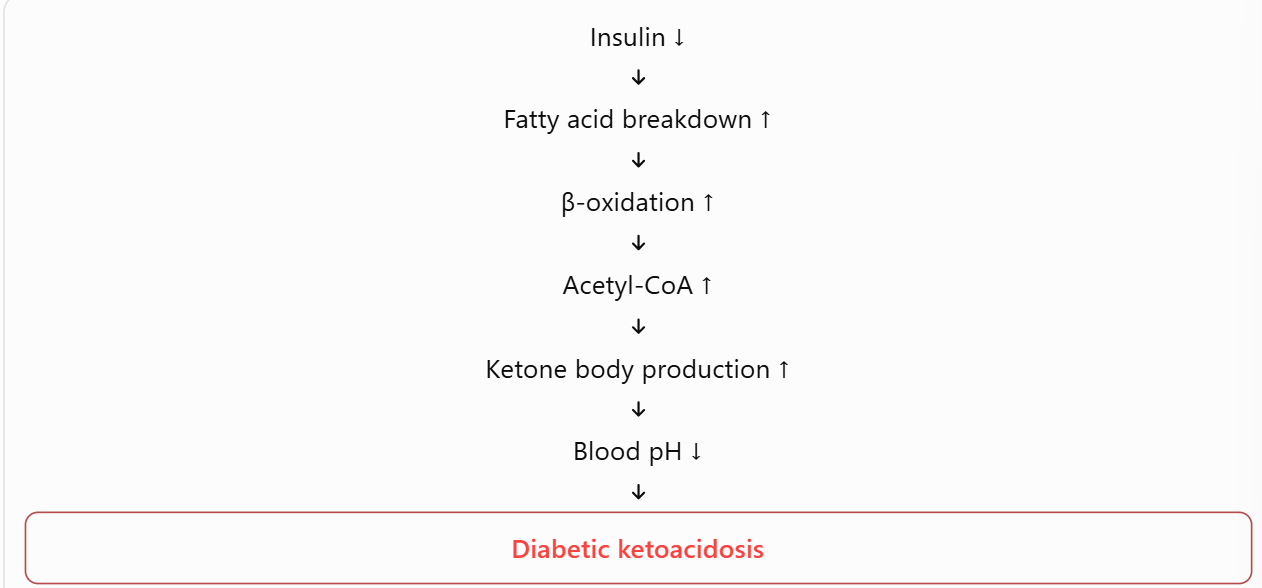
What is diabetic ketoacidosis?
Life-threatening metabolic condition.
Excessive production of acidic ketone bodies.
Ketones accumulate in the blood.
Blood pH decreases.
Associated with severe insulin deficiency.
Diabetic ketoacidosis (DKA)
What is the sequence of events leading to DKA?
Diabetic ketoacidosis (DKA)
What is the difference between ketosis and ketoacidosis?
Ketosis | Ketoacidosis |
|---|---|
Increased ketone production | Excessive acidic ketone accumulation |
Can occur during normal fasting | Dangerous metabolic condition |
Blood pH generally maintained | Blood pH decreases |
Application flashcards
if insulin increases, what happens to glycogen synthase?
Dephosphorylation ↑
Glycogen synthase activity ↑
Glycogenesis ↑
Application flashcards
If glucagon increases, what happens to ACC?
ACC phosphorylation ↑
ACC activity ↓
Malonyl-CoA ↓
Fatty acid synthesis ↓
Application flashcards
If malonyl-CoA increases, what happens to CPT1?
CPT1 inhibition ↑
Fatty acid transport into mitochondria ↓
Application flashcards
If malonyl-CoA decreases, what happens to β-oxidation?
CPT1 inhibition ↓
CPT1 activity ↑
Mitochondrial fatty acid transport ↑
β-oxidation ↑
Application flashcards
If glycogen phosphorylase becomes dephosphorylated, what happens?
Glycogen phosphorylase activity ↓
Glycogenolysis ↓
Glycogen storage favored.
Application flashcards
If oxaloacetate is diverted toward gluconeogenesis, what happens to ketogenesis during fasting?
Oxaloacetate availability ↓
Citric acid cycle activity limited.
Excess acetyl-CoA diverted.
Ketogenesis ↑
Application flashcards
If a drug inhibits ACC, what happens to fatty acid metabolism?
ACC activity ↓
Malonyl-CoA ↓
Fatty acid synthesis ↓
CPT1 activity ↑
Fatty acid oxidation ↑
Application flashcards
If a molecule inhibits CPT1, what happens to ketone body production from fatty acids?
Fatty acid transport into mitochondria ↓
β-oxidation ↓
Fatty acid-derived acetyl-CoA ↓
Ketogenesis ↓