Personality Psychology
 Call Kai
 Learn
 Practice Test
 Spaced Repetition
 Match
 Flashcards
 Knowt Play
1/96

There's no tags or description
Looks like no tags are added yet.
97 Terms
What is personality?
Personality as what is ‘beneath the mask’
•Personality as the true self, separate from social roles
•Linked to rise of Western individualism
•Personality as ‘psychological individuality’
Not physical attributes (tall)
Not intellect-related attributes (eg. smart, dumb)
Not transient attributes (eg. not sad, worried)
And not context-specific attributes (eg. not Greens voter, anti-vaxxer)

Individual differences
Personality refers to enduring, relatively broad psychological differences between people, excluding cognitive abilities
These ‘dispositions’ are fundamentally important
• Personal identity & self-concept
• Social communication & gossip
• Person perception
• Stereotypes
Personality & self-concept

Personality & social communication

Person perception

Personality psychology’s place in the field
Aims to understand the ‘whole person’
Focuses on differences between people, not shared mechanisms and processes
Related to clinical psychology
Places emphasis on factors intrinsic to the person
Contrast with social psychology
The person versus the situation
Stereotypes
Stereotypes are largely made up of personality traits believed (rightly or wrongly) to be associated with social groups

Personality psychology’s place in the field
Aims to understand the 'whole person'
Focuses on differences between people, not shared mechanisms and processes
Related to clinical psychology
Places emphasis on factors intrinsic to the person
Contrast with social psychology
The person versus the situation
Describing personality

Example of the hierarchy of traits

Structure of personality traits
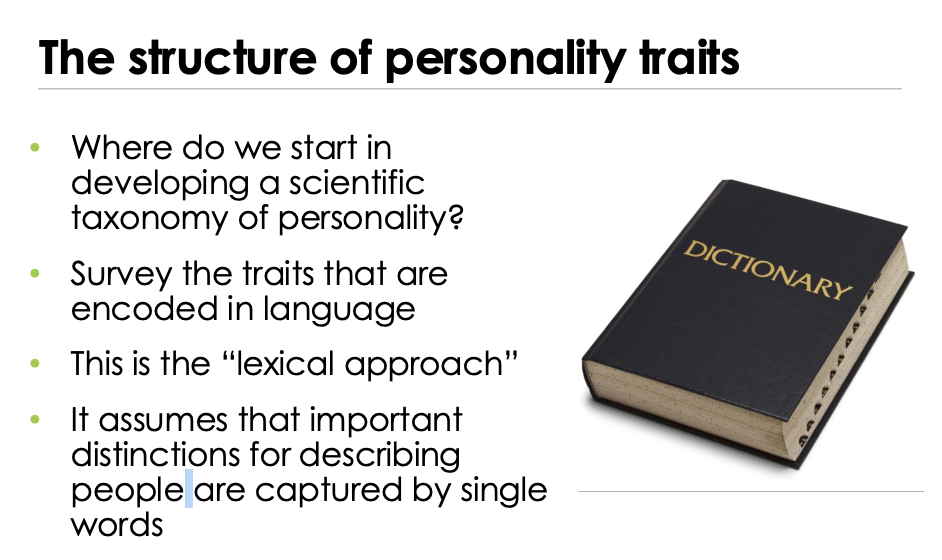
Allport & Odbert (1936)
Searched a dictionary for words to describe how people differ
18,000 out of 550,000
These were filtered to remove
physical attributes (e.g., "tall")
cognitive abilities (e.g., "smart")
transient states (e.g., "sad")
evaluative terms (e.g., "moron")
4,504 terms remained
Raymond Cattell
4,504 trait words is still too many
Many were synonyms
Cattell distilled the set
Sorted words into 171 groups of synonyms or antonyms
Reduced these in several steps to 16
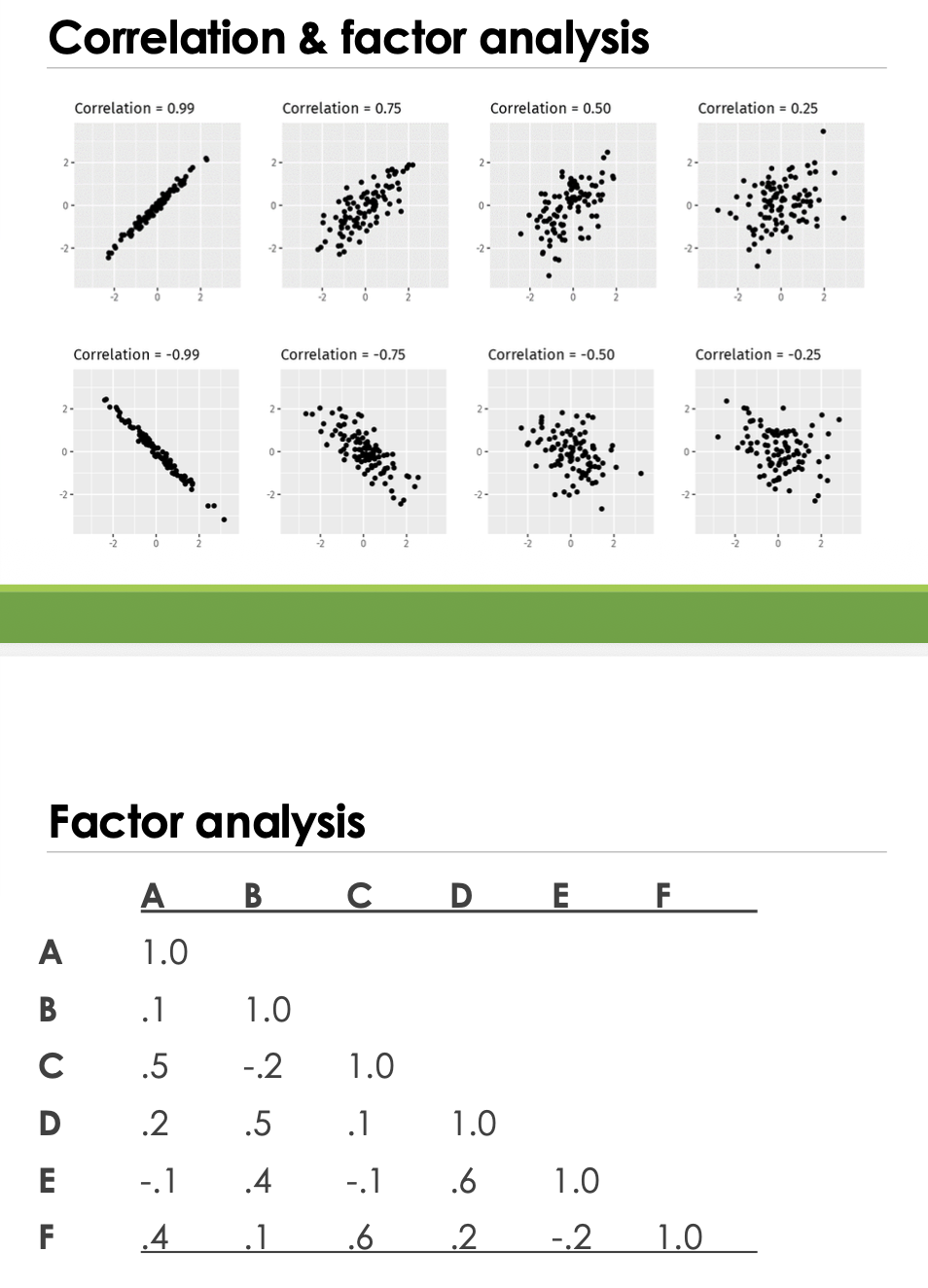
"factors" using a technique called 'factor analysis'
These factors represented basic dimensions of personality
Cattell’s 16 factors

Which traits correlate with those other traits?
tool for detecting clusters of correlating variables
Five basic factors?
• Cattell’s 16 factors were still correlated
• Different factors might both reflect a single underlying “super-factor”
• Ideally, the dimensions of personality should be independent of one another
• Donald Fiske showed that the 16 factors could be further reduced by factor analysis to 5

Key points of Personality Psych Intro
How personality is conceptualised has changed through the ages, but people have always cared about it
Personality characteristics are a subset of the ways in which individuals differ, but a very important subset
Personality psychology is the subfield that emphasises the role of internal influences on behaviour
Traits are the primary units of personality description: they are dispositions that vary in generality
Substantial progress has been made in determining the underlying dimensions of personality traits
The big five description

Value of the “Big Five”
Knowing there are five fundamental dimensions of personality guides
Assessment of personality
Investigation of personality correlates
Explanation of the causes of personality
Provides a framework for mapping specific traits
E.g., shyness is a combination of (low) Extraversion and (high) Neuroticism
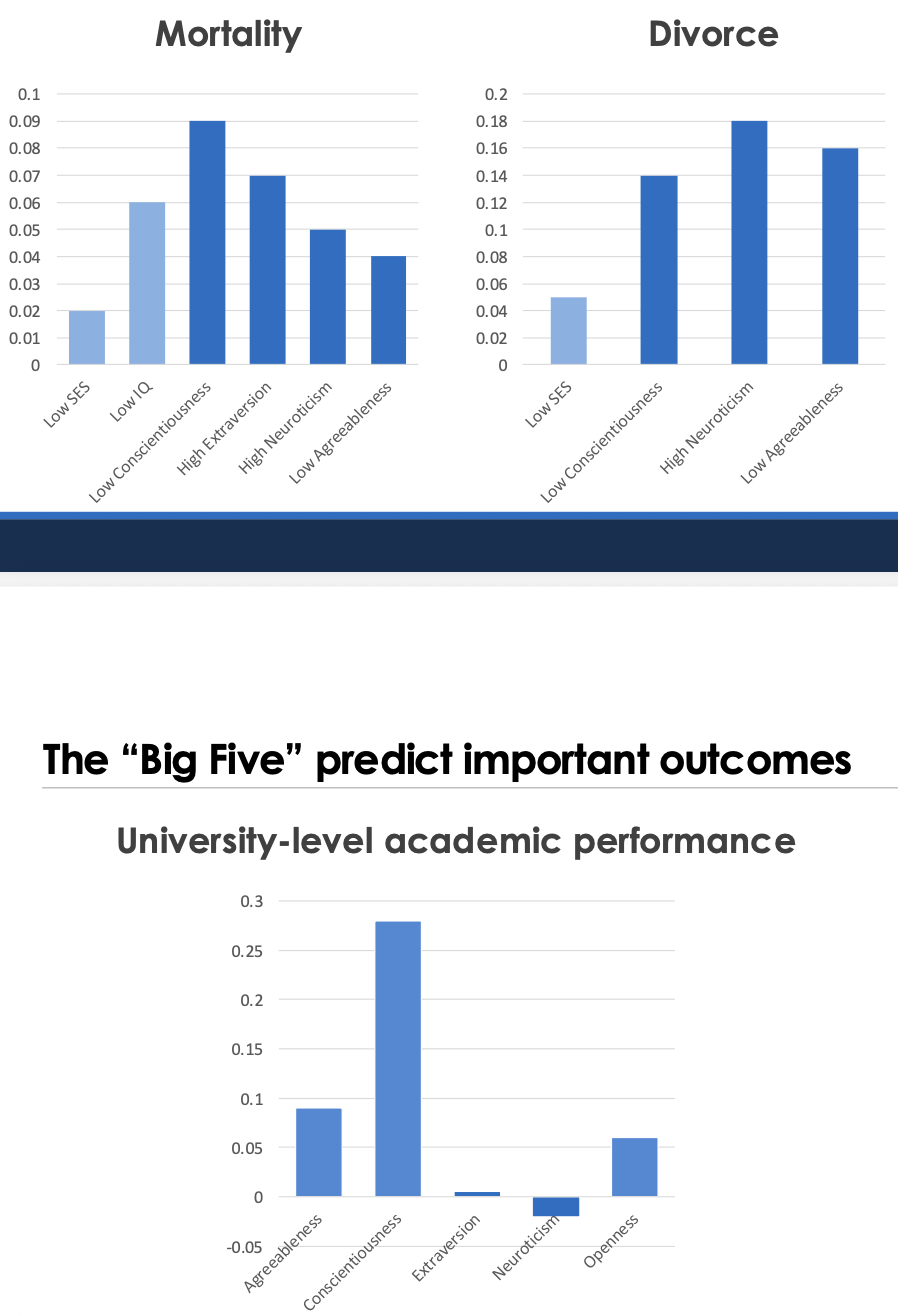
Correlates of the Big 5

The “Big Five” predict important outcomes
Alternatives to the “Big Five”
The Big Five derives from the lexical approach
But what if this approach is flawed?
The "questionnaire approach" does not assume that all important personality variation is captured by single adjectives
It uses personality test items to derive basic factors

Hans Eysenck
Major proponent of this method
Developed a two-factor model
Extraversion
Neuroticism
Later proposed a third factor
Psychoticism
Proposed biological foundations for these factors
Eysenck re-discovers Hippocrates
Health is primarily that state in which these constituent substances are in the correct proportion to each other, both in strength and quantity, and are well mixed.”

Summary so far
• Personality psychology describes individual differences in terms of traits
• Research has developed a scientific framework for describing the structure of traits
• The broad dimensions represent primary dimensions of individual differences
• They have wide-ranging associations with human behaviour
Controversies in trait psychology
Despite its success, trait psychology has been challenged in several ways:
1. Are individual differences consistent?
2. Is the structure of traits universal?
3. Traits or types?
Are traits sufficient for describing personality?
1. Are individual differences consistent?
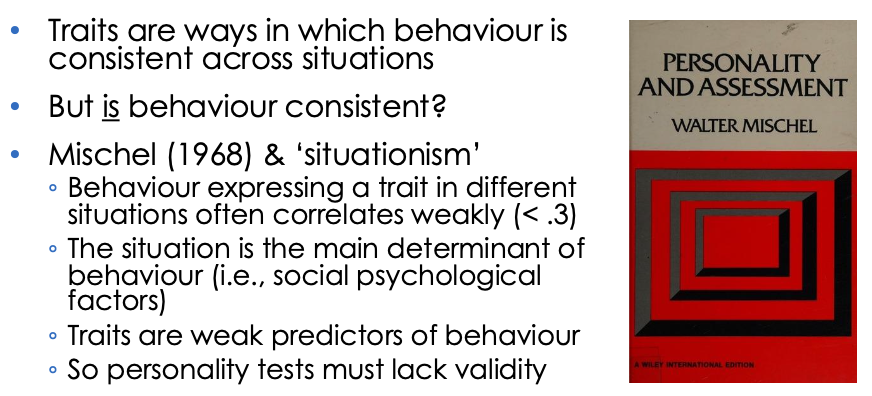
Example of this inconsistency

Responses to Mischel’s critique

2. Is the structure of personality universal?

Indigenous personality systems

3. Is personality a matter of traits or types?

Research on personality types
• Statistical methods exist for comparing typological and dimensional models of psychological variables
• There is no persuasive evidence for any personality types, including Jung’s
• We can therefore assume that traits are dimensional
4. Are traits sufficient?
• Traits are behavioural dispositions
• Other aspects of personality might not be reducible to such behavioural tendencies
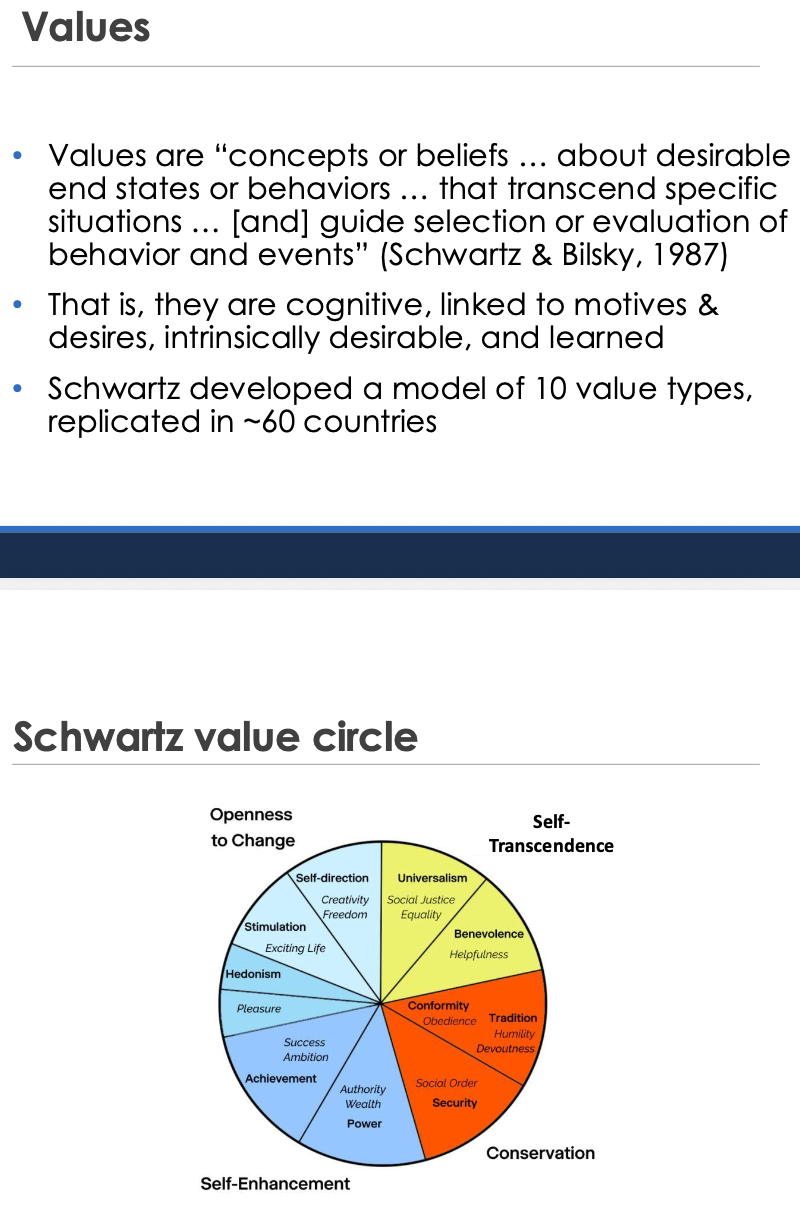
◦ Values
◦ Interests
◦ Character strengths
Values
Vocational interests (Holland’s RIASEC model)

Character strengths
‘Positive psychology’ aims to study and promote human character strengths
Created in opposition to traditional focus on abnormality and conflict
The VIA taxonomy aims to classify character strengths that …
Are environmentally shaped
Contribute to fulfilment in life
Are valued in their own right
Do not diminish anyone in society when exercised
VIA classification

Personality description
There are many alternative units for describing personality beyond traits
Motives, needs, goals
Schemas, personal constructs, interests
We will discuss some of these in later lectures
Traits are not all there is to the description of personality, but they are a simple place to start
Traits and the 'psychology of the stranger'

Key points
• The Big Five trait taxonomy is a valuable organising framework for describing personality
• The five factors are associated with a wide range of important behaviours and life outcomes
• Similar factors emerge when the lexical approach is not used
• Trait models have been criticised, but no criticisms fatally undermine them
• Even so, there is more to personality than traits
Explaining personality
To this point we have discussed ways to describe & classify personality
•Defining the concept
•Trait dimensions
•Alternatives to traits
We now need to explain these individual differences
•Developmental origins
•Underlying mechanisms & processes
Biological approaches
Explanations of the biological basis of personality operate at several levels, from "distal" to "proximal"
Genetics
Brain functioning
Neural systems
Neural structures
Neurochemicals
Hormonal factors
Genetics of personality
Is personality inherited?
DNA as source of our similarities & differences
~20,000 protein-coding genes
~3,000,000,000 DNA base pairs
Most DNA is shared between people: ~99.6% is identical between any two people
To what extent does this DNA variation underpin variations in personality?
Research designs: Family studies
Examine resemblance between family members as a function of genetic relatedness
50%: child, parent, sibling
25%: grandchild, grandparent, half-sibling, uncle, aunt, nephew, niece
Greater resemblance for closer relations implies genetic contribution
BUT: genetic contributions are confounded with shared environmental contributions
Research designs: Twin studies
compare resemblance between monozygotic (MZ) & dizygotic (DZ) twins
MZ twins are 100% related, DZ twins 50% related
Greater resemblance for MZ twins implies genetic contribution
Environments are equally similar for both kinds of TwIn, so environmental factors are not confounded
BUT: possibility of more similar environments for MZ twins, & perhaps twins are unrepresentative
Correlation

Summary of 2748 twin studies (1958-2012)

Research designs: Adoption studies
Compare resemblance of adopted children to adoptive parents (APs) & biological parents (BPs)
APs are 0% related but supply environment, BPs are 50% related
Degree of resemblance to APs & BPs shows environmental & genetic contributions
BUT: adoption must occur early; problem of selective placement; biological mother provides prenatal environment as well as genes
Variance components - Hypothetical sibling correlations

Heritability
Behavioural genetic studies yield estimates of heritability = proportion of variance in the trait accounted for by genes
e.g., .8 for height, .7 for weight, .5 for maths aptitude
Most personality attributes show heritabilities from .3 to .5
This is even true for apparently purely learned attributes (e.g., political attitudes, vocational interests)
Example correlations (Loehlin, 1992)

Important caveats
Substantial heritability of personality does not mean that parents and children are always similar in their personality traits
Heritability relates to variation within a population: it says nothing about genetic contribution to any individual’s personality
Heritability does not imply that personality is fixed
A substantial heritability can coexist with substantial environmental contributions to personality
The role of the environment - shared vs non shared
Behavioural genetics clarifies the environment's role
'Shared' environmental influences (those that make siblings more similar) tend to be weak
• e.g., parental education, neighbourhood, class, ethnicity, diet
'Non-shared' environment influences (those that make siblings more different) tend to be much stronger
e.g., illnesses, friend groups, differential treatment by parents Environmental factors can themselves be genetically influenced
e.g., susceptibility to accidents & other life events
Genetic & environmental contributions to the Big 5 (from Riemann et al., 1997)

Specific personality-related genes
Heritability says nothing about specific genes or genetic mechanisms
Several specific genes have been identified in candidate gene studies, but they do not replicate
e.g., Novelty-seeking & dopamine sensitivity
More recent research, surveying the entire genome with huge samples, finds few replicable personality genes
Most traits appear to be influenced by hundreds of genes, each with very small effect
Brain functioning: Systems Eysenck’s theory

Brain functioning: Systems Gray’s theory

Brain functioning: Structures
• Some links have between found between Big 5 & the size (volume) of brain structures
• Extraversion with a region involved in processing reward information
• Agreeableness with regions that process information about other people’s intentions and mental states
• However, a recent meta-analysis suggests these links are questionable
• A more promising direction is exploring patterns of functional activity and connectivity in the brain

Neural activity patterns
Brain functioning: Chemicals

Hormonal factors

Key points of biological explanations/approaches
Modes of explanation
•Biological explanations of personality operate at many levels, from genes to brain processes
•All traits are moderately heritable, based on many genes of small effect
•Shared environment plays little role in adult personality
•Traits are correlated with many neural factors, from stable structures to dynamic patterns of neural and chemical response
•Reductionist explanation has its place, but other kinds are also required
Cognitive explanations
Explain personality with reference to cognitive processes & structures
Thoughts, plans, memories, beliefs, strategies
Focus on ways of thinking & the construction of meaning
Having versus doing
People as active sense-makers
Emphasis on ‘experience-near’ phenomena
Motivation to understand & predict
Person-as-scientist model
Cognitive theory
There is no single cognitive theory of personality
We will examine four approaches
◦ Perceiving (personal constructs)
◦ Explaining (attributional style)
◦ Thinking (emotional intelligence)
◦ Representing (the self)
Personal constructs
George Kelly proposed that humans are primarily driven to understand, predict & control their environment
We develop ‘theories’ to do so - He called these theories ‘personal constructs’
‘Personal’ because idiosyncratic to individuals
We construct a sense of the world from these theories
We use them to construe that world
To Kely, human cognition is contrastive
E.g., warm versus cold, honest versus untrustworthy
Each person has a system of constructs in terms of which they perceive the world
This system of constructs is the personality
This is a radical approach
It focuses on perception versus behaviour
‘Idiographic’ focus on the person’s uniqueness
Construct systems
Constructs can be analysed in many ways to generate a ‘map’ of the individual’s construct system
Simplicity versus complexity
Rigidity
Internal conflict
Extracted the key constructs - 14 relevant constructs to this man
what he was like beforehand vs the people they know vs now

Attributions
Constructs are about how we perceive the world
‘Attributions’ are about how we explain it
People aim to determine the causes of events and experiences
Attributions differ on several dimensions
Internal versus external (i.e., dispositional vs situational)
Stable versus unstable (i.e., lasting vs transient)
Global versus specific (i.e., broad vs narrow)
Causes can vary along these dimensions
Attributional style

Attributional style predicts many phenomena
◦ Vulnerability to depression
◦ Poorer academic performance
◦ Worse physical health (present + future)
◦ Shorter life-span
◦ Worse sales performance
◦ Poorer performance (especially after bad result) among sportspeople
◦ Losing US presidential elections
◦ Pessimistic song lyrics precede weak economic performance
Emotional Intelligence (EI)
• Constructs & attributions refer to perceptual and explanatory processes
• Abilities & skills are another kind of cognitive concept
• Most cognitive abilities are school-related
◦ Verbal, mathematical & spatial abilities
• Recent extension of the intelligence concept to include emotional & social abilities
Components of EI

The self
The self can be understood as a mental representation of one’s personal attributes
Two individual difference variables relevant to it
1. Self-complexity
◦ Degree to which the self’s structure is complex
2. Self-esteem
◦ Degree to which the self is positively valued
Self-complexity

Self esteem
• Having a positive global self-evaluation is frequently claimed to have many benefits, but …
◦ Little evidence it promotes (rather than results from) academic achievement
◦ Little evidence that it promotes work performance
◦ Little evidence it promotes health
◦ Not associated with less antisocial behaviour
◦ Not associated with greater social sensitivity
◦ May promote aggression in response to insults and when self- esteem is threatened
◦ Need for positive self-view may not be cross-culturally universal

Complexities of self-esteem
The stability or consistency of self-esteem may matter more than its level
• ‘Fragile’ self-esteem may be high but unstable
• ‘Defensive’ self-esteem
◦ High explicit + low implicit self-esteem
• Narcissism
◦ Sense of superiority & arrogance
◦ Entitlement to special treatment
◦ Need for admiration
◦ Sensitivity to criticism
Narcissism & social media
Social networking platforms offer opportunities for
self-promotion
physical display
shallow relationships
Cain & Campbel (2018): narcissism related to …
Time spent on social media
Frequency of status updates
Number of friends
Number of selfies posted
But … no associations for ‘vulnerable narcissism’ and effects varied by cultural setting
Key points with cognitive approaches
• The cognitive approach employs a range of
psychological explanatory concepts
• These involve forms of information processing
Constructs
Explanations/attributions
Intelligences
Representations
• They complement biological explanations and
clarify the processes underlying trait approaches
Domains of personality assessment
Organisational psychology
Clinical psychology
Educational psychology
Counselling psychology
Forensic psychology
Measuring the unmeasurable?
Personality assessment faces serious challenges
Assessment appears to be subjective
There is no infallible source of information about the person
The 'object' knows it is being measured
Personality traits are not directly observable
Measurement quality & confidence
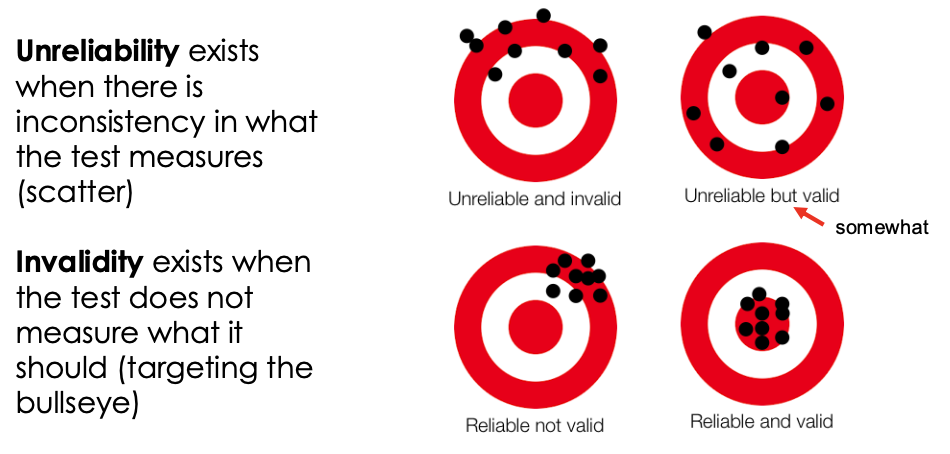
The degree to which personality is measured well is captured by two main concepts
Reliability: does the measurement yield consistent, dependable & error-free information
Validity: does the measurement assess what it is intended to assess & is it useful
Reliability: three varieties
Internal consistency
Inter-rater reliability
Re-test reliability
High reliability = high consistency = low error
Internal consistency
Do the components of the test all cohere?
All test items should correlate with one another
Inter-rater reliability
Does the test provide the same information about the person when diff ppl administer it?
Re-test reliability
Does the test yield similar scores when it is administered to the same person on different occasions?
Three kinds of measurement error
within the test, between testers, and over time
Validity has two components
Does the test measure what it is intended to measure?
• Content validity
• Convergent validity
• Discriminant validity
Does the test provide practically useful information
• Predictive validity
Reliability & validity
So for a good test of trait X …
• All items should intercorrelate
• The same score should occur whoever gives it
• People should get similar scores when they do it twice
• All items should clearly relate to the meaning of X
• It should correlate strongly with other measures of X
• It should not correlate with measures of Y & Z
• It should correlate with things that X is related to
Reliability & validity are both essential, but if reliability is low, validity cannot be high: a test full of measurement error can’t predict anything
Reliability & validity comparison
Kinds of personality measurement
Many different modes of personality assessment
• Interviews
• Personality inventories
• Projective tests
• Implicit personality tests
Interviews

Inventories

Problems of self-report
Inventories are vulnerable to response biases & limitations of self-knowledge
Longer tests include validity scales to check for this
• Lie scales (faking good)
• Infrequency scales (faking bad, random responding)
• Defensiveness scales (subtle guardedness)
• Inconsistency scales (carelessness, random
responding)
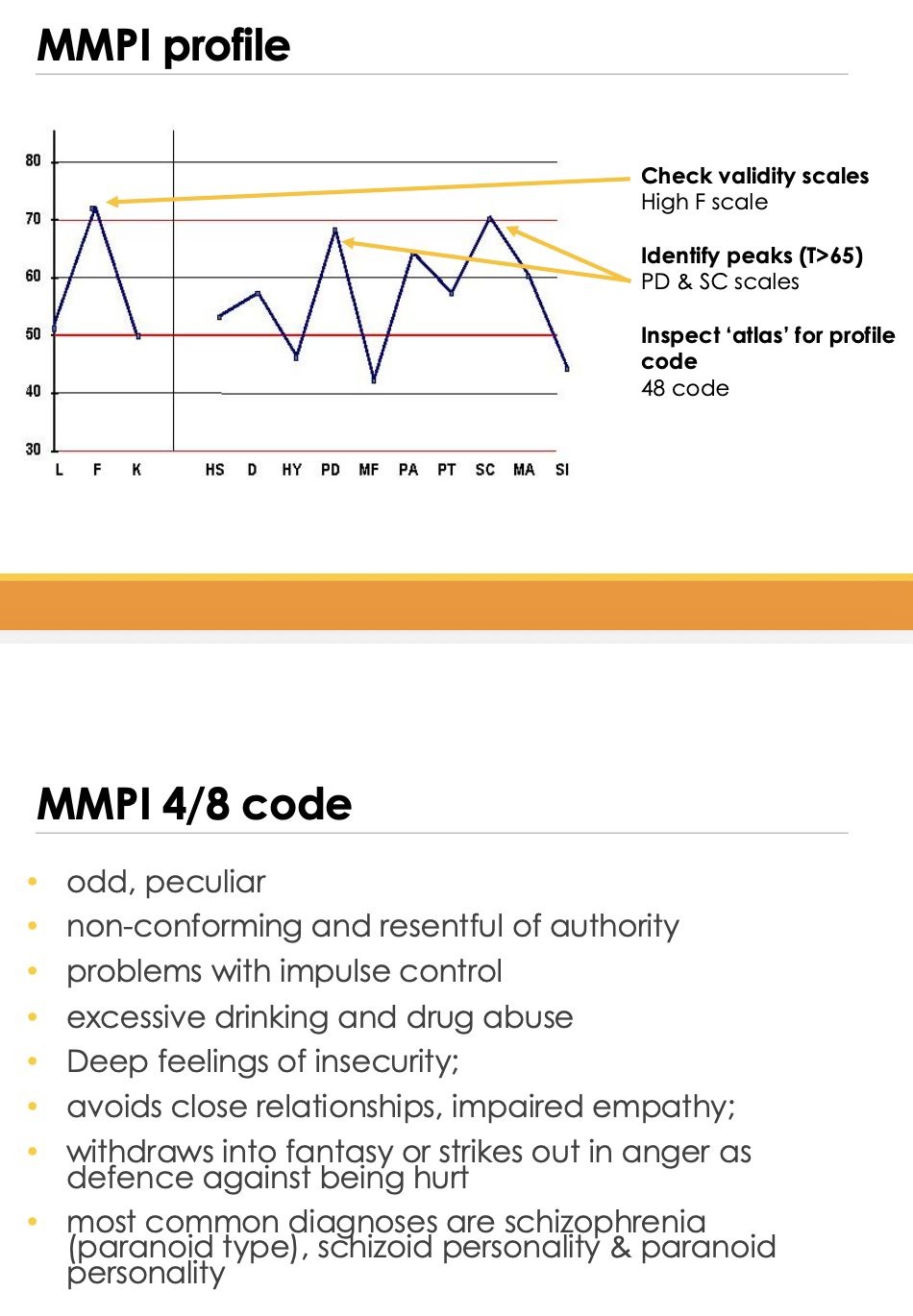
the MMPI
• Developed in 1940s for comprehensive clinical personality assessment
• 10 clinical scales, 3 validity scales; 566 items
• Scale development by selecting items that best differentiated known groups
• Scale scores converted to T-scores (M=50, SD=10)
• Interpretation of scale profiles
Projective tests
Developed to bypass problems of self-report
Aim to penetrate to deeper levels of personality
Dynamics, object relations, core motives
Allied with the psychoanalytic approach
Involve deliberate ambiguity & open-endedness
Ambiguous stimuli
Unstructured responses
Based on the assumption that personality will be ‘projected’ onto stimuli without defensive distortions operating
Thematic Apperception Test

v