Ancient Rome: Notable Concepts (Political, Economic, Social, Militaristic, Legal, etc.; inc. Policies, Laws, Technologies, Routes and Roads, etc.) and Notable Groups (Civilizations, Peoples, Alliances, Leagues, Types of People, Types of Places, Types of Professions, Military Groups, etc.)
 Call Kai
 Learn
 Practice Test
 Spaced Repetition
 Match
 Flashcards
 Knowt Play
1/264

Earn XP
Description and Tags
Each term is addressed by which period of Roman history it was formulated (Kingdom, Republic, Empire, or Byzantine); any concept or system which is not re-addressed in a historically later period of Rome is assumed to have remained the same; if a term is not addressed by the period of Roman history, it is assumed it carried weight in all periods
265 Terms
Roman Kingdom: Class Hierarchy (All Facts)
Kings
Patricians
Controlled the best land
100 of them held positions as Senators
Plebeians
Could not become Patricians regardless of how wealthy they were
Slaves
Could be emancipated by their masters
Chalcidian Alphabet (All Facts)
Version of the Greek alphabet adopted and used by the Etruscans, by which they taught the Romans, which began to circulate amongst the Romans by 500 BCE
Roman Republic: Class Hierarchy (All Facts)
Patricians
Plebeians
Foreign Merchants
Slaves
Patricians (All Facts)
Term used to refer to the wealthy landowning aristocrats of Rome
Held and monopolized virtually all the social, political, and economic privileges and controlled most of the wealth
Allowed to serve in the army, which could then propel them to political careers
Could run for office and thus gain membership in the Senate
They knew the law
Maintained their authority by
Only being allowed as one if you were born into one
Controlled blocks of votes to ensure their candidates got elected to become members of the Senate (since technically, any citizen could run for office)
These authority-maintaining benefits they receive in exchange for providing the benefits to the plebeian class in the Clientela System
They made up most of the “Patrons” in the Clientela System
Due to their heavy financial losses from foreign wars, they made increasing demands on the Plebeians, especially during the “Conflict of Orders”
Plebeians (All Facts)
Term used to refer to all non-Patrician citizens
Comprised 90% of the Roman Republic
Made up most of the “clients” in the Clientela System
They lacked all of the rights and privileges Patricians had, but fought for them over time until they eventually could hold office
Even during the earliest days of the Republic, they were equal before the law with Equestrians
During the “Conflict of Orders,” they attempted to obtain these rights and privileges making several complaints against their Patrician overseers that they
Had no officials to look out for their interests
Did not know what the laws were
Did not know how to prosecute court cases
Had no realistic chance of being elected to office or becoming Senator
Were sold into slavery if they defaulted on loans made by their Patrician counterparts
During the “Conflict of Orders,” they
argued that high interest rates on loans have forced more and more of them into near-slavery as debtors were frequently forced to pledge their bodies if they could not meet their debts and thus that collective protest was the only answer
argued that ignorance of the law had led to the poor being enslaved for debt and being deprived of any say in the government, thus leading to the creation by the Patricians of the “Twelve Tables” by 450 BCE
organized and used class solidarity in order to gain power given the close ties that bound Roman society together at the time
took advantage of the Clientela System and received the benefits from it and then worked their way up and eventually had clients of their own
gradually became good at business and commerce and became extremely wealthy and influential, but still could not enter the Patrician class
Won a major victory in their fight for a bigger say in the government of Rome when they passed the Licinian-Sextian Rogations, a series of three laws which gave them more political and economic equality with the Patricians
Gained the rights to fill more and more offices including
The Office of Dictator, in which the first of them was appointed dictator in 356 BCE
The Office of Censor, opened to them in 351 BCE
The Office of Praetor, opened to them in 337 BCE
Won the ultimate victory in their fight against the Patricians when they passed the Hortensian Law, which finally secured equal political rights between them and the Patricians
The “Conflict of Orders” came to an end in 287 BCE
Roman Kingdom: Citizens (All Facts)
Enjoyed
Private rights - allowed them to carry on business and marry under Roman law
Public rights - permitted them to vote and to run for public office
Roman Kingdom: Slavery (All Facts)
This institution was significantly unique in Rome compared to other ancient societies
This was because slaves that were freed became endowed with full Roman citizen rights
In order for a slave to be freed, it had to go through a formal process of Emancipation
Occurred when a father fictitiously sold his own son and then set him “free” three times in a row, in which the son then became “sui juris”
“Sui Juris” - meant that one (the son) had their own legal authority and gained legal freedom in advance of waiting for their owner (the father) to die
Roman Kingdom: Values and Morals (All Facts)
Valued stability, discipline, industry, frugality, temperance, and fortitude
Devalued intellect, innovation, and imagination
Had a down-to-earth character that rejected the idealized portraiture of the Greeks, having a realistic style instead
Roman Republic: Values and Morals (All Facts)
Its earliest ideals had been egalitarian in which
Plebeians and Equestrians were equal under the law
There was a written constitution
Tribunes of the people possessed real powers
After Marius’s death by 84 BCE, there was
a gradual erosion of civil liberties
an increase in the prestige and political influence of the Roman army
an acceptance of corruption among public servants that would have shocked its founders
an accumulation of vast fortunes by a small group of men who used their wealth, mostly from land, to control the Senate
Mos Maiorum (All Facts)
Term used to codify Roman morals and values
Literally means “The Customers of our Ancestors”
In other words: the older something was, the better it was
Conceptualized as the basis of Roman character
Characterized by being fundamentally conservative
Reciprocal Duty (All Facts)
Term used to refer to the conceptualization of social relations and the necessary responsibility with respect to the gods, the state, family, friends, and benefactors
Meant that if anyone did a Roman a favor, the Roman was beholden to that person until the favor had been repaid - regardless of social status
Manifested in Roman religion, in which it was believed that each “numen” performed its proper function
Manifested in Roman politics, in which senators had felt it was their duty to participate in public life and thus expected to be rewarded by recognition and office
Clientela (All Facts)
Roman social institution, in which a patron and a client rendered mutual services to each other and were bound to each other on the basis of “Reciprocal Duty”
This system bound Roman society together in a way that Greek society never had achieved
It resulted in Romans being inhibited from resorting to violence when disputes arose
It was designed to maintain the status quo and preserve patrician privileges
Its characteristic members were patrons and clients
Patrons (All Facts)
Term used to refer to the figure who had clients in the “Clientela” System
Typically patricians with plebeian clients
They provided clients
Physical protection
Economic support in the form of
Foodstuffs when times were tough
Land to rent if a plebeian lost their own
Legal services
Because only the patricians knew the laws
They received (from clients)
An entourage of clients that accompanied them
In order to
Boost their own status
Demonstrate their power
When they went to war (although they did most of the fighting)
When they went into Rome
Because one of the measures of status lay in the size of their human accompaniments
Support in raising a ransom or dowry
Clients (All Facts)
Term used to refer to the figures who had a patron in the “Clientela” System
Typically plebeians with patrician patrons
They received from patrons
Physical protection
Economic support in the form of
Foodstuffs when times were tough
Land to rent if they lost their own
Legal services
Because only the patricians (patrons) knew the laws
They provided patrons
(Human) Accompaniment
In order to
Boost the patron’s status
Demonstrate the patron’s power
When their patrons went to war (although their patrons did most of the fighting)
When they went into Rome
Because one of the measures of status lay in the size of their patrons’ human accompaniments
Support in raising a ransom or dowry
“Middle class” created by the Patricians in order to
Keep the Plebeians from positions of importance, particularly membership of the Senate
Create a second-class group or “middle class” that could enjoy the patronage of wealthy Romans
Family Organization (All Facts)
Organized by Familia (Family), Gens (Extended Family), Curia (Clan), and Tribus (Tribes)
Divided into three main “Tribus” (tribes) including the Ramnes (from Romulus or Romans), Tities (from Titus Tatius or Italians), and Luceres (from Etruscans), each of which was comprised of 10 clans, each of which was comprised of many gentes and of which there were many gens within each of the gentes
Paterfamilias (All Facts)
Term used to refer to the legal authority the father had over the household or familia - the most basic family unit
Literally means “Father of the Family”
Gave the father absolute (life-and-death) authority over the household
System which made family life structured and authoritarian
Fathers had the responsibility of educating their sons by taking them along as they fulfilled their own responsibilities in the daily round of public and private life
Most sons lived at home under their fathers’ namesake legal authority, even after they were married
This continued until their fathers died and they assumed the same namesake role in their own right
Manus (All Facts)
Term used to refer to the legal authority the man had over women in the household or familia (and outside of the home - given to men over women in general?)
Conceptualized by the idea that the most fitting place for a Roman woman was at home spinning wool to make clothing for her family
All women were placed under this authority except for the six “Vestal Virgins”
Familia (All Facts)
Term used to refer to the individual family within the Gentes that was under the authority of a paterfamilias at one point in time
Family names were based on an attribute of a distant ancestor’
For example, Caesar meant “hairy”
Gens (All Facts)
Term used to refer to the individual family within the Gentes at any given time or across generations
Gentes (All Facts)
Term used to refer to the extended families comprised of individual families (which organized private military campaigns during the Roman Kingdom Period when Rome which operated with little to no government oversight)
Curia (All Facts)
Term used to refer to the clans comprised of extended families
Tribus (All Facts)
Term used to refer to the tribes comprised of clans, each of which was comprised of ten clans
There were three: the Ramnes (from Romulus or Romans), Tities (from Titus Tatius or Italians), and Luceres (from Etruscans)
Roman Kingdom: Marriage (All Facts)
Having this be recognized under Roman law was very important because it allowed one’s children to inherit
Roman citizenship
Property
Daughters were expected to do this and assume control over a household
There were three kinds:
Confarreatio
Coemptio
Usus
In Manum (All Facts)
Term used to refer to the transfer of “Manus” over the wife from the father to the husband upon marriage
Confarreatio “with spelt” Marriage (All Facts)
Form of marriage that was
The most restrictive
Occurred only between patricians
Made divorce nearly impossible
Its wedding consisted of
The couple sharing a cake made of wheat
Being in the presence of 10 witnesses
“In Manum” occurring
Form of marriage that allowed daughters of women who were married this way to become priests, or the Vestal Virgins
Coemptio “purchase” / “sale” Marriage (All Facts)
Form of marriage that was common
Involved
A dowry (suggesting marriage was an economic arrangement)
A father fictitiously selling his daughter in order to complete “In Manum”
Roman Kingdom / Roman Republic: Usus “usage” Marriage (All Facts)
Form of marriage that involved simple cohabitation (equivalent to modern “common law” marriage)
If the woman remained in the husband’s home for a year without interruption, “In Manum” occurred
But if a woman stayed out of his house for at least 3 nights during the year, she remained under the more distant “manus” of her father
Form of marriage that allowed many women (who preferred it) some level of independence in the marital home
Cloaca Maxima (All Facts)
Literally means “big sewer”
Constructed after the drainage of the swampy land between the “Seven Hills” of Rome by the last three kings of the Roman Kingdom Period
Created by Tarquin the Old
Generally helped with hygiene and improved the quality of people’s lives
Roman Republic: Government (All Facts)
Rome during this period was characterized
1st - an aristocracy, in which Rome was governed just by the Patricians
2nd - an oligarchy, in which patricians and influential plebeians served together in the Senate and shared the rule
Roman Republic: Senate (All Facts)
Main advisory body during the Roman Republic Period, just as it was during the Roman Kingdom period, but eventually became the primary governing body of Rome and powerhouse of the Mediterranean
Its decisions affected every man, woman, and child in the vast Republic
All its members were the most influential people of Roman society during the Roman Republic Period
Its duties consisted of
Controlling foreign policy
Supervised military operations
Fixed the status of conquered territories
Controlling domestic policy
Secured the management of the treasury and oversaw state expenditures
Decreed public safety measures
Issuing “resolutions,” which was either
advice to magistrates
interpretations of existing Roman law
It was comprised of
Magistrates
Former Magistrates
Noble families
100 members originally, but increased over time to 300 members
It was structured with checks and balances in that namesake members
Must answer to the Tribunes of the Plebs (who represented the interests of the people)
Were always aware that 80 elite officials were elected annually to share power with them, including consuls and military tribunes
Were always aware that Rome’s victorious army was a powerful force with which to be reckoned
could not actually pass laws or appoint officials, but could control via their control of their voting blocks and in order to maintain their power
which laws got passed
who got elected to offices
Had no constitutional authority to issue legislation, but had a very powerful advisory position
Provided their approval for laws introduced by a Consul or Tribune who wanted to present such a law to an assembly
It exhibited a policy of free speech among its members
Roman law insisted its doors must be left open for all to visit
As long as they all came to agreement with each other on any given issue, they retained power
This is sometimes referred to as the “Gentleman’s Agreement”
Comes from the Latin word for “bunch of old men”
Roman Republic: Senators (All Facts)
Members of the namesake primary governing body of Rome
Wore
Toga
Special shoes
Reserved seats at
Religious ceremonies
Public entertainments
Acted as magistrates, they had the power of life and death over their fellow citizens
They
had to answer to the Tribunes of the Plebs (who represented the interests of the people)
were always aware that
80 elite officials were elected annually to share power with them, including consuls and military tribunes
Rome’s victorious army was a powerful force with which to be reckoned
had free speech
served for life
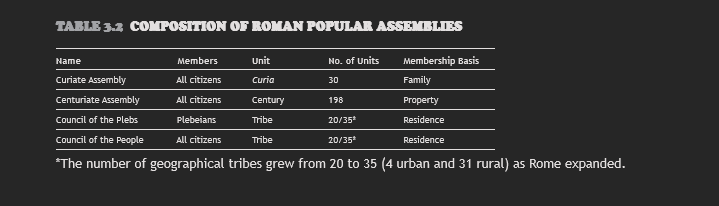
Roman Republic: Popular Assemblies (All Facts)
Governing bodies of all the Roman people, comprised of both patricians and plebeians
Every member of a given assembly was entitled to one vote via voting “units”
Voting was not by popular vote but by voting “units” and within each “unit” voting was popular
They could only vote yes or no on a proposed bill; they could not discuss or amend measures presented to them
Could not introduce legislation, which could only come from the Senate, so the Senate acted as their legislative gatekeeper
Any legislation was presented to them by the Consul, their presiding magistrate, or a Tribune (if the legislation was being called for by the Council of the Plebs)
Had the constitutional authority to issue laws binding on the entire Roman state, but their powers were very limited nonetheless
The real lawmaking went on “behind the scenes” and the real legislative power lay only in the hands of the Senate
Although the Senate had no constitutional authority to issue legislation, a right that had only belonged to these, it had a very powerful advisory position
These included
The Curiate Assembly
The Centuriate Assembly (Army Assembly)
Council of the Plebs
Council of the People
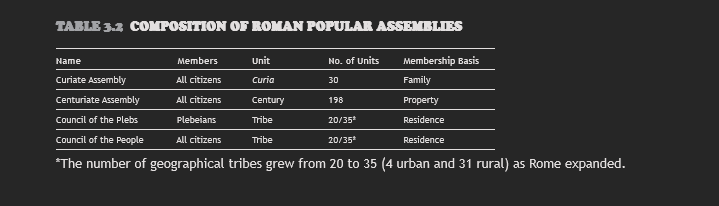
Roman Republic: Curiate Assembly (All Facts)
First Popular Assembly established, it assumed a lot of responsibilities early on when it was the only popular assembly including
Electing consuls
Declaring war
Organized by Curiae (hence the name), the thirty curiae (clans) were organized into this assembly
Like all popular assemblies:
Each member or “curia” (clan) had one vote and each curia’s vote was decided on by the majority decision with each curia
Could only consider motions already approved by the Senate and not others
Roman Republic: Army Assembly / Centuriate Assembly (All Facts)
Created by the Patricians as supplemental to the Curiate Assembly in response to the Servian Reforms
Assumed several duties of the old Curiate Assembly including
Electing Consuls
Declaring War
Each “century” had one vote (was the voting “unit”), even though the poorer centuries contained many more people than the richer ones
Thus, the creation of this assembly by patricians was a response to the growing power of the plebeians because this system allowed them to control the votes, since, as long as they voted together, their 98 votes (of Knights and Class I) outnumbered the 95 votes of everybody else (Classes II to V and “Proletariat”)
This class system was supposedly devised by King Servius Tullius, and was the patrician response to the plebeian creation of the Curiate Assembly
Once a majority was declared, voting stopped, effectively making it so that the lower classes could not vote at all
Organized into 193 units called “centuries” that were distributed among different classes based on wealth
Rome’s government took a census of all the people to decide who should go in which Class, intending to assess how much wealth everyone had
The richest of the Plebeians were in Class I in this assembly, so there was some interactions between the Plebeians and Patricians during this time
Servian Reforms (All Facts)
Passed by the namesake Roman King during the Roman Kingdom period, these reforms essentially gave into the demands of the Plebeians at the time by
Allowing the wealthiest Plebeians to serve in the army, or those who could afford to purchase their own weaponry
This vastly and effectively increased military recruitment by the thousands
They explicitly required that the Plebeian joining the army had land property
Military Tribunes (All Facts)
Comprised of wealthy and influential plebeians in the Equestrians and Class I groups (due to the Servian Reforms) that served in the army side by side with patricians and had the opportunity based on their military ability to serve in this office
Commanded army units; thus army service meant that patricians needed to gain plebeian cooperation more than ever before
Legions in the army were commanded by this office
Looked for ability not class, so this office was quickly taken up by plebeians
Roman Republic: Council of the Plebs (471 BCE) (All Facts)
Assembly formed by the Plebeians on their own from which they found strength in organization and number for the purposes of class solidarity in order to get more rights
Organized based on the 20 “Geographical Tribes” (4 in the city, 16 in the country) [which grew over time into 35 tribes (4 in the city, 31 in the country)] into which people were divided based on where they lived
They used the “geographical tribe” designation instead of the “curiae” (clan) or familiae (family) designations in order to incorporate the votes of foreign merchants, thus counting them as a part of its citizen body
Thus, one’s ability to participate was based only on where they lived, not their class status
The tribes would meet and vote in the same way as the voting “units” of the other assemblies, with each tribe having one vote
Issued Plebiscites, which were binding only on the plebeians, but could become Roman law if ratified by the Senate or one of the other “Popular Assemblies”
Each year, it elected ten “Tribunes of the Plebs”
Roman Republic: Council of the People (449 BCE) (All Facts)
Last of the Popular Assemblies established
Formed as a result of the particular Plebeian secession of 449 BCE
Modeled on the Council of the Plebs
It had the same 20 geographical tribes and new foreign resident citizens, but it also had patrician members
Thus, it was still more inclusive than the Curiate Assembly because it automatically included new citizens who did not belong to one of the family-based “curiae” (clans)
Through it, the Plebeians continued to agitate for more rights
Roman Republic: Senators (All Facts)
Comprised solely of Patricians, who thus gained control of the government
Comprised of many patricians who were also patrons, who could
Instruct their clients on how to vote when a measure was being considered in a popular assembly
Control who was elected to magistracies
Given that they were mostly people appointed by the Consuls, there was little chance a plebeian could become a member
Overtime, many of the patricians it was made of would be ex-plebeians thus shifting its representativeness in the favor of plebeians
Their effectiveness was ultimately based on how well they could work together and maintain a united front or common cause
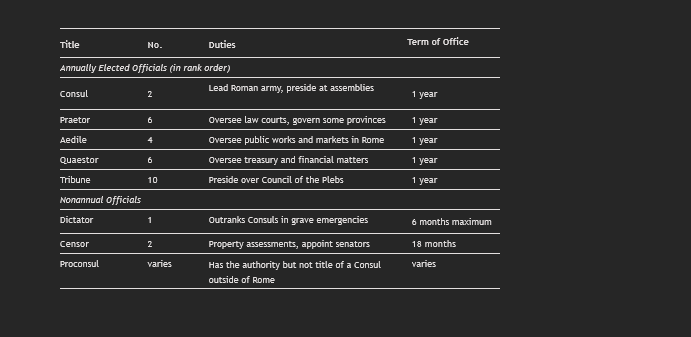
Roman Republic: Magistrates (All Facts)
Term used to refer to Roman Republican public / government officials and their respective offices
Most of these offices and the officials within them would continue during the Empire period, but their power would be diluted to the presiding Emperor
These offices established during the Roman Republic period continued into the Empire period but held no real power compared to the emperor
Organized (in this KNOWT) by highest to lowest rank
Presided over their own provinces
Categorized into “Annual” and “Special” Magistrates
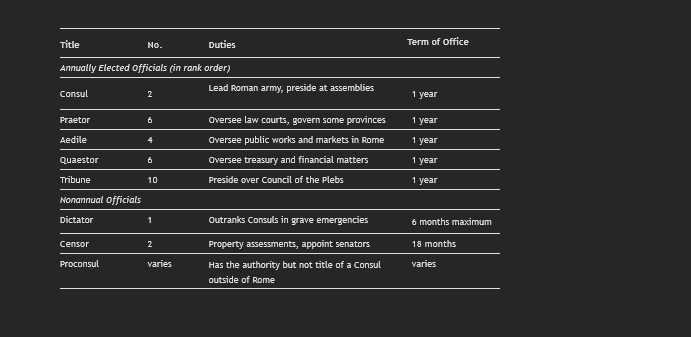
Roman Republic: Annual Magistrates (All Facts)
Magistrates which were elected each year
All of these offices could not be repeated except Consuls
Its offices include
Consuls
Praetors
Aediles
Quaestors
Tribunes
Ambitious Roman politicians worked their way up from Quaestors, to Aediles, to Praetors, and finally to the consulship
However, this tidy ascent of the political ladder was not always observed in practice
Roman Republic: Special Magistrates (All Facts)
Magistrates that were not elected every year
Its offices include
Censors
Dictator
Consul (All Facts)
Highest-ranking Roman magistrate except in times of emergency
Top office of the Roman Republic period, it essentially replaced the King
Were elected every year
Were the only office one could repeat (but that did not happen often)
There were 2 of them
Each had equal authority
To run for this office one had to
Be at least 42 years of age
Have previously been a Praetor
They
Lead armies
Presided at meetings of Popular Assemblies
Had the powers of imperium and auspicium
Had the right to oversee the administration of justice and to name new senators and citizens
Accompanied by 12 "Lictors” who carried the “fasces” symbolizing the power of the namesake office
For most of the Roman Republic period, only Patricians could receive the office; Plebeians could run for it but it was unrealistic to think they would ever receive it
Remained in office while dictators arose to power, but were outranked by the dictator
Their rank fell during the Empire period to the emperor of course
Imperium (All Facts)
Term used to refer to the legal authority citizens had, as Consuls, generally to have supreme power, and particularly to command armies and execute law
Term also used to refer to the emperorship and the powers of the emperor as granted by the Senate, namely the senatorial authority given to emperors to add or expel senators as the emperors saw fit
Some of these powers allowed him to control certain key provinces the armies in them
Auspicium (All Facts)
Term used to refer to the legal authority citizens had, as Consuls, to make judgement on auspices, or the practice of seeking divine guidance through observing natural phenomena, particularly birds and their behavior, as well as other signs like thunder and lightning
Dictator (All Facts)
Highest-ranking Roman magistrate in times of emergency
When not in times of emergency, the Consul was the highest-ranking official
Only magistrate to have one member (non-collegial)
Office of the Roman Republic period that was
Only used in times of dire emergency
Such as if the state was on the verge of being defeated by a foreign enemy
Permitted if the two consuls could not handle the emergency or come to an agreement on their own about matters
Appointed by the Senate or the Consuls themselves
It was the top office even above Consul since Consuls were outranked by it
It could only be held until the emergency was over and then the person had to immediately resign
One could only serve in it for up to 6 months
Praetor (All Facts)
Second highest-ranking Roman magistrate (or senior magistrate)
Were elected every year
There were 2 of them
To run for this office one had to
Be at least 39 years of age
Have previously been an Aedile
They
Had the power of imperium
Had jurisdiction over legal cases involving Roman citizens
In charge of administering Roman law
Filed legal disputes in the “Forum”
Were typically closely connected with military affairs
There were two types, “Urban” and “Peregrine”
Office created by the Patricians in response to growing Plebeian power, especially after the passage of the Sexto-Licinian Law in 367 BCE, in order to retain their privileges as Patricians
However, this office quickly became available to Plebeians, and was granted to them by 336 BCE
Urban Praetor (All Facts)
Type of Praetor that heard cases involving citizens
Put into practice the concepts embodied in the private law of the Twelve Tables
Developed standard legal forms for different kinds of legal actions involving different things
Peregrine Praetor (All Facts)
Type of Praetor that heard cases involving foreigners
Aedile (All Facts)
Third highest-ranking Roman magistrate
Were elected every year
There were 4 of them
To run for this office one had to
Be at least 36 years of age
Have previously been a Quaestor
They oversaw
City infrastructure and public works (markets, streets, and public buildings)
Maintenance of public services in the cities
Upkeeping and building of roads and monuments
Distribution of foodstuffs
Provision of entertainments
The markets to make sure everyone was using legal weights and measures
Organization of games
Office created by the Patricians via the Valerio-Horatian Laws; established in response to the establishment of the Council of the Plebs and the Tribunes of the Plebs
Appointed by the Council of the Plebs
There were 2 of them, 2 more were added by the patricians to retain their privileges after the passage of the Sexto-Licinian Law in 367 BCE
They oversaw the markets, streets, and public buildings
Although initially restricted to them, this office quickly became open to the plebeians
Censor (All Facts)
Highest-ranking magistrate, they served to fill in for Dictators eventually and ranked above the “Consuls”
Only patricians were chosen for this office
Thus, patricians began to make concessions to plebeian demands, but did so gradually
Were elected every five years by the Centuriate Assembly
They served for 18 months
There were 2 of them
They
Took a census of the nation by taking a census of citizen property
Maintained the list of Senate members in which they
Appointed new Senate members
Expelled Senate members
Sometimes this was used for political reasons for Senators they did not like
Other times this was used if the namesake official thought that the Senator was likely to blemish the common good
The expelled Senate members would be transferred to a different social class (or tribe)
Let out contracts for public works construction
Oversaw “public morality” and the (moral) purification of the Roman people
Laid down the “regimen morum,” the moral standards governing all Roman citizens
Regulated much of Roman life
Created in 443 BCE
Quaestor (All Facts)
Lowest-ranking officials along with Tribunes (of the Plebs)
Were elected every year
There were 6 of them
To run for this office one had to
Be at least 30 years of age
Serve in the military for at least 10 years
They
Were essentially “junior officials” - anyone who wanted to start a political career
Entry-level rank into the Senate, in which one could then run for Aedile, then Praetor, and then if really lucky, for Consul
They also
Enforce the laws
Manage finances (dealt with financial administration within the provinces)
Tribune of the Plebs (All Facts)
Lowest-ranking officials along with Quaestors
Were elected every year
By the Council of the Plebs
There were 10 of them
Each had equal authority
They
Represented the Plebeians
Had the right to introduce laws into the Council of the Plebs
Presided over the meetings of the Council of the Plebs
Were responsible for defending the interests of the plebeians against patrician oppression
Had the right to introduce plebiscites to the Senate and see if they could get passed there
If approved by the Senate, then they would be sent to one of the other Popular Assemblies
Thus, they maintained a role in the legislative process
Had the authority to veto (literally, “I forbid”) if the patricians ever did anything against plebeian interests
Could veto any law they did not like and all the government’s operations would have to come to a halt until they were induced to remove their veto
On such occasions, the plebeians went on strike until the Tribune could be induced to remove the veto
This was a right no other office had
Were sworn by the plebeians to be avenged for any harm caused to them by patricians
Thus possessed real political power which lasted until it was eroded leading up to the days of the Roman Empire
Veto (All Facts)
Legal operation exclusively held by the Tribune of the Plebs in which the assembly of Plebeians could vote down measures such as the election of military tribunes
Secession / Secessio Plebis (All Facts)
Action taken or threat to Patricians made by Plebeians to remove themselves from the state and to withdraw to Aventine Hill (one of the “Seven Hills” of Rome) (or the Janiculum Hill, in the case of the one that occurred in 287 BCE) to then establish their own nation
Was done sometimes when Rome was under military threat as a means of coercing the Patricians into making political concessions to them
For example,
in 494 BCE this had occurred for the first time amongst the Plebeians, eventually resulting in the creation of the Tribunes of the Plebs
in 449 BCE this had occurred amongst the Plebeians as a result of the lack of effective reform from the Patricians, and it forced the Patricians to give into their demands, thus
Recognizing the Council of the Plebs to exist
Recognizing the legal right of the (Military) Tribunes of the Plebs to exist
In 287 BCE this had occurred amongst the Plebeians, and it led to a compromise between the Patricians and Plebeians, eventually resulting in the passing of the Hortensian Law
This was essentially the bargaining chip for the Plebeians, which they used to threaten the Patricians whenever the Patricians were responsible for defending Rome against the attack of a foreign power (since mostly patricians served in the army)
The latter term is considered to be a historical precursor and Ancient Roman equivalent to the modern conception of a labor “strike”
Plebiscite (All Facts)
Any measure or resolution that passed in the Council of the Plebs
Means “decree of the Plebs”
Were initially binding only if the Senate ratified or approved it, until the passage of the Hortensian Law, which made them binding on all Roman citizens, including Patricians, regardless of the Senate’s approval
Roman Republic: Military Tribunes with the Power of a Consul (444 BCE) (All Facts)
Essentially abolished the Consulate
When plebeians insisted on being given a realistic opportunity to be Consul, the patricians responded by creating this office
This office
Absorbed the military functions of the Consuls
Could be held by plebeians, who after their terms of service, then entered the Senate
2 to 6 of them were appointed each year
Essentially put Plebeians up to the status of Consuls
Twelve Tables (All Facts)
Term used to refer to the codification of Roman Law by 450 BCE for the purposes of teaching the Plebeians the laws (which the Patricians began to see benefit in doing)
Up until this point, the law remained the preserve of the patricians exclusively, in which it was unwritten, transmitted in speech only, and passed down through generations of pontiffs and magistrates
Plebeian leaders argued that ignorance of the law had led to the poor being enslaved for debt and being deprived of any say in the government
Because the Plebeians thought the Patricians lied about the laws for their own benefit since they were the only ones who knew the laws, they demanded to know the laws
They were displayed prominently in the Forum so all Plebeians could see what the laws were
Thus, they ended years of injustice to the plebeian classes in Rome
It recorded existing law, covering various laws including
Criminal Law
For example, the death penalty was received for crimes of
Arson
Casting spells
Stealing crops
Property law
For example, plebeians could still be sold into slavery if a debt was not paid within 60 days
Sacred law
Stated fundamental concepts of Roman Law
So the laws themselves were not reforms, but this was the first time in Roman history that its laws were written down and codified: a reform in and of itself
Passed one new law: it prohibited marriages between patricians and plebeians, blocking the only means by which members of a plebeian family could enter into the aristocracy
This law was passed because it was happening a lot: a wealthy Plebeian woman would marry a Patrician who was “on hard times,” in so doing the Patrician would have a way into the Patrician class because the child had by the married couple would have become a Patrician
Decemvirs (All Facts)
Board of 10 men who were appointed by the Patricians at the time of the codification of Roman Law into the “Twelve Tables” to write down the laws
Roman Republic: Roman Law (All Facts)
Characterized by fundamental concepts laid out in its codification via the "Twelve Tables” by the Decemvirs including
“Mancipato” - Transferring ownership over property
“Stipulatio” - Making a contract between two parties
“Emancipato” - Freeing someone from slavery
“Nexum” - Reducing someone to slavery
Characterized by there being no police or prosecutors, so criminal prosecutions has to be instituted by the wronged parties themselves
As a result, the laws offered little redress for plebeian complaints
At the time of the “Twelve Tables,” it oppressed plebeians in that:
Those who fell into debt could still be sold as slaves
Plebeians could not legally marry Patricians, blocking the only means by which members of a plebeian family could enter into the aristocracy
Roman Republic: Canuleian Law (445 BCE) (All Facts)
Repealed the “Twelve Tables” (new law)
Named after Canuleius, a Tribune of the Plebs at the time
Plebeian Aristocracy (All Facts)
Collectively grew as it was created when a wealthy Plebeian woman would marry a Patrician who was “on hard times,” in so doing the Plebeian would have a way into the Patrician class because the child made by the married couple would have become a Patrician
Developed as patricians and plebeians happily intermarried over time, in which healthy and wealthy Plebeians were brought into the Patrician class, thus, becoming members of the Senate
So the Plebeians eventually form this new ruling class made up of the old patricians and the most wealthy and influential Plebeians
Roman Republic: Sexto-Licinian Laws / Licinio-Sextian Rogations (All Facts)
Series of three laws passed by the two namesake Plebeian Tribunes in 367 BCE
One law required one of the two annually-elected consuls of Rome to be a Plebeian from that point onwards
This essentially restored the Consulate, and thus repealed the Military Tribune with the Power of a Consul development
This thus ended years of class struggle in Rome
Another law restricted the amount of Ager Publicus (public land) that a single individual could occupy, limiting it to 500 jugera (300 acres)
Intended to prevent wealthy Patricians from monopolizing land and leaving poor Plebeians with little to no land for farming
Was the first significant land reform passed
A third law stated that interest already paid on loans was to be deducted from the principal and that the remaining debt could be paid in 3+ year installments
Intended to prevent the enslavement of plebeians who had defaulted on loans paid out to them
These laws were partially created because the Romans needed to reunify (Patrician and Plebeian) after they were sacked by the Gauls in 390 BCE
Roman Republic: Hortensian Law (All Facts)
Law passed by the namesake dictator in 287 BCE
The law made it so that all plebiscites were binding on all citizens, not just Plebeians
The law also eliminated the requirement that the Senate ratify, or give its prior approval to plebiscites before becoming binding on all citizens
This law was the final to pass in and end the period known as the “Conflict of Orders” and thus secured equal political rights between Patricians and Plebeian
Plebeian Government (All Facts)
Developed overtime
356 BCE - Office of Dictator opened to them (first Dictator appointed)
351 BCE - Office of Censor opened to them
337 BCE - Office of Praetor opened to them
Maniples (All Facts)
120-man units where which more flexible and tactical than phalanxes
Implemented after the Gallic sack of Rome in 390 BCE
Restructured the army, abandoning the old phalanx in favor of the namesake structure which was more flexible and tactical and based on 120-man units
Marius abandoned these in favor of stronger cohorts in his development of the “Volunteer Army”
Servian Wall (All Facts)
Built to protect the city of Rome from its enemies in reaction to the Gallic sack of Rome in 390 BCE
Added to their oath that they would not be humiliated like they were under the Gauls ever again
Attributed to King Servius Tullius, the legendary 6th King of Rome (not in the Political History KNOWT due to the fact that its an attribution)
Defensive Aggression (All Facts)
Term used to refer to the policy adopted by Rome in which they would sometimes preemptively attack neighbors whom they felt were becoming potential threats
Their usual policy that manifested from this was to impose a bilateral treaty on a defeat enemy, with Rome as the patron and the enemy as the client
Rome’s primary concern was to weaken potential enemies in Italy to a point at which they no longer posed a threat to Rome
This policy developed out of the Gallic sack, which caused the Romans to have a fear of strong neighbors
This policy culminated in the creation of the Alliance System or “Italian Allies” since they were mainly focused on weakening potential enemies in Italy
Roman Republic: Rationale for Declaring War (All Facts)
Implementation of Defensive Aggression policy
Enforcement of Alliance System (accepting requests for help from defeated territories that were being attacked by non-Roman entities)
Wishes to obtain land for land-hungry plebeians
Genuine threats
Consuls wanting to gain military glory
Consuls want to do this but they only have a year because they are elected annually, so there were many instances where they would fight battles that they really should not have fought but did anyway to try and get military glory; so the Romans lost many battles due to this going into battles all for the sake of consular military glory, where they were
Outnumbered
On bad ground
In bad weather
Additionally, theirs and Roman generals’ “invincibility” was a myth since most Roman generals were amateurs because Roman generals are consuls and consuls could not gain necessary experience in just one year since consuls only served annually
Was NOT for imperialistic reasons
The Romans did not want to conquer foreign territory at this time because of their belief in duty and responsibility, which they would have had to extend to the peoples of every single territory they conquered and would have the duty of administering said conquered foreign territory
So, they adopted any method that they could for not taking over foreign territory
For example, they would beat an enemy up, believe that they made that enemy weak, and go home
Alliance System / Italian Allies (All Notes)
System of foreign policy created by Rome in which
A defeated territory would become a “socii” in which it would
Revoke its foreign policy powers and decisions
Contribute manpower to the Roman army
Provide some of the public land which was used to establish military colonies at strategic points, such as river fords and mountain passes
Such colonies would allow for the Romans to make land grants to landless plebeians and thus make them eligible for military service
This system thus eventually helped resolve the Agricultural-Military Crisis of 145 BCE
Have no other obligation to Rome other than these three things
This meant that they did not have
Roman governors presiding over them
Romans collecting their taxes
And in exchange, the “socii” would
Be protected by Rome whenever the territory was attacked by a non-Roman entity so long as it requested such assistance from Rome
Rome had to help those who asked for help from them because of their responsibility and core principle of reciprocal duty
Once Romans decide to go to war, they do not quit until they win, willing to take more losses than wins
They were not given Roman citizenship, however
This brewed long-term resentment, which culminated in the Social War, in which they revolted against the Roman Senate and State
System of foreign policy created by Rome in which
Romans showed little interest in taking over the territory of their defeated neighbors
Romans did not gain much territory or expand greatly, but did gain access to a manpower reserve of 500K+ soldiers, gaining an incredible manpower reserve and military resources for all the wars and battles to come
This was way more than any other army in the Mediterranean having access to at the time
Romans thereafter organized their society into citizens (senators and plebeians) and non-citizens (socii and slaves
System of foreign policy facilitated by the Roman principle of “Divide et Impera”
Divide et Impera (All Facts)
Roman foreign policy principle in which Rome would extend its power over the rest of Italy by having each conquered tribe or city in Italy become bound to Rome by a separate treaty in order that a network of socii (isolated allies) would be created
This would facilitate its Alliance System
Socii (All Facts)
Isolated allies of the Roman state that comprised its Alliance System
Were territories defeated by Rome which would
Revoke their foreign policy powers and decisions
Contribute manpower to the Roman army
Provide some of the public land which was used to establish military colonies at strategic points, such as river fords and mountain passes
Such colonies would allow for the Romans to make land grants to landless plebeians and thus make them eligible for military service
This system thus eventually helped resolve the Agricultural-Military Crisis of 145 BCE
And in exchange, they would
Be protected by Rome whenever their territory was attacked by a non-Roman entity so long as it requested such assistance from Rome
Rome had to help those who asked for help from them because of their responsibility and core principle of reciprocal duty
Once Romans decide to go to war, they do not quit until they win, willing to take more losses than wins
They were not given Roman citizenship, however
This brewed long-term resentment, which culminated in the Social War, in which they revolted against the Roman Senate and State
Corvus (All Facts)
Military technology consisting of a long plank with a spike attached at the end that was built in the front of Roman ships
Also known as “ravens,” they were grappling hooks designed to hold together Roman and enemy ships
Used to stab enemy sea ships and overwhelm them in foot combat
They allowed the Romans to fight hand-to-hand on board enemy sea ships
This was due to the fact that the Romans were not experienced seafarers but were great on land
Were first used against the Carthaginians in the Battle of Mylae during the First Punic War
Under these circumstances, Rome, since it absolutely had to be, was imaginative/innovative even though they did not value these traits as a society
Roman Republic: Coinage (All Facts)
Warfare created the need for an effective monetary system to pay for it
The earliest Roman money had consisted of large copper bricks known as “stamped copper” with animal symbols imprinted on them
Copper coins are issued for the first time and was valued at a pound of copper
Rome realized that by linking the value of the copper and silver coinage (one silver denarius equaled the value of ten copper asses), it could “float a loan” on the population by using smaller, cheaply produced copper coins in place of silver ones
Established by 229 BCE
Gold Aureus (All Facts)
Coinage that was used only in times of great emergency, such as when the Romans consolidated their resources in the fight against Hannibal
Denarius / Denarii (All Facts)
Standard Roman silver coin introduced when great amounts of coinage were needed to pay the expenses of the Second Punic War
By the time Rome politically controlled the Mediterranean World, their economic influence became so great that this coin became the standard currency for the entire Mediterranean world
Established by 212 BCE
Roman Republic: Knights / Equestrians (All Facts)
Up-and-coming social class who ranked between the senators and the plebeians (not to be confused with the highest-ranking class of the Centuriate Assembly, just named after them rather)
Characterized by making their fortunes in trade, manufacturing, moneylending, tax collecting, and any other activities conservative senators considered disrespectable
Given business advantages over non-Romans, such as as access to large financial resources and legal preference in Roman courts
Were equal under the law with Plebeians, even in the earliest days of the Republic; this eroded by the latest days of the Republic
Roman Republic: Tax-Farming Companies (All Facts)
Paid the Roman government a sum to extort as much money as they could from the Provincials (citizens of the provinces)
This occurred because the provincial government did not have sufficient staffing to arrange to collect the taxes itself, so the right to do so was auctioned off to these companies
They were the only ones with financial resources sufficient to raise the large amounts of money needed to bid
Their connections in Rome made it difficult for provincial governors to repress their corruption and corruptive practices, and once a governor’s term was up he could expect resentment and resistance from ambitious members of the namesake and their senatorial allies back in Rome
Thus, this made it difficult for provincial governors to protest against or limit abuses and when they did it was difficult to prevent it altogether
Roman Republic: Women (All Facts)
Became more outspoken and assertive
Gained more rights such as marriage “without authority” as well as
The right to initiate various kinds of legal proceedings such as divorces
The right to buy and sell property or make wills
Roman Republic: Oppian Law (All Facts)
Passed in 215 BCE during the Second Punic War to limit women's spending on luxury items like gold and jewelry, and to restrict their use of carriages
The law was intended to help the Roman state finance the war effort by curbing the extravagance of wealthy women
It ordered that no woman should
Own more than a half-ounce of gold
Wear multicolored clothing
Ride in Rome in a carriage
By 195 BCE, women protested against it by
Blockading the Forum
Confronting the senators
This kind of political activism from women was absolutely unprecedented
Was eventually repealed
Marriage “without authority” (All Facts)
Replaced the “usage” type of marriage
In this form of marriage, a woman still remained under the authority of her father
But her property was kept separate from that of her husband
Also, when her father died, she then became under her own authority of and had independent ownership of her property
Roman Republic: Decline and Fall circa 145 BCE (Causes) (All Facts)
Provincial Administration
The establishment of provinces within Rome created critical pressure for the Roman administration, which had been instituted to govern a small city-state, not a Mediterranean-wide empire
Romans saw little reason to alter their city-state form of government in order to accommodate the provinces because they never really wanted most of them in the first place and only took them to keep them out of the hands of potential enemies
Benign Neglect
The Roman Republic never found a way to integrate the provinces into the Roman government and their Provincials into Roman government and society
The failure of Roman methods for administering the provinces became so serious that they threatened the existence of the Republic itself
Italian Alliance
The Italian Allies at this point demanded Roman citizenship
Such demands were resisted by
Senators, who feared losing control of voting in the Popular Assemblies
Plebeians, who feared their privileges would be lessened via the dilution of citizen ranks
When one Latin town tried to secede from Rome, it was annihiliated
They felt they were bearing more and more of the burden of Rome’s wars but sharing less and less of the benefits
Resented the Roman acquisition of their lands for plebeians via mass protest after the passage of Gracchus’s land law
The Senate
At this point, no matter how much they attempted to close ranks, resist change, and hold onto authority, the united front on which they had prided themselves so much in the past was broken
Provincials (All Facts)
Term used to refer to the non-citizens of the provinces
They had no
Established means of interaction with the Roman government
There was no centralized office of provincial administration either in Rome or in the individual provinces
Rights (in Rome)
Path to become Roman citizens
They had problems with their taxes due to
Publicans abusing / exploiting the Tithe System
Tax Farming Companies
Roman Republic: Direct Taxes (All Facts)
Form of tax which is abolished by 167 BCE
Roman Republic: Tithe (All Facts)
Form of tax in which
Farmers pay 1/10 of their annual crop in taxes
This meant that in a good framing year taxes would be high, and in a bad year taxes would be low
This tax system, however, was abused by the Publicans who seized large quantities of crops and arbitrarily deemed them to be 1/10 without actually counting
Implemented in provinces that were more economically developed
Roman Republic: Tribute (All Facts)
Form of tax in which
Persons paid a fixed amount each year irrespective of how economically productive their province had been during the year
Due to their being no uncertainty about exactly how much each taxpayer owed, this system was less liable to corruption compared to the other system
Implemented in provinces that were less economically developed
Roman Republic: Publicans / Publicani (All Facts)
Term used to refer to the officials that were collecting and levying taxes
They bid at an auction for the right to collect taxes
They took advantage of the Tithe Tax System by having seized large quantities of crops and arbitrarily deeming them to be 1/10 of a yield without actually counting them
Thousands were massacred by Asiatic rebels under Mithridates of Pontus in 88 BCE
Proconsul (All Facts)
Magistrate office developed much later compared to the others
Served for one year
Had the same imperium power as Consuls, and thus could
Issue laws
Lead armies
Armies were stationed in the provinces only on an as-needed basis because of how expensive they were
Had a very small staff, consisting of a Quaestor to handle finances and Legates to whom the power of imperium could be delegated
They
Oversaw the administration of justice
Provided military defense
Collected taxes
Made a regular circuit of the cities in their provinces in order to
Remind the Provincials of the Roman presence
Arbitrate legal disputes that could not be settled locally
Roman Republic: Provincial Administration (All Facts)
Nearly all aspects of day-to-day local administration were left in the hands of locals
This was done by dividing up the provinces into smaller territorial units, each administered by the city council or “Civitas”
If a province did not already have cities, the Romans created them, and, for purposes of local administration, divided up the province’s territory among them
Thus, the “Civitas” were in charge of local administration
Roman Republic: Agricultural-Military Crisis (All Facts)
Development in which the Roman military was losing manpower in its armies due to the fact that there was no more land to give plebeians to then serve in the army due to the land-hungry senators taking it instead
Development which arose due to
Roman armies fighting farther from home for longer periods
Many small farmers fighting Rome’s wars
Rather than tilling their soil and not returning
Rather sell their land to a senator after returning from war than continue to work a tedious life after the war
Roman Law outlined in the Servian Reforms
As a result, the recruiting pool became smaller and smaller, thus creating the namesake development
Rather than abandon the property requirement or grant plebeians the right to land in order to serve; both reform ideas were blocked by the Senate
Optimates (All Facts)
Political strategy used by Roman senators in which they still pretended to be working for the greater glory of Rome but in reality pursued their own personal ambitions
Term used to refer to the senators who favored the method of preventing reform of Roman political, economic, and social systems by preferring to remain and work within the Senate
Literally means, “the best people”
Populares (All Facts)
Political strategy used by Roman senators in which they still pretended to be working for the greater glory of Rome but in reality pursued their own personal ambitions
Term used to refer to the senators who favored the method of preventing reform of the Roman political, economic, and social systems by preferring to seek support for political programs directly from the people, hence their name
Characterized by instituting programs intended to gain popular support such as
Land distribution
Subsidized foodstuffs
They made common cause with the Equestrian Class and the Italians, in attempt to find support outside the Senate
Also known as the “People’s Party,” they were initially led by Tiberius Sempronius Gracchus, who, along with his followers, had demanded that the Agar Publicus be redistributed among the poor
Gentlemen’s Agreement (All Facts)
Clause made by the senators to work together to avoid dissension and to keep power in the hands of the Senate only and preserve old traditions while at the same time favoring the ambitions of a new preselected nobles that characterized the Senate during the Roman Republic Period
Last Decree of the Senate / Senatus Consultum Ultimum (All Facts)
Essentially undid the “Gentlemen’s Agreement,” which, as a system, was just not working anymore at this point in the Roman Republic period
Command by the Senate to the Consuls to take whatever measures they thought were necessary to see to it that the state came to no harm
Term used to refer to the resolutions of the Roman Senate that lent moral support for magistrates to use the full extent of their powers and ignore the laws in order to safeguard the state
Roman Republic: Decline and Fall circa 88 BCE (Causes) (All Facts)
Provincial Administration
Creation of the “Republican Empire” placed tremendous stress on administration and politics
Rome’s city-state form of government was not equipped to handle the administration of overseas provinces hereafter
Overall, there was ineffective administration of the provinces
Volunteer Army
The need to raise large professional armies was inconsistent with the Roman tradition of armies recruiting from peasant farmers
Ambitious, self-interested Senators and Generals
There was an increasing disinclination of ambitious senators to get along with each other
Powerful ambitious senators, in command of the large armies, increasingly tended to put their own personal ambitions ahead of the best interests of the Roman state
These factors combined to cause civil wars and the namesake phenomenon
Additionally, after Marius’s death around this same time period, there was
a gradual erosion of civil liberties
an increase in the prestige and political influence of the Roman army
an acceptance of corruption among public servants that would have shocked its founders
an accumulation of vast fortunes by a small group of men who used their wealth, mostly from land, to control the Senate
Volunteer Army / Armies (All Facts)
Model of the Roman army that was developed by Gaius Marius in 107 BCE, which
Offered military training to working-class Romans for the first time
It thus replaced the Roman army traditions of
soldiers belonging to the wealthiest of the traditional classes only
soldiers only being in the army while hostilities continued
Came about as a result of the difficulty Marius had in recruiting soldiers
The circumstances of Marius’s military assignments originally forced him to sign up men contrary to Roman military tradition up to that point
Under this model,
Each army was
comprised of 6K men
enlisted from the poor
trained in Africa
Each soldier was
equipped with a javelin, a sword, and wooden stakes
licensed to carry silver standards
Pros
Helped resolve the Agricultural-Military Crisis by increasing the recruitment pool by including the lower classes in it for the first time
Raised more professional fighters who liked soldiering as a way of life rather than as a duty to country
This culminated in Rome’s decisive defeat of the Cimbri and Teutones tribes in 102 BCE and 101 BCE
Cons
Corroded and confused class loyalty, the army’s bonding agent, since fighters were loyal to whoever paid them
Because the Roman Republican government could not legally pay the soldiers of these armies since they did not own property, their generals paid them instead; so they became loyal to the general, not the state
In other words, soldiers fought to gain profit, not for the greater glory of Rome
In other words, armies became clients and generals became patrons
Disrupted the balance between military and political power and elites by causing an increase in generals’ political power
Latifundia (All Facts)
Large senatorial estates that war captives labored on
Its slaves were treated poorly, cost little, and were worked to death and bought anew
Mancipato (All Facts)
Term used to refer to the Roman legal concept of transferring ownership over property
Stipulatio (All Facts)
Term used to refer to the Roman legal concept of making a contract between two parties
Emancipatio (All Facts)
Term used to refer to the Roman legal concept of freeing someone from slavery