L2: Limb Development & Comparison
 Call Kai
 Learn
 Practice Test
 Spaced Repetition
 Match
 Flashcards
 Knowt Play
1/59

There's no tags or description
Looks like no tags are added yet.
60 Terms
Which type of pelvic tilt often occurs during pregnancy?
anterior pelvic tilt (tight hip flexors and erector spinae)
* increased lordotic curve AND anterior pelvic tilt
during pregnancy.. which muscles are needed in order to to pull back into neutral position?
abdominals, glutes, hamstrings
Cranial (rostral) = toward the ______
head
Caudal = toward the _______
tail/feet
Ventral = toward the _______
front
Dorsal = toward the _______
back
Preaxial =
1st digit side of extremity
* thumb and big toe
Postaxial =
5th digit side of extremity
* pinky and little toe
When it comes to limb development steps, what is exactly happening at "step 1"?
limb buds appear
"flipper-like" appearance
In terms of limb buds appearing... do upper or lower limb buds appear first?
upper limb buds appear FIRST... lower limb buds appear ~1 week later
what direction do upper limb buds point?
point CAUDALLY (toward feet)
When it comes to limb development steps, what is exactly happening at "step 2"?
Hand and Foot Plates Form
How exactly are the hand and foot plates formed?
DISTAL ENDS of limb buds flatten to form hand/foot plates
* eventually become hand or foot
When it comes to limb development steps, what is exactly happening at "step 3"?
Digital Rays Form
"Hand inside mitten"
in step 3... what is between the digital rays?
webbing/webbed fingers
What exactly are digital rays?
condensations of tissue that form the primordial fingers and toes
When it comes to limb development steps, what is exactly happening at "step 4"?
NOTCHES form between digital rays
What exactly are the notches that form between digital rays?
starting to hollow the webbing between rays out to resemble short stumpy fingers
Through which process do notches form?
APOPTOSIS begins to separate the individual fingers/toes... still connected by a fleshy web and NOT 100% separated yet
During step 4... the limb buds and hand/foot plates point more _________
VENTRALLY (toward body surface)
When it comes to limb development steps, what is exactly happening at "step 5"?
Digits separate
* NO FLESHY CONNECTION between adjacent fingers
What is important about the 3rd step (formation of digital rays)?
early formation: "mitten like"
later formation: early notches creating little divots between digital rays
In terms of upper limb rotation: rotate ___________
rotate 90 degrees laterally
In upper limb rotation... the elbow bend points ________
dorsally
in upper limb rotation... the pollex (thumb) is on the ___________ aspect of the hand
lateral aspect of the hand
In terms of Lower limb rotation: rotate _________
~90 degrees medially
in lower limb rotation... the knee bend points _______
ventrally
in lower limb rotation... the hallux (big toe) is on the _________ aspect of the foot
medial aspect of the foot
When it comes to dermatome development... what is the importance of the central axis?
the central axis prevents overlapping of C6 into T1 or C5 into T2
preaxial structures =
cranial side
* thumb, digit 2, radius
postaxial structures =
ulna, pinky, 4th digit
3rd digit on the hand is more ________
axial
In terms of limb deficiencies... the sensitive period is the first ___ days of development
36 days
What are some potential causes of limb deficiencies?
1. Genetics
2. Teratogen exposure (alcohol, radiation, thalidomide, etc.) that CAUSE birth defects
3. Ischemia
4. Combination of all
What are the 2 types of Transverse deficiencies?
1. Terminal
2. Intercalary
What are the 3 types of Longitudinal deficiencies?
1. Preaxial
2. axial
3. Postaxial
What is the most extreme limb deficiency?
amelia
What is amelia?
absence of limb(s)
What went wrong with amelia?
limb bud did NOT form
transverse deficiencies occur ___________ to the long axis of the limb
perpendicular
What is Transverse Terminal Deficiency?
Partial absence of limb(s)
* DISTAL PART is missing
What went wrong with Transverse Terminal Deficiency?
issue with limb bud formation
What is transverse intercalary deficiency?
Partial absence of limb(s)
* Distal part is present, proximal portion missing
What went wrong with transverse intercalary deficiency?
issue with limb bud formation
longitudinal deficiencies occur __________ to the long axis of the limb
parallel
* manifest more DISTALLY
What is longitudinal preaxial deficiency?
Absence or hypoplasia of preaxial segment
(DIGIT 1 SIDE OF LIMB)
• Thumb or big toe side of extremity
• Radius
• Tibia
What went wrong with longitudinal preaxial deficiency?
issue with limb bud and/or digital ray formation
* issue that extends into forearm/leg = LIMB BUD FORMATION ISSUE
* issue localized specifically to ONLY the hand/foot = DIGITAL RAY FORMATION ISSUE
What are longitudinal axial deficiencies?
Central digits affected --> results in split-hand or split-foot
What went wrong with longitudinal axial deficiencies?
issue with digital ray formation
What are longitudinal postaxial deficiencies?
Absence or hypoplasia of postaxial segment
(DIGIT 5 SIDE OF LIMB)
• Pinky finger or little toe side of extremity
• 5th digit (sometimes 4th digit)
• Ulna
• Fibula
What went wrong with longitudinal postaxial deficiencies?
* issue that extends into forearm/leg = LIMB BUD FORMATION ISSUE
* issue localized specifically to ONLY the hand/foot = DIGITAL RAY FORMATION ISSUE
What is Brachydactyly?
short digits (phalanges)
What went wrong with Brachydactyly?
bones fail to grow to expected length
(NOT issue with digital ray formation)
What is syndactyly?
Webbing of digits
• Can be osseous or cutaneous
What went wrong with syndactyly?
failure of digits to fully separate
• Osseous: issue with digital ray formation
• Cutaneous: incomplete apoptosis
What is polydactyly?
More than 5 digits on the hands or feet
What went wrong with polydactyly?
supernumerary digital rays
* hand or foot plate formed TOO MANY digital rays
What is talipes equinovarus?
"club foot"
Most common musculoskeletal deformation (~1 in 1000 live births)
All bones are present, but foot is:
• Fixed in plantar flexion (equinus)
• Deviated toward the midline (varus)
• Upwardly rotated so it rests on its outer surface ("supinated")

What are the suspected causes of talipes equinovarus?
• Genetic and environmental factors
• Position in utero (normally baby is head down but if baby is breached/head up becomes a problem)
• Muscle development
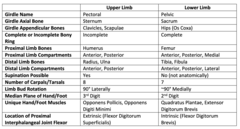
What are some differences and similarites between the upper and lower limbs? ** mostly differences
look at chart in image