Integumentary System Test
 Call Kai
 Learn
Learn Practice Test
 Spaced Repetition
 Match
Match Flashcards
 Knowt Play
1/117

There's no tags or description
Looks like no tags are added yet.
Name | Mastery | Learn | Test | Matching | Spaced | Call with Kai | Chat |
|---|
No analytics yet
Send a link to your students to track their progress
118 Terms
What are the 2 major components of the integumentary system?
Cutaneous Membrane
Accessory Structures
The cutaneous membrane is made up of the _______________________ and the ___________________
Epidermis and Dermis

What are the accessory structures of the integumentary system?
Hair, Glands, Other Glands, Nails
List the 5 general functions of the integumentary system.
Protection, Excretion, Temperature Regulation, Synthesis of Vitamin D, Sensation
5. What is the acid mantle?
On the outer surface of the epidermis, covering the corneum
- Protects against harmful bacteria and other microorganisms.
- Helps maintain the skin's natural barrier.
- Prevents excessive moisture loss.
- Supports healthy skin enzymes and normal skin function.
How does the integumentary system play a role in the regulation of your body temperature?
Heat Loss - Controlled by the activation of sweat.
Heat Retention - Controlled by not allowing the blood to flow into the skin's capillary beds. Keeps heat in the body by directing blood to the core
Make sure you have read and understand the Case Study on Frostbite page 164.
What vitamin is made by exposing the skin to sunlight?
Vitamin D
What type of tissue makes up the epidermis?
Stratified Squamous Epithelium
- tissue made of multiple layers of cells
Explain what it means when tissues become keratinized.
Cells fill with keratin, a tough protective protein. The cells become hard and eventually die, forming a protective outer layer that helps prevent water loss and protects the skin from injury and infection.
What type of tissue makes up the dermis?
Dense Irregular Connective Tissue
12. What type of tissue makes up the subcutaneous layer?
Loose Connective Tissue
Where is most of the fat in the body stored?
subcutaneous layer

What is the fancy term for fat?
Adipose Tissue
What are 3 major functions of adipose tissue?
1. Acts as a shock absorber
2. Insulates deeper tissues from external temperature changes
3. Creates the curve that distinguishes men from women
List the layers of the epidermis from most superficial to deepest for hairless skin.
Corneum
Lucidem
Granuiosm
Spinosum
Basale
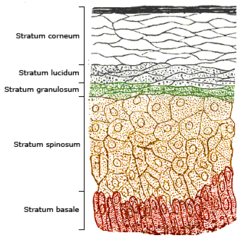
Which layer of the epidermis has the greatest number of cell layers?
Corneum
Which layer of the epidermis is completely dead and keratinized?
Corneum

Which layer of the epidermis is missing from skin with hair?
Lucidem
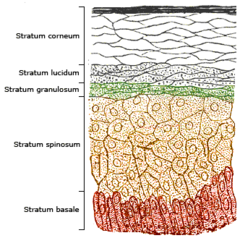
Where in the body do you find hairless or thick skin?
Palms, Soles of feet, fingertips
In which layer of the epidermis is keratohyalin found?
Granulosm
What substance starts to cause the nucleus and other organelles to start to deteriorate and die?
keratohyalin
Which layer of the epidermis consists of only one layer of cells?
Basale
Which layer of the epidermis is the growth layer?
Basale
True or false: all the cells of the stratum basale push upwards and become part of the more superficial layers of the epidermis.
False.
Most of the cells do, but not all.
What does the term desquamate mean?
Ability for one cell to turn into another type
How long does it take for the cells of the stratum basale to reach the surface of the epidermis and desquamate?
Around 40-56 days
What happens to the cells of the stratum basale that migrate down into the dermis?
Give rise to sweat glands, oil glands, and hair follicles

The dermis contains collagenous and elastic fibers. What is the purpose of these fibers?
Increase surface area. Collagen fibers give the skin strength, while elastic fibers allow it to stretch and return to its original shape.
List the 2 layers of the dermis.
Papillary region
Reticluar region

What is the prominent structure of the papillary region of the dermis?
Small like finger structures which greatly increase the surface area of this region.
Where do your fingerprints come from?
Friction ridges are formed by the dermal papillae
What type of tissue makes up the reticular region of the dermis?
Dense irregular connective tissue that interlaces in a net-like formation
Is the dermis of equal thickness throughout the skin? Explain.
No. The dermis varies in thickness depending on the location on the body.
Is the hypodermis part of the skin?
No
What is the difference between skin tone and skin undertone?
Hemoglobin and Carotene: These are related to undertone, not skin tone
What 3 pigments determine or influence your skin tone or undertones?
Melanin
Carotene
Hemoglobin
What substance determines your natural skin color?
melanin
- Determined by genetics
What determines how dark or light your skin color is?
Genetic factors
What is the purpose of melanin?
Protect against UV rays
Be able to describe the basic steps of melanin production.
Tyrosine is converted by the enzyme tyrosinase into dopaquinone, which is then used to produce melanin. The melanin is packaged into melanosomes and transferred to surrounding skin cells (keratinocytes).
True or false: people with darker skin have more melanocytes than people with lighter skin. Explain...
False, all humans have the same number of melanocytes, but the amount of melanin produced by melanocytes is genetically determined
What would happen if your body stopped making or had an inability to make tyrosinase?
The body would be unable to make melanin, causing albinism.
Why does exposure to sunlight cause your body to make more melanin?
Exposure to sunlight stimulates the production of melanin to help protect the skin from harmful UV rays.
Can hormones affect how your body produces melanin? Explain.
Yes. Hormones can affect melanin production by stimulating melanocytes to produce more or less melanin, which can change skin pigmentation.
What is vitiligo?
Occurs when melanocytes die or stop producing melanin.

How can blood flow change your skin undertones?
1) Inflammatory responses stimulated by sunburns, infections, allergic reactions, or insect bites
2) Emotional changes like blushing can result in erythema: Redness of the skin caused by inflammation from sunburns, infections, allergic reactions, or insect bites.
3) Illness/shock can result in pallor: Illness, shock, or fear can cause pallor, which is an unusual paleness of the skin.
4) Exposure to cold results in cyanosis: Exposure to cold or low oxygen levels can cause cyanosis, a bluish discoloration of the skin
5) The liver breaks down worn-out red blood cells; if they are not broken down properly jaundice occurs
What is erythema?
Redness of the skin caused by inflammation from sunburns, infections, allergic reactions, or insect bites.

What is pallor?
Illness, shock, or fear can cause pallor, which is an unusual paleness of the skin.

What is cyanosis
Exposure to cold or low oxygen levels can cause cyanosis, a bluish discoloration of the skin.

What is jaundice, and which organ is associated with it?
Yellow discoloration of the skin and eyes caused by a buildup of bilirubin in the blood. It is associated with the liver
What other substance can change your skin undertone?
Carotene
Eating carotene-rich foods can cause a temporary orange tint to the skin as carotene builds up in the corneum, adipose tissue, and subcutaneous tissue.
What is ecchymosis?
Medical term for a bruise

Explain how bruising occurs.
1) An injury damages small blood vessels beneath the skin
2) Damaged blood cells leak under the skin
3) The blood pools under the skin, which makes the bruise visible
Why do bruises turn yellow?
As a bruise heals, hemoglobin in the blood breaks down and is reabsorbed by the body. This breakdown results in localized jaundice
What 2 vitamins are thought to be responsible for the evolution of skin color?
Vitamin D and Folate
What is the function of folate?
Helps the body make DNA and new cells, supports red blood cell production, and is essential for healthy fetal development. It is important for skin color evolution because UV radiation can break down folate, which is needed for normal cell growth and reproduction
Be able to explain or identify how varying levels of sunlight may have influenced changes in skin color over many millennia.
High UV sunlight: Darker skin evolved with more melanin to protect folate and reduce UV damage.
Low UV sunlight: Lighter skin evolved with less melanin to help the body produce enough vitamin D.
Moderate UV sunlight: Intermediate skin tones developed to balance folate protection with vitamin D production.
60. What are exteroreceptors?
Sensory receptors of the skin
List the 6 sensory receptors we discussed in class.
"Funny Monkeys Make Really Huge Pancakes"
Funny = Free nerve endings
Monkeys = Merkel disks
Make = Meissner's corpuscles
Really = Ruffini endings
Huge = Hair follicle receptors
Pancakes = Pacinian receptors
Of the 6 sensory receptors, which one is the simplest and most common?
Free Nerve Endings
What stimuli do free nerve endings respond to?
Strong and painful stimulation
Temperature
Why are some temperatures associated with a pain response and others are not?
Our receptors only detect pain at certain temperatures.
Anything below 10 degrees Celsius is too cold
Anything above 45 degrees Celsius is too hot
Which sensory receptors respond to light touch and superficial pressure?
Merkel Disks
Which sensory receptors are responsible for 2-point discrimination?
Meisseners Corpuscles
What is 2-point discrimination?
skin's ability to recognize two separate points of touch at the same time rather than feeling them as one point
Which sensory receptors are responsible for sensing deep cutaneous pressure and vibrations?
Pacinian Receptors
What do hair follicle receptors sense?
Bending of hair and light touch
EX: a fly landing on your arm
Which sensory receptors are responsible for helping to adjust the grip on an object and how?
List the 6 receptors from (roughly) most superficial to deepest.
1) Free nerve endings
2) Merkel disks
3) Meissner's corpuscles
4) Ruffini endings
5) Hair follicle receptors
6) Pacinian Receptors
"Funny Monkeys Make Really Huge Pancakes"
How is tissue repair defined?
The restoration of tissue architecture and function after an injury
Tissue repair can occur in 1 of 2 ways. What are these?
Regeneration
Replacment
How are regeneration and replacement similar and different?
Regeneration: New cells are the same type as those that were destroyed, and normal functions are restored
Replacement: A new type of tissue develops that eventually causes scar production and the loss of some tissue function
What protein binds the edges of a wound together?
Fibrin
Besides acting like glue, what other role does fibrin play in the healing process?
Isolates walls from foreign material
What is the role of fibroblasts in wound repair?
Produces collagen and other connective tissue components that rebuild and strengthen the skin during wound healing.
What is the problem with granulation tissue?
When a large amount of granulation tissue forms, a scar may develop. Scar tissue consists of dense, irregular collagenous connective tissue and can result in a larger, more noticeable scar that may require sutures (stitches).
Be able to label hairless skin and/or skin with hair.
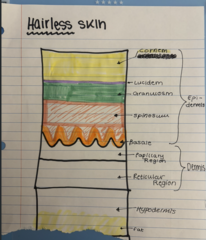
83. There may be a question from the blue box on page 162.
Lanugo Hair
Delicate, unpigmented hair that covers a fetus by 5-6 months of development
terminal hair
Long, coarse, pigmented hair found on the scalp, legs, arms, and bodies of males and females.
replaces lanugo hair
vellus hair
peach fuzz replaces the rest of the lanugo hair
During and after puberty, what happens to vellus hairs?
Terminal hair replaces much of the vellus hair, especially in the pubic and axillary regions
Primary Union
The edges of a wound are close together
1) The wound fills with blood, and a clot forms
2) A Protein in the clot binds the edges of the wound together. This protein is fibrin.
3) The surface of the clot dries and forms a scab, which seals the wound and helps prevent infection
Secondary Union
1) Healing and repair are similar to primary union with the exception of much more granulation tissue forming to fill the wound
2) A large amount of granulation tissue will result in a scar. Scar tissue consists of dense irregular collagenous connective tissue (Replacement!)
3) This results in a large scare, which may be disfiguring and debilitating. This is why sutures, stitches, are used to close up a large wound
Labile Cell
Continue to divide through life. Includes the cells of the skin, mucous membranes, lymphatic, and hematopoietic tissues. Damage to these cells is repaired completely by regeneration.
Stable Cells
Do not divide after growth stops, but retain the ability to do so and are capable of regeneration in response to injury, including cells of some connective tissues and glands (Bones, liver, pancreas, endocrine glands)
Permanent Cells
very limited ability to replicate, and if damaged, will be replaced by a different type of cell. (Neurons?, heart cells, and skeletal muscle cells)
Know where the following glands are: Apocrine, Eccrine, Sebaceous

List the 3 types of hair a person will have throughout their lifetime.
Lanugo, Vellus, Terminal
What type of hair is associated with a fetus?
Lanugo
Which type of hair is on your scalp, arms, and legs after puberty
Terminal
Which type of hair would you find on your face/cheekbones before puberty
Vellus
What is the average growth phase for eyelashes?
The average rest phase?
Growth 30-45 days
Rest 100 days
What is the average growth phase for scalp hair?
The average rest phase?
Growth 3-5 years.
Rest 3-4 months.
What percent of hair is in the growth phase?
85%
What portion of the hair is enclosed in the follicle?
Root
What portion of the hair is projecting from the skin
Shaft
List the 3 layers of the hair from deepest to most superficial
Medulla, Cortex, Cuticle

What is hair pigment determined by?
Melaninis the primary determinant of hair color, produced by melanocytes.