phsychology sap
 Call Kai
 Learn
 Practice Test
 Spaced Repetition
 Match
 Flashcards
 Knowt Play
1/102

There's no tags or description
Looks like no tags are added yet.
103 Terms
Definition of Psychology
The scientific study of mental processes and behaviours of people
about the brain
The “command centre” of your body
There are two hemispheres that are connected through the corpus callosum
the brain is generally divided into three major regions:
hindbrain, midbrain, forebrain
the two brain hemispheres:
left and right
left brain specialties
logic and reasoning, controls language, verbal skills, math ability,
right brain specialties
visual, non-verbal abilities, creativity, imagination, athleticism
cerebrum
the lobes oft he brain
what are the four cerebrum lobes?
frontal lobe, parietal lobe, temporal lobe, occipital lobe
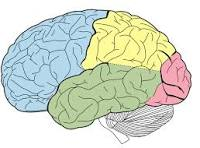
where is the frontal lobe?
the blue


where is the parietal lobe?
the yellow

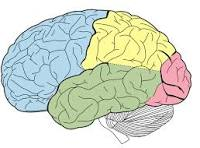
where is the temporal lobe
the green


where is the occipital lobe
the pink

about the frontal lobe
largest lobe
primary motor cortext / controls movement of the muscles
high executive functions / CEO of lobes
emotinoal regulation, planning, reasoning, problem solving
about the occipital lobe
receives visual information from the eyes : driving
interprets depth, distance, location, and identity of seen object
about the sensory cortex
responsible for sensory info: touch, temperature, pressure, pain
The right side of the body delivers information to the left hemisphere's sensory cortex.
left side of the body delivers info to the right hemisphere's sensory cortext
registers WHAT you feel (I feel this oject is cold and sharp)
about the parietal lobe
repsonsible for processing sensory, temperature, pressure, info: touch temperature pressure pain
ex: takes info n figures out WHERE it is in space
my hands touching an ice cube on a table
about the temporal brain
repsonsible for integrating sensory information (reciewving and deliveirng info)
3 senses
3 temporal brian senses and meanings:
AUDITORY: receiving and processing what you hear
VISUAL: make sense of complex visual information
MEMORY: contains the hippocampus
neurons
Nerve cells that send messages all over your body to allow toy to do everything
Receiving sensory information
Send commands and signals
Neurogenesis
In the past, psychologists believed that neurogenesis (the generation of neurons) stopped shortly after birth
With today’s research, we now know that new neurons can still be created in childhood and adulthood, just at a much slower rate
neuroplasticity
The brain's ability to change, adapt, grow, and reorganize its neural networks.
forms rapidly during child development
Synapses are created whenever you learn an new concept or skill
how to improve neuroplastiity
enrich environment: learn languages.
get rest
exercise
play
what does left hemisphere of brian control?
right hand, arm, leg, eyebrow
what does the right brain hemisphere control?
left hand, arm, leg, eyebrow
behaviourism
Focuses on observable behaviour
Psychologists can predict, control, or modify human behaviour by identifying factors that motivate it in the first place
behavioural psychologist B.F. Skinner
started in 1930s, oserving animal behaviour
wanted to understand why animals behave the way they do
he theorized that human behaviours are ALSO controlled by rewards nad punishments
operant conditioning
use of rewards and punshments can influence behaviour
the skinner box
Inside the box, a rat is rewarded with food whenever it presses a LEVER
When the rat realizes THIS, it will keep pressing the lever
when the dispenser has no more food, the rat will STOP pressing the lever
now what is the skinenr ox had a punishment instead of a reward, ex: shocking?
when presisng it would shock the rat, the rat STOPPED pressing the lever.
reinforcment
the process where a behaviour is stregthened and more likely to happen agian
positive reinforcment vs negative and examples
positive: making a behaviour stronger by following the behaviour with a pleasant stimulus
ex: rewarding with candy
negative: making a behaviour stronger by taking away a negative stimulus
ex: removing buzzer sound
punishment
process in which a behaviour weakens and lessl ikely to happen agian
positive punishment vs negative and examples
positive: decreasing a behaviour by following the behaviour with an unpleasant stimulus
ex: shock
negative: making a behaviour stronger by taking away a positive stimulus
ex: taking away recess
ivan pavlov the theorist
studied dog biologu
Discovered dogs SALIVATE when food is in front of them
noticed thast they drool when he wore his lab coat
learned TO ASSOCIATE person wearing lab coat to FOOD
what did pavlov attempt to do (research)
attempted to train dogs to associate
1. bell sound
'2. food when the bell rang
3. dog will salivate
classical conditioning
an organism learns to associate one stimulus with another. The first stimulus is a cue for the second stimulus
conditioning in real life example
Unconditioned stimulus=getting immunization shots
Unconditioned response= ANXIETY
Neutral stimulus = entering a clinic
Neutral response = calm
Associate clinic with getting shots
Conditioned stimulus = entering clinic
Conditioning response = ANXIETY
Sgimund Freud's psychoanalysis theory
Formed in the 1900s, it is the belief that unlocking the unconscious mind is the key to understanding human behavior, personality, motivation, and relationships. It emphasizes that we are driven by biological motives and early childhood experiences.
According to Freud, what conflict drives human behavior?
Society requires us to bring our innate animal impulses under control, meaning the parts of our psyche (mind) are continually at war with each other.
the 3 parts of the human phsyche
ID, ego, superego
what is the id? (part of the human psyche)
The instinctual part of the mind that is driven by the pleasure principle. Present at birth (a newborn is completely selfish).
What is the Ego?
The rational part of the mind that operates on the reality principle. It develops around age 3 (when children realize others have feelings) and tries to suppress the Id while satisfying the moral Superego.
What is the Superego?
The moral center of the mind. It develops around age 5 from the sense of morality passed down by parents.
How do the Id, Ego, and Superego interact in a real-world scenario (e.g., seeing a stranger's hamburger when hungry)?
Id: Wants to steal and eat the hamburger immediately to satisfy hunger (pleasure principle).
Superego: Wants you to leave it alone because stealing is wrong (moral center).
Ego: Struggles to mediate between the two (e.g., buying your own food to satisfy hunger realistically).
What is the Conscious Mind?
Everything that we are currently aware of in our immediate thought processes.
What is the Unconscious Mind?
The part of the mind containing thoughts, feelings, urges, and biological drives that exist outside of our direct awareness.
How does Freud's Iceberg Metaphor explain consciousness and the structure of the mind?
Above Water (Conscious Mind): Represents what we are actively aware of.
Below Water (Unconscious Mind): The massive hidden part of the mind containing buried motives and feelings.
Placement of Psyche Parts: The Id lives entirely in the unconscious mind below water. The Ego and Superego straddle both sides of the iceberg, operating both consciously and unconsciously.
What is the definition of a defense mechanism?
Unconscious strategies used by the Ego to resolve internal conflicts and distort reality in order to protect against anxiety and unacceptable feelings.
How does the Ego use defense mechanisms to distort reality?
Represses unacceptable feelings and memories so they remain below the surface of awareness.
Rationalizes the situation.
Distorts reality to protect the psyche.
What are three specific examples of defense mechanisms?
Regression: Returning to primitive levels of behavior when stressed (e.g., biting nails, pacing back and forth).
Repression: Completely blocking a painful or unacceptable thought from conscious awareness.
Denial: Refusing to accept reality (e.g., repeating "I am not hungry, I'll get food once I get home").
How did Carl Jung’s view of the unconscious differ from Freud’s?
Jung disagreed with Freud and believed the unconscious is divided into two distinct levels: Personal and Collective.
What is the Personal Unconscious?
the part of the unconscious mind that is unique and specific to each individual person.
What is the Collective Unconscious?
he shared layer of the unconscious mind that reflects the inherited memories, experiences, and impulses of human ancestors, shared by all human beings.
What are Archetypes according to Jung?
Universal symbols, patterns, and images stored in the collective unconscious that tend to reappear across human culture and in our dreams.
How did Sigmund Freud access the unconscious mind?
Through Free Association, where a client relaxes and speaks whatever comes directly to mind without censorship, regardless of how silly or embarrassing it may seem.
How did Carl Jung access the unconscious mind?
Through Creative Expression (e.g., painting or art), where the goal is to let spontaneous mental images flow freely to express archetypes and subconscious thoughts.
cognitive phsychology
the study of mental processes such as
Attention
memory
What was the primary purpose of Albert Bandura's Bobo Doll Experiment?
To demonstrate that children can learn social behaviors—specifically aggression—purely through observational learning by watching an adult model.
How was the Bobo Doll Experiment conducted?
Children observed an adult model acting aggressively toward an inflatable "Bobo doll" (e.g., punching, kicking, yelling). Later, when left alone in a room with the doll, the children imitated the exact same aggressive behaviors they had observed.
What were the key findings of the Bobo Doll Experiment?
Children imitate observed behaviors without receiving direct rewards or direct instruction.
Exposure to aggressive models increases the likelihood that children will act aggressively.
the observational learnings
attention
retention
reproduciton
motivation
RRAM
What is Attention? and example
Paying close attention to and observing the behaviors, routines, or demonstrations of a role model or teacher.
Example: Watching a teacher demonstrate step-by-step how to solve a math problem.
What is Retention? and ex
Storing a mental representation in memory of what was observed, taking note of what worked well and what the outcome was.
Example: Remembering the exact steps and formulas the teacher used to solve the problem.
What is Reproduction? and ex
Converting stored memory into physical action by practicing the observed behavior or skill yourself.
Example: Trying to solve a similar math problem on your own using the steps you memorized.
What is Motivation? and ex
Having a reason or desire (sourced from yourself, another person, or an event) to practice and master the observed behavior.
Example: Being motivated to practice math because you want to get better grades and understand the course material.
How does Elizabeth Loftus describe human memory?
Memory does not work like a recording device or video camera. Instead, memory is malleable, reconstructive, and subject to distortion over time.
What is a False Memory?
A memory of an event or detail that never actually happened, or a memory that is significantly altered from how the event actually occurred.
What is the Misinformation Effect?
The phenomenon where exposure to misleading post-event information (such as suggestive questioning or leading words) alters or distorts a person's recall of the original event.
How did Elizabeth Loftus demonstrate the Misinformation Effect using the car crash study?
Loftus showed participants a film of a car crash and asked them how fast the cars were going when they hit each other.
When she used stronger verbs like "smashed", participants estimated much higher speeds and falsely remembered seeing broken glass.
When she used milder verbs like "hit" or "contacted", participants estimated lower speeds and correctly recalled no broken glass.
Can false memories be completely implanted?
Yes. Through suggestive techniques and social reinforcement, Loftus successfully implanted entire false childhood memories into participants (e.g., convincing people they were lost in a shopping mall as a child or attacked by an animal).
why is false memory research critical to the legal system?
Eyewitness testimony is often heavily relied upon in courtrooms, but leading questions by police or prosecutors can inadvertently plant false memories, leading to wrongful convictions.
According to Loftus, what causes memory contamination?
Leading questions, talking to other witnesses, media coverage, or biased interrogation techniques can alter an eyewitness's original memory.
How did Jean Piaget believe cognitive development occurs?
Maturation occurs through physical activity and active interaction with the environment. As children experience new things, their brains adjust through assimilation and accommodation (updating their mindsets/mental representations).
What are the 4 stages of Piaget's Cognitive Development in order?
Sensorimotor Period (Birth to 2 years)
Preoperational Period (2 to 7 years)
Concrete Operational Period (7 to 11 years)
Formal Operational Period (11 years to adulthood)
What happens during the Sensorimotor Period (Birth to 2 years)?
Children coordinate sensory input with motor abilities and begin developing mental symbols.
when does object permaance develope
during the sensorimotor period (birth to 2 years)
object permanence:
the recognition that objects continue to exist even when they are no longer in sight (e.g., why babies find peekaboo surprising before developing this skill).
What characterizes the Preoperational Period (2 to 7 years)?
Children rely heavily on imagination and symbolism, but their logical thinking is limited by key cognitive shortcomings:
Conservation (Lack of): Inability to understand that physical quantities remain constant despite changes in shape or appearance.
Centration: The tendency to focus on only one feature of a problem while ignoring other important aspects.
Irreversibility: The inability to envision reversing an action back to its starting state.
Egocentrism: Limited ability to view the world from another person's perspective.
What characterizes the Concrete Operational Period (7 to 11 years)?
Children can perform mental operations based on tangible, concrete objects and events.
Key developments: Mastery of conservation, decentration (ability to focus on multiple aspects of a problem), reversibility (can undo actions in their mind), decreased egocentrism, and the ability to compare, contrast, and sort objects.
What characterizes the Formal Operational Period (11 years onwards)?
Children apply mental operations to abstract concepts and hypothetical possibilities. They begin solving problems systematically (thinking things through before acting) rather than using pure trial and error.
How did Lev Vygotsky explain cognitive development in his Sociocultural Theory?
Cognitive growth is an "apprenticeship" fueled by social interactions with more knowledgeable partners (parents, teachers, older peers). Culture and environment directly shape how cognitive development occurs.
What is the Zone of Proximal Development (ZPD)? and ex
The gap between what a learner can accomplish independently on their own and what they can achieve with guidance and encouragement from a more skilled partner.
Example (Samantha writing her name): What she can do alone = write individual letters; ZPD = print her full name with parental assistance; What she cannot do yet = write in cursive.
What is Scaffolding?
The temporary support or assistance provided to a learner by a more skilled person during the learning process. As the learner's competence increases, the amount of assistance provided is gradually reduced.
What is Memory?
The brain's system for taking in information, storing it, and retrieving it when needed.
What are the three main parts of forming a memory
Encoding: Processing new information so your brain can use it (requires attention).
Storage: Holding onto the coded information in your brain over time (like saving a file to Google Drive).
Retrieval: Recalling or pulling stored information back out of memory when you need it.

What is Sensory Memory? and ex
Information taken in directly through the 5 senses (sight, hearing, touch, taste, smell). It only lasts for a few seconds—just long enough to notice what is important.
Example: Looking at an ad for a second before the image fades, or remembering the start of a sentence as you finish reading it.
What is Short-Term Memory? and ex
Holds onto a small amount of information for about 15 to 20 seconds. It can hold up to 7 items (unrelated things) at once before it is either saved or forgotten.
Example: Remembering a phone number or page number just long enough to use it.
What is Long-Term Memory? and ex
Keeps information stored for long periods of time (days, years, or a lifetime).
Flashbulb Memories: Unusually clear, vivid, and detailed memories of major or emotional life events.
What are the 3 types of Long-Term Memory?
Procedural Memory: How to do physical tasks or skills (e.g., riding a bike, playing the flute).
Semantic Memory: General facts, words, and knowledge (e.g., knowing the name of the Prime Minister).
Episodic Memory: Personal life experiences and specific events (e.g., remembering your first day of high school).
What are three main ways to encode information into memory?
Acoustic Encoding: Remembering something by sound (repeating words or saying things out loud to yourself).
Semantic Encoding: Remembering something by making sense of its meaning (e.g., understanding the difference between ego and superego).
Elaborative Encoding: Remembering something by connecting it to things you already know (prior knowledge).
How does information move through the Memory Diagram (Information Processing Model)?
Sensory Input & Sensory Memory: Information enters through the senses. If you pay attention, it moves to the next stage (otherwise it is lost).
Short-Term Memory: Information is held for 15–20 seconds. If you rehearse (repeat) or encode it, it moves forward.
Long-Term Memory: Information is stored long-term. When you need to remember something, your brain retrieves it back into your short-term (working) memory.

label this
ayyy
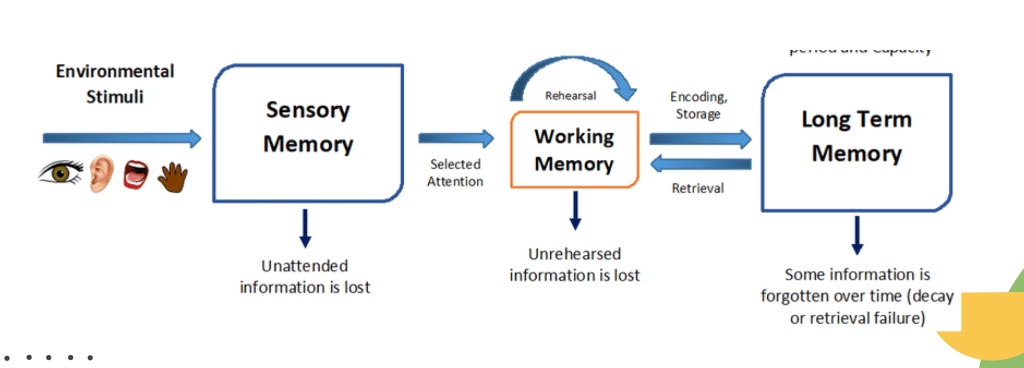

label this
What happened in the case study of Kitty Genovese (1964)?
Kitty Genovese was brutally attacked outside her New York apartment over a period of time while 38 neighbors looked on from their windows. Despite her screams for help, none of the neighbors intervened or called the police during the assault until after the attacker had fled.
2
What is a bystander and what is the Bystander Effect?
A bystander is a person present at an event without participating. The Bystander Effect is the phenomenon where individuals are less likely to help a stranger in distress—or will take much longer to help—when other people are present. The larger the group, the less likely anyone is to help.
What are the three main reasons why the Bystander Effect occurs?
Ambiguity: Witnesses aren't sure if an emergency is actually happening and fear embarrassing themselves if it's a misunderstanding.
Pluralistic Ignorance: Witnesses look to other people to see how they are reacting; if no one else is acting or panicking, everyone assumes there is no emergency and decides not to act.
Diffusion of Responsibility: Because multiple people are witnessing the event, individuals assume someone else will step in or has already called for help, which reduces their own personal sense of obligation.
What is the definition of Conformity?
Changing your behavior, opinions, or beliefs to match those of other people, typically as a result of real or imagined social pressure. People conform to feel a sense of security, belonging, and acceptance within a group.
Under what conditions is conformity most likely to occur?
When the group size is large.
When people must express their opinions publicly (rather than privately).
When individuals have low self-esteem.
When the task or situation is difficult or confusing.
When there is a group member who is perceived as an expert or knowledgeable.
What was the purpose of Stanley Milgram's 1963 experiment?
Conducted after WWII/the Holocaust to understand obedience to authority—specifically why ordinary people blindly follow instructions from an authority figure, even when commanded to harm another person.
What was the method and setup of Milgram's experiment?
Participants were told the study was about "memory and learning."
The participant was assigned the role of Teacher, while an actor was assigned the role of Learner (strapped into a chair in another room).
The Teacher was ordered by an authority figure (an Experimenter in a lab coat) to deliver electric shocks to the Learner every time they got a memory question wrong, increasing the voltage with each error from 15V up to 450V (Note: No real shocks were delivered, but the Teacher believed they were real).