General Anatomy
 Call Kai
 Learn
Learn Practice Test
 Spaced Repetition
 Match
Match Flashcards
 Knowt Play
1/56

There's no tags or description
Looks like no tags are added yet.
Name | Mastery | Learn | Test | Matching | Spaced | Call with Kai | Chat |
|---|
No analytics yet
Send a link to your students to track their progress
57 Terms
Anatomy
the science of the structure of the body
sagittal plane
divides the entire body or a body part into right and left segments
midsagittal plane
plane that passes through the midline of the body and divides it into equal right and left halves
coronal plane
passes through the body vertically from one side to the other and divides the entire body or a body part into anterior and posterior segments
midcoronal plane
passes through the midline of the body, dividing it into equal anterior and posterior halves
midcoronal plane can also be referred to as this..
midaxillary plane
horizontal plane
passes crosswise through the body or a body part at right angles to the longitudinal axis and divides the body into superior and inferior portions
oblique plane
can pass through a body part a any angle
interiliac plane
transects the pelvis at the top of the iliac crests at the level of the fourth lumbar spinous process
occlusal plane
formed by the biting surfaces of the upper and lower teeth with the jaws closes
the two great cavities of the torso
thoracic and abdominopelvic cavity
what can be found within the thoracic cavity?
pleural membranes, lungs, trachea, esophagus, pericardium, heart, and great vessels
what can be found in the abdominal cavity?
peritoneum, liver, gallbladder, pancreas, spleen, stomach, intestines, kidneys, ureters, major blood vessels
what can be found in the pelvic portion of the abdominal cavity?
rectum, urinary bladder, parts of the reproductive sysemt
4 clinical divisions of the abdomen
quadrants
4 quadrants of the abdomen
RUQ, RLQ, LUQ, LLQ

What is Quadrant A.?
Right Upper Quadrant

What is Quadrant B.?
Left Upper Quadrant

What is Quadrant C.?
Right Lower Quadrant

What is Quadrant D.?
Left Lower Quadrant
how are the 4 quadrants of the abdomen made?
the midsagittal plane and a horizontal plane intersect at the umbilicus and created the 4 quadrants
another way to divide the abdomen, made by using four planes, two horizontal, and two vertical
nine regions
9 regions o the abdomen
right hypochondrium, epigastrium, left hypochondrium, right lateral, umbilical, left lateral, right lateral, hypogastrium

what is #1 of the abdominopelvic region?
right hypochondrium

what is #2 of the abdominopelvic region?
epgastrium

what is #3 of the abdominopelvic region?
left hypochrondium

what is #4 of the abdominopelvic region?
right lateral

what is #5 of the abdominopelvic region?
umbilical

what is #6 of the abdominopelvic region?
left lateral

what is #7 of the abdominopelvic region?
right inguinal

what is #8 of the abdominopelvic region?
hypogastriun

what is #9 of the abdominopelvic region?
left inguinal
common variations in the shape of the human body are
body habitus
why is body habitus important to radiography?
it determines the size, shape, and position of the organs of the thoracic and abdominal cavities
what parts of the body are directly affected by the body habitus?
heart, lungs, diaphragm, stomach, colon, galbladder
the four major types of body habitus
sthenic, asthenic, hyposthenic, and hypersthenic
85% of the population have either …
sthenic or hyposthenic

average body habitus
stenic

organs and characteristics for this habitus are intermediate between sthenic and asthenic- most difficult to classify
hyposthenic

extremely below average habitus; heart nearly vertical at midline, long lungs, and stomach medial and low in pelvis when standing
asthenic

above average habitus; heart is axial nearly transverse, short lungs near clavicles, and stomach is high/transverse in the middle
hyperstenic
surface landmarks
what radiographers use to obtain radiographs of optimal quality consistenly for a wide variety of body types

TEA
Top of Ear Attahcment

C1
Mastoid

C2,C3
gonion( angle of mandible)

C3, C4
hyoid bone
C5
thyroid cartilage

C7, T1
vertebra prominens

T1
approximately 5 cm (2 ins) above level of jugular notch

T2, T3
level of the jugular notch

T4, T5
level of sternal angle

T7
level of inferior angles of scapulae

T9, T10
level of xiphoid process
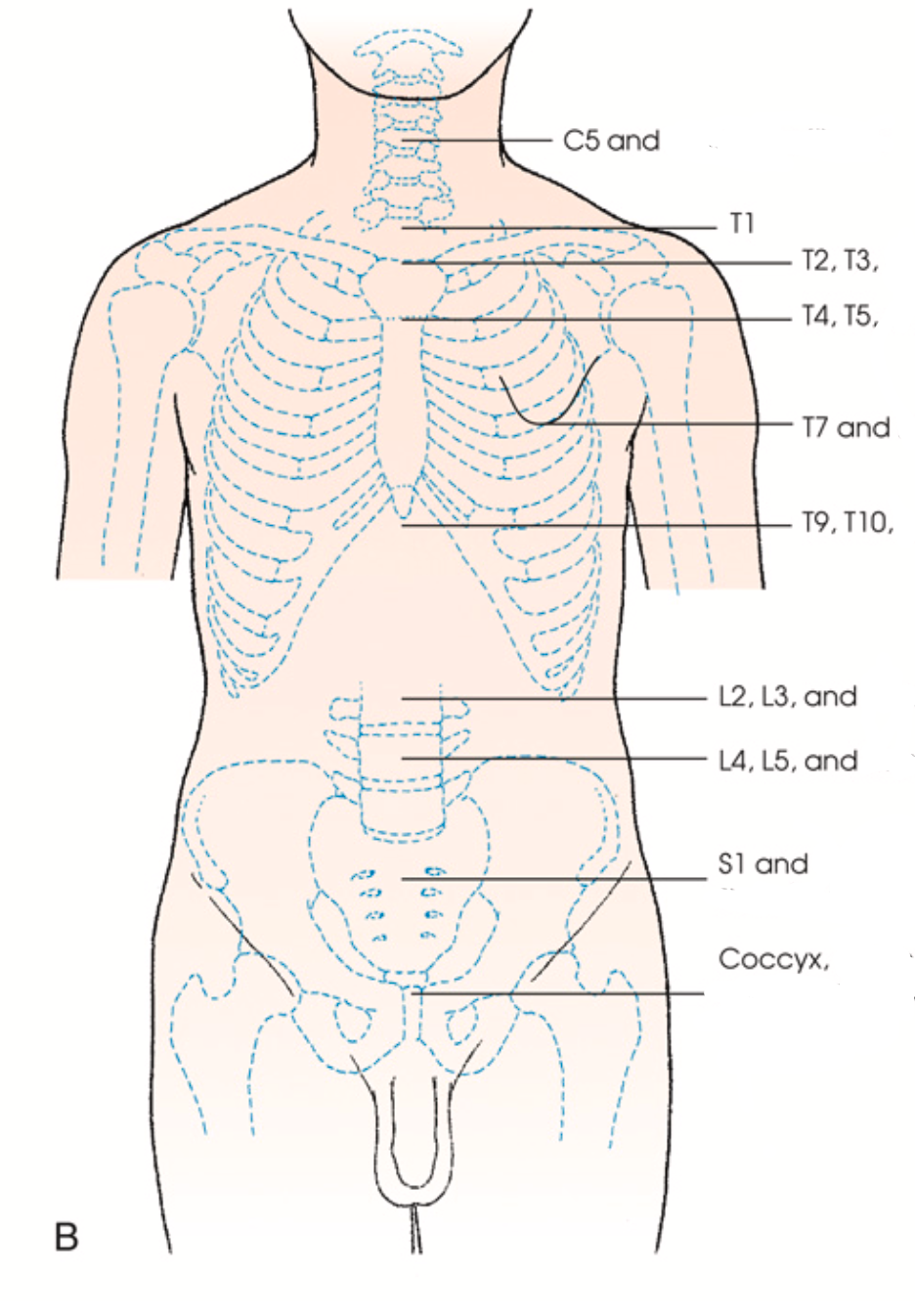
L2, L3
inferior costal margin

L4, L5
level of superior aspect of iliac crests
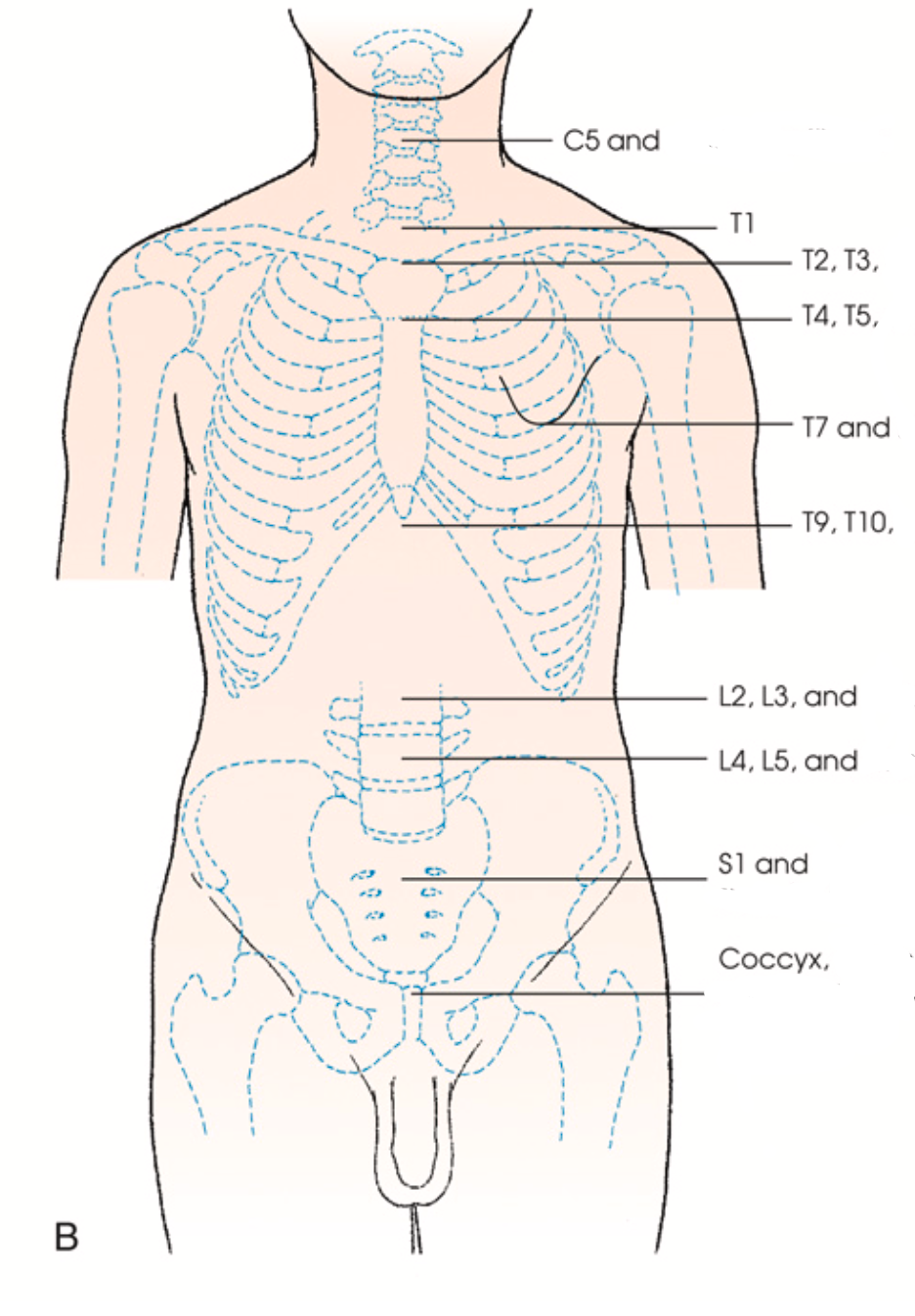
S1, S2
level of anterior superior iliac spin (ASIS)

coccyx
level of pubic symphysis and greater trochanters