lec 13 - generation of T cells
 Call Kai
 Learn
 Practice Test
 Spaced Repetition
 Match
 Flashcards
 Knowt Play
1/41

There's no tags or description
Looks like no tags are added yet.
42 Terms
As we know, our naive T cells sit inside our ….
As we know, our naive T cells sit inside our lymph nodes!

Recall what cell activates T cells to mature —> go into peripheral tissues —> and enact their effector functions?
dendritic cells activate T cells!
Recall where are T cells born?
in the bone marrow!
Hematopoietic stem cell progenitors differentiate into T cell precursors in the bone marrow

Hematopoietic stem cell progenitors differentiate into T cell precursors in the bone marrow
—> T cell precursors travel to the _________ where they develop into naive T cells
Hematopoietic stem cell progenitors differentiate into T cell precursors in the bone marrow
—> T cell precursors travel to the thymus where they develop into naive T cells

Where is the thymus?
in the middle of ur chest, above your heart!

Naive T cells travel from the thymus to ___________ tissues and await activation.
Naive T cells travel from the thymus to lymphoid tissues and await activation.

BOO YA!!! What does the T in T cell stand for?
for Thymus!
Recall the stages of development of a T cell… What happens in the thymus?
Hint: 3 developmental stages
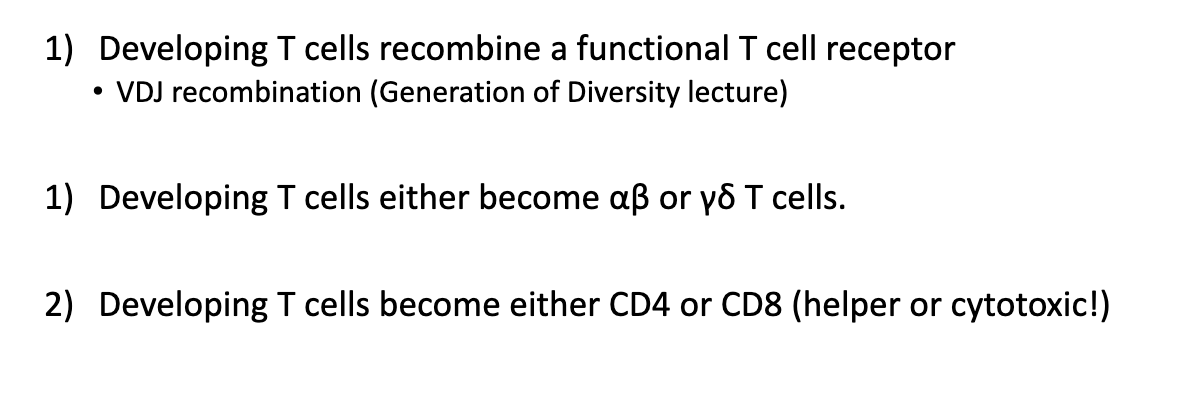
VDJ recombination
Becomes either alpha-beta or gamma-delta T cell
Becomes either CD4 helper or CD8 cytotoxic T cell

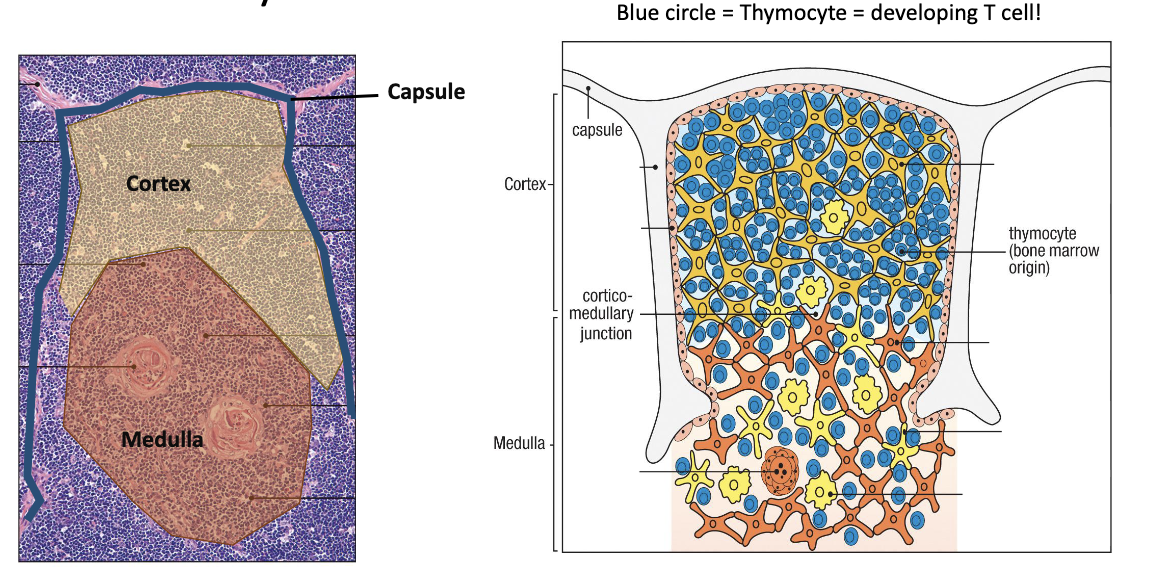
This image shows a real microscope view of thymus:
Capsule: The protective outer shell that wraps around the organ and divides it into lobules via septa.
Cortex: The packed outer layer (dark purple) where immature T cells (blue circles) multiply and start developing.
Corticomedullary junction: The border btwn the cortex and medulla where new cells enter from the bone marrow and mature cells leave into the bloodstream.
Medulla: The lighter inner core where T cells finish maturing and are tested so they do not attack your own body
…

Why does the cortex stain darker purple?
cuz it contains more thymocytes! this is afterall where they develop

Why does the medulla stain lighter purple?
cuz it contains less thymocytes!
In the medulla, T cells undergo ___________ selection (AKA a check to …) before maturing into CD4+ or CD8+ T cells
In the medulla, T cells undergo negative selection (AKA a check to make sure they don’t attack the body's own tissues) before maturing into CD4+ or CD8+ T cells
Precursor T cells are called ________-cytes
Precursor T cells are called Thymocytes!
Immunologists often figure out what an organ does by observing what happens when it is missing….
What is DiGeorge syndrome?
a birth condition caused by a chromosomal deletion that disrupts the growth of several organs, including the thymus!
—> no mature T cells

What is the nude mouse experiment?
The nude mouse experiment proved that the thymus is both necessary and sufficient for T-cell development by removing and restoring the organ in mice.

The hairless (nude)mouse is a type that are severely immunocompromised. They have no thymus nor T cells. What went wrong in their DNA?
They have a FOXN1 gene mutation that left them without a thymus or T cells ☹
Surgically removing the thymus (thymectomy) from normal newborn mice —→ what outcome?
Transplanting a functional thymus graft back into a nude mouse —> what outcome?
Surgically removing the thymus (thymectomy) from normal newborn mice —→ wiped out their T cells, mimicking the nude mouse.
Transplanting a functional thymus graft back into a nude mouse —> restored its T cells
So a thymectomy on newborn mice wiped out their T cells, but does a thymectomy on adult mice do the same?
no! it does not eliminate an adult’s T cells.
Why?
Because their body has already built up a full supply of mature T cells living outside the thymus!

So a thymectomy on newborn mice wiped out their T cells, but a thymectomy on adult mice doesn’t do the same.
Cuz for adults their tissues are already stocked with T cells (has already left the thymus long ago) and can self-clone. But newborns have an empty supply.
Over time our thymus shrinks anyway, meaning …
… meaning adults rely mostly on their existing T-cell pool anyway!
What is the thymus shrinking called?
THYMIC INVOLUTION


So as the thymus shrinks, thymic tissue is replaced with…
…with fat!

Since we undergo thymic involution as we age, the ability to produce new T cells [rises / declines] with age.
Since we undergo thymic involution as we age, the ability to produce new T cells declines with age.
What did the nude mouse experiment prove? That T-cell precursors exist in the body, but….
That T-cell precursors exist in the body, but they need a working thymus to mature.
Remember both types of T cells have CD3. Helper T cells have CD3 and CD4. Killer T cells have CD3 and CD8.
How can these surface proteins be used as markers?
Entry stage (CD3-): Immature cells from the bone marrow arrive in thymus with no markers.
Double negative stage (CD4- CD8-, CD3+): Once inside thymus, cells become CD3 (officially committed to T cell path).
Double positive stage (CD4+ CD8+, CD3+): The T cells turn on BOTH at the same time as they get tested in the thymus.
Single positive stage (CD4+ or CD8+, CD3+): Each cell turns into either a CD4+ or CD8+ T cell.
Therefore knowing what the cell expresses and where the cell is located determine the…
Therefore knowing what the cell expresses and where the cell is located determine the stage of development!
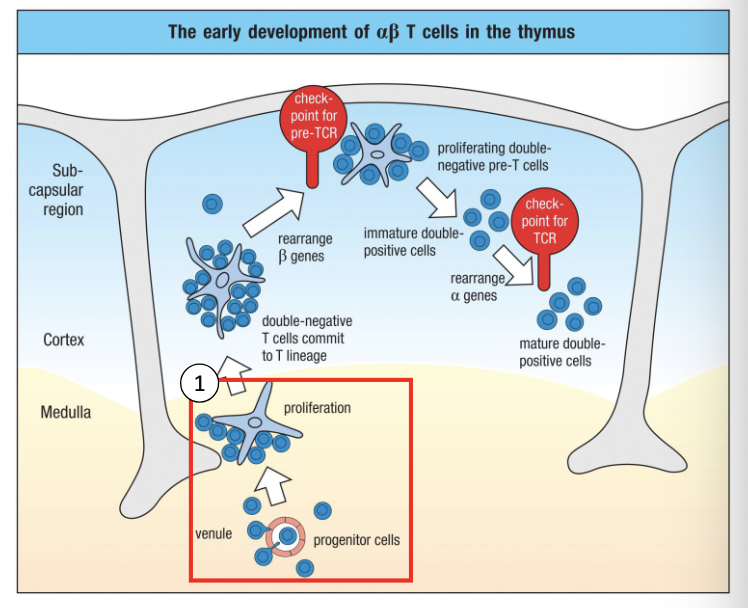
Tell me more about the entry stage (CD3-)! This is when progenitor T cells go from blood into medulla —> proliferate like crazy.
Why?
cuz not all progenitors make it! so clone a bunch of times so it has a good chance to survive.
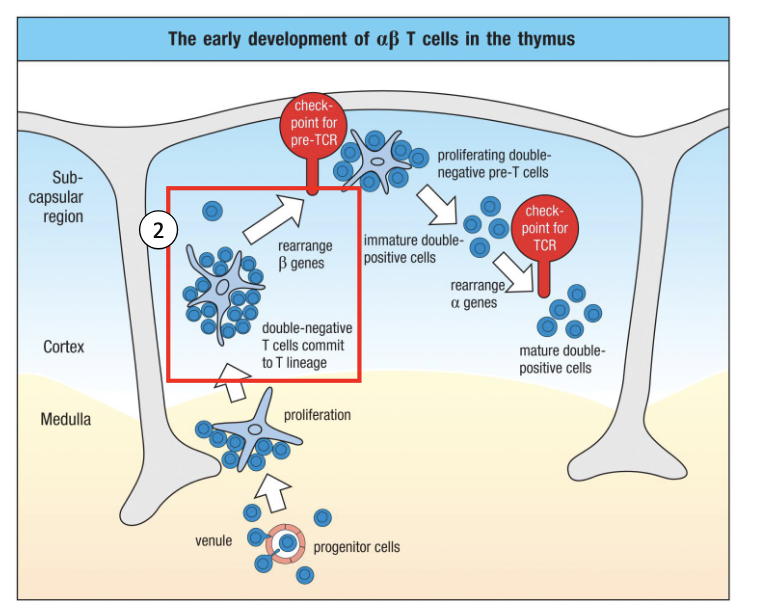
Tell me more about the double negative stage (CD3+, CD4- CD8-)! This is when thymocytes commit to T cell path.
They upregulate _ _ _ genes to allow VDJ recombination to make a TCR. They move into the cortex towards the subcapsular region.
They upregulate RAG genes to allow VDJ recombination to make a TCR. They move into the cortex towards the subcapsular region.
Fun fact what does RAG genes stand for?
Recombination-activating gene (RAG)
At what stage does a T cell decide to become either alpha-beta or gamma-delta?
the double negative stage! and immediately! it just depends on which receptor genes it successfully builds first.

T/F: 95% of T cells carry an alpha-beta T cell receptor.
true!
If 95% of T cells are alpha-beta TCR, where are the 5% gamma-delta TCRs found?
Hint: mostly at mucosal sites
gamma-delta T cells are mostly found at mucosa — like the intestines!
they detect molecules related to cellular stress etc and tend to act like innate immune cells.

Tell me more about the double negative stage (CD3+, CD4- CD8-)! From VDJ recombination, the cell builds a beta-chain only. It must first check whether the Beta-chain is functional.
How?
The cell uses a placeholder protein called the surrogate alpha chain (pTalpha). This pairs with the new β chain to form a pre-TCR!
If the pre-TCR sits properly on the cell surface and sends a signal inside, the cell passes the test (produced a functional beta chain) and survives 🙂 —→ clones itself a bunch of times
If the β chain is broken and cannot signal, the cell dies ☹

Wait so what if the Beta chain wasn’t functional? i.e., didn’t pass the test?
then VDJ will try again!
Wait so what if the Beta chain wasn’t functional? And it tried again and still didn’t work?
then the cell dies! no receptor —> no survival signal —> death by neglect
>66% of VDJ recombination tries fail anyway. mostly due to frameshift mutations.
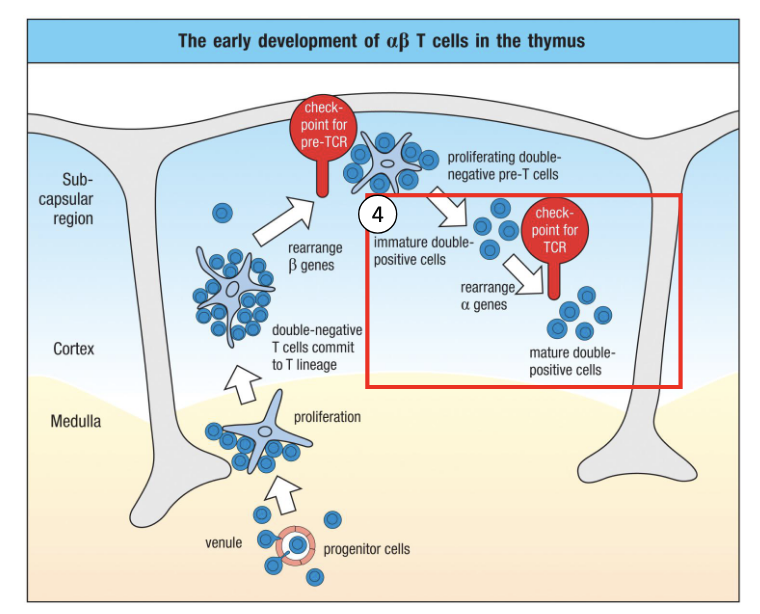
Ok so after the double negative stage, a functional beta chain was made. Then the alpha chain will be made in the double positive stage.
So the placeholder alpha chain (pTa) gets kicked out. What replaces it?
the proper alpha chain! it pairs with the beta to complete the alpha-beta TCR.
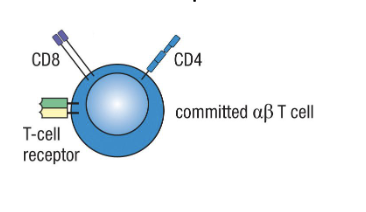
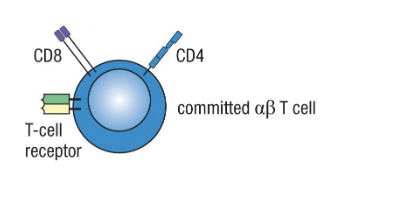
Tell me more about the double positive stage! Now it is a committed alpha-beta T cell.
Both CD4 and CD8 are on (+). What will the cell test for and where?
It will test whether it works better with MHC Class I (which needs CD8) or MHC Class II (which needs CD4).
This positive and negative selection happens in the cortex and medulla, respectively.
Positive selection happens in the thymus’ [cortex / medulla].
Positive selection happens in the thymus’ cortex.


The cortical epithelial cells in the cortex of the thymus provide a POSITIVE signal if the thymocyte can bind to either MHC 1 or 2.
If the thymocyte cannot bind to MHC I or II, it is useless —> cell dies by …
—-> cell dies by neglect!

The cortical epithelial cells in the cortex of the thymus provide a POSITIVE signal if the thymocyte can bind to either MHC 1 or 2. How does it do this?
cortical epithelial cells generate practice peptides (self peptides) to put onto the MHC to test binding!
There’s a whole mouse experiment i’m too lazy to explain. It boils down to “positive selection is controlled by the cortical thymic epithelial cells”.
In the experiment, these cortical blah blah cells are the ________ cells.
cortical thymic epithelial cells are STROMAL cells.
stromal = supporting/scaffolding cells in the thymus (aka non immune cells)
Tell me more about the single positive stage! Positive selection is when a thymocyte decides if it will express ____ or ____.
Positive selection is when a thymocyte decides if it will express CD4 (binds to MHC 2) or CD8 (binds to MHC 1).

If the self-peptide that the stromal cortical cell tests out —> has the MHC 2 bind to the TCR —> this is a ____ T cell!
This is a CD4 T cell!
The other co-receptor (CD8) gets removed.