Bones of the forearm, wrist and hand
 Call Kai
 Learn
Learn Practice Test
 Spaced Repetition
 Match
Match Flashcards
 Knowt Play
1/23

There's no tags or description
Looks like no tags are added yet.
Name | Mastery | Learn | Test | Matching | Spaced | Call with Kai | Chat |
|---|
No analytics yet
Send a link to your students to track their progress
24 Terms

Head of radius
The head of the radius is the circular, disc-like proximal end of the radius bone that articulates with the humerus at the elbow joint, allowing for rotation of the forearm.
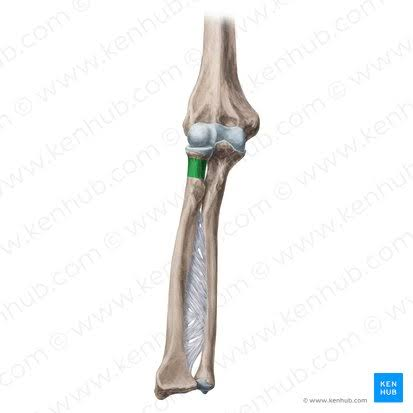
Neck of radius
The region below the head of the radius, connecting it to the shaft, allowing for rotation during forearm movement.

Radial tuberosity of the radius
A prominence located just below the neck of the radius, serving as the attachment site for the biceps brachii muscle, which aids in flexion of the elbow.

Interosseous border of the radius
The edge of the radius that faces the ulna, providing an attachment site for the interosseous membrane and contributing to the stability of the forearm.

Styloid process of the radius
A bony projection at the distal end of the radius, providing attachment for ligaments of the wrist and contributing to the stability of the wrist joint.

Dorsal tubercle of the radius
A bony prominence on the dorsal surface of the distal radius, acting as a pulley for the extensor tendons of the wrist.

Olecranon process of the ulna
The large, curved bony prominence at the proximal end of the ulna, forming the tip of the elbow and serving as a lever arm for the muscles that extend the forearm.
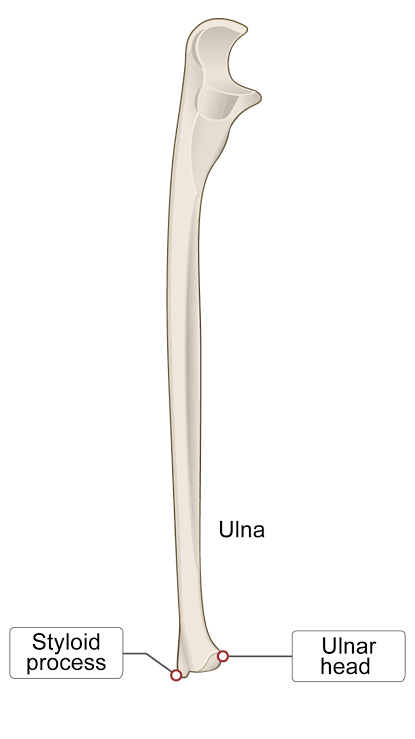
Head of the ulna
The rounded end of the ulna, located at its distal end, which articulates with the carpal bones and plays a role in wrist stability.

Trochlear of the ulna
The part of the ulna that fits into the humerus at the elbow joint, allowing for forearm flexion and extension.
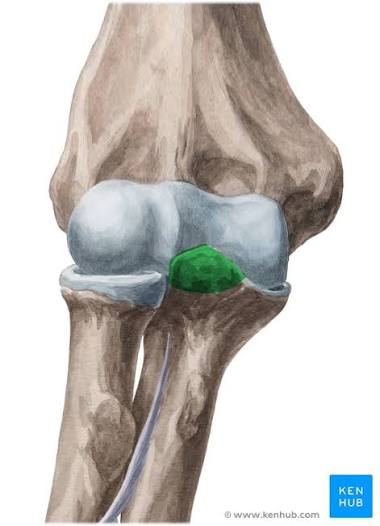
Coronoid process of the ulna
The triangular projection at the proximal end of the ulna, located below the olecranon process, which provides an attachment point for the brachialis muscle and helps stabilize the elbow joint.

Radial notch of the ulna
The depression on the lateral side of the ulna that articulates with the head of the radius, facilitating the rotation of the forearm.

Unlar tuberosity of the ulna
The bony prominence located below the coronoid process of the ulna, serving as an attachment site for the brachialis muscle.

Styloid process of the ulna
A distal projection of the ulna that provides attachment for the ulnar collateral ligament and helps stabilize the wrist joint.

Interosseous border of the ulna
The sharp edge running along the length of the ulna, providing an attachment site for the interosseous membrane between the radius and ulna.

Scaphoid
The largest bone in the proximal row of the carpal bones, it articulates with the radius and is involved in wrist movement and stability.

Lunate
A crescent-shaped carpal bone located between the scaphoid and the triquetrum, it plays a key role in wrist flexibility and movement.
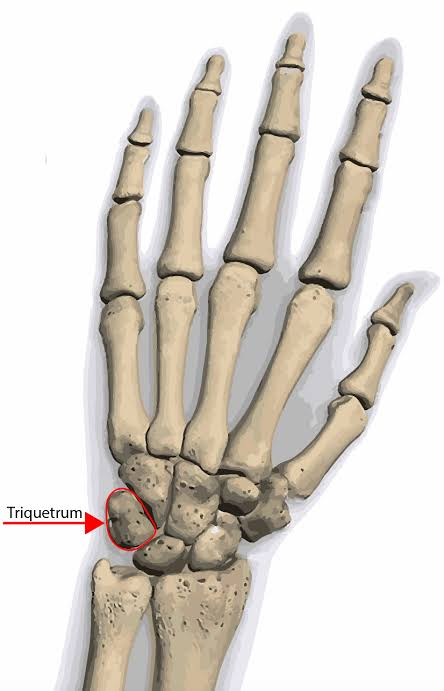
Triquetrum
A pyramid-shaped carpal bone located on the medial side of the wrist, it articulates with the scaphoid and lunate bones, contributing to wrist stability and movement.

Pisiform
A small, pea-shaped carpal bone located anterior to the triquetrum, it serves as an attachment point for ligaments and muscles, playing a role in wrist function.

Trapezium
A saddle-shaped carpal bone located at the base of the thumb, it articulates with the first metacarpal and allows for thumb opposition and grip.

Trapezoid
A wedge-shaped carpal bone located between the trapezium and the capitate, it articulates with the second metacarpal and assists in wrist stabilization and hand movements.
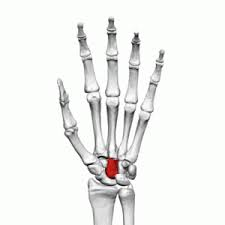
Capitate
The largest carpal bone, located in the center of the wrist, it articulates with multiple bones including the third metacarpal and is crucial for wrist mobility and stability.

hamate
A hook-shaped carpal bone located on the ulnar side of the wrist, it articulates with the fourth and fifth metacarpals and plays a role in hand grip and stability.

Metacarpals
The five long bones in the hand that connect the wrist to the fingers, providing structure and facilitating movement. Each metacarpal corresponds to a digit, numbered one to five from the thumb to the little finger.

Phalanges
The bones of the fingers and toes, consisting of three bones in each finger (proximal, middle, and distal phalanges) and two in the thumb, allowing for flexibility and dexterity.