MA 266 E2
 Call Kai
 Learn
 Practice Test
 Spaced Repetition
 Match
 Flashcards
 Knowt Play
1/16

Earn XP
Description and Tags
mwehehehehe
17 Terms
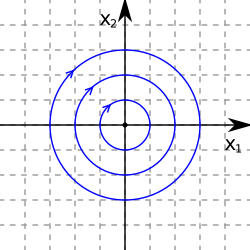
Center
purely imaginary
Spiral sink
complex with negative real part
Spiral source
complex with positive real part
Node sink
two negative real eigenvalues
Saddle
real eigenvalues with opposite signs
mx`` + cx` + kx = F(t)
m = mass
c = damping coefficient/dashpot
k = spring constant
F(t) = outside force
x = position
vocab for mx`` + cx` + kx = F(t) (and what is resonance)
undamped: c = 0
Damped: C > 0
Free/unforced: F(t) = 0
Forced : F(t) ≠ 0
resonance is when the natural frequency and the forcing frequency are the same.
Classify a damped mass-spring system using c^2 - 4mk
c^2 - 4mk > 0: overdamped
c^2 - 4mk = 0: critically damped
c^2 - 4mk < 0: underdamped
converting xsp(t) = Acos(wt) + Bsin(wt)
to
Ccos(wt - a)
C = sqrt(A2 + B2)
a = arctan(B/A)
xsp(t) is the steady periodic solution. Found by using undetermined coefficients on the right side and getting values for A and B with the diff eq.
classify origin of x` = Ax using its eigenvalues
λ = ±bi —> center
λ = a ±bi, a > 0 —> spiral source
λ = a ±bi, a < 0 —> spiral sink
Two real λ of opposite signs —> saddle
Both λ are negative and real —> node sink
Both λ are positive and real —> node source
defective λ—> means?
repeated λ but only one linearly dependent eigenvector
get v normally: (A - λI)v = 0
get w with v: (A - λi)w = v
general form: x(t) = C1(e^λt)v + C2(e^λt)(tv + w)
Variation of Parameters (form) : y'' + P(x)y' + Q(x)y = g(x)
1. find y1 and y2, which are the things attached to c1 c2 in the homogenous solution.
2. Find W, which is y1y2` - y2y1`
3. u1' = -(y2*g)/W
4. u2' = (y1*g)/W
5. yp = u1*y1 + u2*y2

g = the right side in the form

If full solution is requested:
y = C1*y1 + C2*y2 + ype^At for triangular
see image

e^at for general case

identify eigenvalues based on phase portrait
Closed loops: center

No spiraling; everything moves toward the origin: node sink

No spiraling; everything moves away from the origin: node source

One straight direction moves toward the origin while
another straight direction moves away: saddle

Arrows shrink and reverse across an entire line instead
 of converging to one point: one eigenvalue is zero

Arrows toward that line:
other eigenvalue is negative

Arrows away from that line:
other eigenvalue is positive

For direction-field matching, plug in (1,0) or (0,1) and match the arrow direction.trajectory Identification
x^2 + y^2 = C
Circle

A*x^2 + B*y^2 = C, where A and B are positive and unequal
Ellipse

A*x^2 - B*y^2 = C
Hyperbola

y = m*x
Straight line through the origin

y^2 = A*x or x^2 = A*y
Parabola