Bisc 202 - M2 material
 Call Kai
 Learn
Learn Practice Test
 Spaced Repetition
 Match
Match Flashcards
 Knowt Play
1/12

There's no tags or description
Looks like no tags are added yet.
Name | Mastery | Learn | Test | Matching | Spaced | Call with Kai | Chat |
|---|
No analytics yet
Send a link to your students to track their progress
13 Terms
complete dominance; Tay-Sachs disease phenotype
1 allele masks the effect of another allele at the same gene locus, leading to a noticeable trait in the organism's phenotype. (M1 material).

In Tay-Sachs disease, the presence of a dominant normal allele prevents the expression of the recessive allele, resulting in the absence of hexosaminidase A activity.

Incomplete dominance
neither allele is completely dominant, resulting in a phenotype that is a blend of both traits (intermediate).

heterozygotę produces less pigment than homozygote
Genotypic + phenotypic ratios:
1 : 2 : 1
each genotype can be seen
Co-dominance
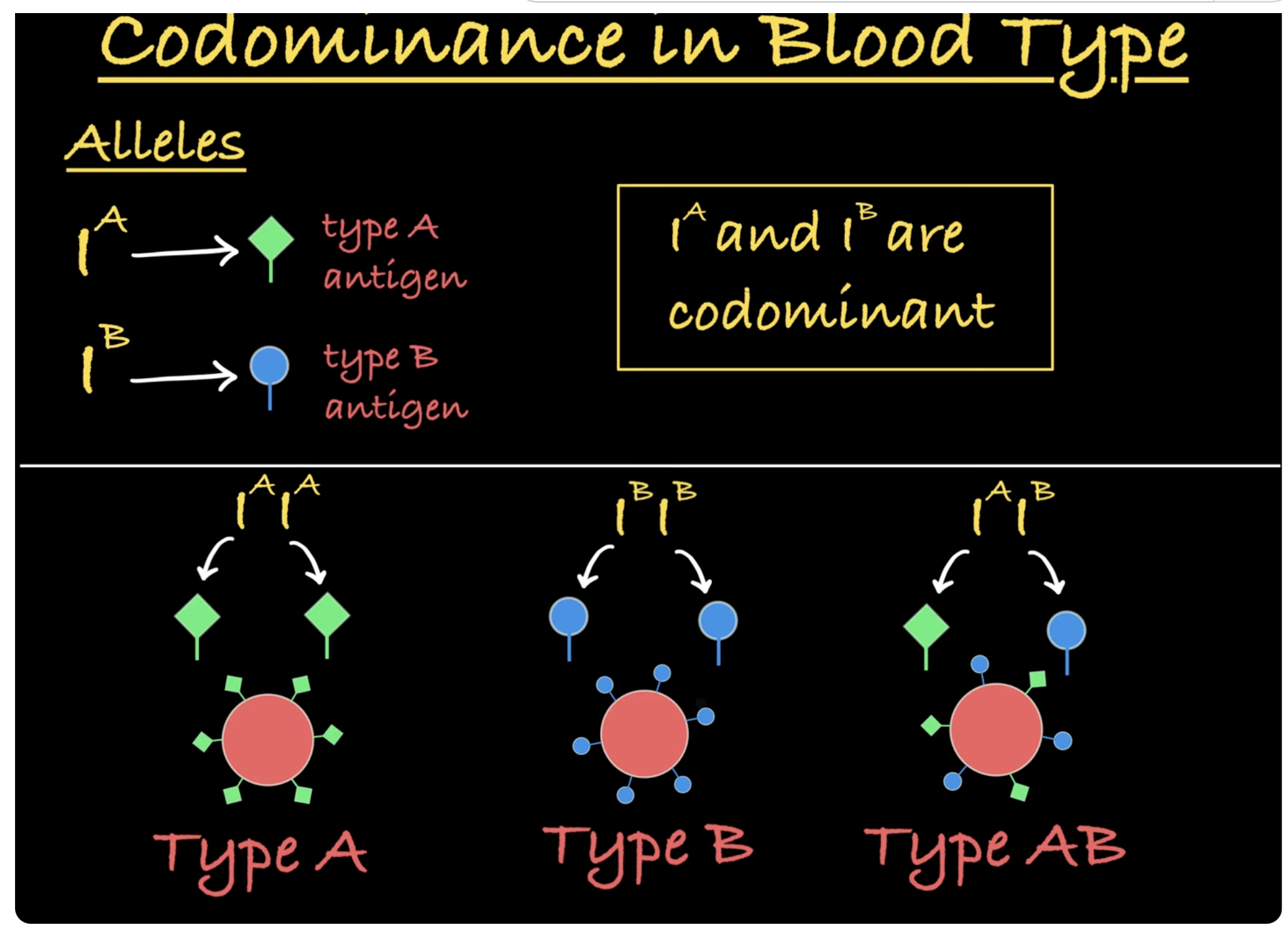
when both alleles of a gene are expressed equally + independently → resulting in distinct phenotypic traits being displayed simultaneously in a heterozygote. (non-mendelian inheritance)
heterozygote shows both alleles simultaneously EX: AB blood type.
NOT A BLEND

Multiple alleles
More than two alleles exist for a single gene, allowing for a greater variety of possible genotypes and phenotypes in a population, such as the ABO blood group system.


Lethal alleles
alleles that can cause the death of an organism when present in certain combinations
reduced survival rate in individuals with homozygous recessive genotypes.
*die before birth
also means can’t be true breeding parents for the recessive bc they would be dead already

the denominator changes from all conceptions to the surviving.

Epistasis
the interaction between genes where one gene's expression is suppressed or modified by another gene, affecting phenotypic outcomes.
recessive and dominant epistasis.
Typical observations are:
independent assortment
equal viability
full penetrance
recessive epistasis
occurs when the presence of two recessive alleles at one gene locus masks the expression of alleles at another locus, leading to a modified phenotypic ratio.
recessive epistasis alters the classic 9:3:3:1 Mendelian ratio to a 9:3:4 ratio.
must be homozygous

dominant epistasis
occurs when a dominant allele at one gene locus masks the effects of another gene locus, resulting in a modified phenotypic ratio.
alters the 9:3:3:1 ratio to a 12:3:1 ratio.
heterozygous or homozygous; doesn’t matter
complementary gene interaction
when two or more non-allelic genes work together to produce a single trait, and both must have at least one dominant allele for the trait to appear.

list all the modified dihybrid ratios you should keep in mind?
refer to image (active recall)

duplicate genes
occur when two or more genes can produce the same phenotype, allowing for redundancy in genetic function. This can lead to modified phenotypic ratios, such as a 15:1 ratio, instead of the typical 9:3:3:1.
Penetrance
the proportion of individuals with a particular genotype that actually express the expected phenotype, reflecting the probability that a genotype will result in a phenotype.

Expressivity
The degree of phenotype expression among individuals with the same genotype.