Small Animal Nursing II Exam 2 - Aseptic Technique, Anesthesia, and Critical Care Nursing
 Call Kai
 Learn
Learn Practice Test
 Spaced Repetition
 Match
Match Flashcards
 Knowt Play
1/205

There's no tags or description
Looks like no tags are added yet.
Name | Mastery | Learn | Test | Matching | Spaced | Call with Kai | Chat |
|---|
No analytics yet
Send a link to your students to track their progress
206 Terms
Asepsis
Condition of sterility wherein no living organisms are present
Exogenous route
Source of microorganisms by way of air, surgical supplies, patient's skin, or surgical team
Endogenous route
Source of microorganisms by way of bacteria through the bloodstream
Bacteremia
Bacteria in the blood
Doubles
For every hour under general anesthesia, the risk of infection ____
Sterilization
The elimination or destruction of all living organisms from a material
Disinfection
The destruction of vegetative forms of bacteria but not the spores
Filtration (i.e pharmaceuticals)
Use of a filter to separate particulate material from liquids or gases
Radiation (i.e gloves and suture materials)
Destroys microorganisms without causing significant temperature elevation
Heat
The most common physical method of sterilization
Lasts 7 weeks in a closed cabinet (3 weeks in an opened cabinet)
Why is it recommended to package instruments in a double wrapped muslin pack for sterilization?
Flash sterilization (emergency sterilization)
Unwrapped instruments are placed in a perforated metal tray for sterilization and then are carried to the operating room with the use of detachable handles
To reduce condensation formation
Why should you allow packs to cool slowly after sterilization?
Assurance of sterility
Why is quality control of an autoclave important?
Glutaraldehyde
Most common method of liquid sterilization
Gas sterilization (ethylene oxide and hydrogen peroxide gas plasma)
Used for items that cannot tolerate the high temperatures or steam associated with autoclaving
Povidone-iodine
One of the most common surgical scrubs in veterinary hospitals
Iodine
Chemical disinfectant used for surgical prep, topical wound therapy, and joint/body cavity lavage
4-6 hours
The bactericidal activity of iodine is
Chlorhexidine
Chemical disinfectant effective against bacteria, mold, yeast, and viruses
Dilute 1:40 with sterile water or saline for 0.05% solution
What is the proper dilution for chlorhexidine?
Alcohols
Chemical disinfectant that are solely bactericidal
Aldehydes
Chemical disinfectants that are toxic and irritating with antimicrobial effects
Cold sterilization (chlorhexidine or glutaraldehyde)
Soaking instruments in disinfecting solutions for minor procedures or equipment that cannot tolerate other sterilization methods
Completely disassembled and gas sterilized or cold sterilized
How should arthroscopic and laparoscopic equipment be sterilized?
• Clip hair with No. 40 clipper blade, 5 to 15 cm around surgery site
• Clip potentially infected areas last
• Pre-surgical scrub alternating between antiseptic scrub and alcohol
• Final sterile surgical scrub after animal is positioned on surgery table
Describe how to appropriately prepare a patient's skin for surgery
• Only touch nonsterile items
• Never reach over sterile fields
• Always face the sterile field
Describe how to maintain sterility while in surgery when you yourself are nonsterile
• Only touch sterile items or areas
• Remember that neckline, back, armpit area not sterile
• Keep hands above waist level
• Always face the sterile field
Describe how to maintain sterility while in surgery when you yourself are sterile
An absence of sensation that affects the whole body or an isolated part or region of the body
What is anesthesia?
Unconsciousness and insensibility to feeling and pain induced by administration of anesthetic agents
General anesthesia is characterized by
Loss of sensation in a localized part of the body without loss of consciousness
Localized anesthesia is characterized by
∙Cardiac output
∙Blood pressure
∙Respiratory drive
∙Central nervous system function
Anesthesia is considered a high risk procedure because of potential adverse changes involving
Induction
The process that is used to take the patient from a state of consciousness to general anesthesia
Maintenance
The process used to keep the patient under general anesthesia until recovery
Procedures that do not require the patient to be unconscious
What is local anesthesia used for?
∙ Relax patient or provide sedation
∙ Ease induction and recovery
∙ Reduce amount of anesthesia needed
∙ Provide muscle relaxation
∙ Provide analgesia
Identify reasons premedications are given to patients before induction of general anesthesia
8-12 hours for food (less for patients < 2 kg)
2-4 hours for water
How long should food/water be withheld before a dog or cat goes under anesthesia?
American Society of Anesthesiologists (ASA)
Assigns classification on the basis of a patient's condition to guide anesthetist in patient management
ASA I (Minimal risk)
Identify the ASA classification of a normal, healthy patient undergoing an elective procedure such as a spay or neuter
ASA II (Low risk)
Identify the ASA classification of a patient with mild systemic disease such as obesity, mild dehydration, or skin tumors
ASA II
Identify the ASA classification of a neonatal or geriatric patient
II
Any brachycephalic patient would automatically be considered ASA class
ASA III (Moderate risk)
Identify the ASA classification of a patient with severe systemic disease such as anemia, moderate dehydration, or major organ disease
ASA IV (High risk)
Identify the ASA classification of a patient with severe, life-threatening systemic disease such as a ruptured bladder, pyometra, pneumothorax, or internal hemorrhage
ASA V (Extreme risk)
Identify the ASA classification of a patient that is not expected to survive without operation (i.e severe head trauma, pulmonary embolus, GVD, end-stage major organ failure)
IV induction
Induction of anesthesia administered to effect
IM induction
Induction of anesthesia administered at 2-3x the corresponding IV dosage
Anesthetic masks
Used to administer oxygen or anesthetic gases to non-intubated patients
300 ml/kg/minute
Anesthesia induction using a mask is accomplished at an O2 flow rate of
Anesthetic chamber (higher risk)
Box that utilizes a semi-closed rebreathing system to induce general anesthesia in small or aggressive patients
Propofol (3-6 mg/kg to effect)
An ultra-short-acting IV anesthetic used to induce and maintain general anesthesia
Given IV slow at 1/4th the calculated dose every 30 seconds to effect
How is propofol administered for anesthesia induction?
General anesthesia in 30-60 seconds with duration of 2-5 minutes
How long does it take propofol to induce anesthesia, and how long does it last?
Apnea
What is a major caution associated with propofol?
Inhalant anesthetics
Identify the most common method of maintaining anesthesia
Endotracheal tube
Used to maintain an open airway in anesthetized patients
∙ Maintain open airway
∙ Minimize risk of aspiration of blood, stomach contents, etc
∙ Ease supplemental oxygen flow
∙ Allow anesthetist to ventilate patient
Identify the functions of an ET tube
Allows the patient to ventilate even if the ET tube becomes occluded
Identify the function of the Murphy's eye component of an ET tube
Pilot balloon
Access site for inserting air into the cuff of an ET tube
Laryngoscopes
Used to visualize the larynx while placing endotracheal tubes
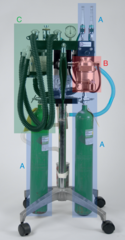
Carrier gas supply (A)
Component of the anesthesia machine that delivers oxygen to the patient at a controlled flow rate

Oxygen
The carrier gas supply delivers _____ to the patient
Anesthetic vaporizer (B)
Component of the anesthesia machine that vaporizes liquid inhalant anesthetic and mixes it with oxygen

Breathing circuit (C)
Component of the anesthesia machine that delivers the anesthetic and oxygen mixture to the patient and conveys expired gases away from the patient
Scavenging system
Disposes of waste and excess anesthetic gases
∙ Waste gas exits from the pop-off valve (A)
∙ The waste flows through the interface (B)
∙ Moves into a canister (C) or an outlet pipe in the ceiling
How does the scavenging system dispose of waste?

Green (US) or white (international)
What color is an oxygen cylinder?
Blue
What color is a nitrous oxide cylinder?
∙ Never leave an unattended compressed gas cylinder unsupported or lying on its side
∙ Never attempt to remove the valve or index pins
∙ When turning a tank on, keep skin and eyes clear of the valve port
∙ Do not use oxygen near any source of ignition
Identify the rules for handling a compressed gas cylinder
Isoflurane and sevoflurane
An anesthetic vaporizer holds liquid inhalant anesthetic such as
Minimum alveolar concentration (MAC)
Percent concentration of an agent required to prevent a response to surgical stimulation in 50% of patients
1.5x the minimum alveolar concentration (Iso/sevo dial setting of 2.0)
A baseline dial setting of approximately _____ is required to reach surgical anesthesia in most patients
A scavenging system
A breathing circuit circulates fresh gases to the patient and conveys waste gases to _____
ET tube is not in the trachea or the patient isn't breathing
Lack of movement in a reservoir bag or unidirectional valves could indicate
Pressure manometer
Indicates pressure in a breathing circuit and in the patient's lungs
Oxygen flow and adjustment of the pop-off valve (Should read no more than 20 cm H2O)
A pressure manometer is influenced by
Corrugated breathing tubes
Complete the breathing circuit by carrying anesthetic gases to and from the patient
Directs expired gases through a soda lime canister for absorption of CO2, and then is rebreathed by the patient
How does a rebreathing circuit work?
Non-rebreathing circuit
Designed to deliver oxygen and anesthetic gases with less resistance to breathing in small patients
< 7 kg
Non-rebreathing circuits are appropriate for patients _____
Tip of nose to thoracic inlet
How should you measure the length of your ET tube?
• Hypoventilation
• Hypoxia
• Dead space
What can result if an ET tube is too short for the patient?
Hypoxia
Low levels of oxygen in the body tissue
Dead space
Breathing passages and tubes that convey fresh oxygen to the alveoli but in which no gas exchange can occur
Glottis
Structure between the vocal folds which move apart when the patient inspires and relax as patient expires
Laryngospasm (treated with 0.1 ml of 2% injectable lidocaine in cats)
Closing of the glottis during intubation, especially common in cats
• Pulmonary aspiration
• Leaking of anesthetic gas, polluting the surgical environment
An under-inflated ET tube cuff poses a risk of
• Tracheal mucosal irritation
• Tracheal wall ischemia leading to necrosis
An over-inflated ET tube cuff poses a risk of
Anesthetic monitoring
The cornerstone of successful anesthesia
Stage I
Plane of anesthesia referring to the period of voluntary movement
Patient gradually loses consciousness and ability to stand, and becomes recumbent
Describe anesthetic plane stage I
Stage II
Plane of anesthesia referring to the period of involuntary movement
• "Excitement stage" where patient loses voluntary control
• Irregular breathing pattern
• Vocalizing
• Reflex struggling, or paddling
Describe anesthetic plane stage II
Stage III of the anesthetic plane
The period of surgical anesthesia
• Progressive muscle relaxation
• Decreasing HR and RR
• Loss of reflexes
Describe anesthetic plane stage III
Stage IV of the anesthetic plane
A period of anesthetic overdose
Heart stops, and death follows quickly unless rapid action is taken
Describe anesthetic plane stage IV
Between stage II and III
What is the ideal anesthetic plane for a patient during surgery?
• Palpebral reflex
• Swallowing
• Corneal reflexes
• Jaw tone
• Eye position and pupil size
• Response to surgical stimulation
Identify visual monitoring parameters used to determine if your patient is in the appropriate anesthetic plane
Normal: 60-180 bpm
Anesthesia: 60-150 bpm
Report to DVM: < 60 or > 140
Identify a normal HR for a conscious dog versus one who is anesthetized