Eating Disorders
 Call Kai
 Learn
Learn Practice Test
 Spaced Repetition
 Match
Match Flashcards
 Knowt Play
1/29

There's no tags or description
Looks like no tags are added yet.
Name | Mastery | Learn | Test | Matching | Spaced | Call with Kai | Chat |
|---|
No analytics yet
Send a link to your students to track their progress
30 Terms
List the Presenting Complaints of Patients with Eating Disorders
Obsession w/ dieting/thinness
Fatigue, inability to exercise, or other sequelae of malnutrition
Uncontrolled binge eating and/or purging
Symptoms of depression
Functional impairment (inability to focus)
Family/marital discord related to eating
Dental erosion or salivary gland enlargement
Desire to lose weight despite being normal/low weight
Other:
Weakness,
light-headedness,
amenorrhea,
bloating,
Abdominal discomfort,
blood in vomitus


List the factors contributing to eating disorders:
Biochemical
Familial
Psychological
Biochemical Factors
Imaging studies
Reduced brain volumes (AN and BN)
Frontal cortex
Hypometabolism before eating
Hyperarousal after eating (AN)
Hyperactivity
caudate,
temporal cortex,
lentiform nucleus
brain stem (AN)
Loss of symmetry of frontal and prefrontal areas (BN)
Reduced brain serotonin transporter activity
Decreased Serotonin + impaired secretion of cholecystokinin in response to meal
Familial factors
Family members of patients with anorexia and bulimia nervosa have a 10 to 20 fold likelihood of having the disorders
Twin studies: Monozygotic 55%, dizygotic 5%
More likely in families with obese members
Psychological factors
Cognitive distortions about self Perfectionism
“Black and white” thinking
Childhood anxiety disorder
Significant comorbidity w/ personality disorders
Calorie labeling on foods




List the Lab. Findings of:
Anorexia nervosa
BULIMIA NERVOSA
Laboratory Findings
ANOREXIA NERVOSA
Leukopenia
Elevated BUN
Elevated liver function tests (AST,ALT)
Hyponatremia
Hypokalemia
Low estradiol
Low LH and FSH
GFR may decline over time
High cortisol
High growth hormone
Low triiodothyronine,
high reverse
triiodothyronine
Head CT: mild atrophy
and increased
ventricle/brain ratio
EKG: sinus bradycardia,
rarely prolonged QT
interval
Bone scan: osteoporosis
BULIMIA NERVOSA
Hypokalemia
Hyponatremia
Hypochloremia
Hypomagnesemia
Elevated serum amylase
Metabolic alkalosis
Metabolic acidosis (laxative abuse)
List the Psychological Findings of:
Anorexia
Bulimia
ANOREXIA NERVOSA
Alertness:
Early: alert and cheerful
Later: sad and withdrawn
Rigid thinking
controlling and manipulative
Often deny illness or intellectualization
Absolute thinking
Socially isolative and hyposexual
BULIMIA NERVOSA
Superficially sociable
Low self-esteem
Conflicts with intimacy
Difficulty managing anger
Preoccupied with control over eating
May have other impulsive behaviors


List the APA Guideline for Treating Eating Disorders
APA Guideline for Treating Eating Disorders
Screen for eating disorders during initial psychiatric evaluation
Weight
Eating behaviors and weight control behaviors
Co-occurring medical and psychiatric conditions
Review of systems
PE
General appearance
Vital signs and orthostatic pulse
Height/weight/BMI
Labs:
CBC
CMP
EKG’s
Known to have prolonged QTc

Describe Anorexia Nervosa
Dx criteria
Subtypes
Risk Factors
Comorbidity
DDX
Tx
Dx criteria:
Restriction of Calories -> Clinically sig. Low body weight
Fear of gaining weight or becoming fat; even though currently underweight
Disturbance in perception of body’s weight/shape Or Denial of underweight’s seriousness
Subtypes:
Restricting Type
During last 3 months; person not binge-eating/purging
Binge-Eating/Purging Type
During last 3 months; person regularly binge-eating/purging
NOTE: often progressed from Restricting
Based on BMI:
Mild: BMI at least 17 kg/m sq
Moderate: BMI 16-16.99 kg/m sq
Severe: BMI 15-15.99 kg/m sq
Extreme: BMI less than 15 kg/m sq
Risk Factors
History of trauma
Living in society that values thinness
In utero exposure to rubella
Multiple birth and preterm birth
Comorbidity
MDD
Lifetime depression:
Lifetime anxiety disorder:
MC OCD and Social Phobia
Substance abuse:
especially stimulants
Personality Disorders:
Cluster B:
Cluster C:
DDX:
Superior mesenteric artery syndrome
Celiac disease
Inflammatory bowel disease
Bowel adenocarcinoma
Intestinal motility disorders
Treatment
Inpatient behavior management:
Diet designed to gain weight:
Goal: 90% normal
Typically 1200 kcal/d to avoid refeeding syndrome
Nutritional counseling
Management of Bone Loss
Eating autonomy gradually shifted back to pt
Pharmacotherapy
Usually directed at comorbid conditions
fluoxetine, duloxetine, second generation antipsychotics, dronabinol, oxytocin
Psychotherapy
CBT, interpersonal; psychodynamic; Family therapy
Describe WEIGHT RESTORATION Treatment:
Goals
When is Higher level of care needed? Factors for less relapse/readmission?
Method
Describe Refeeding Syndrome:
Occurrence
Symptoms
Prevention
WEIGHT RESTORATION
Goals:
Outpatient: 1 to 2 Ibs
Intensive outpatient: 1 to 2 Ibs
Partial hospital: 1 to 3 Ibs
Residential: 2 to 4 Ibs
Inpatient: 2 to 4 Ibs
Higher level of care needed when:
no progress after 6 weeks of treatment
Factors for less relapse/readmission:
The closer pt is to target before discharge
If Pt maintain weight for a period of time before discharged
Method:
1,500-2,000 kcal/day, -> 3,000-4,000 kcal/day (rapidly)
Formulas for calculating calories = underestimate b/c pt’s = hypermetabolic
Involve registered dieticians
Increase dietary variety.
Meal-based nutrition > tube feeding
Calorie dense liquid supplements can be given in between meals
Refeeding Syndrome:
Occurance:
Recent rapid weight loss + low BMI
Symptoms:
Main:
Hypophosphatemia
Less common:
Rhabdomyolysis
Seizure
Severe Edema -> Heart Failure
Prevention:
Continuing adequate nutrition;
Examining pt for signs of heart failure;
Monitoring lab values
(e.g., glucose and electrolytes including magnesium and phosphorous);
Replacing phosphorous orally when clinically indicated.
Describe these AN Treatments:
Acceptance and Commitment Therapy
Method?
List the efficient Psychotherapy Tech:
Describe FAMILY-BASED TREATMENT IN ADOLESCENTS AND EMERGING ADULTS
Philosophy
Method
Acceptance and Commitment Therapy
Method:
Help pt
understand relationship btw internal urges/symptoms
understand that Identity not defined by thoughts of themselves
define recovery
Instill:
Thoughts are not facts
Mindfulness
Have goals/Monitoring
Psychotherapy Tech:
CBT
Focal psychodynamic psychotherapy (FPT)
Interpersonal therapy (IP T)
Maudsley Model of Anorexia Nervosa Treatment for Adults
(MANTRA)
Specialist Supportive Clinical Management (SSCM)
Experienced Carers Helping Others (ECHO)
aimed at supporting carers of patients with AN but can also contribute to improved outcomes.
FAMILY-BASED TREATMENT IN ADOLESCENTS AND EMERGING ADULTS
Philosophy:
considers effects of severe weight loss as being central to the core psychology of AN
Method:
Parents oversee and take responsibility for nourishing pt
Therapist = knowledge expert and facilitator.
NOTE:
Not limited to family members; could involve other non- family caregivers with whom the patient resides
When to hospitalize AN?
When to hospitalize AN
BMI 15 kg/ m sq or less (under 13 very high risk)
Greater than 30 BPM increase in orthostatic HR (40 BPM in children)
Greater than 20 mm drop in orthostatic sBP
Greater than 10% weight loss in 6 months or 20% in past year
Bradycardia (<50 BPM) or arrhythmia
Blood pressure <90/60 adults, adolescents 90/45
Severe hematemesis
Severe neutropenia or thrombocytopenia
Severe hypokalemia (<3 mEq/L)
Hypophosphatemia or hypomagnesemia
Uncontrolled type I diabetes or glucose <60 mg/dL
Temp <96.8 F
QTc >450
Acute medical complications or physiologic consequence
Describe Atypical anorexia nervosa
What is it?
Atypical anorexia nervosa
What is it?
All AN Criteria are met + pt experience associated physiological complications
BUT: Individual = w/in normal or above normal weight
NOTE:
Little is known about the course or response to treatment of this condition


Describe Bulimia Nervosa
Dx Criterai
Physician instruction if there is purging
Tx
Dx Criteria:
Recurrent episodes of Binge eating; defined by both:
Eating # of food > than most people would eat
during similar discrete period of time and circumstances
Lack of control over eating during episode
Recurrent inappropriate compensatory behavior
Vomiting; Lax misuse; diuretics, enemas, fasting; or excessive exercise
Both occurs once a week for 3 months
Self-eval = unduly influenced by body shape/weight
Physician instructions if there is purging:
Refer for a dental evaluation.
Instruct patients not to brush teeth after vomiting.
Oral rinsing with water after vomiting and avoiding ingestion of carbonated beverages or citrus fruits may help to reduce effects on dentition
Treatment
outpatient
Nutritional counseling
Psychotherapy
develop a better integrated view of herself
Pharmacotherapy
SSRI’s, MAOI’s, atypical antidepressants
Describe these treatment for BN:
NUTRITIONAL INTAKE
Why assess?
Method:
CBT AND SSRI TREATMENT FOR ADULTS
Method
Rationale
FAMILY-BASED TREATMENT IN ADOLESCENTS AND EMERGING ADULTS,
Method
NUTRITIONAL INTAKE
Why assess?
Normal body weight or BMI does not imply appropriate nutritional intake
Method:
Structured meal plan
Can reduce episodes of restriction + binge/purge urges
Cooperate w/ dietitian
CBT AND SSRI TREATMENT FOR ADULTS
Method:
CBT
eating disorder-focused
SSRI
fluoxetine
Rationale:
Greater binge/purge abstinence/reduction
Also good for depression
FAMILY-BASED TREATMENT IN ADOLESCENTS AND EMERGING ADULTS,
Method:
Similar to AN but more focus on:
secrecy, shame, and dysfunctional eating patterns

Describe Binge Eating Disorder
Dx criteria
Assessment Tools
Tx
Dx Criteria:
Recurrent episodes of binge eating
Episodes associated w/ 3:
Eating more rapidly than normal
Continuing to eat until uncomfortable
Eating large amount despite lack of hunger
Reluctantancy eating w/ others b/c embarrassment
Afterward: Guilty, depressed, disgusted
At least once a week for at least 3 months
Not accompanied by compensatory behaviors
Assessment Tools
Eating Disorder Examination-Questionnaire (EDE-Q)
Questionnaire for Eating and Weight Patterns- Revised (QEWP-R)
Eating Disorder Diagnostic Scale (EDDS)
Treatment
Cognitive-behavioral therapy
Correct maladaptive cognitions
Remission 50-70%
Interpersonal therapy
Identifying interpersonal problems that contribute
Make changes to relationships
Prepare for future interpersonal problems
Pharmacotherapy
SSRI’s
Effective but long-term data unavailable
Opioid antagonists?
CBT>SSRI but combo best
Bariatric Surgery
Should have behavioral or psychotherapy first
procedure takes away coping mech
List the Bed meds we can use
Lit; Specific Types
Benefits; Dosage
Caution
BED Meds
Antidepressants
Literature:
Some benefit to meds alone
Generally no weight changes
Specific types:
TCA + MAO = less used due to AE profile
Lisdexamfetamine
Benefits:
Generally, well tolerated.
Dosage:
Normal = Dosage adjustment (increase)
Hepatic dysfunction = no Adj
Renal Impairment = Lower Dosage
Caution:
Pt w/ hypertension or cardiac disease.
Describe Avoidant/Restrictive Food Intake Disorder
Dx criteria
Avoidance due to?
Tx
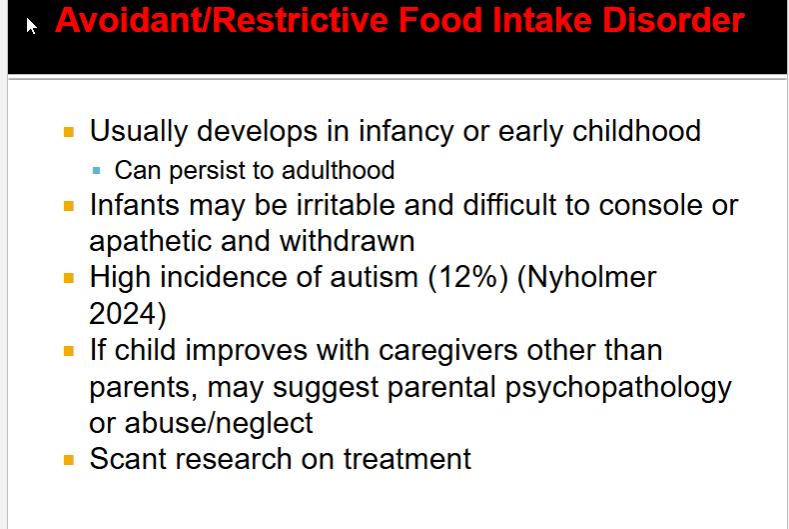
Dx Criteria:
Feeding/eating disturbance associated w/ inadequate intake + 1
Significant weight loss
Significant nutritional deficiency
Dependence on enteral feeding or oral nutritional supplements
Marked interference with the individual’s social and psychological functioning
Inadequate intake = NOT:
Lack of food or cultural sanctioned practace
No disturbed Body image
Not due to medical Problem
Avoidance of food usually due to:
Fear of negative consequences of eating
N/V (MC)
abdominal pain
Low appetite or disinterest in food
Based on sensory characteristics such as taste, texture or smell (picky eaters)
Treatment
Family-based therapy
Lifting blame
Raising family’s anxiety about dangers of low weight and malnutrition in young people
Empowering parents to take charge of nutrition and focus on the goal of weight gain
CBT
What is Pica
Dx Criteria:
Persistent eating of nonnutritive, nonfood substances
Inappropriate to dev. Level
Not culturally/socially supported
over a period of at least 1 month

Describe Rumination Disorder
Dx criteria
Med. Complications
Tx
Rumination Disorder
Dx Criteria:
Regurgitation of food over a period of at least one month
Can’t be part of AN/BN or other
Medical complications
Malnutrition,
dehydration,
Esophageal ulceration,
tooth decay
Tx:
Maybe Negative reinforcement or reward
Describe Deliberate Foreign Body Ingestion (DFBI)
Associated w/
Subgroups
Tx
Deliberate Foreign Body Ingestion (DFBI)
Associated with:
Male gender
Incarceration (2% of inmates)
History of substance abuse
Psychiatric disorders
Four psychiatric disorder subgroups:
Malingering
Psychosis
Pica
Personality disorders
Management
Safe environment
Manage surgical and medical needs
Work toward reducing frequency
Manage the countertransference of the treatment team
Address issues of the environment the patient returns to