criminal law - exam 1
 Call Kai
 Learn
Learn Practice Test
 Spaced Repetition
 Match
Match Flashcards
 Knowt Play
1/122

Earn XP
Description and Tags
CJUS345
Name | Mastery | Learn | Test | Matching | Spaced | Call with Kai | Chat |
|---|
No analytics yet
Send a link to your students to track their progress
123 Terms
The Criminal Justice System (CJUS)
comprises institutions, policies, and practices with the goal of maintaining social control and deterring crime through sanctions (punishments) and rehabilitation.
Criminal Justice
refers to the system of law enforcement, courts and corrections/the system and study of how those laws are enforced, adjudicated, and managed
Criminal law
the rules and statutes defining crimes and punishments.
Criminology
refers to the study of the nature, extent & causes of criminal offending and criminal victimization
Purpose of Criminal Law
primary purpose is to help maintain social order and stability
Statutory Law
laws passed by a legislative body (today virtually all criminal law is statutory law)
All 50 states and the Federal government have their own separate sets of statutory criminal laws.
No state is bound by the criminal laws of another state or by the laws of the federal government, criminal law is a matter of state jurisdiction
Principle of Legality
Under this principle, no one can be punished for an act that was not defined as criminal before the person did the act
Rule of Law
requires that citizens be guaranteed fairness, justice & liberty. It is an ideal that guides governments and societies to ensure that no one is above the law and that everyone is treated fairly & impartially. (fundamental principle in the U.S. criminal justice system)
mala in se
refers to behavior that is sinful and inherently wrong by nature
mala prohibita
describes behavior that is prohibited by law. It is dynamic and changes over time
Probable Cause (PC)
standard established by criminal law to make an arrest, obtain a warrant, or conduct a search; a reasonable amount of suspicion, supported by circumstances sufficiently strong to justify a prudent and cautious person’s belief that certain facts are probably true”; concrete evidence that a crime has taken place based on objective circumstances and facts
Reasonable Suspicion
considered an objective measure but is based on minimal or no evidence. lower standard probable cause; general observation that a crime may have taken place, based on subjective factors and totality of the circumstances
Standard Burden of Proof
"beyond a reasonable doubt"
Beyond a Reasonable Doubt
burden of proof is always on the Prosecution who must prove that Δ satisfied each element of the crime’s statutory definition & their participation was "beyond a reasonable doubt”; does not mean proof beyond all possible doubt, it is a heavier burden than required in civil cases & is much greater than 50%.
"Person of interest" (POI)
term used by LE when identifying someone involved in a criminal investigation who has not been arrested or formally accused of a crime. It has no legal meaning but refers to someone in whom the police are "interested in
Suspect
someone that the police feel they have enough information or evidence on to tie the person to the crime
5 goals of Criminal Law
retribution
restitution
incapacitation
deterrance
rehabilitation
retribution
Punishment is deserved or morally right. Seeks to punish the offender for criminal behavior
restitution
Compensation to victims as Punishment & Restoration Repayment as part of a punishment for injury, damage, harm or loss
incapacitation
Removing from society. Isolates offender from the public and takes away one’s ability to commit crime against public
deterrance
General & Specific. Punish an offender to deter otherwise from committing same the crime or crime(s). Set an example.
rehabilitation
Reforming. Seeks to reduce chances of future offenders through education, programs or treatments
which of 5 goals does prof. believe was critical in crime prevention
retribution and rehabilitation
when does the criminal justice response and process begin
begins when crimes come reported or discovered by law enforcement; Not necessarily when the crime was committed; criminal justice court process begins when the suspect is arrested upon PC and the filing of criminal charges through a Bill of "Information" or Grand Jury indictment.
Procedural Law
Rules/law governing court proceedings. determines how people are treated in the system. The Bill of Rights (the first 10 amendments to the U.S. Constitution) guides this law pertaining to issues such as arrests, warrants, search and seizure, and trials; asks: How does the process work? What are the defendant’s protections? In the criminal context the laws protect defendants’ rights to due process and a fair trial
Substantive Law
Rules/laws that are used to determine the rights of individuals and collective bodies. It designates what conduct is considered criminal; definition of the crime
Judicial Systems
State and Local Courts
Federal Courts
are adversarial; dual court system
federal courts
may decide cases that involve the US government, the Constitution, or federal laws
power of judicial review. This means they can review acts of Congress and actions of POTUS to ensure that they are permitted by the Constitution
3 levels; trial courts and appellate courts.
state courts
have jurisdiction over a wider variety of civil and criminal cases, including most cases that do not involve the Constitution or federal laws
3 levels; trial courts and appellate courts.
3 levels of courts
trial courts
appellate courts
supreme court
trial court
First level; hear evidence and decide cases (e.g., U.S. District Courts, state trial courts). Federal, State District Courts including City Courts and Municipal & district & city courts) are the “workhorse” courts of the American Criminal Justice system, and adjudicate the vast majority of criminal cases. Adjudicate means to render a formal judgment about a disputed matter
appellate court
Review trial court decisions for legal error
supreme court
Final authority Courts of Last Resort; SCOTUS is the highest federal court; state supreme courts are the highest in each state
key players in courtroom
prosecution
defense
judge and jury
prosecutors
legal representative of the government or state. In each County/Parish, the chief prosecutor in most is an elected official called the (County/Parish or Judicial District [JDC] District Attorney (DA). the job is to take the case from LE and pursue it until the case terminates by trial, verdict or dismissal. role is to present compelling evidence that establishes the guilt of the accused “beyond a reasonable doubt.” They have much discretion in deciding whether to prefer formal charges against an accused and what crime. They are also responsible for conducting any plea negotiations, deciding whether to dismiss charges, and all aspects of trying the case
defense
responsibility is to advocate for the accused, safeguarding their rights throughout the legal proceedings. can be privately hired or a public defender (depending on the financial ability of the Δ). must zealously represent their client (the criminal Δ) from the point of interrogation through the trial process and appeals if necessitated. also ensures the Δ’s constitutional rights are respected and work diligently to get an acquittal or a fair plea agreement, The Δ is presumed innocent until proven guilty by the Prosecution
judges
presiding judicial officer and central figure in the courtroom. responsible for ensuring that the trial proceeds in accordance with the law. allows each side the opportunity to present its version of the facts. and oversees the trial and decides any legal questions that arise. If a trial is a bench trial and not a jury trial, receives and considers the evidence presented by the parties, before making a ruling/decision or verdict. of “guilty” or “not guilty.” If a guilty verdict is reached, determines the appropriate sentence or punishment.
jury
a group of individuals selected as jurors are responsible for determining the verdict listens to the evidence instructions from the judge and arguments from both the prosecution and defense before deciding on guilt or innocence.
key takeaways

main types of police encounters
consensual or approaching a person (“contact” or “conversation”)
detention (sometimees called “stop and frisk/ask or field stop” and Terry Stop)
arrest (in custody)
consensual
At any time (some say with a reason requirement) a Law Enforcement Officer (LEO)has the authority to approach a person and ask questions. Refusing to answer an officer's questions is not necessarily a crime and generally a person cannot be arrested simply for failing to respond to questions. This means that unless an officer has "probable cause" to make an arrest or a "reasonable suspicion" to conduct a "stop and frisk," a person approached by a LEO may have the legal right to walk away, but that is not always the wisest thing to do. Although, as a general rule, a person does not have to respond to an officer's questions, this may not hold true if the officer suspects the person of loitering or in traffic violations stops or in States that have adopted Stop and Identify laws as discussed below.
detention
LEO may briefly detain a person if s/he has reasonable suspicion that the person has committed, is committing, or is about to commit a crime ("reasonable suspicion" that the person is engaged in criminal activity and is based on the totality of the circumstances).
arrest
involves brief questioning in the place where one is detained; requires that the LEO have probable cause (PC) that the person has committed a crime. In other words, if the officer wishes to hold you for a longer period of time or decides to take you to the police station, he is no longer just stopping you, but is what?
custodial interrogation and miranda warning
If a person is under arrest and police wish to question her, they are required to inform her of the 5th-Am. right to remain silent by giving a Miranda warning; Miranda warnings MUST be given before
Custody means that a reasonable person under the circumstances would not believe that they were free to terminate an interrogation and leave. Police custody is the deprivation of a person’s freedom to leave.
Terry Stop
Terry v. Ohio (1968)
if the officer feels that the suspect is in This information is for academic & educational purposes only. It’s not intended as legal advice nor answer to legal problem or issue. Laws & Cases are periodically repealed or interpreted. Page 8 of 18 possession of a weapon that is of danger to him or others, he may conduct a limited search for weapons (known as a “frisk” or “pat down of the suspect's outer clothing garments to search for weapons”) in areas within the suspect’s immediate control based on a reasonable and articulable suspicion that the person stopped was "armed and dangerous" and had been, is, or was about to engage in a criminal act.” The type of frisk authorized by this decision has become known as a Terry Stop. It has two parts: (1) the stop and (2) the frisk.
stop and identify law
requires that a person when stopped under the circumstances stated above, must identify themselves (under reasonable suspicion)
when making a lawful arrest/detention, a LEO may use what type of force
reasonable force
elements of a crime (3 + 2 key burdens)
actus reus
mens rea
concurrence
identity
accused must be at scene of crime
actus reus
"performing the act." Did accused perform the act forbidden by the statute? (Criminal/Guilty act.)
mens rea
"intent to do the act." Person’s state of mind when act was committed. Did the accused intend to do the act? (Criminal intent can be general or specific) Motive refers to the reason behind an illegal act (i.e., revenge), and it is not an essential feature of a crime but, ALL Criminal Activity is Motive plus (+) Opportunity.
concurrence
Requires the act and the mental state occur together in order for a crime to have taken place.
accused (defendant) must be at scene of crime
That personal knowledge is one reason witness testimony can be so persuasive to juries. As for identity, this is where forensic evidence such as DNA and fingerprints becomes critical.
primary role of law enforcement today
patrol
basic principles and rights
There are two main types of trials
The Presumption of Innocence
The Burden of Proof in a Criminal Trial
Right to a Speedy Trial
types of trials
bench = trial by judge
jury = legal proceeding in which a jury makes a decision or findings of fact
presumption of innocence
All people accused of a crime are legally presumed to be innocent until they are convicted, either by trial or as a result of plea. This presumption means not only that the P must convince the jury of the 's guilt, but also that the defendant need not say or do anything in his own defense. If the prosecutor can't do this, the Δ may go free.
burden of proof in a criminal trial
Proving Guilt "Beyond a Reasonable Doubt": refers to the standard used to prove allegations in a court proceeding. To convict a criminal Δ, the prosecutor must prove to the judge or jury that the Δ is “guilty beyond a reasonable doubt”, but not all doubt.
right to a speedy trial
the accused shall enjoy the right to a speedy and public trial, by an “impartial jury of the State and district wherein the crime shall have been committed, which district shall have been previously ascertained by law, and to be informed of the nature and cause of the accusation; to be confronted with the witnesses against him; to have compulsory process for obtaining witnesses in his favor, and to have the Assistance of Counsel for his defence
Motions
motion to dismiss
motion to suppress
motion (for discovery) to compel
motion in limine
motion to qualsh
motion to dismiss
an attempt to get the judge to dismiss a charge or the case. This may be done if there is not enough evidence, if the alleged facts do not amount to a crime
motion to suppress
an attempt to keep certain statements or evidence from being introduced as evidence. For example, if police conducted a search without probable cause (in violation of the 4th Amendment), it may be possible to suppress the evidence found as a result of that search.
motion (for discovery) to compel
a request for the Gov’t to provide the defense with evidence.
motion in limine
request that the Judge rule on whether or not a particular piece of evidence can be used at trial
motion to qualsh
is a formal request asking a judge to declare a specific legal document or court proceeding invalid, void, or canceled
stages of criminal trial
arraignment
jury selection
opening statements
trial and presentation of evidence
closing arguments
jury instructions (judge’s charges to jury)
jury deliberation and verdict
verdict
primary purpose of criminal trial
structured process through various stages where the facts of a case are presented to a jury or Judge, and they decide if the Δ is guilty or not guilty of the charge offered
arraignment
serve as the initial appearance, marking the start of the criminal trial proceedings. At this stage, the Δ is informed of the charges against them and they are asked to enter a plea (1 of 3 pleas) ‒ typically “guilty”, “not guilty” or “no contest
the court may address matters concerning bail or release. The Δ is also informed of their rights, including the opportunity to request a public defender. In the US criminal justice system, defendants typically enter one of 3 primary pleas during an arraignment: Not Guilty, Guilty, or Nolo Contendere (No Contest). In specific cases, defendants may also enter an Alford plea or a Conditional plea
it is not be considered an admission of guilt if…
the criminal the Δ does not have to take the stand to testify
jury selction
judge and both opposing attorneys will question a pool of potential jurors in a process called “voir dire”. The purpose is to determine a potential juror's fitness to serve by asking about personal ideological biases or life experiences pertaining to the case.
The judge can excuse potential jurors at this stage if their responses show they cannot be fair or impartial. Also, the defense and the prosecution may exclude a certain limited number of jurors through "peremptory challenges" and "for cause."
challenges in jury selection
challenges for cause - a request to remove a potential juror when there is reason to believe that s/he cannot serve as an impartial juror, such as exposure to pretrial publicity, connection with a party, experience as a victim, religious prohibition, or bias. (Limited number by statute)
peremptory challenges - a request to remove or exclude a potential juror without giving a reason, except subject to limitations based on gender, race, ethnicity, or other constitutional grounds. (Limited number by statute
hardship challenges - a request to remove a potential juror who would suffer undue hardship or inconvenience by serving on the jury, such as financial, medical, or personal issues.
standby challenges - a request to remove a potential juror who is not needed, but may be recalled if needed
alternate challenges - a request to remove a potential juror who is selected as an alternate, but not a regular juror.
jury deliberation
jurors will attempt to agree on whether the Δ is guilty or not guilty of the crimes charged. Deliberation is the first chance for the jury to discuss the case and apply facts to the evidence presented
If the jury has a question on the law, they must write a note to the judge, which the judge will read in court with all parties present. In federal criminal trials, the jury must reach a unanimous decision in order to convict the Δ. Once the jury reaches a verdict, the jury foreperson informs the judge. The verdict is read in open court. All states require a jury in a criminal case to be unanimous in finding a Δ "guilty" or "not guilty." If the jury fails to reach a unanimous verdict and finds itself at a standstill (a hung jury), the judge may declare a "mistrial" and dismiss the case, or the trial may start over from the jury selection stage
important notes on jury trials and deliberations

In Louisiana, as in most States, an accused is charged with a crime by what 2 means?
Grand Jury Indictment (GJ) - more serious charges
Bill of Information (BOI) - other crimes
Don’t confuse GJ with regular trial juries (called "petit juries" PJ). GJ, like PJ, are made up of randomly selected individuals, but GJ’s are larger, hear evidence, decide whether charges and its type should be brought against accused. PJs decide whether or not a Δ is guilty based upon evidence introduced. P’s often leave it to GJ to make the charging decisions.
4th amendment
guarantees every American citizen a right to freedom from unreasonable searches and seizures and that probable cause must first be established before obtaining a search warrant
5th amendment
right to remain silent by giving a Miranda warning
no person shall "be deprived of life, liberty, or property, without due process of law"
6th amendment
guarantees a Δ the right to a speedy trial by an impartial jury of one’s peers (unless waived)
8th amendment
protects against imposing excessive bail, excessive fines, or cruel and unusual punishments
14th amendment
addresses citizenship rights and equal protection under the law at all levels of government
granted citizenship to "all persons born or naturalized in the United States."
Who has the final authority to interpret the US Constitution?
SCOTUS
A judge or magistrate will issue a search warrant only if an affidavit establishes what?
probable cause
actus reus requirement can be satisfied by what 4 different ways?
voluntary act
omission (failure to act)
possession
state of affairs
4 critical constitutional rights
right to counsel (attorney)
right to peer jury
right to remain silent
right to face one’s accusers
sources of law and procedure
The U.S. Constitution [USC} & State’s Constitution
Laws/Statutes/Ordinances passed by legislative bodies
Judicial opinions/decisions. Also known as “Case Law” or precedent
Administrative Law
Proclamations/orders by executives of the federal, state of local governments
Custom in some states (like LA)
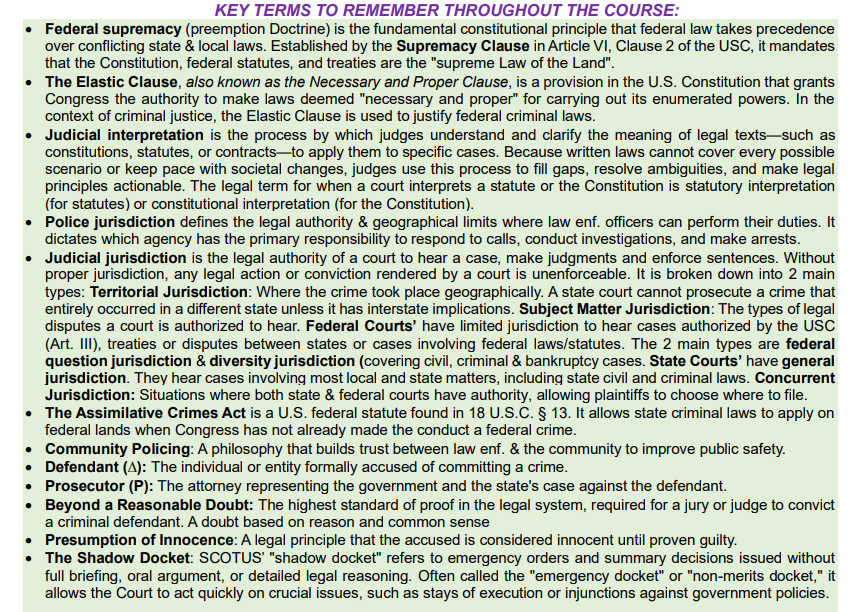
key terms
forensics
Meaning pertaining to the courts- or of and relating to the application of scientific methods, tests and techniques used in the detection and investigation of crime
ex post facto laws
a law that retrospectively changes the legal consequences or status of actions that were committed, or relationships that existed, before the enactment of the law./“from a thing done afterward.”
corpus delecti
proof that a crime was committed before attempting to show Δ’s guilt
M’Naughten Rule
a legal test defining the defence of insanity; insanity at the time of the act, don’t have show history of mental illness (LA)
plea agreement (plea bargain)
contract in which the defendant agrees to plead guilty to a certain charge in exchange for concessions from the prosecution.
90% of all criminal trials end in plea agreement
motive
refers to the reason behind an illegal act (i.e., revenge), and it is not an essential feature of a crime
writ of certiorari
orders a lower court to deliver its record in a case so that the higher court may review it
Model Penal Code (MPC)
a comprehensive recodification of the principles of criminal responsibility. which classifies crimes by "degree." (LA didn’t adopt)
Strict Liability criminal laws
exists when a defendant is liable for committing an action, regardless of their intent or mental state when committing the action.
Jury Mistrial
If the jury cannot agree on a verdict on one or more counts, the court may declare a mistrial on those counts. The government may retry any defendant on any count on which the jury could not agree.
preemption doctrine
federal law is the “Supreme Law of the Land.” i.e.; federal law overrides conflicting state laws
cjus system comprises of 4 primary components
legislatures
law enforcement
courts
corrections
2 main categories of crimes
felonies
misdemeanors
4 basic police functions
prevention
investigation
detection
court preparation
main categories of defenses
legal
factual