Chapter 12: Chromosomal rearrangements and changes in chromosome number
 Call Kai
 Learn
 Practice Test
 Spaced Repetition
 Match
 Flashcards
 Knowt Play
1/19

There's no tags or description
Looks like no tags are added yet.
20 Terms
four types of chromosomal rearrangement
- deletion
- duplication
- inversion
- translocation
fluorescent in situ hybridization can detect large chromosomal rearrangements

homozygosity for deletions is…
often harmful
deletion heterozygotes
- can have mutant phenotype due to gene dosage effects (haploinsufficiency)
- increases risk of altered phenotype due to mutation in the other copy of the gene
- may uncover existing recessive mutant alleles
what is responsible for chronic myelogenous leukemia?
a reciprocal translocation

Transposable elements (TE)
any segment of DNA that has the ability to move from place to place within a genome (studied by Marcus Rhoades and Barbara McClintock). Are unstable and disrupt gene function and alter genomes. Also have the ability to jump in and out of the gene if an autonomous TE

structure of DNA transposons
- contain inverted repeats of 10-200 base pairs at each end
- gene encoding transposase which recognizes the inverted repeats and cuts at the border between the inverted repeats and genomic DNA

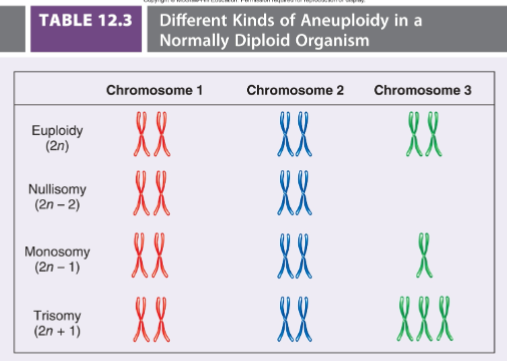
aneuploidy
the loss or gain of one or more chromosomes (usually lethal or causes abnormalities). individuals whose chromosome number is not an exact multiple of the diploid number for that species are considered aneuploid.
nondisjunction
causes aneuploidy due to failure of chromosomes to cross over during meiosis 1 and/or 2.
Exceptions to diploidy
- most animals are diploid
- exceptions are ants, bees, hermaphroditic worms, and some fish
- polyploidy in humans is lethal
formation of a triploid organism
note: all triploid organisms that undergo meiosis become sterile due to imbalanced gametes

tetraploid cell generation

polyploids in agriculture
approximately one third of all known flowering plant species are polyploid.
tetraploids - alfalfa, coffee, peanuts, Macintosh apples, bartlett pear
octoploids - strawberries
Euploid
a complete set of chromosomes (usually diploid)
Polyploid
a euploid species that carries 3 or more complete sets of chromosomes
autopolyploid
a kind of polyploid that derives all its chromosomes sets from the same species
allopolyploid
hybrids in which chromosome sets come from distinct but related species. Usually infertile because chromosome sets cannot easily pair and segregate properly
amphidiploid
has two diploid genomes, each from a different parental species. Example: Raphanobrassica
colchicine
causes chromosome doubling in germ cells. Used to generate hybrids such as triticale from wheat and rye. treatment prevents spindle formation and results in doubling of chromosome numbers

Gene families
sets of related genes with slightly different functions (usually diverged in sequence and function)
example of rapid chromosomal evolution
