Bacterial conjugation
 Call Kai
 Learn
 Practice Test
 Spaced Repetition
 Match
 Flashcards
 Knowt Play
1/19

There's no tags or description
Looks like no tags are added yet.
20 Terms
Fertility (F) factor
a plasmid that gives the bacterial cell the ability to produce pili

Hfr strain
a bacterial strain in which the F factor is INTEGRATED into the chromosome
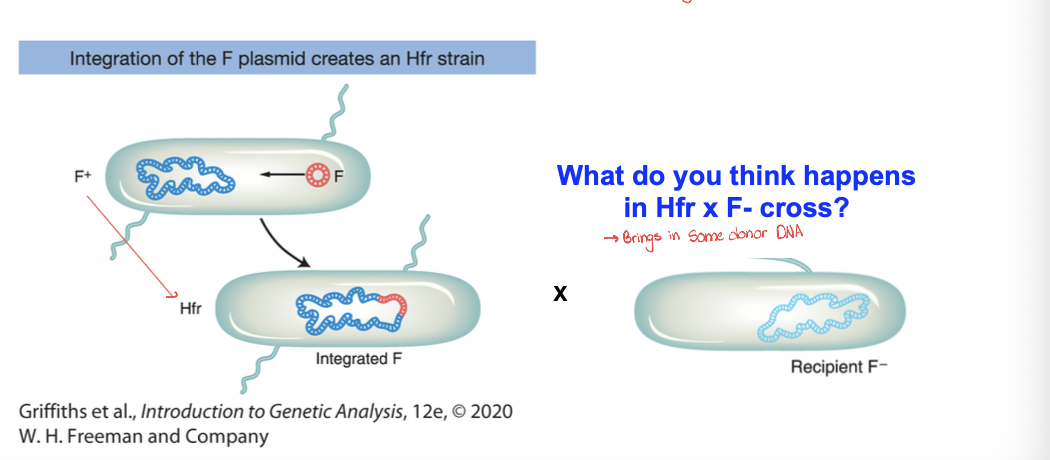
What happens in Hfr x F- cross
None* of the F- recipient strains are converted into WHAT nor WHAT
this would require copy and transfer of WHAT
The integrated F factor (in the Hfr strain), drives transfer of some (rarely all) of the WHAT
The donor chromosomal fragment can WHAT with the recipient chromosome
What happens in Hfr x F- cross
None* of the F- recipient strains are converted into F+ nor Hfr strains
this would require copy and transfer of ENTIRE GENOME
The integrated F factor (in the Hfr strain), drives transfer of some (rarely all) of the BACTERIAL CHROMOSOMES
The donor chromosomal fragment can RECOMBINE with the recipient chromosome

Bacterial conjugation
The integrated F factor (in the Hfr strain), drives transfer of some (rarely all) of the WHAT
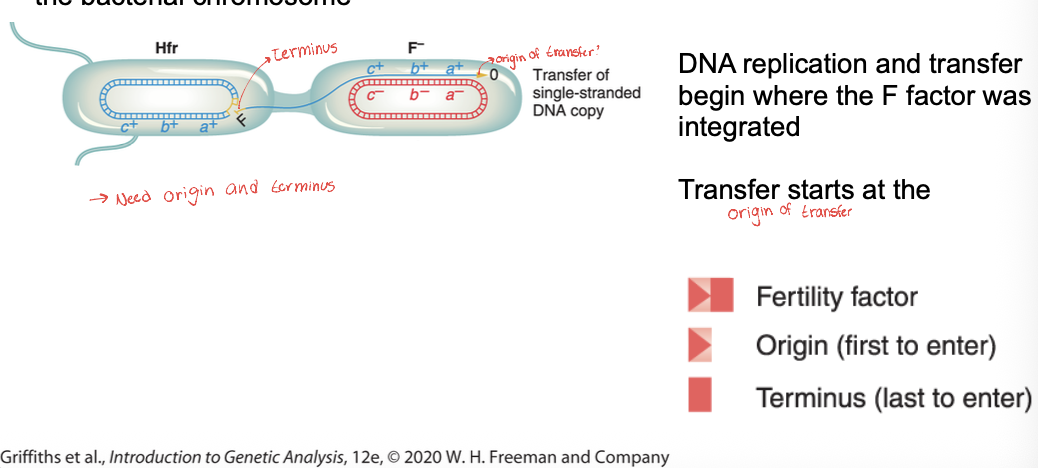
DNA replication and transfer begin where the WHAT was integrated
Transfer starts at the WHAT
Bacterial conjugation
The integrated F factor (in the Hfr strain), drives transfer of some (rarely all) of the BACTERIAL CHROMOSOMES
DNA replication and transfer begin where the F FACTOR was integrated
Transfer starts at the ORIGIN OF TRANSFER
Exoconjugant
Cell that contains a fragment of donor DNA; has participated in conjugation

Lastly, the donor chromosomal fragment can WHAT (randomly) with the recipient chromosome
Lastly, the donor chromosomal fragment can RECOMBINE (randomly) with the recipient chromosome

Bacterial conjugation - as a gene mapping tool
Interrupted mating experiments
Interrupted mating experiments
Disrupt conjugation at fixed time intervals to see which genes get transferred

Interrupted mating experiments tell you gene
WHAT
WHAT
Interrupted mating experiments tell you gene
Order
Spacing

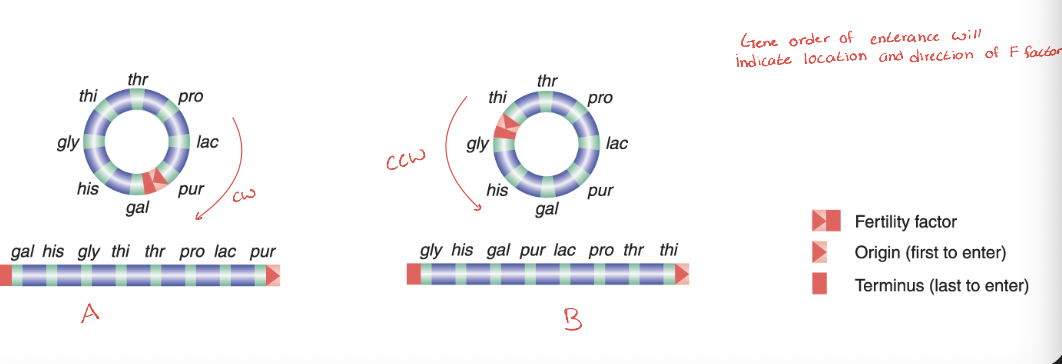
F plasmid can integrate at different WHAT and in different WHAT therefore different interrupted mating experiments will give different WHAT
F plasmid can integrate at different SITES and in different ORIENTATIONS therefore different interrupted mating experiments will give different RESULTS

Gene order of entrance will indicate WHAT and WHAT of F factor
Gene order of entrance will indicate LOCATION and DIRECTION of F factor
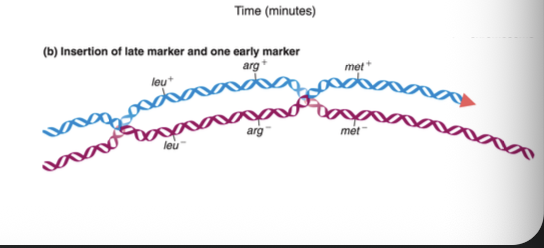
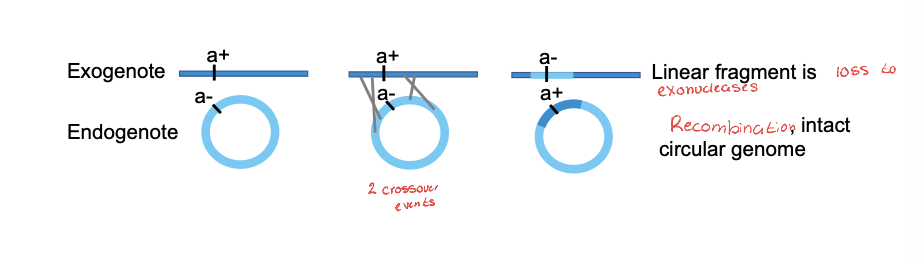
Recombination can take place between a WHAT (WHAT) and a WHAT (WHAT) (any double-stranded DNA that is WHAT) - DNA transferred by conjugation
Recombination can take place between a COMPLETE GENOME (ENDOGENOTE) and a PARTIAL GENOME (EXOGENOTE) (any double-stranded DNA that is HOMOLOGOUS) - DNA transferred by conjugation

In recombinant bacteria a single crossover cannot produce a WHAT recombinant
In recombinant bacteria a single crossover cannot produce a VIABLE recombinant

To keep the circular genome intact, there must be an WHAT number of recombination events
To keep the circular genome intact, there must be an EVEN number of recombination events

Linear fragment is loss to WHAT
Recombinants intact WHAT
Linear fragment is loss to EXONUCLEASES
Recombinants intact CIRCULAR GENOME
The closer the two genes are together on the chromosome, the less likely a WHAT event will occur WHAT them
The closer the two genes are together on the chromosome, the less likely a CROSSOVER event will occur BETWEEN them


Interrupted mating
Tracking the time of marker entry to generate a WHAT (in units of WHAT)
Interrupted mating
Tracking the time of marker entry to generate a CHROMOSOMAL MAP (in units of MINUTES)

Recombination frequency
Crossing-over in different regions generates different WHAT, allowing us to WHAT between genes (in units of WHAT)
Recombination frequency
Crossing-over in different regions generates different RECOMBINANTS, allowing us to ESTIMATE DISTANCE between genes (in units of cM)