Economic History Partial One
 Call Kai
 Learn
Learn Practice Test
 Spaced Repetition
 Match
Match Flashcards
 Knowt Play
1/221

There's no tags or description
Looks like no tags are added yet.
Name | Mastery | Learn | Test | Matching | Spaced | Call with Kai | Chat |
|---|
No analytics yet
Send a link to your students to track their progress
222 Terms
What are the two main changes the industrial revolution brought to our world
Technological advancements
Labor intensive economies changed into machine based economies
Why did the West industrialize first (Overview)
The conditions for growth in the early modern period were fundamentally different in Western Europe in terms of:
Social Structure
Political Institutions
Science and culture
Demography
Economic Incentives
What are the main topics that explain the difference in social structure in western europe
Karl Marx’s theory of capitalism
Property and labour relationships
What are the stages in Marx’s schematic account of historical development
Primitive communism
Slave society
Feudalism
Capitalism
Socialism (Predicted)
Explain the origin of capitalism
The origin of capitalism was set in motion by capital accumulation, which happened due to:
Dispossession of the peasant class, which meant there was a free propertyless working class
The existence of mercantile capital due to surplus extracted from the colonial trading system
Explain what Marxist theory attributed the path of eocnomic development to
Marxist theory contended that property and labour relations are what determine the path of economic development
The medieval economy was based on serfdom, and so it limited labor mobility and capital markets
And so the modern economy, which was based on industry and commerce, could only develop with capital institutions like free markets and a landless working class
Critiques on the Marxist theory of capitalism
Vibrant trade in medieval cities has already demonstrated capital features
Serfdom was not a “blanket of tradition”
Markets existed, and peasants responded to commercial opportunities
Serfdom was flexible: Landlords demanded tribute in kind, money, or labor
What are the main topics that explain how European Political institutions were different from the rest of the world?
Liberal political economy theory
European state centralization
Doorstep conditions for democratic transition
Explain the liberal political economy theory
Economic development is determined by political institutions: Secure property rights and limited government
Key work: North and Weingast (1989)
The Glorious Revolution in England created a parliament, which is good because
They could impose taxes and abolish monopolies, business friendly culture
Kings could not remove judges, which meant secure property rights
The king could only issue new debt guaranteed by parliament which increased fiscal capacity and public investment
Critique on the liberal political economy theory
Secure property rights existed in places like France and China yet no growth was seen there
England wasted high taxes and public debt on global warfare
How was Europe different when it came to state centralization?
Medieval kings relied on feudal armies
First consolidated nation-states with centralized governments
Absolutism: The crown, along with the parliament, formed a monopoly of power
Royal absolutism: Portugal, France, and Spain
Parliamentary absolutism: England
Describe centralization in Europe in the 17th century
State consolidation along the atlantic and north sea, so lots of centralization around Europe
Italy and Germany fragmented until the 1860s
What are the doorstep conditions for democratic transition?
Equality before the law
Permanent institutions to regulate social conflict
State monopoly of violence
All three conditions require state centralization, so the new model that achieved this centralization was called the fiscal-military state
What are the main topics that explain how Europe’s science and culture was different from the rest of the world
Cultural change favoring growth
Human capital growth
The printing press
Apprenticeships
What culture change favoring growth did Europe portray
Protestant revolution
Weber: The rise of the West was explained by Western rationality that arose from protestant theology
However, the empirical evidence is unconvincing
Scientific revolution
Modern technology
Mokyr: Industrial Enlightenment
Western exceptionalism: The scientific approach was widely used in Europe, but not elsewhere
Useful knowledge: Scientific method was applied to the study of tech
Bourgeois identity
Mccloskey: English society valued knowledge and entrepreneurialism
Explain the rise of human capital growth in Europe
Key to economic growth
Cities and the printing press increased literacy
Rising numeracy, since they now had books on math and geometry
Manufacturing skills
Apprenticeships taught urban crafts
England trained the most skilled artisans
What was the key science and culture invention in Europe, explain
The printing press
Invented by Gutenberg in 1448
Printing quickly diffused in Germany
By 1480: It was well established in Western capitals
Until 1650: It spread in Europe and not beyond
Overall, from 1450-1650, we had widely facilitated printing in Europe
Evidence on literacy and the critique
Extreme literacy growth between 1500 and 1800, tracked by seeing those who could sign their name
However, the usefulness of literacy before 1800 is widely contested
Apprenticeships: State the effects and why it was attractive
Industrial skills developed slowly
Accumulation of industrial skills
Diffusion of proto-industries
Apprenticeship was attractive in England because
There was competition (Best masters)
Integration (People moved from rural areas to London)
Social mobility (All social classes could participate)
How was demography different in western europe
The Malthusian theory: When income increases, fertility increases and mortality decreases, but population growth depresses average well-being. While restricted fertility means higher living standards.
Explain the Malthusian trap
Growth in pre-industrial Europe was limited by a self-equilibrating mechanism:
Birth rate was constant, only increasing if real wages increased
Death rate declined with rising real incomes
Real incomes declined if the population increased
soo growth of both the population and living standards was unsustainable
According to the Malthusian model, what happens as income increases?
Parents afford more children
More children survive to adulthood
Fewer people die
So the population increases
As population increases and land stays constant, income decreases (Diminishing MPL)
Bottom line: In the long run, population growth absorbs any gains in income
According to the Malthusian model, what happens if there is a fall in birth rate or an increase in death rate?
Population decreases, and so MPL increases
Income increases
A non technological improvement only leads to a temporary increase in income
What are the long-run implications of the Malthusian model?
Inverse relationship between population growth and income
Income/ real wages are stationary in the long run, close to subsistence level
Give some evidence that supports the Malthusian model
English data is broadly supportive
Most of the Pre industrial world was Malthusian
North Western Europe diverged early on
How were economic incentives different in Western Europe
European marriage pattern
Economic incentives favoring industrialization
Explain the marriage pattern in Northwestern Europe
24-26
High fertility within marriage
Many women never married (10-25%)
Low illegitimacy (3-4%)
Explain the marriage pattern in Southern and Eastern Europe
16-19
Very high fertility within marriage
Very few women never married
Hajnal line
A line that proposed an east/ west divergence in Europe
East= East+ Southeast + Southern Italy+ Spain + Finland + Iceland
West= North West
Explain the reasons behind the Western Marriage pattern
Late marriage
Nuclear families: had to earn enough
Urban economy: male apprentices and female servants could not marry
Girl power
Urban jobs= Women supporting themselves
The opportunity cost of marriage was high (Domestic service)
Littl efertility control= Growth was held in check by economic incentives
What were other economic incentives that existed in Western Europe that supported industrialization?
Consumerism
Access to trade and goods made people want to work hard
This is referred to as the Industrial Revolution = working-class efforts increased
Globalization
International trade meant higher living standards and human capital, which was connected to urbanization
Industrial tech was a response to high wages
Scientific Revolution and literacy enhanced the supply for innovation; high wages created the demand for it
What are the sources of moderne economic growth?
Measured through GDP, per capita, per worker, etc.
Schumpeterian: Results from accumulated capital and technology
What are the determining factors regarding global inequality?
Little to do with natural resources
Countries could have great land and still be poor
Resource rich countries often have inefficient institutions
Capital and technology matter the most
RIch countries have the best trained workforce
Best and more machines
What are the sources of pre modern growth?
Smithies: Results from specialisation and trade
Technological progress was slow as a trial and error process was the main method used
Capital was little and it complemented labor
Two key theories made by Adam Smith in the Wealth Of Nations
Invisible Hand: Resources naturally go to where they are used best
Division of labor: Specialisation is cheaper and more efficient, which implies the idea of economies of scale
Explain economies of scale
Gains from specialization and the division of labor
Gains from trade
However, market size limits the division of labour
Cycle: Ubranisation= Bigger markets → Specialisation → Higher labor productivity → Higher output per worker → Growth
Pin factory example
10 workers, each producing 20 pins= 200 pins total
However, if specialization and division of labor are used
10 workers producing 4,800 parts each= 48,000 pins total
Again, this is only worthwhile if a large market exists to buy the output
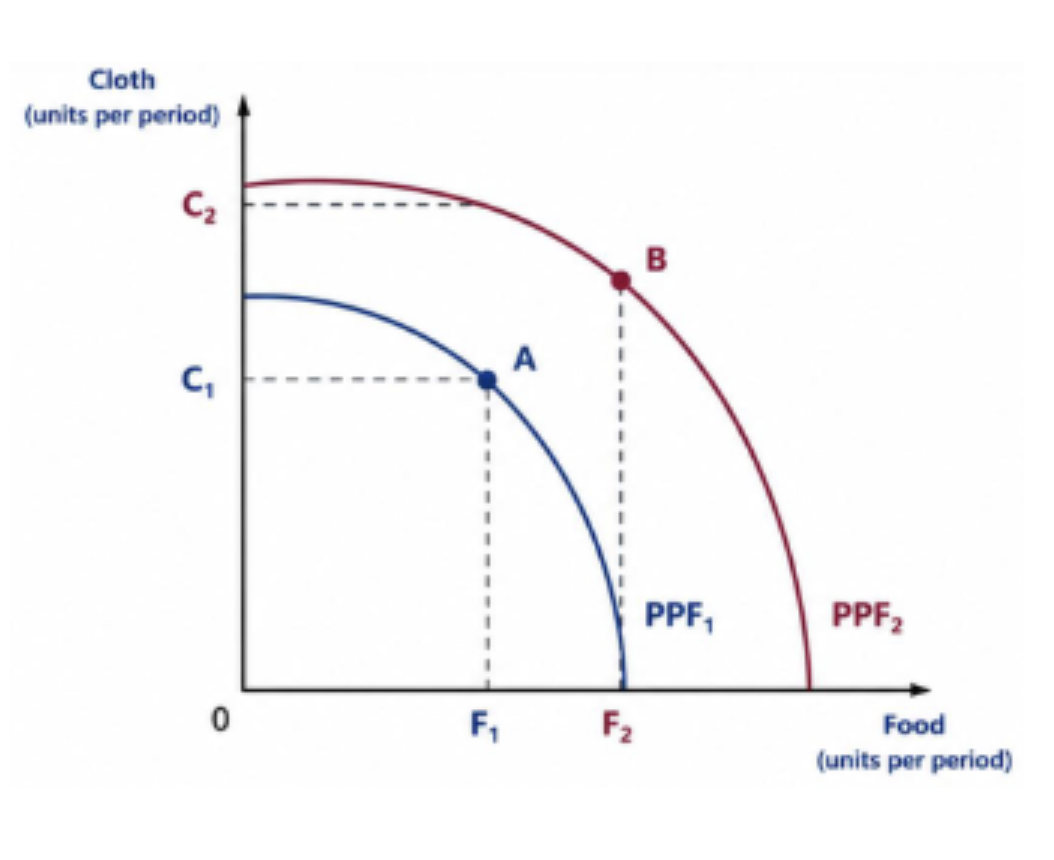
Before specialisation: Producing more food meant being able to produce less cloth
Post specialisation: For the same amount of food, more cloth can be produced and vice versa
What were the limits of pre industrial trade
Transportation costs:
Technology was not advanced
Custom borders
Bad routes
Other transaction costs:
No common currency
Heterogeneity of measures (Kilos, pounds, etc.)
Lack of a common language
Lack of security and trade disruptions (War, epidemics)
and sooo: Only goods with high value relative to their weight were even worth trading
Explain how European markets became larger
From the 5th to the 8th century: European population decreased by ½
Depopulation, along with trade disruptions, meant cities declined
From the 9th to the 14th century: Population increased by 3x, and so cities increased
In Italy: There was little growth post-11th century
In Northwest Europe, cities grew drastically
Before 1500, the European rate of urbanisation was similar to india and china
Explain what the silk road was and how it impacted pre industrial growth
Connected china, middle east, europe, and central asia
Allowed luxury goods to be traded like silk, spices, tea, and porcelain
Larger markets meant more specialisation, which meant the diffusion of technology and increase in urban growth
No low value goods traded on the silk road
The Black death and its economic consequences
Trade routes spread disease
Started in Central Asia and spread along caravan routes and to the Mediterranean
Dense trading cities became major centers
30-50 % of the population died in Europe
Cities were hit
Urbanisation and trade decreased
Agricultural economies returned
Labor was rare, and so wages increased (Beginning of the high wage economy)
The reneissance created a cultural revival
Europe after the Black Death (Renessaince Period)
1448: printing press
1470s: Rifle
1488: Cape of Good Hope reached
1492: Columbus and the Americas
1498: De Gama reaches India
1517: Protestant Reformation in Germany
Outcomes:
Printing and the Protestant Reformation increased literacy
New routes and a military advantage: Colonisation led to a commercial revolution
Explain the European overseas expansion and its consequences
1492-1913: Imperialism
Wave 1(1500s): The Americas and Africa were conquered by Spain and Portugal
Wave 2 (1600-1800): British, Dutch, and French colonies in the Americas and trade colonies in Asia
Led to new commercial institutions:
Private stock-listed companies raising unprecedented amounts of capital from 1000s of investors (English East India Company and Dutch East India Company)
Bottom line: Euro overseas expansion was driven by commercial motives and led to a much larger market and faster commercial expansion
Give some examples that show the importance of commerce when it comes to expansion
Britain went to Ceylon for pepper and tea
Britain went to the Cape Colony for defense and ships
Britain went to the Caribbean islands for sugar
To supply plantations, slaves were shipped (the slave trade became even larger than the shipping of goods)
Atlantic trade became the engine: Increased so much after 1600, and by 1800 Atlantic trade was larger than medditerranean trade
Explain the little divergence
Trade shifted from Italy to england
Structural change occurred: Ubranisation and proto-industrialisation
Economic consequences: High wage economy, the agricultural revolution, and the energy revolution
What was the commercial revolution?
New goods at lower prices, meant more demand
Economic consequences: Consumption increased, markets became larger, and an increase in business opportunities.
What is proto industrialisation
17th century, households produced everything internally
Small scale manufacturing expanded before factories
Production became more specialised and commercial
The growing demand stimulated manufacturing
What is the industrious revolution
New goods change behavior
Work increased
Producing for markets increased
Buying increased
Evidence: More working days per year
How was Europe able to out compete foreign producers?
Until 1700: Manufacturing expanded through trade within Europe
Imitation of Flemish and Italian textiles
Rise of textile manufacturing in Italy and the Netherlands
Italian cloth was driven out of Northern Europe
From 18th century: Overseas trade increased imports
British textiles substituted for imported Indian cotton cloth
European porcelain replaced Chinese imports
Overall: Trade first transmitted ideas and products, european industries improved, and so they outcompeted foreign producers
Structural change: Agricultural imports descreased, manufacturing and services increased, and urbanisation increased
What are historical national accounts and how can they be used?
Reconstructing output, income, and population from archival sources
Angus Maddison pioneered systematic long run international comparisons
Maddison project extends and revises them
Estimates are more uncertain as we move back in time
Explain the two different theories on wage differences
Smith: Wages were highest in the commercial centers of the North Atlantic
Malthus: Demographic behavior explains international wage differences
Wages higher in England with fertility restrictions
Wages lower in Asia with high fertility
Contemporary traveller accounts supported these views
What are the two benchmarks used to analyse income
Subsistence basket
Minimum calories and protein
Classical local food (No meat, dairy, bread, butter, or oil)
Minimal clothing, fuel, etc.
Adult male= 1900 kcals
Differs across countries
Respectability basket
More calories and higher quality protein
Bread, meat, dairy
Comfortable working class
Rich diet= 2500 kcals a day
High protein for high manual labor
Based on historical household budgets in England and Holland
List some large differences in living standards between different countries
England: The best-off workers had meat, bacon, cheese, and bread instead of oats and barley
Dutch: Bread, meat, butter
French: 95% of the diet consisted of cereals, with little animal protein
Italy: Living standards declined in the early modern period, polenta became a staple
China: Rice and the occasional fish
India: Cheap grains, poorest diet, meat was taboo
What are two ways we can measure historical living standards?
GDP Per capita
Broad measure of average economic performance
Pre 1870: Estimates were scare and innacurate
Point estimates, no continouous series
Real wages
Simpler and easier
Direct measure based on historical wage and price observations
Measures purchasing power of labor income
More comparable: Usually collected for simple trades in every country (Farmer w farmer, etc.) and nominal wages are deflated using the same approach
Method for constructing real wages
Nominal wages
Collect daily wages
Convert currency to a common unit (Silver)
Cost of Living
Consumption basket
Local price for items
Cost of purchasing basket
Real wage
Welfare ratio= annual earnings/ annual cost of the basket
1= just enough, >1 above subsistence
The little diveregnce in real wages
Black death increased wages in Europe, and then wages declined towards subsistence until the 19th century
England and the Netherlands: Wages remained high for centuries
Calculated under and assumption of 250 days of work per year, is that an over statement?
The little divergence in purchasing power
Higher purchasing power in England and the Netherlands; even respectable baskets were affordable
High wages genuinely translated to high purchasing power
The little divergence in skilled wages
England and the Netherlands remained high-wage economies
Exceptionally high purchasing power
Allen: Expensive labor increased the pay off of using labor saving technology
Explain why New England had high wages with no early industrialisation
Atlantic trade:
Abundant land meant a very high land to labor ratio
High wages attarcted migrants from Britain
Colonies specialised in primary exports for European markets
BUT economic structure was agriculturally heavy:
Colonial america was rural
Manufacturing was limited before independence
Urbanisation and industrialisation expanded post 1776
so… by 1800 New England had the highest waged in the world but it did not automatically lead to industrialisation
How was New England exceptional?
Massachussets had higher wages than London
Britain was still well above continental Europe
North Atlantic economy combined high wages with expanding markets, increasing growth
High wages alone cannot explain why industrialisation happened in Britain
How did nominal wages differ across England?
London was the highest wage labor market
Wage differences between cities lasted for centuries
Yet industrialisation happened in North and midland England NOT london
Explain what high wages provided in terms of living standards
More food
More expensive food like sugar and tea, meat and dairy
Alchohol consumption
How does the biological standard of living prove that england had better living standards
Adult height reflects childhood nutrition and disease environment
18th century English people were 8-10 cm taller than thos in France, Italy, and Austria
Explain income and social structure in England
Only cottagers and the poor lived at subsistence
Average Englander’s income was x5 subsistence
Even ordinary worked made x3 subsistence
This broad purchasing power created a large domestic market for manufactured goods
Explain the role of agriculture and how it limits growth
Food is a necessity
Society can only start producing non-agricultural goods if farmers produce a surplus
Agriculture limits economic growth because (Smithian)
The population depends on it
Only surpluses allowed specialization
Higher farm productivity meant bigger towns and trade
How does industrialization depend on agriculture?
Industrialization needs resources and markets and both rest on agricultural productivity because it led to less labor demand and an increase in food surplus, which meant increased urbanization.
This is exactly why England and Holland were more urban.
They had higher labor productivity for the average worker
They ahd high farm output per unit of land
Give a brief timeline of teh agricultural revolution
The black death
Decreased population
Land abandonment
High wages
Consumers demand
Less grain
More meat and dairy
Farmers Response
Shift from arable farming to livestock
More animals meant an increase in power and manure
Both of these shifts meant an increase in productivity
Explain the new sources of growth that the agricultural revolution brought
Capital
Higher wage meant money to invest in livestock
Greater draft power meant less labor
Technology
Natural fertilisers
Better fertility meant better yield
Explain the cycle of self sustaining growth that occured during the agricultural revolution
Increased livestock meant more power and manure which meant increased labor productivity and higher yields which meant higher wages which meant more livestock and the cycle continues.
The classic explanation for England’s exceptional agriculture
Changing land tenure.
Open fields before the black death meant that land was divided into many scattered strips, and there was collective management of the fields.
Enclosures meant that land was consolidated into larger farms.
Also, as a consequence of the rising demand for english wool farmers started switching to livestock farming.
Enclosures timeline
1500: About 50% of farms enclosed
1750: 2/3 enclosed
1760-1830: Parliamentary enclosures accelerated consolidation
18th century English agriculture was dominated by consolidated landholdings rented to capitalist farmers.
Explain capitalist farming and provide an example.
Capitalist farming occurred when wealthy investors increasingly bought agricultural land and large estates were rented to commercial tenant farmers, and so farming became more market-oriented.
An example is Albany Wallis, a London solicitor, who was also a member of parliament.
Compare open fields vs enclosures
Open fields:
Farmers cultivated many scattered strips
Villagers coordinated crop rotation
Some land lay fallow to restore soil fertility
Enclosures:
Small strips were merged into larger fields
Hedges and fences defined private property
Larger farms were easier to manage and invest into
How were open fields inefficient?
Villagers being forced to cooperate meant that it was hard for innovation to happen
Peasants land was separated and far away which meant costly friction
Lands were rotated among villagers and so there was no incentive to invest
How were enclosed fields efficient?
Large consolidated holdings meant people could benefit from economies of scale
Tenant farmers invested in capital to economise on labor
Long leases meant tenants were interested in improving and maintaining yields
Explain the broad effect of enclosures
Enclosures meant an increase in productivity, which meant less farm labor needed, which led to urbanisation, which led to industrialisation.
How can we measure agricultural productivity
Farm output must be estimated from consumption.
Old approach: Backward projection of output assuming constant food consumption per capita.
New approach: Adjusting consumption to income levels.
Allen found that
There was rapid growth before 1750
Slow growth in the 18th century
Rapid growth during industrialisation
How does Allen decompose agricultural growth? What does he compare?
Adoption of new crops and rotations- Technology
Land use- Arable to grass
Crop yields
Labor productivity
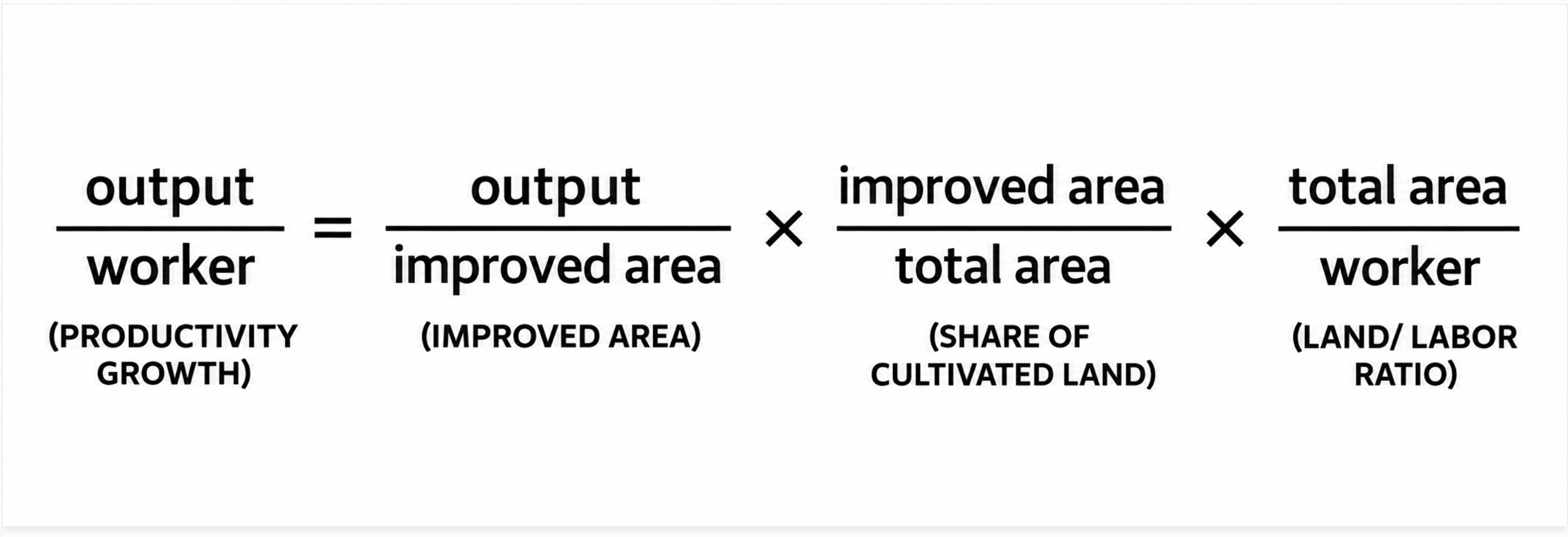
Explain the mixed evidence about open fields vs. enclosures that Allen’s decomposition brought around
Advanatge of enclosed farming was only 6-15%
Enclosed and open fields both saw large improvements
What are the sources of agricultural productivity growth
Increased draft power per worker
Increased land per worker
Better farming techniques
Give the two opposite views explaining what the incentives were to adopt new agricultural techniques
The traditional view: Improvement in agriculture led to increased urbanisation
Allen’s view: Urbanisation led to improvement in agriculture
(Cities created the demand for agricultural innovation and growing trade is what led to the growing cities)
Explain the mechanism that explains Allen’s view on the incentive to adopt new farming technniques
Explained by Von Thünen in 1826
Urban demand raised the prices of farm products that were expensive to transport so goods were produced near cities
Evidence: Farms near London shifted from arable production to pasture so they could supply meat and dairy. However, grain production remained spread out
Explain what growing cities meant in terms of wages and prices and how farmers responded
Growing cities meant higher wages and more expensive food and so farmers responded by enclosures, saving labour through pastures, and investing in productivity.
Compare farm and urban wages
Urban wages were a lot greater than farm wages
Farm faced growing labour shortages
Labor saving innovation became profitable
Explain the difference in agricultural mindest before and after 1630
Before:
Rural wages were high
Labor was not scarce
Little incentive to innovate
After:
Workers moved to cities
Labor was scarce
Farmers consolidated
Productivity improved
What are the origins and consequences of the high wage economy
Origins:
Commercial revolution
Agricultural revolution
Consequences:
Proto industrialization
Industrious revolution
Skill accumulation and literacy
Innovation in agriculture
Explain the difference between Britain and the low countries when it came to the origins of the industrial revolution
Both Britain and the low countries had agricultural and commercial revolutions
However, Britain industrialized first, followed by Belgium, not the Netherlands
One of the main differences is Coal.
Most of the world’s coal existed in Britain in the 18th century
Southeast Belgium was the only other region of significant coal production
The rest of the world still used traditional energy
The timber crisis hypothesis (Nef 1932)
Until the 17th century, Britain cut down its forests for heating fuel and material for shipbuilding
However, a timber shortage meant that wood and charcoal were replaced by coal
Evidence: Coal mining increased around 66x between 1560 and 1800
Based off of wood prices rising after 1650
Allen’s critique of the timber hypothesis
Allen believes the timber hypothesis is incomplete and that the phenomenon was actually related to real prices.
The increase in wood prices reflected inflation
Real wood prices rose after urban growth increased the demand for wood
However, coal only became cheaper in 1650
Implication: Higher prices were more likely to be driven by urban growth
Explain the importance of coal
Coal created a shift from an organic to a mineral fuel economy
It helped create the first modern industry
Geographically concentrated (Northeast)
Large-scale production (Mining)
High investment requirements
Strong industry linkages (Finance, insurance, shipping)
Later technological spinoffs:
Steam engine
Mass production of iron and steel
Railways
Explain the coal regional spillover
The coal burning hosue was invented and spread to Western Britain and Scotland
The growth of cities raised the demand for fuel further, which increased coal mining
Explain the supply and demand characteristics of the coal industry
London became Europe’s largest city
Rapid urban growth led to increased fuel demand
Increased demand made coal mining commercially attractive
Coal mining developed in the Midlands and in the north of britain
Explain how the growth of london led to the increase in fuel prices
By 1800, London had a population of 1 million
Timber had to be transported over longer distances as fuel demand for london grew
Transport costs meant that fuel prices increase
Why didn't coal become expensive like wood?
Coal was not clean energy
Houses and industries still preferred charcoal
And so coal could only be sold as discounted fuel, but reserves were unlimited
Coal behaved like a backstop technology
An energy source that provides virtually unlimited power at a constant unit cost
The transition from wood to coal
Wood prices increased as london grew
Coal prices remained stable
Once wood became expensive, coal mining became profitable
Coal demand increased, and so coal responded
How was energy like in 1700 and 1800, why did this not happen earlier
By 1700, ½ of coal was used for heating
By 1800, almost all thermal energy was derived from coal
Tech constraints prevented the energy revolution from happening earlier
Medieval fireplaces burned wood
Coal produced smoke and sulphur that were dangerous
Existing houses were unsuitable
The new heating technology is what made coal practical
Explain the new house design innovation and diffusion
Innovation:
Closed fireplace/ metal chamber
Chmineys created to keep smoke away
Diffusion:
Common in London by the 17th century
Great fire of 1666 accelerated adoption
Coal trade took off in the Southeast when new designs became common
Explain the impact of the great fire of 1666
Complete destruction
80% homeless
5/6 of the city destroyed
Reconstruction
Happened quickly because London was a global trade hub
Reconstruction spread modern coal burning houses
Higher timber demand made coal even more attractive
Explain collective invention
No patents, so gains were non-excludable
The industry must internalize the cost of innovation
The rate of innovation depends on the market size
London’s reconstruction accelerated technology
Innovation became cheaper because many builders experimented simultaneously
Coal pre 1660 vs post fire
Pre-1660:
Firewood cheap
Little incentive for coal
Post:
Coal tech spread
Wood was expensive
Demand for coal increased
Coal mining expanded