(NDT) Chapter 5: Lipids
 Call Kai
 Learn
Learn Practice Test
 Spaced Repetition
 Match
Match Flashcards
 Knowt Play
1/22

There's no tags or description
Looks like no tags are added yet.
Name | Mastery | Learn | Test | Matching | Spaced | Call with Kai | Chat |
|---|
No analytics yet
Send a link to your students to track their progress
23 Terms
What Are Lipids?
Diverse groups of molecules that are insoluble in water
When referring to Fats: lipid content of diets and foods
1. Triglycerides
2. Phospholipids
3. Sterols
Triglycerides
A molecule consisting of a 3 carbon backbone with 3 fatty acid chains
Classified by chain length, shape and level of saturation
Long chain fatty acid is most common in our diet (>14)
Saturated (no double bond, solid at room temp), unsaturated (mono or poly, double bond, liquid at room temp)
Trans: Hydrogen on opposite sides, kinked shape
Foods rich in fat contain different types of fatty acids.

Essential Fatty Acids
Cannot be produced by the human body and therefore they are needed to be consumed in ones diet.
Linoleic acid (omega-6 fatty acid) found in vegetable and nut oils
Alpha Linoleic acid (omega-3 fatty acid) found in dark, green leafy vegetables, soybeans/oil,
flaxseeds/oil, walnuts/oil, canola oil
Omega-3 fatty acid
Fatty acid that reduces inflammatory responses, and blood clotting as well as decreasing the risk of heart disease.
Found in fish and fish oil
Eicosapentaenoic acid (EPA) + Docosahexaenoic acid (DPA)
UL= 5g a day
Omega 6 (proinflammatory)
Omega-6 fatty acid
Essential polyunsaturated fats that increase inflammatory responses, such as blood clotting
Key sources include soybean, corn, safflower, and sunflower oils, along with walnuts, sunflower seeds, and almonds
Phospholipids
Contain a glycerol backbone and two fatty acid phosphates
soluble in water and transports fat into the bloodstream
manufactured in out bodies (not needed to be consumed)
Lecithins combine with bile salts= BILE

Sterols: Cholesterol
Subclass of steroid lipids containing multi ring structure which naturally occur in cell membranes in animals, plants and fungi
Already made in the body therefore consumption is not needed
Naturally occur in animal products as well as plants (block absorption of dietary cholesterol)
(e.g.,) Sex hormones, bile and vitamin D

Lipid Digestion: Oral Cavity
Lingual lipase is secreted by tongue cells + saliva
Little lipid digestion occurs
Lipid Digestion: Stomach
Most fat arrives in tact
Mixed and broken down in droplets
Gastric lipase digests SOME triglycerides
Lipid Digestion: Small Intestine (Bile)
Majority lipid digestion and absorption will occur in small intestine
Bile salts (hydrophobic and hydrophilic) break large lipid droplets into small ones
Large fat droplets filled with triglycerides emulsified by bile
Lipid Digestion: Small intestine (Pancreatic lipase)
Once it is emulsified the pancreatic lipase can access and break then into free fatty acids
Micelle
Made of products of lipase digestion along with cholesterol esters
Transports digestion products into intestinal enterocyte to be ABSORBED
Lipoprotein
Transports lipids into the bloodstream
Chylomicron: produced in intestine to transport lipids from a meal
Absorbed by enterocyte of the small intestine then travels through the lymphatic system

Absorption of fats
Chylomicrons are transferred from the lymphatic system to the bloodstream (thoracic duct)
Short and medium chain fatty acids are easily absorbed
enter directly into the circulatory system
Chylomicron
Highest in triglycerides
Transports dietary fat into the body + body’s tissues

VLDL (Very low density lipoprotein)
Transports endogenous lipids, especially triglycerides to various tissues of the body.
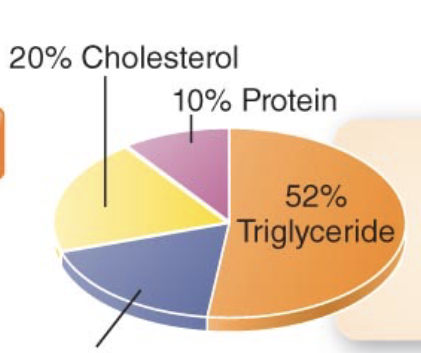
LDL (Low density lipoprotein)
High in cholesterol (transports cholest.)

HDL (High density lipoprotein)
Lowest in triglycerides and cholesterol, transports cholesterol from tissues back into the liver.

Various functions of Lipids
They function to serve energy storage, satiety, flavor, protection and maintaining cell functions)
Essential fatty acids
◦ Eicosanoids
◦ Cell membranes
◦ Needed for growth
Transport of Fat: Chylomicrons
How much fat do we need?
AMDR (DRI): 25-35%
Dietary guidelines: los in sat fats <10% and high is 10%>
Selecting healthful fats…
Beneficial fats
Increase Omega 3’s: Eat more fish
Sustainable fish, walnuts, chia seeds, pumpkin
seeds, flaxseed
Use olive or canola oil in place of butter or margarine
Select low-fat or nonfat dairy products