Commercial Prep: systems
 Call Kai
 Learn
 Practice Test
 Spaced Repetition
 Match
 Flashcards
 Knowt Play
1/30

There's no tags or description
Looks like no tags are added yet.
31 Terms
Electrical systems basics:
28V DC system.
24V battery.
28V, 60amp alternator driven by engine.
Battery provides power for engine start and as a backup.
Busses:
a “bus” is simply an electrical distribution bar or circuit group that multiple electrical components share.
1.) Electrical/ primary Bus 1.
2.) Electrical/ primary Bus 2.
3.) Avionics Bus 1.
4.) Avionics Bus 2.
5.) Essential Bus.
6.) Cross feed Bus.
Electrical/ primary Bus #1:
Electrical/ primary Bus 1.
Aux fuel pump.
Beacon light.
landing light.
flaps motor.
AVN 1(switch)
Electrical/primaery Bus #2:
Electrical/ primary Bus 2.
Pitot heat.
taxi lights.
strobe lights.
panel lights.
AVN 2(switch)
Avionics Bus #1:
Avionics Bus 1.
PFD.
ADC/AHRS
Nav 1.
E/A unit
FIS
Avionics Bus #2:
Avionics Bus 2.
MFD.
XPDR
Com 2.
Nav 2.
audiopanel.
Autopilot.
Essential Bus:
Essential Bus.
Receives power from both primary Bus and standby battery.
PFD.
ADC,AHRS.
NAV 1
COM 1
E/A Unit
E bus voltmeter
standby indicator lights.
Cross feed bus:
Cross feed Bus.
Links the two primary bus to allow load sharing and redundancy.
Alt. field/master switch
WARNG circuit breaker
stall warning
AP warning
Voltmeter
main buss
Landing gear
Tricycle type, with a steerable nose wheel and two main wheels. Shock absorption is provided by the tubular spring steel main landing gear struts and the air/oil nose gear shock (oleo) strut.
How does the oleo strut work?
The visible part of the strut we check during preflight is a piston filled with hydraulic fluid. When the aircraft lands, the piston compresses air or nitrogen in the upper chamber, cushioning the impact on the nose gear.
Brake system:
The airplane has a single-disc, hydraulically-actuated brake on each main landing gear wheel. Each brake is connected by a hydraulic line (looks like a hose) to a master cylinder attached to each of the pilot's brake pedals.
Why do engines have oil systems?
1) Lubrication of the engine’s moving parts, 2) cooling of the engine by reducing friction, 3) removing heat from the cylinders, 4) providing a seal between the cylinder walls and pistons, and 5) carrying away contaminants.
What are your aircraft's oil quantity limitations?
5-8 quarts.
How is a wet sump different from a dry sump oil system?
A wet sump system stores oil in a pan attached to the engine, while a dry sump system uses a separate oil tank and multiple pumps to circulate oil. Dry sump systems are more complex and expensive but prevent oil starvation during high or low g-loads, making them ideal for aerobatic aircraft.
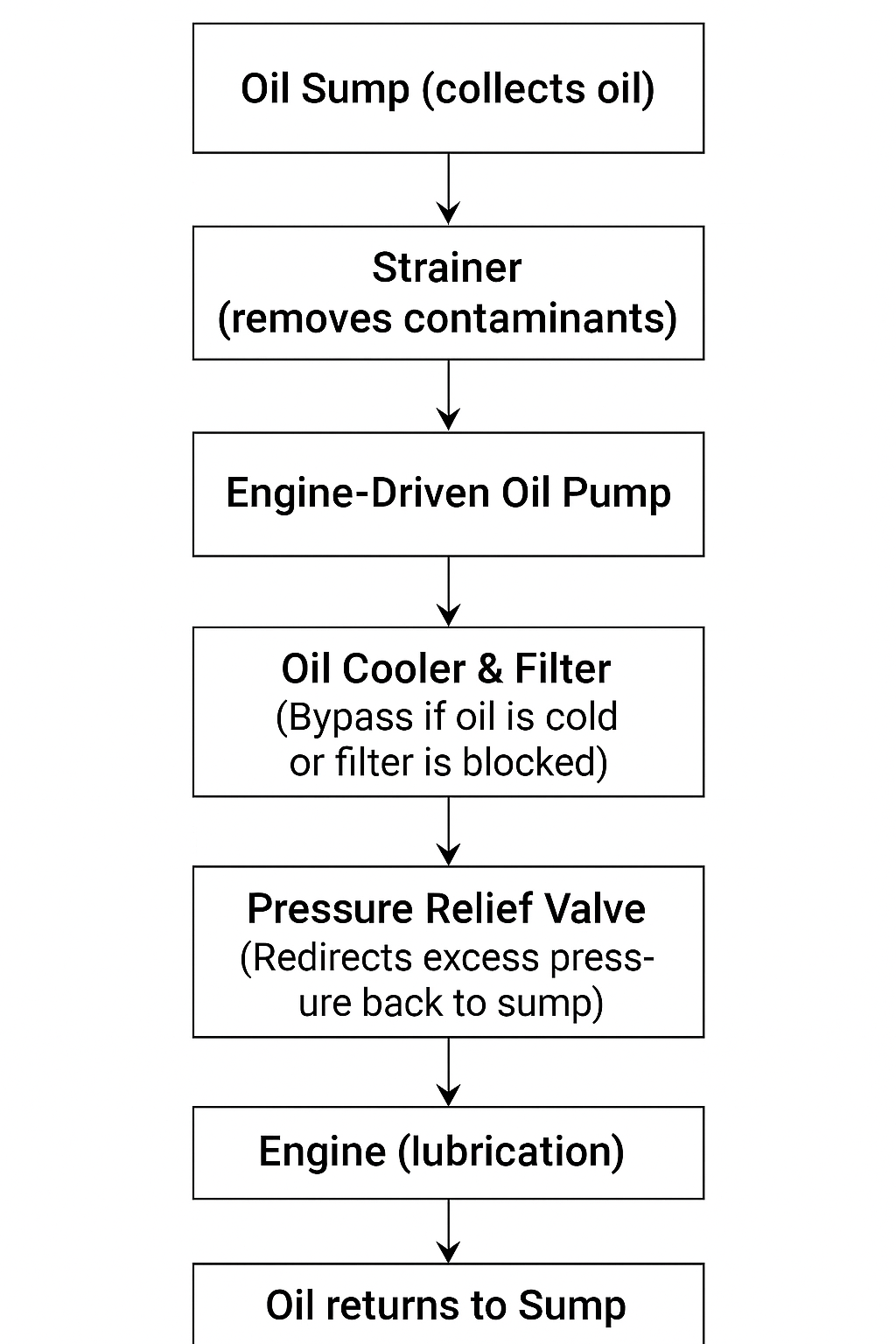
Describe the path that oil takes through your engine’s oil system.
Oil collects in the sump at the bottom of the engine.
It is drawn through a strainer and the engine-driven oil pump.
The oil passes through the cooler and filter, which can be bypassed if the oil is cold or the filter is blocked.
It then goes through a pressure relief valve to control excess pressure.
Finally, the oil circulates through the engine for lubrication before returning to the sump.
Take me through what is going on internally during the ignition process for your aircraft, from battery master on to the engine running on its own. Feel free to reference your checklist.
Turn on the battery to supply electricity to the starter and auxiliary fuel pump.
Crack open the throttle, turn the auxiliary fuel pump on, and push the mixture in to allow fuel to flow into the cylinders (prime the engine).
Pull the mixture back to cut-off and turn the aux pump off to avoid over-priming/flooding.
Press and hold the starter, which engages its spinning gear with the flywheel, causing the flywheel to spin.
The flywheel spins the crankshaft, which is geared to the magnetos.
The magnetos operate, providing electricity for the spark plugs to fire sparks inside the cylinders.
Fuel already in the cylinders ignites, causing combustion.
Once combustion is self-sustaining, release the starter.
The crankshaft continues to spin, driving the propeller, which begins to turn.
Take me through each step of your aircraft’s air induction system.
Ram air enters through the lower front intake.
An air filter removes dust and debris.
Filtered air goes into an air box with a spring-loaded alternate air door.
If the filter clogs, engine suction opens the alternate air door to pull unfiltered air from inside the cowl.
Air then goes to the fuel/air control unit.
From there, it’s sent through intake tubes to the cylinders.
Burned gases exit through the exhaust pipe.
What do the throttle and mixture lever control in a fuel injection system?
Opening the throttle lets more air in by opening a butterfly valve.
The fuel/air control unit adds more fuel to match the extra air, keeping the ratio the same.
More fuel/air mixture enters the cylinders → more combustion → more power.
Enriching the mixture adds extra fuel without adding air.
This makes the mixture more fuel-rich and may slightly change power depending on whether it was too lean or too rich before.
How does a basic pressurization system work?
Engine compressor air is bled off and sent into the cabin.
A heat exchanger cools this hot compressed air first.
Outflow valves control how much air escapes the cabin.
Closing the valves keeps more air in and lowers cabin altitude.
Opening the valves lets more air out and raises cabin altitude.
A cabin pressure regulator automatically manages this process.
Air induction system:
Ram air enters through the front lower intake.
An air filter removes dust and debris.
Filtered air goes into an air box with a spring-loaded alternate air door.
If the filter gets blocked, engine suction opens the alternate air door to pull unfiltered air from inside the cowl.
Air then flows to the fuel/air control unit and through the intake manifolds into the cylinders.
After combustion, exhaust exits through the exhaust pipe.
How can the relative wind adequately cool the cylinders when they are largely confined within the cowling and therefore not exposed to the outside air?
This is where the cooling fins and baffles come in. The heat from the cylinders transfers to the cooling fins, which are exposed to the relative airflow, allowing the heat to dissipate. The baffles are positioned to guide the airflow to where engine cooling is needed, namely over the cooling fins/cylinders.
Shimmy damper:
A shimmy damper on a 172S prevents the nose wheel from rapidly vibrating during takeoff and landing rolls. It stabilizes the steering by resisting quick, unwanted movements.
A small cylinder is filled with hydraulic fluid.
At slow speeds, the fluid moves easily, so the nose wheel turns easily.
At high speeds, the fluid can’t move through the cylinder quickly.
This makes the damper resist rapid movement and helps stop nose-wheel shimmy.
LRU’s
an LRU (Line Replaceable Unit) is a self-contained avionics or electrical component—like a G1000 display, GPS/NAV/COM, AHRS, ADC, or transponder—that can be quickly removed and replaced as a unit without troubleshooting down to the component level.
What flight instruments does the AHRS control?
Attitude indicator, heading indicator (processes info from the magnetometer), slip/skid indicator, and the rate-of-turn indicator.
Does the AHRS utilize gyroscopes or have any spinning parts?
No, just sensors and accelerometers that don’t spin and therefore won’t tumble.
Which LRU(s) provide heading information?
Magnetometer and AHRS.
Which flight instruments does the ADC control?
Airspeed, altimeter, and VSI. The ADC
also processes and displays OAT and pressure altitude information.
Does the airspeed indicator still utilize a diaphragm? Does the altimeter use aneroid wafers?
No to both. The ADC replaces the internal components of a conventional pitot/static system.
Where are the com, nav, and GPS antennas located on the aircraft?
The com/GPS
antennas are mounted on the top of the cabin. The #1 antenna is on the right, #2 on the left. The blade-type navigation antenna (for the localizer, glideslope, and VOR) is mounted on either side of the vertical stabilizer.
How does the compass work?
Two small magnets inside the compass align with Earth’s magnetic field.
They’re attached to a float that moves freely in fluid.
A compass card is wrapped around this magnet/float assembly.
When the airplane turns, the compass card stays aligned with the magnetic field while the airplane moves around it.