BPD: Pit and fissure sealing
 Call Kai
 Learn
 Practice Test
 Spaced Repetition
 Match
 Flashcards
 Knowt Play
1/9

There's no tags or description
Looks like no tags are added yet.
10 Terms
Tooth anatomy (development groove, fissures, pits and fossae)
Developmental groove: A narrow depression separating tooth lobes.
Fissure: A deep groove caused by incomplete fusion of tooth lobes.
Pit: A small depression where grooves meet or end.
Central fossa: A depression on the occlusal surface where several grooves converge.
Central pit: A pit within the central fossa, often susceptible to caries.
Important: Pits can also occur on the lingual surfaces of maxillary incisors, especially lateral incisors, below the cingulum.

Fissure anatomy (types of fissures)
Fissures are classified according to their shape:
U-shaped: Similar width from top to bottom.
V-shaped: Wide opening, gradually narrowing towards the bottom.
I-shaped: Very narrow slit.
IK-shaped: Narrow entrance with a wider space at the bottom.
Inverted Y-shaped: Narrow entrance with branching at the bottom.
Important: Narrow and deep fissures are particularly difficult to clean and may retain bacteria.
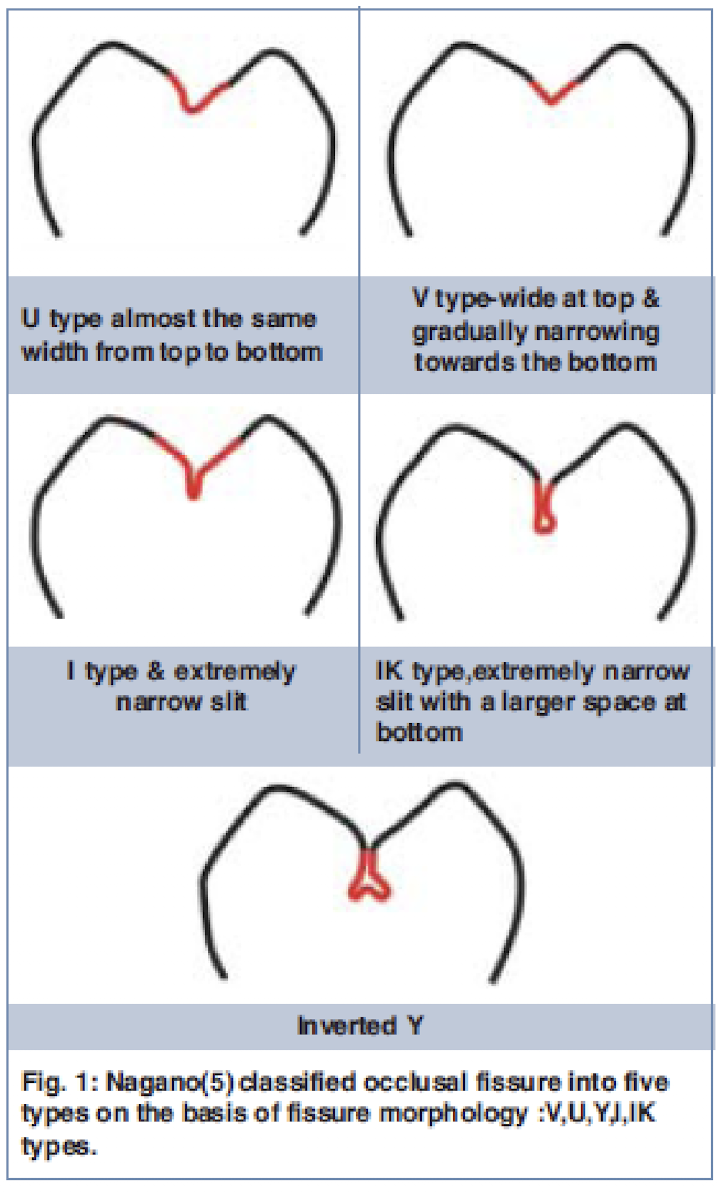
Pit and fissure sealing
Pit and fissure sealing is a preventive procedure in which a protective material (sealant) closes pits and fissures to prevent dental caries.
Why is it needed?
Deep pits and fissures are difficult to clean because toothbrush bristles cannot reach them.
Bacteria and plaque accumulate, increasing caries risk.
Recently erupted teeth have less mature, more porous enamel.
Main benefit: Creates a protective barrier that prevents bacteria and food from accumulating in fissures.

Indications and contraindications for sealing
Indications:
Deep pits, fissures or fossae that are difficult to clean.
Teeth with increased caries risk, especially permanent molars.
Patients with high overall caries risk.
Contraindications mentioned in the lecture:
Inability to keep the tooth dry (poor cooperation).
Open carious lesions.
Large existing occlusal restorations.
Restorations on other surfaces that would interfere with the sealant.
Important: The patient’s caries risk is more important than the time since tooth eruption.
When should sealants be applied
Typical ages:
3–4 years: Deciduous molars.
6–7 years: First permanent molars.
12–13 years: Second permanent molars.
Benefits:
Effective in preventing occlusal caries.
Relatively inexpensive compared with restorations.
Painless, quick and easy to apply.
Important: Sealants should be monitored over time because their protective effect depends partly on retention.
Types of sealant materials
Key difference: GIC is more moisture-tolerant, whereas resin-based sealants require a dry surface
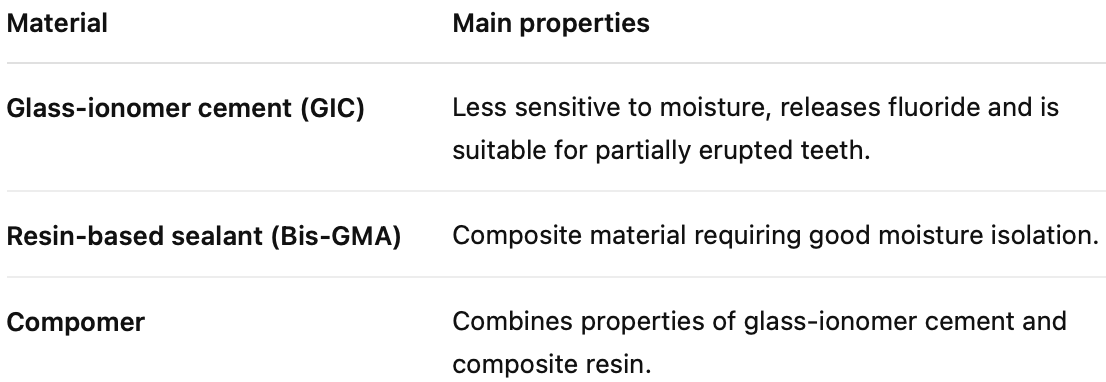
Classification of fissure sealants
1. Polymerisation:
1st generation: UV-light cured.
The material has a fotoinitatior
2nd generation: Chemically cured.
3rd generation: Visible-light cured.
4th generation: Visible-light cured with fluoride.
2. Fillers:
Unfilled: Better flow into narrow fissures.
Semi-filled: Greater wear resistance.
3. Colour: Clear, opaque, tinted, etc.
Ideal properties: Good flow, strong and long-lasting adhesion, wear resistance, low toxicity, insolubility, dimensional stability and rapid curing.
Steps for pit and fissure sealing
Clean/polish: Remove deposits using fluoride- and oil-free paste.
Isolate: Keep the tooth dry (e.g., rubber dam or cotton rolls).
Etch: Apply 37% orthophosphoric acid for 15–30 seconds to create enamel microporosities.
Rinse and dry: Remove acid and dry the surface.
Apply sealant: Allow material to flow into fissures and remove air bubbles.
Cure: Light-cure for the required time if using a light-cured material.
Evaluate: Check sealant coverage and retention.
Check occlusion: Ensure the bite is not disturbed.
Final polish: Use fluoride-containing paste.
Why etch? Microporosities allow resin to penetrate the enamel and form resin tags, producing mechanical retention.
Exteneded pit and fissure sealing
Conventional sealing: Covers pits and fissures to prevent caries without removing tooth structure.
Extended sealing: Includes minimal removal of small carious lesions before applying the sealant.
Considered secondary prevention because early carious defects are treated.
Uses minimally invasive instruments, such as fissurotomy burs or microabrasion devices.
Preserves as much healthy enamel and dentin as possible.
Important: If the lesion reaches dentin, a bonding material is needed to improve adhesion, according to the lecture.
Fissurotomy system
The fissurotomy system uses specially designed burs to minimally enlarge fissures and remove small carious lesions.
Advantages:
Removes less healthy tooth structure than conventional burs.
Mainly cuts enamel, reducing discomfort.
Often does not require local anaesthesia.
Allows treatment of small lesions while preserving healthy enamel and dentin.
Procedure: Minimal fissure preparation → conventional sealing procedure.
