Color Theory Exam 2
 Call Kai
 Learn
 Practice Test
 Spaced Repetition
 Match
 Flashcards
 Knowt Play
1/19

There's no tags or description
Looks like no tags are added yet.
20 Terms
Which of the following is not using additive color mixing to create color?
a. The color produced by TVs, monitors, tablets, and smart phones
b. light which comes from an opaque spinning disc that has different colors (you
see it as a single color)
c. Using different lamps which generate different colors and superimposing them
on a white screen
d. Mixing different colors of paint to create a purple color
d. Mixing different colors of paint to create a purple color
In additive color model, adding red and green light together, you will get ______?
a. Brown
b. Yellow
c. Magenta
d. Cyan
b. Yellow
In subtractive color model, when red light is subtracted from the white light (e.g. red light
was absorbed by certain pigment on the surface), you will get _________?
a. Cyan
b. Magenta
c. Yellow
d. Brown
a. Cyan
Dyes and pigments are both colorants, but they differ in their _________?
a. solubility, particle size, and how they are used
b. duration, particle size, and how they are used
c. solubility, particle size, and color diversity
d. none of the above
a. solubility, particle size, and how they are used
Three dye solutions were mixed in equal proportion with the following absorbance values
at 580 nm. What is the absorption of the mixed solution?
Dye No. 1 20% absorption
Dye No. 2 35% absorption
Dye No. 3 15% absorption
a. 70%
b. 50%
c. 30%
d. 20%
a. 70%

Based on the following CIE Lab value measured by the spectrophotometer, please select
the best answer describing how Sample A is different from the Standard color
a. Sample A is lighter, more red, and more yellow
b. Sample A is lighter, more green, and more yellow
c. Sample A is darker, more red, and less yellow
d. Sample A is lighter, more green, and less blue
b. Sample A is lighter, more green, and more yellow

Using the color difference formula, what is the ΔE between the Standard and Sample A?
a. 25.3
b. 36.5
c. 47.4
d. 42.8
c. 47.4
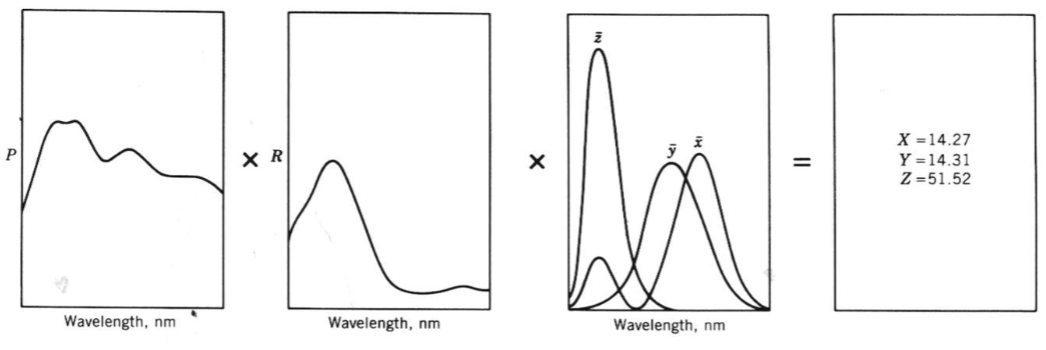
1. Describe the following three graphs:
light source, object reflection, observer
In Munsell system, what does a color code 5PB 5/8 mean?
Hue 5 purple blue, Value 5, Chroma 8
In Natural color system, what does a color code NCS S 2040 –Y70R mean?
Blackness 20, Chromaticness 40, Hue Y70R
What are the advantages of using the Munsell color system?
Agreement to equal visual perception
Any conceivable color can be fit into the system
System can match each book very closely
What are the disadvantages of using the Munsell color system?
The colored sample and the chip from the collection will be usually made from different colorant. Therefore, they may match under one light and not match under another light
Samples fade and change over time - not sustainable
What are the advantages of using the CIE Chromaticity Diagram (1931)?
We can locate the dominant wavelength
We can calculate the purity
White point is near the center of the diagram (x=0.33, y=0.33)
The standard observer z is equal to zero for a large wavelength range. Therefore, for colors with a wavelength greater than 580 z is negligible and the color can be described by only x and y
What are the disadvantages of using the CIE Chromaticity Diagram (1931)?
Equal distances on the 1931 CIE xy chromaticity diagram do not correspond to equal perceived color differences
No provision for black
Color differences are not clearly established
Location on the CIE diagram is not used to describe the appearance of color
Name five differences between dyes and pigments
Dyes:
Usually don’t scatter and only absorb
Dissolve into the material
Can be used to color transparent material such as films, liquids, plastics and are able to color translucent objects such as paper and textiles
Do not change the surface structure of materials such as stained wood, dyed fabric or leather
Pigments:
Can absorb and scatter visible energy
Are usually mixed with adhesives to stay on the material (e.g. in paint, pigments are held to the surface in a binder such as oil or acrylic)

List the Tristimulus values for X, Y, and Z
X: 14.26
Y: 13.66
Z: 50.95
You are given the tristimulus values for a particular color: X = 39.25, Y = 18.26, Z = 11.93
Calculate the x, y chromaticity coordinates
x = 39.25/69.44=0.565 or 0.57
y=18.26/69.44=0.263 or 0.26

Using the CIE Chromaticity Diagram and “X = 39.25, Y = 18.26, Z = 11.93” find the color’s (dominant or complimentary dominant) wavelength: (note: the white light’s coordinates are x=0.33, y=0.33)
Complimentary dominant wavelength: about 495 (493-496 is accepted)

Using the CIE Chromaticity Diagram and “X = 39.25, Y = 18.26, Z = 11.93” find the estimated Purity of this color
About 0.59
(Distance of (0.33,0.33) to (0.57,0.26)/ (0.33,0.33) to edge, same direction)

Please describe the color (X = 39.25, Y = 18.26, Z = 11.93) using the color categorization figure
pR, purpleish red