Disruptive impulse control disorders
 Call Kai
 Learn
Learn Practice Test
 Spaced Repetition
 Match
Match Flashcards
 Knowt Play
1/11

There's no tags or description
Looks like no tags are added yet.
Name | Mastery | Learn | Test | Matching | Spaced | Call with Kai | Chat |
|---|
No analytics yet
Send a link to your students to track their progress
12 Terms

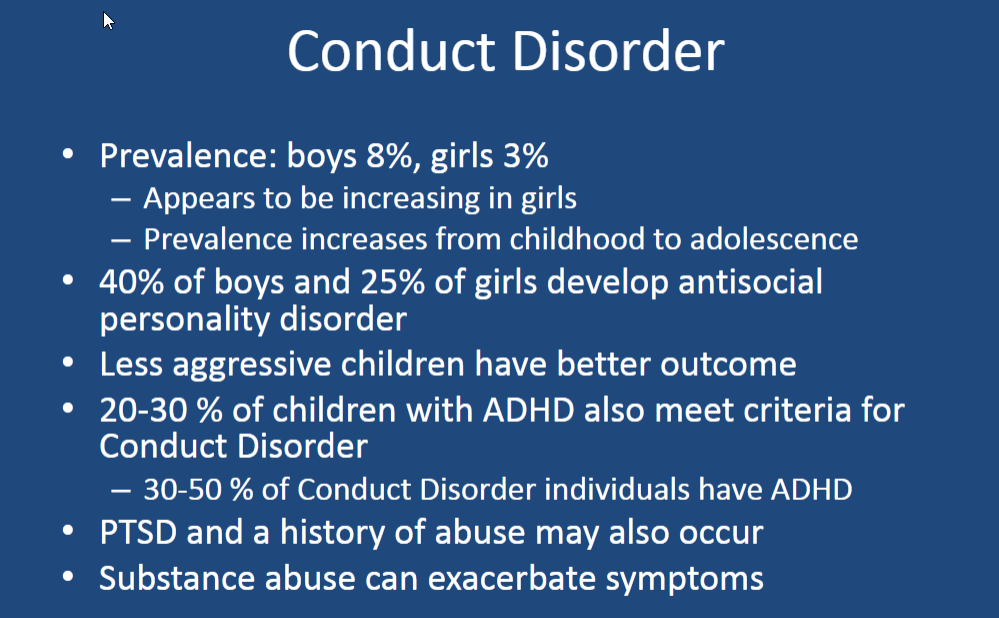
Describe Conduct Disorder
Dx Criteria (4) (7,2,3,3)
Subtypes
Etiology
Consequences
What is different in females
Dx Criteria:
Pattern of behavior in which basic rights of others or major age-appropriate societal norms or rules are violated; as indicated by 3 or more of following criteria for 12 months + at least ONE Criterion present w/in past 6 months
Aggression to people and animals
often bullies, threatens or intimidates others
often initiates physical fights
has used a weapon that can cause serious physical harm to others
has been physically cruel to people
has been physically cruel to animals
has stolen while confronting a victim
has forced someone into sexual activity
Destruction of property
deliberately engaged in fire setting with the intention of causing serious damage
deliberately destroyed others’ property
Deceitfulness or theft
broken into someone else’s house building or car
lies to obtain goods or favors or to avoid obligations (i.e. “cons” others)
stolen items of nontrivial value without confronting a victim (e.g. shoplifting, forgery)
Serious violation of rules
often stays out at night despite parental prohibitions, beginning before age 13 years
has run away from home overnight at least twice while living in parental or parental surrogate home (or once without returning for a lengthy period)
truant from school, beginning before age 13 years
Subtypes
Childhood-Onset Type
Onset of at least one criterion before age 10
more guarded prognosis
Adolescent-Onset Type
Absence of any criterion characteristic of Conduct Disorder before age 10
More likely to have favorable outcome
Unspecified Onset
Age at onset is not known
Multifactorial Etiology
Antisocial disorder, mood disorders, substance abuse and learning disorders in families
Physical/sex. Abuse from parents
Adopted children have a higher incidence
Risk Factors:
parental separation or divorce,
parental substance abuse,
poor parenting or inconsistent or excessively harsh discipline,
peer rejection,
association with delinquent peer group
Positive relationship w/ parent/family member or import. adult = protective factor
Consequences
Have difficulty conforming
School performance average to poor
Outer veneer of toughness and rebellion
Often have profound feelings of self-doubt and worthlessness
Female Conduct Disorder
Engage in more covert conduct-disordered behaviors
Higher rates of
tobacco, alcohol and marijuana dependence
Higher rates of
STD + early pregnancy
More medical problems and poorer self- ratings of overall health
Describe Conduct Disorder
Psych characteristics (7)
Management
Psychological Characteristics
Attention deficits
Learning disorders
Impulsivity
Impaired mood: sullenness, impulsive anger
Impaired cognition:
Lack of or distorted connection between prior events and consequences;
limited problem-solving ability
Pathological defense mechanisms
Minimizing
Avoiding
Externalizing
Unconscious manipulating
Denial
Identification with the aggressor
Interpersonal impairment
Suspiciousness or paranoia, with cognitive distortions
Misperceptions of others’ actions as hostile
Difficulty relating to peers and adults
Lack of guilt/empathy
Management
Mild cases:
individual and family therapy
Severe cases:
removal from the home and placement in a group home or juvenile detention facility
Psychotherapy
improving communication skills, problems-solving skills, impulse control and anger management
Encourage school attendance and achievement
Typically involves parent training
Communication skills; address problems
Appropriate and consistent discipline
Monitoring child’s whereabouts
Keeping child away from bad peers
Enhance family relationships
Medications:
Not typically used for CD unless substantial aggression
Lithium, psychostimulants, second-generation antipsychotics
Useful for comorbid conditions, especially ADHD
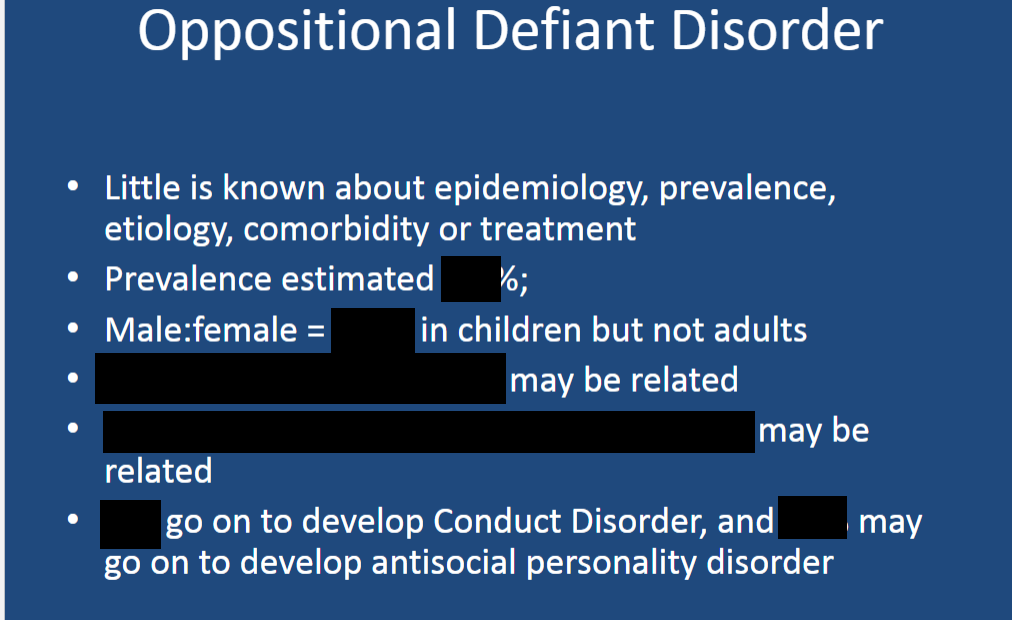

Describe Oppositional Defiant Disorder
Dx criteria (3;3,4,1)
Pt Characteristics
Management
Dx Criteria:
Pattern of angry/irritable mood + argumentative/defiant behavior + Vindictiveness ; Indicated by 4 + exhibited during interaction w/ at least one nonsibling:
Angry/Irritable Mood
often loses temper
often touchy or easily annoyed by others
often angry and resentful
Argumentative/Defiant Behavior
often argues with authority figures,
often actively defies or refuses to comply with requests from authority figures or with rules
often deliberately annoys people
often blames others for his or her mistakes or misbehavior
Vindictiveness
often spiteful or vindictive
Lasts at least 6 months
Disturbance = Distress in immediate social context OR impacts negatively on functioning
Pt Characteristics
No serious violation of others’ rights
Will forfeit a toy or privilege rather than lose a battle or argument
Parents may giving up or become overly harsh
Management
Problem-solving skills training
Parent management training
Psychotropic medication reserved for comorbid disorders


Describe Intermittent Explosive Disorder
Dx criteria
Tx
Dx Criteria:
Recurrent behavioral outbursts b/c failure of controlling aggressive impulses; as indicated by ONE:
Verbal aggression or physical aggression for period of 3 months;
DOES NOT result in damage/destruction/injury
Three behavioral outbursts involving damage/destruction/injury during a 12 month period
Magnitude of aggressiveness = out or proportion
Not premeditated or has an objective
At least 6 Y/O
Management
CBT
learn to recognize signs they are angry
learn to identify and diffuse the triggers
Medication
SSRI’s
Mood stabilizers
Beta-blockers
Second generation antipsychotics
Benzodiazepines
May reduce tension that leads to outbursts
May cause disinhibition


Describe Kleptomania
Dx criteria (4)
Management
Dx Criteria:
Failure to resist stealing something;
Increasing sense of tension immediately before committing theft
Pleasure, gratification or relief @ time of the theft
Stealing = purposeless
Management
Behavioral:
Aversive therapy
Covert sensitization
Self-imposed ban on shopping
Psychodynamic psychotherapy
Medication
Naltrexone:
may reduce stealing urges and behaviors
Antidepressants and mood stabilizers:
conflicting results
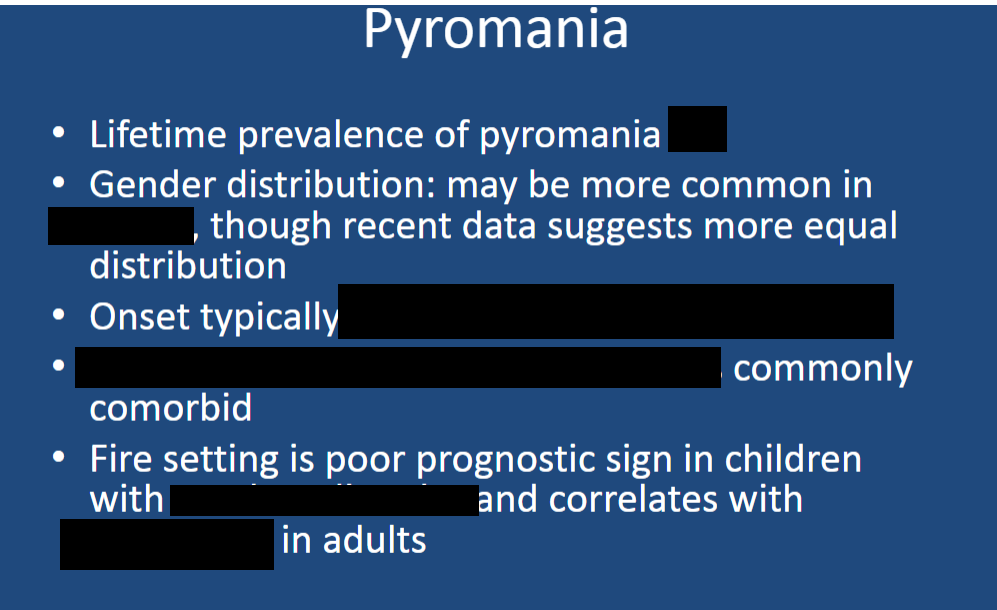

Describe Pyromania
Dx Criteria (4)
Management
Pyromania
Dx Criteria:
Deliberate + Purposeless fire setting on >1 occasion
Tension or affective arousal before the act
Fascinated to Fire (content/characteristics)
Pleasure, gratification or relief when setting fires or witnessing or participating in their aftermath
Management
Treat comorbid conditions
Education
Exposure to consequences of fire
Family therapy
Psychotherapy
Stress coping skills