Neuron
 Call Kai
 Learn
 Practice Test
 Spaced Repetition
 Match
 Flashcards
 Knowt Play
1/30

There's no tags or description
Looks like no tags are added yet.
31 Terms
axon hillock

Bipolar sensory neuron
special senses

unipolar sensory neuron
sensory impulses

multipolar motor neuron
motor impulses 99%

anaxonic neuron

Somatic sensory division
afferent neurons that recieve information about external environment and body position (pain, pressure, temp, stretch). Mainly body, walls, bones, muscle
visceral sensory division
afferent neurons that receive information about stretch, chemical changes, pressure within viscera organs including digestive organs, blood vessels, chemical levels within blood. Organ sensation PCO2, PO2, Blood pressure
somatic motor division
efferent neurons that synapse specifically on skeletal muscle. under voluntary control
visceral motor division
efferent neurons that synapse on various effectors like glands, adipose, and cardiac and smooth muscle. (autonomic nervous system) Divided into sympathetic and parasympathetic nervous system. involuntary control.
Sympathetic NS
fight/flight
Parasympathetic NS
rest and digest
Neurons
transfer information
sensitive to external changes
high metabolic rate (need much O2 and glucose)
can’t divide after 3 years
show extreme longevity(100+ years)
appear gray
vary in size
neuroglia
support
1) cannont transmit impulses (supporting cells)
2) can protect, reapair, regulate, and aid neurons and neural impulse transmission
3) can divide (most brain tumors)
4) vary in shape and function (some work only in CNS and Some only in PNS)
Atrocytes
form blood brain barrier (CNS)
Microglia
Remove pathogens in CNS
Ependymal
fomation of cerebrospinal fluid (CNS)
Oligodendrocytes
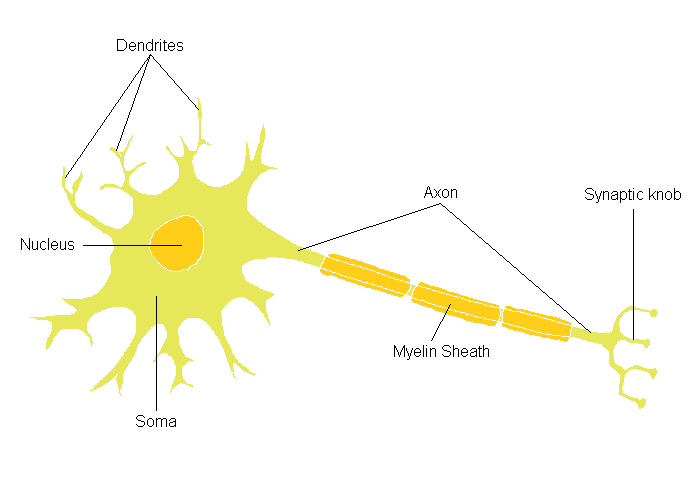
form myelin sheath in CNS
Schwann cells
form myelin sheath in PNS (like insulating a wire) form white covering
Satellite cells
surround and protect neuron cell bodies in ganglia (PNS) regulate environment
Dentrites
receptive region, sometimes forming “free nerve” receptors
axon
only one, transmitting fiber, may be myelinated
white matter
primarily myelinated fibers (axons) and dendric fibers
gray matter
primarily neuron cell bodies and un-myelinated neurons
synaptic terminal
forms synapses, releases neurotransmitters
divergence
a circuit for spreading stimulation to multiple neurons or neuronal pools in the CNS
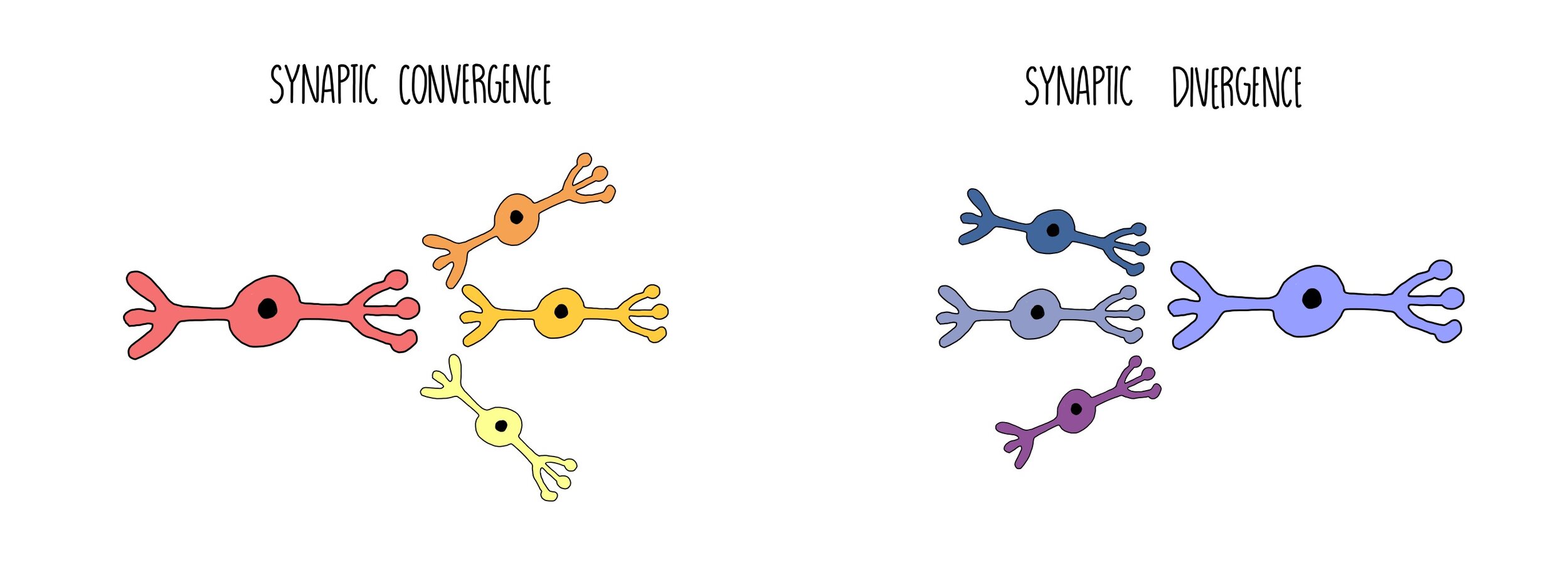
convergence
a circuit for providing input to a single neuron from multiple sources
Serial processing
a circuit in which neurons or pools work sequentially
parallel processing
a circuit in which neurons or pools process the info simultaneously

reverberation
a positive feedback loop

nodes of ranvier

synaptic knobs