UNIT 7.1 APICOMPLEXA: MALARIAL PARASITES
 Call Kai
 Learn
 Practice Test
 Spaced Repetition
 Match
 Flashcards
 Knowt Play
1/83

There's no tags or description
Looks like no tags are added yet.
84 Terms
Ague
Paludism
Tropical Fever
Malaria is also known as
MALARIA
It is actually a vector-borne disease of the blood
It commonly occurs in developing countries located in the tropics, where the tropical climate favors transmission.
Plasmodium spp. (of the class Sporozoa)
P. falciparum
P. vivax
P. malariae
P. ovale
P. knowlesi
Malaria etiology
P. falciparum
70%
cerebral malaria
Malarial Parasites
causes aestivo-autumnal malaria, blackwater fever, or malignant tertian malaria
Most common in the Philippines, around ____ of cases
This species is the most common etiologic agent in the Philippines
Causes severe or complicated malaria and death if not treated promptly and appropriately, particularly ______________
Cerebral malaria
______________ occurs when infected red blood cells travel through the small blood vessels of the brain and block these vessels, interfering with normal brain function. This can lead to coma and eventually death if not managed properly.
William Welch; 1897
P. falciparum was first Described by __________ in _____
P. vivax
30%
Relapse
Malarial Parasites
causes benign tertian malaria
Around ____ of cases in the country
Very rarely causes severe disease
________ is common if not treated adequately
Giovanni Battista Grassi & Raimondo Feletti; 1890
P. vivax was Described by _________________ and __________________ in _______;
P. vivax (and P. ovale);
hypnozoite
Among the Plasmodium species, relapse is most commonly associated with ________________ This is because these parasites have a __________ stage.
hypnozoite;
liver
The _________ stage is a dormant stage in the ______, where the parasite remains inactive for a period of time. When it becomes active again, it can cause a recurrence of infection even after the initial illness has resolved.
Malarial Parasites
P. malariae;
1%
50 years
Malarial Parasites
causes quartan malaria
Less than ____ of cases in the country
Infection is usually not severe but may last up to _________ if not treated
Although infections are generally milder, they may persist for decades if untreated.
Charles Louise Alphonse Laveran; 1880
P. malariae was Described by ________________ in _____
P. ovale
2 cases
1950s
Malarial Parasites
causes benign tertian ovale malaria
Very rare, last documented ______ in the Philippines in the ______
Relapse may occur if not treated adequately due to the presence of the hypnozoite (dormant) stage in the liver.
John William Watson Stephens; 1922
P. ovale was Described by ________________ in _____;
P. knowlesi
macaque monkeys (Macaca mulatta)
Malarial Parasites
causes primate malaria
This parasite is primarily associated with malaria in monkeys, particularly ___________________
Very similar with P. malariae
Because of this similarity, laboratory technologists performing malaria microscopy previously reported infections as P. malariae when P. knowlesi was actually present.
Female anopheles mosquito
Malarial parasites vector
male Anopheles
The __________ feeds exclusively on nectar and fruit juices; do not bite humans.
female Anopheles
The _________ feeds primarily upon blood.
Need blood for egg development
livestock;
zooprophylaxis.
Because mosquitoes may feed on animals, in some communities people place _______ (e.g., carabao or cows) near houses so mosquitoes will bite the animals instead of humans. This practice is called _____________
~30 days
Average life span of an Anopheles mosquito:
Anopheles flavirostris
PRIMARY VECTOR
Breeds in slow-flowing, partly shaded clear streams
Indoor and outdoor biter
Bites both man and animals
Aedes aegypti
Unlike ___________ (vector of dengue and chikungunya) which breeds in clean stagnant water.
Flight range of 1.5 to 2.0 kilometers
Peak biting time of 9:00PM to 2:00AM
Anopheles flavirostris Flight range & Peak biting time
Anopheles litoralis
Anopheles maculatus
Anopheles mangyanus
Anopheles balabacensis
SECONDARY VECTORS
A. litoralis
SECONDARY VECTORS
Coastal areas
A. maculatus
SECONDARY VECTORS
Semi-stagnant streams along sides of shallow rivers with mat of algae
A. magyanus
SECONDARY VECTORS
Slow-flowing streams in wooded areas
A. balabacensis
SECONDARY VECTORS
Stagnant water in forested areas, hoofprints, animal wallow
Race
Black Americans
Duffy antigen
BASIC FACTORS IN MALARIA TRANSMISSION
Some populations are naturally resistant to certain malaria species.
For example, many _____________ lack the ______________ on their red blood cells (RBCs). The Duffy antigen acts as a binding site for Plasmodium vivax. Without this receptor, the parasite cannot attach to and penetrate the RBCs, making these individuals resistant to infection by P. vivax
Sex
males
BASIC FACTORS IN MALARIA TRANSMISSION
Studies suggest that ______ may have a slightly higher probability of acquiring malaria, possibly due to occupational exposure or lifestyle habits that involve outdoor activities
partial
Immunity in malaria is only ________
This means that previous exposure does not give complete protection against the disease.
Young children
Pregnant women
Non-immunes: Their immune defenses are weaker or less developed
More susceptible population to malaria
Temperature
Rainfall
Relative Humidity
Environmental Factors Affecting Transmission
Temperature;
+20°C to +30°C
Environmental Factors Affecting Transmission
The best conditions for the development of malaria parasites in the mosquito and the transmission of infection are when the mean temperature range is ______________
Rainfall
Environmental Factors Affecting Transmission
umerous breeding places are created; Increase density of mosquitoes; Rise in relative humidity; Higher probability of survival of mosquitoes
Relative humidity;
60%
Environmental Factors Affecting Transmission
lengthens the life of the mosquito and enables it to live long enough to transmit the infection to several persons
should at least be ____ to favor malarial growth
Asexual cycle (Schizogony)
GENERAL LIFE CYCLE OF THE MALARIA PARASITES
occurs in humans
Humans are the intermediate host.
Sexual cycle (Sporogony)
GENERAL LIFE CYCLE OF THE MALARIA PARASITES
occurs in mosquito
The mosquito is the definitive host because sexual reproduction occurs here.
anticoagulant
The mosquito saliva also acts as an ____________, allowing the mosquito to feed on blood easily.
Infective stage to humans: Sporozoite
Infective stage to mosquito: Gametocyte
Malarial parasite infective stage
Intermediate host: Human
Definitive host: Anopheles mosquito
Malarial parasite IH and DH
Liver Stage: Pre-erythrocytic/Hepatic Cycle)
Blood Stage: Erythrocytic Cycle
Sexual Cyle in MOsquito (Sporogony)
3 STAGES OF MALARIA PARASITES
1. Chills
2. Fever
3. Sweating
CLINICAL SIGNS AND SYMPTOMS
Acute;
cerebral malaria
PATHOLOGY
May present as non-severe acute febrile illness
If not treated promptly and adequately, it may progress to __________ and death
Chronic
Anemia
placental malaria
PATHOLOGY
May be asymptomatic
_______
Need for multiple blood transfusions
Developmental disorders
Death
May occur during pregnancy
May cause ____________ to low birth weight, then increased infant mortality rate.
Examination of Thick and Thin Blood Smear
Using a microscope with an oil immersion objective and immersion oil.
The gold standard for laboratory diagnosis of malaria infection.
Trophozoite
Schizont
Gametocyte
When examining the blood smear (blood film), we can observe three developmental stages seen in blood films:
Trophozoite and gametocyte
_____________________ are used for identifying the species of Plasmodium.
Nucleus/Chromatin dot
Vacuole
Cytoplasm
Stippling
Structure of Plasmodium spp.

stippling
Refers to granules that appear in the infected red blood cell (RBC).
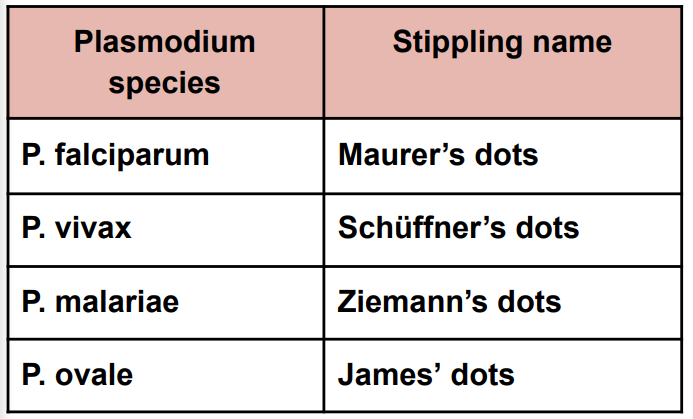
stippling name for each plasmodium spp.
P. vivax
P. ovale
Size of infected RBCs enlarged?

thin smear
To determine enlargement, compare the infected RBC with surrounding RBCs in the _________
P. falciparum
P. malariae (occasionally smaller than normal)
Not enlarged RBC?

P. vivax
Single infection (1 parasite per RBC)
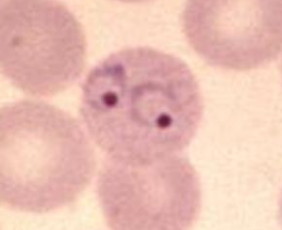
P. falciparum
Multiple infection (several parasites in one RBC)
Multiple ring forms within a single RBC. Up to five parasites may infect one RBC.
P. vivax
P. ovale
Presence of stippling (dots in RBC)

P. falciparum
P. malariae
Stipplings not clearly visible:

P. vivax (Schuffner’s dots)
When stippling appears coarse and granular, it usually suggests _______
P. falciparum trophozoite
TROPHOZOITE (DIAGNOSTIC POINTS OF EACH)
➔ Small, regular, fine to fleshy cytoplasm
➔ Infected RBCs not enlarged
➔ Numerous, multiple infection is common
➔ Ring, comma (incomplete), marginal, or accole forms are seen; often have double chromatin dots
➔ Maurer's dots not clearly visible

Maurer’s dot
P. falciparum
It is also called the ring form because of its ring-like appearance. It may appear half-moon shaped.
thin smear = intact and round RBC
thick smear = RBCs rupture during hemoflobinization; parasite stages
P. falciparum
In thin smear, RBCs remain ___________
In thick smear, RBCs are ruptured during _______________, so only ______________ remain visible.
P. vivax
TROPHOZOITE (DIAGNOSTIC POINTS OF EACH)
➔ Infected RBCs usually enlarged
➔ Irregular or fragmented cytoplasm (amoeboid)
➔ Mature ring forms tend to be large and coarse
➔ Schuffner's dots are frequently visible, but cannot be seen as well in some cases.

P. malariae
TROPHOZOITE (DIAGNOSTIC POINTS OF EACH)
➔ small, few
➔ Ring to rounded, compact, vacuolated or non-vacuolated
➔ Band forms seen
➔ Dark, scattered pigment
➔ Ziemann's dots not clearly visible
➔ Infected RBCs not enlarged, or smaller

Bands
This is the key identifying feature of P. malariae trophozoites
TROPHOZOITE (DIAGNOSTIC POINTS OF EACH)
P. ovale trophozoite
TROPHOZOITE (DIAGNOSTIC POINTS OF EACH)
➔ James’ dots present at early ring forms; dots may be larger and darker than P. vivax
➔ Ring larger than P. vivax
Few
➔ Ring to rounded, compact
Ring shape maintained until late in development
➔ Single, prominent chromatin
➔ Reported in the Philippines
P. falciparum schizont
SCHIZONT (DIAGNOSTIC POINTS OF EACH)

P. vivax schizont
SCHIZONT (DIAGNOSTIC POINTS OF EACH)

P. malariae schizont
SCHIZONT (DIAGNOSTIC POINTS OF EACH)
➔ Small, compact, dark ➔ Usually few
➔ 6 – 12 merozoites in ‘rosette’ formation, but more often in irregular cluster
The rosette formation resembles a flower or star pattern, making the schizont easier to identify.
➔ Concentrated pigments

P. ovale
SCHIZONT (DIAGNOSTIC POINTS OF EACH)

P. falciparum
GAMETOCYTE (DIAGNOSTIC POINTS OF EACH)

Plasmodium falciparum gametocyte (FG).
P. falciparum
In reporting results, it is not necessary to specify macro- or microgametocyte. The report simply indicates ____________________________
Microgametocyte
P. falciparum Gametocyte
Broader, shorter, and more sausage-shaped
Loosely scattered chromatin
Golden brown pigments scattered at the central half
Macrogametocyte
P. falciparum Gametocyte
Small, compact, central chromatin dot
Pigments closely adhere to the chromatin
P. vivax gametocyte
GAMETOCYTE (DIAGNOSTIC POINTS OF EACH)
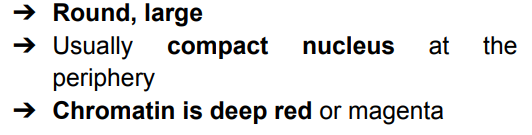
P. malariae gametocyte
GAMETOCYTE (DIAGNOSTIC POINTS OF EACH)
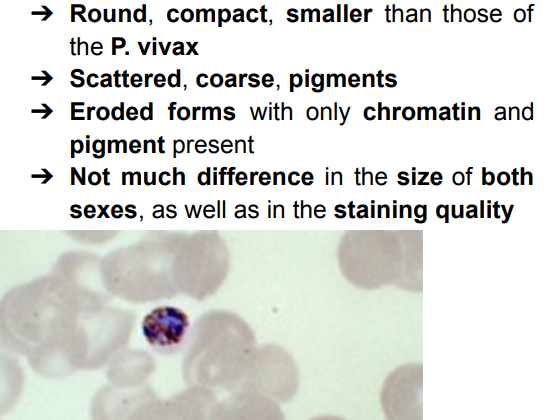
P. vivax
GAMETOCYTE (DIAGNOSTIC POINTS OF EACH)

P. malariae
GAMETOCYTE (DIAGNOSTIC POINTS OF EACH)

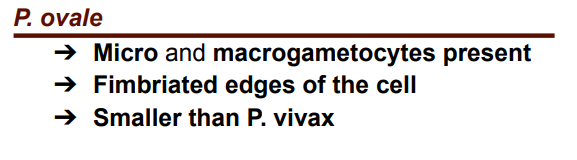
P. ovale
GAMETOCYTE (DIAGNOSTIC POINTS OF EACH)
MIXED INFECTIONS
Infection of an individual by more than one species of Plasmodium
MULTIPLE INFECTION
when more than one parasite infects a single red blood cell, which is commonly seen in Plasmodium falciparum.
P. vivax and P. falciparum
Possible mixed infection with ____________________