PY2DAL 1) Cognitive and Language Development
 Call Kai
 Learn
Learn Practice Test
 Spaced Repetition
 Match
Match Flashcards
 Knowt Play
1/36

Earn XP
Description and Tags
A set of 25 vocabulary flashcards reviewing key terms and definitions from the lecture transcript on cognitive and language development.
Name | Mastery | Learn | Test | Matching | Spaced | Call with Kai | Chat |
|---|
No analytics yet
Send a link to your students to track their progress
37 Terms
Constructivist approach to child development
Piaget's viewpoint that the child constructs and discovers the world through their activity as an active learner.
Domain-general approach to child development
An approach stating that the same mechanisms apply to all domains of cognitive development.

Sub-stages of cognitive development
The segments within Piaget's 1st stage of development (sensorimotor stage).

Biological approach to child development
Applied Darwin’s evolutionary ideas to human infant cognitive development, such as the order of development, is fixed and determined by the biology of the human brain.
Schemas
Mental frameworks or building blocks of knowledge that help individuals organize, interpret, and navigate the world.

Assimilation
Applying an existing schema to a newly encountered aspect of the environment.


Accommodation
Altering an existing schema to fit a new environment.

Sensorimotor stage
Piaget's first stage of cognitive development (0-2 years / 0-24 months) where learning occurs through action and sensory interaction (sucking mother’s breast and own thumb).
Preoperational stage
Piaget's second stage (2-7 years), also known as the pre-logical stage, where learning occurs through perception.

Concrete operational stage
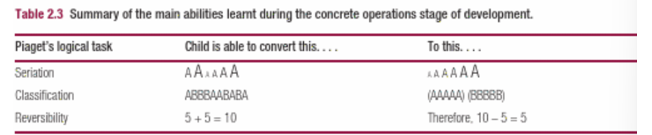
Piaget's third stage (7-11 years) is where mental operations are learnt, such as seriation, reversibility and classification.

Formal operational stage
Piaget's fourth stage (11-12+ years / 11 to adulthood) is characterised by abstract and hypothetical-deductive reasoning.

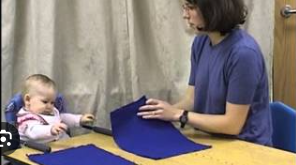
A-not-B Error
An error committed by 8-12-month-old infants who look for a hidden toy in its original hiding place (Location A) rather than where it was just hidden (Location B).
Centration
The preoperational tendency to focus on only one aspect of a situation at a time.
Artificialism
The preoperational belief that aspects of the environment are made by people.
Irreversibility
The inability to reverse the direction of a sequence of events back to their starting point.


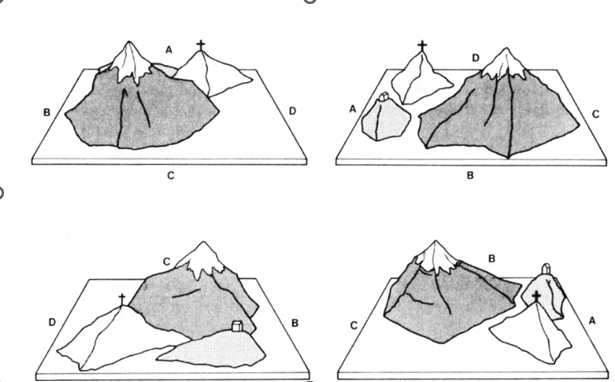
Three mountains task
An experimental task designed to test a child's ability to see the world from another person's perspective. The child sits in front of a physical 3D model featuring three distinct mountains of different sizes and details. The child is allowed to walk around the entire model to examine the mountains and features from multiple angles. A small doll is placed at a different, specific position around the table. The child is shown 10 sets of photographs. From ten photographs taken at different angles, the child must pick the one showing what the doll can “see”.


Peroperational errors: conservation
An experiment to test if a child understands that an object's core properties like quantity, weight, or volume stay the same even when outward appearances change. An example of this is where the same amount of water is poured into 2 glasses. Then, one of the glasses has its water poured into a narrower glass.

Intersubjectivity
The mutual understanding that two people arrive at and share during communication, described as a meeting of the minds.
Joint Attention
The shared focus of two or more people on the same object, event, or activity for purely social purposes.

Zone of Proximal Development
The range of tasks that are too difficult for a child to manage alone, but can be mastered with help and guidance from a more knowledgeable person.

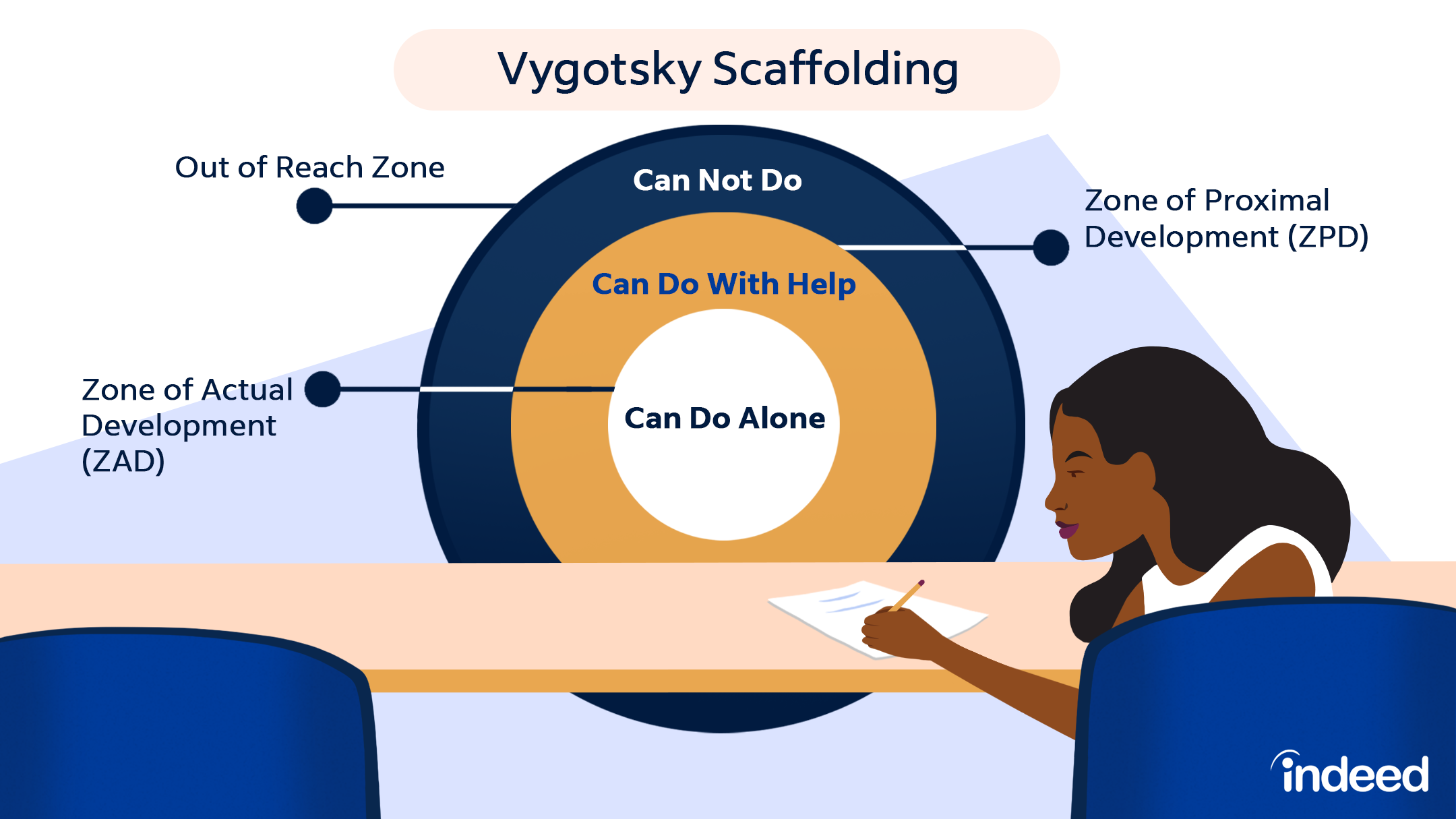
Social Scaffolding
A teaching method where an adult or more capable peer gives temporary support to help a learner master a task.

Private Speech
Self-directed speech spoken by children to themselves, which increases with task difficulty and is most prevalent between ages 4 and 6.

Tabula rasa
John Locke's view that children are born as a 'blank canvas' and learn speech, emotions, and morals through social interactions.

Noble Savage
Rousseau's concept of an innocent, good child who becomes corrupted by society.

Seriation
A concrete operational skill involving ordering objects from smallest to biggest.

Deductive reasoning
The ability to use a general principle to determine a specific outcome through the manipulation of hypothetical situations.
In the continuous perspective of development, influences that occur to an individual cannot be predicted or predetermined (peer pressure, trends).
Non-normative influences

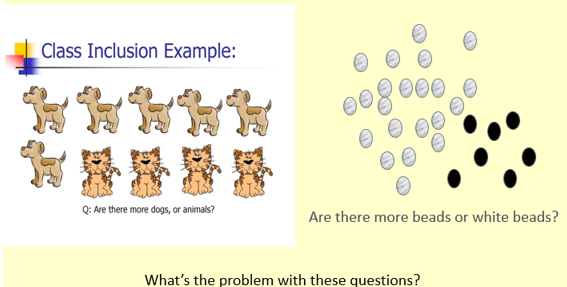
Preoperational errors: Class Inclusion
Preoperational children have problems with hierarchal classification: Organisation of objects in classes and sub-classes (linked to centration). Questions lead you subconsciously to think of one subclass rather than both at the same time.

Preoperational errors: Egocentrism
In the three-mountain task, they found that children between the ages of 4 and 7 (preoperational children) tended to choose images that reflected their own perspective rather than the experimenter’s viewpoint. This suggested a strong egocentric bias.

Urie Bronfenbrenner (1917-2005): bioecological theory
Describes social influences as a series of concentric circles with the person at the centre.

Phase 1: The use of reflexes (birth thorugh first month)
First phase of the sensorimotor stage:
-The newborn child makes a sucking motion at the mother’s breast, to her finger or indeed to any object placed near the infant’s mouth.
- Later in the month the infant will also incline his head, raise his mother’s breast or milk bottle and appear to actively seek the opportunity to feed.
Phase 2: Primary circulator reactions (1 to 4 months)
Second phase of the sensorimotor stage:
-The infants begin to repeat actions. The infant may find her hand and start to suck on it apparently by chance but will then repeat the action later and more frequently as she progresses through this stage.
-The actions become more deliberate in this phase and more coordinated
Phase 3: Secondary circular reactions (4 to 10 months)
Third phase of the sensorimotor stage:
-The infant is making more deliberate actions; his behaviour starts to show connections with objects.
-Children in this phase begin to kick their legs and see how this causes the blanket to come off in the pram, or they see that shaking a toy makes the bell tinkle in response.
Phase 4 The coordination of secondary schemas (8 to 12 months)
The fourth phase of sensorimotor stage
-The child begins to demonstrate more complicated behaviour.
-Having learnt the connection between action and a response (Such as shaking the toy to hear the bell tinkle), the child now starts to put different actions together in goal-oriented behaviour.
-An example of this could be seen in a simple game. Sit the child down and, whilst they are watching, hide the child’s favourite toy under a cloth.
-By the age of 12 months, Piaget argues that the child is coordinating their behaviour to achieve what they want.
Phase 5 Tertiary circular reactions (12 to 18 months)
The fifth phase of the sensorimotor stage
-The child begins to experiment with learned schema. If you present a toy drum to an 18-month-old boy, he will try different ways of playing with it, like banging it softly and then harder.
- In the latter months the child learns object permanence (the cognitive understanding that people and objects continue to exist even when they cannot be seen, heard, or touched).
Phase 6: The beginning of mental representation (18 months to 2 years)
-Children start to form mental images of routes of getting to what they want and will climb onto anything to reach it.
- All kinds of mental representation develop at this point, and children begin to put words together and make decisions without needing to have tangible examples. They decide what they want to eat, what they want to do and how they want to do it.

Vygotsky Sociolutural theory
We develop as children, as it is our biological drive to do so. but also as a result of social interactions.
