3.17-3.22 Reversible reactions and equilibria
 Call Kai
 Learn
Learn Practice Test
 Spaced Repetition
 Match
Match Flashcards
 Knowt Play
1/18

There's no tags or description
Looks like no tags are added yet.
Name | Mastery | Learn | Test | Matching | Spaced | Call with Kai | Chat |
|---|
No analytics yet
Send a link to your students to track their progress
19 Terms
What do product molecules do in reversible reactions?
They react with each other or decompose and form reactant molecules again
What is the reversible symbol?
⇌
What does heating ammonium chloride produce?
Ammonia and hydrogen chloride gases

As ammonia and hydrogen chloride (g) cool down what do they recombine to form?
Solid ammonium chloride

What is water of crystallisation?
Water that is included in the structure of some salts during the crystallisation process
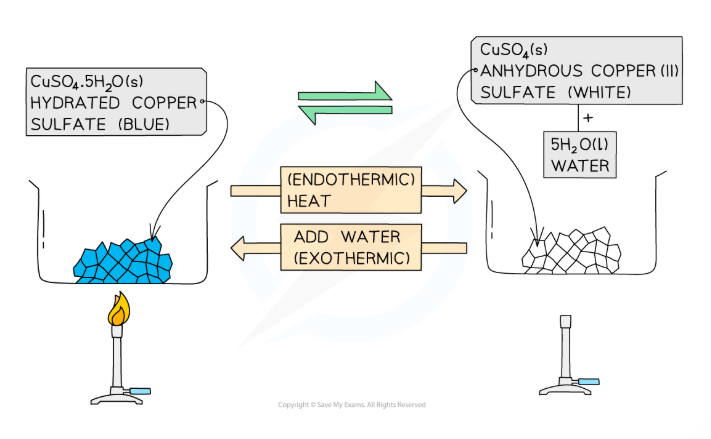
Which is endothermic and which is exothermic? Reversible reaction of hydrated copper sulfate to anhydrous copper sulfate.
Exothermic: adding water to create hydrated copper sulfate
Endothermic: heating to create anhydrous copper sulfate
When is the overall reaction said to be in a state of equilibrium?
When the rate of the forward reaction equals the rate of the reverse reaction
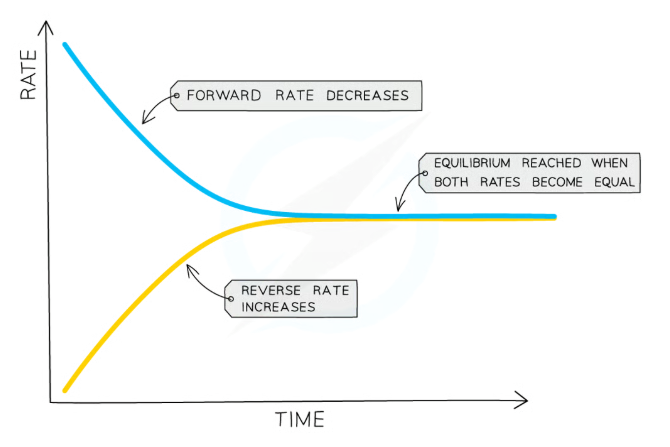
Equilibrium is [ ]
Dynamic
In dynamic equilibrium, the concentration of reactants and products remains [ ]
Constant
Dynamic equilibrium can only happen in a…
Closed system
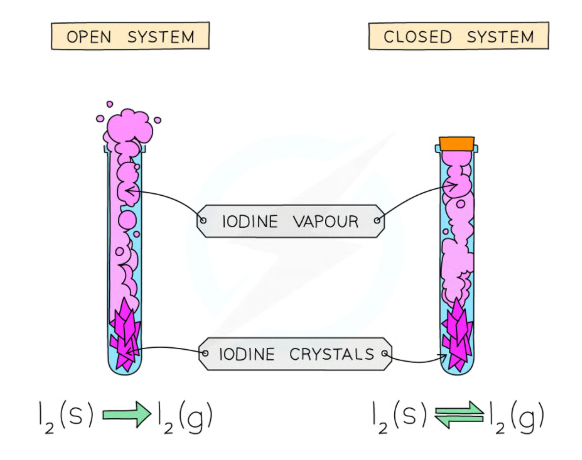
What are the 3 characteristics of a state known as dynamic equilibrium? (excluding being in a closed system)
Concentrations of the reactants and products remain constant
Rate of the forward reaction is equal to the rate of the reverse reaction
Forward and reverse reactions continue to occur
What does Le Chatelier’s Principle state?
When a change is made to the conditions of a system at equilibrium, the system automatically moves to oppose the change
When is Le Chatelier’s Principle used to predict changes to the position of equilibrium?
When there are changes in temperature or pressure
When the position of equilibrium is said to shift, when it goes to the left, what does that mean?
It means that the reverse reaction is favoured (think how you would write a chemical equation)
If the temperature increases, which direction will the equilibrium shift to?
To the direction of the endothermic reaction as chemical potential energy is being absorbed
In gaseous reactions, what will a decrease in pressure favour? What type of reaction? A reaction that…
A reaction that produces the greatest number of molecules (to try and increase the pressure back up following Le Chatelier’s Principle)
If there are equal moles of gases one either side of the equation, there is NO effect on the position of equilibrium when pressure is changed. Increasing the pressure will…
Increase the rate of forward and backward reaction equally so the position of equilibrium is unchanged
When the conditions at equilibrium are changed, the system always responds by doing the…
Opposite
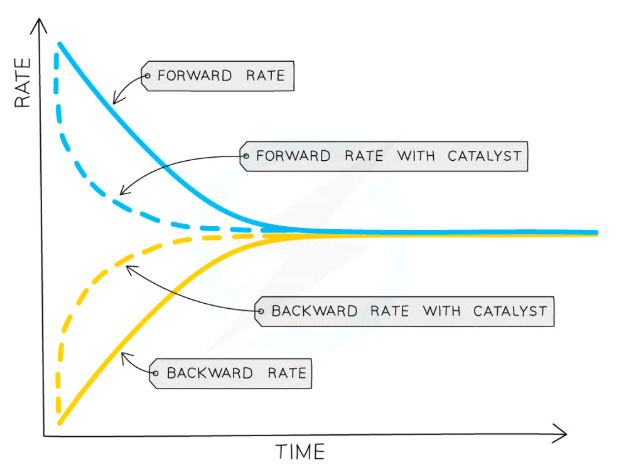
What does the presence of a catalyst on equilibrium do?
The presence of a catalyst does not affect the position of equilibrium but it DOES increase the rate at which equilibrium is reached