AQA A level Bio 3.2 Gas exchange Part II
 Call Kai
 Learn
Learn Practice Test
 Spaced Repetition
 Match
Match Flashcards
 Knowt Play
1/9

Earn XP
Description and Tags
Name | Mastery | Learn | Test | Matching | Spaced | Call with Kai | Chat |
|---|
No analytics yet
Send a link to your students to track their progress
10 Terms
Midges are very small insects. The early stages of the life cycle of midges are called larvae. Midge larvae live in water. A biologist investigated the uptake of oxygen by the larvae of two species of midge. He measured the rate of uptake of oxygen by the larvae in water containing different concentrations of oxygen. The table shows his results.
| Concentration of | Mean rate of oxygen uptake / cm3g-1h-1 | |
| Chironomus longistylus | Tanytarsus brunnipes | |
| 1 | 220 | 141 |
| 2 | 285 | 246 |
| 3 | 304 | 342 |
| 4 | 313 | 362 |
| 5 | 320 | 367 |
| 6 | 318 | 430 |
| 7 | 320 | 469 |
Describe the effect of an increase in oxygen concentration on the mean rate of oxygen uptake in Chironomus longistylus. (2)
Increases then levels out / stops increasing / fluctuates slightly (1)
At 5 (cm3 dm-3) / 320 (cm3 g-1h-1) (1)
Midges are very small insects. The early stages of the life cycle of midges are called larvae. Midge larvae live in water. A biologist investigated the uptake of oxygen by the larvae of two species of midge. He measured the rate of uptake of oxygen by the larvae in water containing different concentrations of oxygen. The table shows his results.
| Concentration of | Mean rate of oxygen uptake / cm3g-1h-1 | |
| Chironomus longistylus | Tanytarsus brunnipes | |
| 1 | 220 | 141 |
| 2 | 285 | 246 |
| 3 | 304 | 342 |
| 4 | 313 | 362 |
| 5 | 320 | 367 |
| 6 | 318 | 430 |
| 7 | 320 | 469 |
Chironomus longistylus lives in still water whereas Tanytarsus brunnipes lives in fast running streams. The water in fast running streams has a higher concentration of oxygen than in still water. Use the table in part (a) to suggest how Chironomus longistylus is better adapted than Tanytarsus brunnipes to living in still water (2)
Chronimus longistylus has higher uptake at low (oxygen) concentrations (1)
(higher uptake) up to 2cm3 dm-3 (1)

Lungfish are freshwater fish which have gills and lungs. Scientists investigated how Australian and African lungfish use their lungs and gills for gas exchange. The graphs show the results of this investigation.
African lungfish are likely to survive for longer than Australian lungfish when living in pools that dry up. Explain why (2)
More/most exchange is via lungs (in African lungfish) (1)
Gills will not function/function less efficiently (in air) (1)
Two groups of people volunteered to take part in an experiment.
• People in group A were healthy.
• People in group B were recovering from an asthma attack. Each person breathed in as deeply as they could. They then breathed out by forced expiration.
A scientist measured the volume of air breathed out during forced expiration by each person. Figure 4 shows the results.
The people in group B were recovering from an asthma attack. Explain how an asthma attack caused the drop in the mean FEV shown in Figure 4. (4)
Muscle walls of bronchi/bronchioles contract (1)
Walls of bronchi/bronchioles secrete more mucus (1)
Diameter of airways reduced (1)
(therefore) flow of air reduced (1)

The graphs below show results for three insects.
Suggest an explanation for the effect of temperature on the rate of carbon dioxide release (3)
Enzymes/metabolism faster (1)
higher rate of respiration and carbon dioxide production/release (1)
Spiracles open more often (1)
Seals are mammals. They have lungs and must breathe air. They can dive and remain under water for a long time.
There is a greater percentage reduction in blood flow to the diaphragm than to the lungs during a dive. Explain the advantage to a diving seal of blood continuing to flow to the lungs (1)
some oxygen still in lungs which will enter blood (1)
Seals are mammals. They have lungs and must breathe air. They can dive and remain under water for a long time.
There is a greater percentage reduction in blood flow to the diaphragm than to the lungs during a dive. Explain the advantage to a diving seal of a large reduction in blood flow to the diaphragm (2)
More blood available for other organs (1)
Supplying oxygen (1)
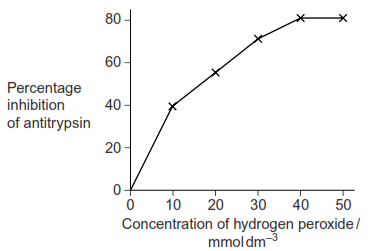
Alpha-1-antitrypsin is a protein that reduces the activity of enzymes that can damage lung tissue.
Cigarette smoke contains hydrogen peroxide. Hydrogen peroxide reduces the activity of alpha-1-antitrypsin. Scientists investigated the effect of different concentrations of hydrogen peroxide on the activity of alpha-1-antitrypsin. The graph shows their results.
Hydrogen peroxide reacts with two amino acids in alpha-1-antitrypsin. Explain how this reduces activity of the protein (2)
Changes shape of antitrypsin (1)
No longer interacts with trypsin (1)
When first hatched, the young of some species of fish are less than 2mm long. Explain how these young fish get enough oxygen to their cells without having gills (2)
exchange/diffusion across body surface/skin (1)
short diffusion pathway (1)
Mackerel are fast swimming fish whereas toadfish only swim slowly. The table shows some features of the gills of these fish.
| Thickness of | Number of lamellae |
Mackerel | 5 | 32 |
Toadfish | 35 | 8 |
Use evidence from the table to explain how mackerel are able to swim faster than toadfish. (3)
large numbers of lamellae so large SA (1)
lamellae thin so short (diffusion) pathway to blood/capillaries (1)
High rate of oxygen uptake for respiration /energy release (1)