Keynesian vs Classical LRAS
 Call Kai
 Learn
 Practice Test
 Spaced Repetition
 Match
 Flashcards
 Knowt Play
1/9

There's no tags or description
Looks like no tags are added yet.
10 Terms
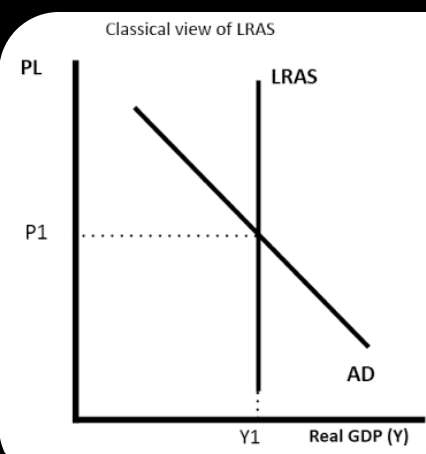
Shape of the Classical LRAS curve
A vertical line at the full-employment level of output showing that long-run aggregate supply is perfectly inelastic with respect to the price level.
Shape of the Keynesian LRAS Curve
Horizontal (Spare capacity): High unemployment means firms can boost output without raising prices (no inflation).
Upward-sloping (Bottlenecks): Resource shortages push up costs, so higher AD raises both output and prices.
Vertical (Full capacity): All resources are fully used, so higher AD only causes inflation.

Core assumption behind the Classical LRAS curve
Wages and prices are fully flexible both upwards and downwards, allowing markets to clear and the economy to self-correct back to full employment.
Long-run effect of increasing AD in the Classical model
It is purely inflationary (raising the price level) with zero permanent increase in real GDP, as the economy returns to full-capacity output.
Shape of the Keynesian LRAS curve
A backward L-shaped (curved) line with three distinct sections: horizontal (spare capacity), upward-sloping (bottlenecks), and vertical (full employment).
Horizontal section of the Keynesian LRAS curve
Represents deep recession with high spare capacity and unemployment; AD can increase to boost real GDP without causing any inflation.
Upward-sloping section of the Keynesian LRAS curve
Represents the economy approaching full capacity, where resource bottlenecks and skill shortages emerge, so higher AD raises both real GDP and the price level.
Vertical section of the Keynesian LRAS curve
Represents full capacity where all factors of production are fully utilised; further increases in AD are purely inflationary.
Why Keynesians argue an economy can get stuck below full employment
Wages are "sticky downwards" due to trade unions, employment contracts, and minimum wage laws, preventing real wages from falling enough to clear the labour market.
Policy implications of Classical vs. Keynesian LRAS
Classical economists favour supply-side policies to shift the vertical LRAS right, whereas Keynesians advocate expansionary demand-side policies (fiscal/monetary stimulus) to close a negative output gap during recessions.