Animalia I: Porifera, Cnidaria, Platyhelminthes, and Nematoda
 Call Kai
 Learn
 Practice Test
 Spaced Repetition
 Match
 Flashcards
 Knowt Play
1/55

Earn XP
Description and Tags
Comprehensive review flashcards covering taxonomy, anatomical models, diagnostic structures, and lab specimens for Phylum Porifera, Cnidaria, Platyhelminthes, and Nematoda from Animalia I.
56 Terms
What are the core general characteristics of organisms classified under Kingdom Animalia?
Multicellular adults, eukaryotic, heterotrophic, require O2 for respiration, motile, diploid, reproduce sexually, undergo embryonic development, and possess ectoderm, mesoderm, and endoderm germ layers.
What level of organization and motility characteristics define Phylum Porifera?
They display cell specialization (no true tissues or organs), are filter feeders, and are sessile as adults but motile as larvae.
What are choanocytes, and what specific functions do they serve in sponge anatomy?
have a flagellum that drives water flow through the sponge, a mucus-coated collar that traps food particles, and the ability to perform phagocytosis of food particles.
What are sponge spicules, and why are they biologically significant?
They are small needlelike skeletal structures composed of calcium carbonate or silica that provide structural support and are used to identify sponge taxa.
What are the two asexual reproduction methods and the primary sexual pathway in Phylum Porifera?
Asexual reproduction occurs via fragmentation/fission and budding; sexual reproduction occurs through external fertilization, forming an embryo that develops into a planktonic amphiblastula larva.

Identify the two lab specimens of sponges shown below:
Grantia (left) and Bath Sponge (right).
What is the scientific name and common name of the local sponge species presented in lab?
Microciona prolifera, commonly known as the Red Beard Sponge.
What type of symmetry and level of organization are characteristic of Phylum Cnidaria?
Radial symmetry and a tissue level of organization (diploblastic, possessing an epidermis from ectoderm, gastrodermis from endoderm, and a nerve net).
What are the two primary morphological body forms found across Phylum Cnidaria?
Polyp and medusa.
What is mesoglea, and where is it located in a cnidarian?
The acellular "jelly" layer located between the outer epidermis and the inner gastrodermis.
What is an incomplete digestive tract, and in which phyla from this lab is it found?
A digestive system where a single opening serves as both mouth and anus; it is found in Phylum Cnidaria and Phylum Platyhelminthes.
What are cnidocytes and tentacles in Phylum Cnidaria?
Cnidocytes are specialized stinging cells evolved for prey capture; tentacles are elongated structures lined with cnidocytes that capture prey and move it toward the mouth.
What are the three classes of Phylum Cnidaria examined in this lab?
Class Hydrozoa, Class Scyphozoa, and Class Anthozoa.
How do the dominant life stages differ between Class Hydrozoa and Class Scyphozoa?
In Class Hydrozoa, immature larvae exist as medusae while adults exist as polyps; in Class Scyphozoa, immature stages exist as polyps while adults exist as medusae.

What organism is shown in this image, and what is its taxonomy (phylum and class)?
Physalia (Portuguese Man-O-War); Phylum Cnidaria, Class Hydrozoa.
What local hydrozoan specimen was collected at Sandy Hook, NJ, and what is its genus and common name?
Ectopleura, commonly known as Pink-Hearted Hydroids.
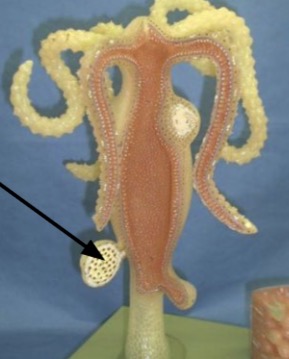
What structure is indicated by the bulge with the 'pepperoni pizza' appearance near the pedal disk on the Hydra model?
Ovary.

What structure is represented by the bottom outward bulge formed by a fold in the gastrodermis and epidermis on this Hydra model?
Asexual Bud.
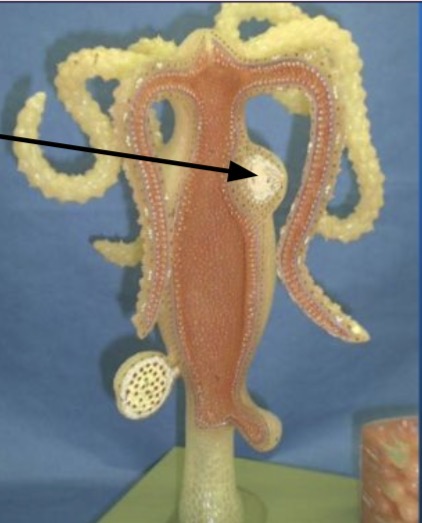
What is this structure on the hydra model
Testies

round white structures embedded in the surface of the epidermis
Cnidocytes

Petal disk

Gastrodermis
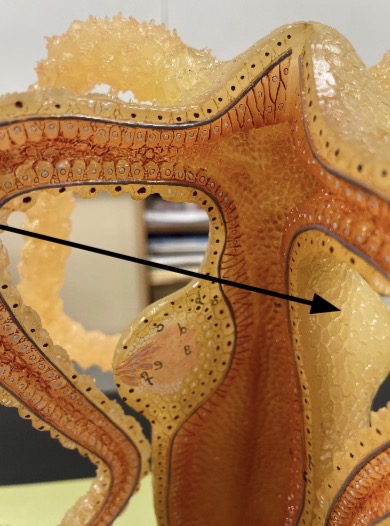
Outer skin covering
Epidermis

Gastrovascular Cavity

Tentacles

Mouth
What are two representative scyphozoan jellyfish studied in lab, and what is the scientific name of the Moon Jelly?
Aurelia aurita (Moon Jelly) and Aequorea spp.
What body form is exclusively present in Class Anthozoa throughout their life cycle?
They always and ONLY exist as polyps (the medusa stage is completely absent).
Outline the sexual life cycle of corals in Class Anthozoa.
Gonads release eggs and sperm that undergo fertilization to form a ciliated planula larva, which settles onto a hard surface, develops into a mature polyp, and then multiplies asexually via budding to form a colonial reef.
What are the common representatives of Class Anthozoa covered in lab?
Stony corals, brain corals, fan corals, and sea anemones.
What major morphological and developmental traits define Phylum Platyhelminthes?
Bilateral symmetry, dorsoventrally flattened elongated bodies without depth, longitudinal muscles, incomplete digestive tract, acoelomate body cavity, and an organ level of development.
What are the three major organs found in Phylum Platyhelminthes?
Ganglia (simple two-lobed brain showing cephalization), intestine (incomplete gut with one opening), and protonephridia (flame cell clusters that aid in excretion).
What are the three classes comprising Phylum Platyhelminthes?
Class Turbellaria, Class Trematoda, and Class Cestoda.
What are the key anatomical characteristics and feeding structures of Planaria (Class Turbellaria)?
An arrow-shaped head with two ganglia and two photoreceptive dark eyespots, a retractable pharynx serving as the mouth, a branched intestine for nutrient distribution, and high regenerative capacity.
What is an intermediate host in the life cycle of Class Trematoda (flukes)?
An environment for juvenile growth where the host is usually not harmed; mature trematodes are never found inside an intermediate host.

Identify this parasite specimen, its common name, and its class:
Fasciola hepatica (the liver fluke); Class Trematoda (Phylum Platyhelminthes).
Are flukes (Class Trematoda) monoecious or dioecious?
Trematodes are dioecious (individuals are distinct males or females).
How do tapeworms (Class Cestoda) attach to the host intestine and absorb nutrients?
They use an anterior scolex armed with hooks and suckers (no mouth or ganglia) to anchor; because they lack a digestive tract, nutrients are absorbed directly across their body wall.
How does reproduction occur across tapeworm proglottids?
Cestodes are monoecious; younger proglottids near the scolex produce and expel sperm that fertilize ovaries in older proglottids located toward the posterior, transforming them into gravid proglottids.
What defines a 'gravid' proglottid?
A mature segment packed with fertilized eggs that breaks off from the tapeworm strobila to pass out with the host's feces.

Hooks
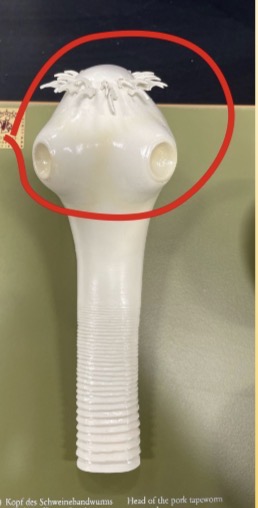
Scolex
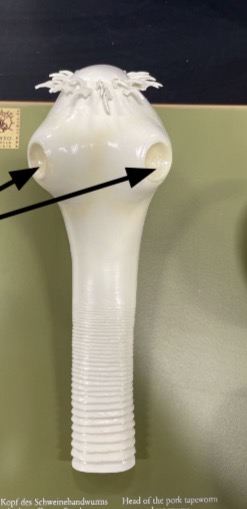
Suckers

Neck

Strobilia

Uterus

Ovaries

THE DOTS
Testies

What is shown in this model
Immature Proglotti

What is shown in this model section of a tapeworm?
Mature Proglottid (displaying uterus, ovaries, and dotted testes).

What is shown in this model section of a tapeworm?
Gravid Proglottid (filled with fertilized eggs).
What are the two lab example species of Class Cestoda and their respective hosts?
Dipylidium (uses dogs as hosts) and Taenia pisiformis (uses pigs and cows as hosts).
What body cavity type defines Phylum Nematoda, and how is it lined?
Pseudocoelomate; they possess a false body cavity holding internal organs that is only incompletely lined by mesoderm.
Which muscle types and physiological systems do nematodes possess or lack?
They possess both circular and longitudinal muscles, but they lack circulatory, respiratory, and skeletal systems.

Identify this dioecious intestinal parasite from Phylum Nematoda that grows to 25–35cm in length:
Ascaris.

Identify the parasite shown encysted in skeletal muscle tissue below, and state how infection occurs:
Trichinella (Phylum Nematoda); humans and pigs become infected by ingesting undercooked pork cooked below 165∘F.