Audiology and Hearing
 Call Kai
 Learn
 Practice Test
 Spaced Repetition
 Match
 Flashcards
 Knowt Play
1/50

There's no tags or description
Looks like no tags are added yet.
51 Terms
what are the aims / questions/ methods / frequencies measured / types of conductions used / time need / environment needed for: a) audiometric screening b) audiometric hearing test?
Audiometric Screening | Audiometric Hearing Test / Evaluation | |
Aim | Pass or Refer | Measures the degree + type of hearing loss for each ear |
Asks |
|
|
Method | Tests at only 1 volume. Is the sound heard or not? | Follows a rigorous technique to find the threshold (softest sound that can be heard at different frequencies) |
Frequencies Measured | Tests a limited number of frequencies (for example: 0.5, 1, 2 & 4 kHz) | Tests at more frequencies (usually 0.25, 0.5, 1, 2, 4, 8 kHz) |
Types of Conductions Used | Only air conduction (standard earphones) | Uses both air and bone conduction |
Time Needed | Quicker Can be performed by any trained person e.g. teacher or speech pathologist | More time consuming and requires more advanced training (audiometrist or audiologist) |
Environment Needed | Can be done in a quiet room. No need for a sound-treated booth | Requires a sound treated-booth that meets acoustic standards |
what are the three methods used in hearing evaluation?
Otoscopy (Visualisation) | Auditometry | Tympanometry |
|
| Are the structures of the middle ear moving as expected? If not, what might be the cause? |
what is a pure tone? what is a complex tone?
pure tone = one sound that contains one single frequency e.g 250Hz —> used in audiograms
complex tone = what speech is > multiple frequencies at once
what is an audiogram measuring
the softest levels in dB a person can hear sounds of different frequencies in Hz
uses the whole ear = sound passes the whole system
on a audiogram graph, what ear correlates to what?
red line / round circle = RIGHT ear
blue line / crosses = LEFT ear
what is decibels and hertz?
Decibels (dB): measurement of volume / loudness of sound
Comparative measure → in audiometry we use dB HL (HL = hearing levels)
Hertz (Hz) = measurement of pitch / frequency of the sound
Hz = 1 cycle per seconds
what are the hearing loss severity ranges?
normal = -10 to 20dB
mild = 21+ dB
moderate = 41+
severe = 71+
profound = 91+
what is a threshold? an air conduction threshold? a bone conduction threshold?
Threshold | The point at which an effect begins to be produced |
Air Conduction Threshold | What the softest sounds a person can hear → indicates the severity of their hearing loss |
Bone Conduction Threshold | Will tell what part of the ear is causing the issue |
what is bone conduction? what part of the ear does it focus on? what tool is used? what threshold is used? what is required to determine the results = type of hearing loss?
Define | Focuses on inner ear
|
Measuring Tools | Bone Oscillator
= confirms the type of hearing loss |
Hearing Thresholds | Analysed relative to the air conduction (AC) thresholds = type of hearing loss
|
what are the 3 types of hearing loss? the ear structure affected? its meaning? the quality of sound resulting?
Types of Hearing Loss | Ear Structure Affected | What does that mean? | Quality of Sound |
Sensorineural |
Most common HL | = hearing loss in cochlea BUT nothing blocking outer / middle ear | Makes sounds SOFTER + distorted (less clear) Even if the sounds are louder, doesn’t help |
Conductive | Outer and/or middle ear | blocking the sound before it reaches the inner ear inner ear (cochlea) = normal | Similar to a plug = makes sounds SOFTER at different frequencies |
Mixed | Outer and/or middle ear and Inner ear and/or auditory nerve | both a conductive and a sensorineural component to the hearing loss = in the same ear. |
give examples of potential aetiologies of sensorineural hearing loss: relating to 4 different structures
Structures Affected | Related Aetiologies |
Outer and/or inner hair cells in cochlea |
|
Inner hair cells and/or synapses |
|
Auditory nerve |
|
Beyond Auditory Nerve |
|
what are examples of potential aetiologies of conductive hearing loss in the outer ear and middle ear?
Outer Ear | Middle Ear |
Wax (cerumen) | Otitis Media: fluid in the middle ear
|
Malformation of the external ear canal | Otosclerosis
|
Foreign object: small berry / pea / play dough | Perforated eardrum |
Cholesteatoma (expanding mass → tumor) | |
Malformation of the Ossicles
|
what are the thresholds of air-bone conduction / bone conduction and air conduction for the types of hearing loss?
Sensorineural | Conductive | Mixed | |
Air-Bone Conduction Thresholds | Overlap between AC and BC (≤10dB) | Air-bone gap (>10dB = more than 10dB difference) | Air-bone gap (>10dB) |
Bone Conduction Threshold | Normal limits (0-20dB) | Hearing Loss (>20dB) | |
Air Conduction Threshold | Hearing loss (>20dB) |
what is a air-bone gap?
when there is greater than a 10dB gap b/w air conduction line and bone conduction line
what is masking? its function?
Def | Using a sound to keep the non-test ear busy
|
Function |
|
when is masking required?
When there is a possibility that the “non-test” ear could be responding to the pure-tones being presented to the test ear
Done by measuring auditory thresholds, with either air conduction or bone conduction
red flag = if it appears to be conductive hearing loss

what are the masked symbols of AC and BC in the left and right ear?
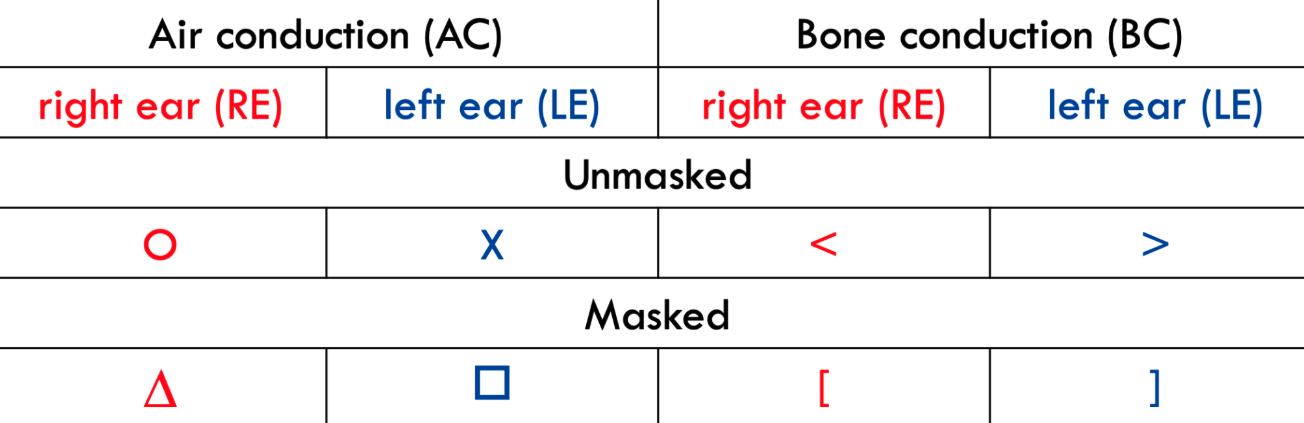
what are some risks with masking?
The clinician forgot or did not have time to mask the non- test ear
The masking noise was not loud enough to mask the non-test ear
The masking noise was too loud and crossed back to affect the test ear
what is tympanometry? reason for use?
Define | Verifies the function of the middle ear
|
Reason for Use |
Provides more information, whether there is:
|
how is a tympanometry performed?
the client needs to be still, not swallow, speak, or cough.
Background noise does not affect the test.
Steps for Conduction:
A probe is placed in the entrance of the ear canal (sealing required).
A tone is continuously presented (most often 226Hz at ~ 60 dBHL).
Air pressure is delivered from a positive value to a negative value.
The level of sound that remains within the ear canal while the pressure is varied is monitored by a microphone (absorbed or reflected by eardrum).
These levels are interpreted by the equipment representing either an increase or a decrease in admittance.
Changes in admittance are plotted on a graph (tympanogram) displaying a pressure/admittance function.
when interpreting tympanograms what are things you should look for?
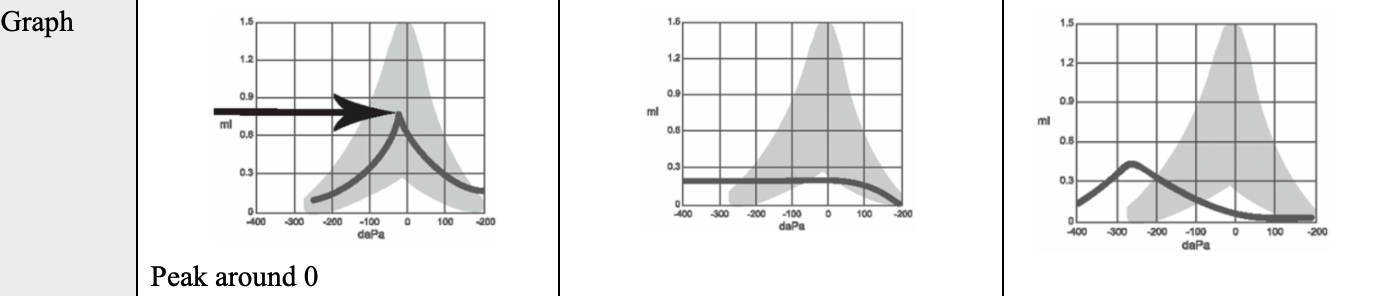
Sound is most effectively transmitted to the inner ear when the pressure on both sides of the eardrum is the same = around 0 daPa.
Shape (is there a peak?)
Height of the peak (admittance/compliance)
Air pressure at which the peak occurred (normal between -150 and 100 daPa)
Ear canal volume (may be indicated as “ml”, “cc” or “cm3 ”)
what is the typical ear canal volume for children?
(3-5yrs): 0.4 – 1.0 cm3
what is the typical ear canal volume for adults?
Typical for Adults: 0.6 – 1.5 cm3
what types of graphs are these?

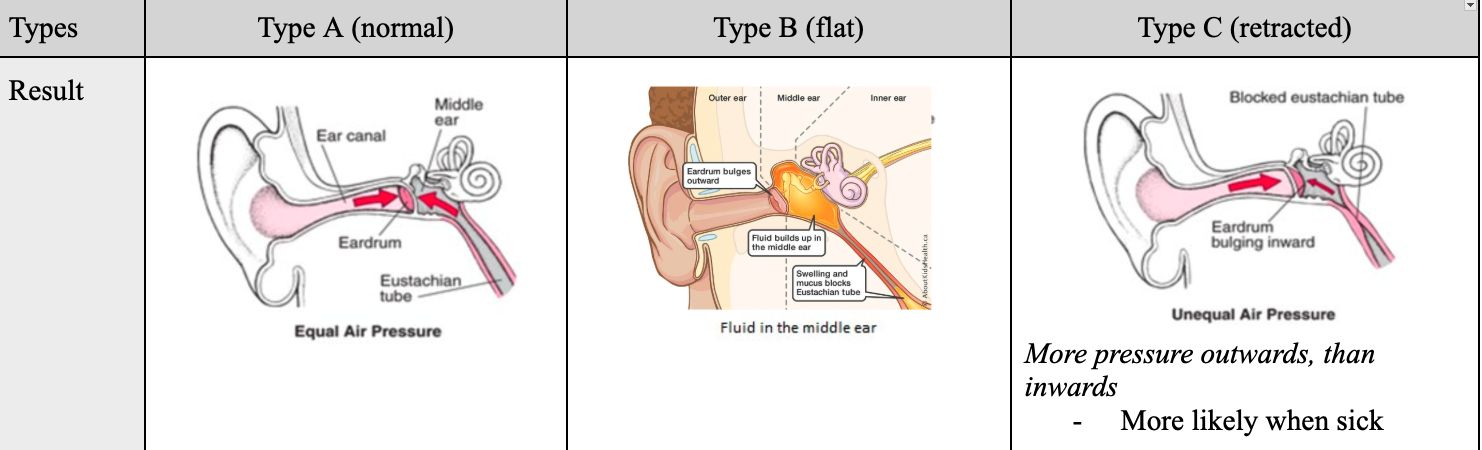
what are the consequences of type a, type b and type c graphs on a tympanometer?
what are the further types of A graphs? reason for that?

what to do when interpretting type b (flat) tympanograms?
look at the ear canal volume
Ear Canal Volume | Results Consistent with |
Within normal
|
|
Smaller than Expected | Something taking the space in the outer ear, such as wax blockage. |
If it is close to 0cm3: probe tip placed against ear canal wall. | |
Larger than Expected | Perforated Eardrum |
Grommet (a tiny plastic, metal, or silastic tube placed into the eardrum during a minor surgical procedure) |
what is a speech-recognition threshold (SRT)? how is it done?
What is the softest sound level that a word can be identified 50% of the time and repeated back (in dB)
This test is done to help confirm the reliability of the pure-tone auditory thresholds.
The SRT is expected to be very close to the 3-frequency pure-tone average (PTA) on the audiogram.
Pure-Tone Average (PTA) = average pure-tone thresholds at 500, 1000 and 2000Hz
Uses a small selection of two- syllable words that have equal stress on both syllables.
The words have a high level of word familiarity, phonetic dissimilarity, and homogeneity with respect to audibility, between the words.
E.g toothbrush, doormat, inkwell
what is word identification tests / speech recognition tests?
Assesses performance, measured in %
Sound level of the test can be set to either:
A conversational level (55dB)
A comfortable level (based on client’s preference)
Listening condition:
Aided and/or unaided (with or without hearing devices)
Each ear individually, or both ears together
Material: Recorded soundtracks of words, presented in quiet or with background noise (part of the soundtrack)
E.g AB word lists (monosyllables)
what is the Ling 6 sounds?
The Ling 6 sounds cover the main frequencies relevant for speech identification: mm ss sh ah ii oo
in consonants, what frequency is required for: nasal sounds, plosive bursts, discriminating sounds, /f/,/s/:
Nasal sounds: 250Hz
Plosive bursts: 500Hz
discriminate /r/ and /l/, hear plosive
burst /p/ and /k/, affricate bursts /ch/ and /j/, fricative noise /sh/ and /zh/: 2000Hz
/f/, /s/, /θ/: 4000Hz
in vowels, the 2 formants of a vowel need to be heard correctly. what frequencies are required for all vowels to a) be detected b) be identified
250-1000Hz = all vowels can be detected
The first formant of all vowels is low frequency.
250-3000Hz = all vowels can be identified
The human brain needs to hear the 2 first formants to identify a vowel sound.
what are hearing aids? what do they contain?
Delivers an acoustic output.
Different styles exist, but the basic components are the same:
microphones detect and convert sound into an electrical signal
amplifier increases the strength of the electrical signal (in the process it will also alter the balance of the sound, usually giving more emphasis to high-frequency sounds and weak sounds than it does to low-frequency sounds and intense sounds)
Receiver (a miniature loudspeaker), turns electricity back into sound
the amplified sound is transmitted into the ear canal via an earmould
The battery provides the power needed by the system
what are bone-conducting hearing aids?
Delivers a mechanical output → Vibrates the structures within the cochlea without the sounds passing through the middle ear.
May be suitable for people with:
Permanent conductive hearing loss
Frequent outer ear infections or eczema
Malformation of the outer or middle ear
what are bone anchored hearing aids?
Uses a mechanical vibration.
However, it is surgically implanted = it does not compress the skin (more comfortable) + can provide greater stimulation
what is a cochlear implant?
Useful when conventional hearing aids provide limited speech perception benefit or cannot be used.
Bypasses the middle- and inner-ear structures,
Electrode array implanted via surgery in the cochlea to replace the function of the hair cells and stimulate the auditory nerve.
what is auditory brainstem implant?
Bypasses the auditory nerve.
The electrodes are positioned on the surface of the brainstem – in the cochlear nucleus complex.
what are assistive language devices?
Any device that helps detect sounds or understand speech, but that are not worn totally on the head or body.
what are hearabales?
Are not classified as hearing aids, but can be purchased rather easily to help with listening.
when selecting behavioural measures in audiology, what should you look at?
The task for behavioural hearing testing in a child must be appropriate for their ability
Age is a good guide, but some children may have undiagnosed comorbidities
what is visual reinforcement audiometry? what age? theoretical basis? approach? results?
Age: 6 montsh - 2.5 years
Based on Skinner’s (1953) Principles of Operant Conditioning
Audiologist teaches a young child that every time they hear a sound, a fun visual surprise will appear = positive reinforcement
Child “responds” to the sounds by turning their head to where they think that visual surprise will be
Testing: wait → stimulus → response → reinforcement
Distracts → “beep” → child turns head → toy appears
Usually requires 2 clinicians
Audiologist controls the stimuli presentation
Other clinician distracts the child + encourages the desired behaviour
Also make sure, the parent is sitting away so the parent can’t provide any reactions to the sound
Usually done through done through a loud speaker (rather than a headset)
Hence, you can’t test the hearing for each individual ear
If hearing is equal on both sides = doesn’t matter
If hearing is better in one ear = that ear is responding
= Will only know the results for the better ear
what is play audiometry? age? method?
age: 2.5 - 5 years
Similar to audiometric tests, but uses toys to make it more fun
The audiologist teaches the child to engage in an activity each time they hear a test signal.
Then they do the testing: Wait (listen) → stimulus → response → reinforcement
“Listen” → “beep” → child plays → “Yay!!! Let’s try again!”
what tests do we use if we can’t reliably measure the thresholds of children younger than 6 months?
physiological tests
what are physiological measures?
Physiological measures do NOT rely on a person's response
E.g heart rate, skin conductance, auditory brainstem responses
Behavioural responses are different, relies on someones response
Useful to:
Confirm reported / behavioural measures
When clients can’t provide reliable responses (babies, adults with dementia)
Verify if the hearing loss is related to issues beyond the cochlea (auditory nerve, brainstem)
what does tympanometry test? results?
structure assessed: eardrum / ossicles
results: Abnormal graph = problems of outer and/or middle ear
what does otoacoustic emissios (OAE) test? measure? results: OAE yes, no OAE, no OAE but yes tympanometry?
tests: cochlea
Otoacoustic Emissions (OAE) = pass or fail measure (screening tool)
To verify the function of the outer hair cells in the cochlea
What needs to be functioning: outer ear, middle ear
How it works:
sound sent in ear canal → if outer hair cells react → sends echo back → measures that echo = echo must be > background noise recorded
Results:
OAE testing detects hearing loss > mild
if OAE = hearing is relatively okay OR mild hearing loss
If there is NO measurable OAE = moderate, severe, profound hearing loss
OAE ❌+ tympanograms ✅= outer hair cells may not have normal function → sensorineural hearing loss that is greater than mild
what do vestibulor-ocular reflex or vestibulo-spinal reflex test?
labryinth (balance)
what does the stapedius reflex test? what does it use? how it works? results?
Stapedius Reflex (often done with tympanometry)
Verifies the integrity of the auditory nerve
Uses the same equipment as tympanometry
Uses the activation of the stapedius muscle in response to loud sounds (protective response) = will pull on the eardrum
This response is bilateral = both ears should response
How it works:
Loud sounds sent in ear at different frequencies → remaining sound that DOESN’T go through eardrum is measured (by microphone) → when reflex activates → sound measured in the ear canal changes
Results:
Abnormal results (i.e the reflex cannot be measured / isn’t maintained) = client referred for further testing
Like MRI - is there anything compressing the nerve?
what does the auditory brainstem response test? how it works? results?
Auditory Brainstem Response
To verify the integrity of the auditory nerve and brainstem
Analysis of electrical waveform patterns = generated when groups of neurons are activated + fired together
How it works:
Electrodes place on ear level + top of head → sound sent to ears → electrodes on head measure electrical current generated by the fired neurons at different sites in the auditory pathway over time
Results:
This electrical current is compared to the current measure at the reference electrodes (ear level electrodes)
If tympanograms ✅, OAE ❌, ABR ❌: sensorineural hearing loss + indicates its severity
If tympanograms ✅, OAE ✅, ABR ❌: neural condition (e.g auditory neuropathy)
what does cortical auditory-evoked potentials test? how.
Cortical Evoked Responses (Later waveform patterns)
tests: auditory cortex - sound discrimination
Uses of speech sounds / continuous speech possible
Good measure for detection + discrimination
Not precise enough to inform on an individual's recognition of speech
what newborn hearing screening is used in NSW?
Statewide Infant Screening - Hearing (SWISH) Program
Consists of automated auditory brainstem response (AABR) test = measures the baby’s auditory response to sounds presented to ears