508: Pregnancy & Lactation II - Management of Chronic Conditions in Pregnancy
 Call Kai
 Learn
Learn Practice Test
 Spaced Repetition
 Match
Match Flashcards
 Knowt Play
1/38

There's no tags or description
Looks like no tags are added yet.
Name | Mastery | Learn | Test | Matching | Spaced | Call with Kai | Chat |
|---|
No analytics yet
Send a link to your students to track their progress
39 Terms
What are complications of gestational diabetes in pregnancy?
Fetal/Neonatal Complications
Macrosomia
Neonatal hypoglycemia
Hyperbilirubinemia
Shoulder dystocia
Other birth trauma
Childhood/adult obesity/diabetes
Maternal Complications
Pre-eclampsia
Cesarean delivery
Preterm labor/delivery
Increased risk of T2DM
How do we screen for diabetes mellitus in pregnancy?
Oral Glucose Tolerance Test (OGTT) between 24-28 weeks gestation is recommended for ALL women
Who is oral glucose tolerance test indicated for?
Early OGTT indicated for overweight/obese (BMI >25) women with 1 additional risk factor:
Physical inactivity
First-degree relative with diabetes
High-risk race or ethnicity
Have previously given birth to an infant weighing 4,000g (approximately 9 lb) or more
Previous gestational diabetes mellitus
Hypertension (140/90 mm Hg or on therapy for hypertension)
Women with polycystic ovarian syndrome
A1c greater than or equal to 5.7%, impaired glucose tolerance, or impaired fasting glucose on previous testing
History of cardiovascular disease
What types of OGTTs are used in pregnancy?
One Step OGTT
2 hour 75g OGTT
Performed morning after over night fast
Diagnosis made if any of the following are elevated:
Fasting: > 92 mg/dL
1 hour: > 180 mg/dL
2 hour: >153mg/dL
Two Step OGTT
1 hour 50g OGTT
If 1 hr >140 mg/dL ➔ perform 3 hour 100g OGTT
If 1 hr >200 mg/dL ➔ diagnosis made, no further testing required
Diagnosis made if ≥ 2 readings are elevated for 3 hour 100g OGTT
Fasting: >95 mg/dL
1 hour: >180 mg/dL
2 hour: >155 mg/dL
3 hour: >140 mg/dL
What are nonpharm ways to manage diabetes in pregnancy?
Weight management
Dietary modifications
Carb counting
Light/moderate exercise as tolerated
~80% of women diagnosed with GDM can control BG with diet and exercise
What are our pharmacologic options to manage DM in pregnancy?
1st line: Insulin replacement
0.7-1.0 units/kg/day divided ➔ dose depends on diagnosis
Insulin DOES NOT cross placenta
Maternal BG influence fetal BG
2nd line: Metformin (max dose: 2000mg daily)
Intolerance to insulin, good post-prandial BG with impaired fasting BG
Metformin DOES cross the placenta
What should we monitor pregnant pts with diabetes?
Antenatal Self Monitored Blood Glucose (SMBG)
Testing at least 4x daily ➔ fasting and 2hr post-prandial
Goals:
Fasting BG: 65-95 mg/dL
2 hr PP: <120 mg/dL
Postpartum monitoring
Screen for persistent DM at 6-12 wks postpartum
Place in therapy for the 2hr OGTT
Screen for T2DM every 3 years in appropriate patients
Counseling on continuing lifestyle modifications to prevent DM
How we do differentiate chronic HTN vs gestational HTN in pregnancy?
Chronic HTN (cHTN)
HTN diagnosis prior to pregnancy or
BP >140/90 mmHg x 2 BEFORE 20 weeks gestation
Gestational HTN (gHTN)
BP >140/90 mmHg x 2 on or after 20 weeks gestation
What are the BP cutoffs for indications of medications?
Severe: >160/110 ➔ meds indicated
Moderate: 150-159/100-109 ➔ meds considered
Mild: 140-149/90-99 ➔ meds considered
What are risk factors for pre-eclampsia (pregnancy complication marked by high blood pressure and signs of damage to another organ system)?
History of pre-eclampsia in prior pregnancy
Family history of pre-eclampsia
Nulliparity or multi-order gestation
Advanced maternal age ( >35 yo )
Comorbidities: Diabetes, Hypertension, Obesity, CKD
How is pre-eclampsia diagnosed in pregnancy?
BP ≥ 140/90 × 2 at least 20min apart + ONE of the following:
(+) Proteinuria → 300+mg protein in 24 urine
> 0.3 alb/cr ratio
≥ 1+ protein on urine dipstick
(+) Thrombocytopenia → Plt <100,000/microL
(+) Renal → SCr > 1.1 or doubling from baseline
(+) Hepatic → AST/ALT 2 x ULN
(+) Pulonary edema
(+) Cerebral/Visual symptoms
BP ≥160/110 mmHg x 2 at lest 1-2 minutes apart sufficient for BP target
When is eclampsia diagnosed?
Preeclampsia + seizures (grand mal seizures)
What are goals of therapy for preeclampsia?
Decrease BP to goal
<140/90 mmHg for most patients with gHTN / cHTN
<130/80 mmHg for cHTN and pre-existing DM
Prevent pre-eclampsia/eclampsia
Prevent complications (target organ damage, pre-term labor/delivery, low birth weight)
Deliver a viable, health infant
Maternal morbidity/mortality prevention
What is HELLP syndrome?
Hemolysis
Elevated liver enzymes
Low platelets → may be sevre form of pre-eclampsia, but could be present independent of BP elevations and proteinura
What are pharmacotherapy options for cHTN vs gHTN?
cHTN
if medication controlled prior to pregnancy, either continue medication OR change to preferred agent
gHTN
initiate therapy when BP >150/100 OR when BP >140/90 if preexisting cardiac hx, vascular dx, or DM
What are our 1st line options for HTN in pregnancy?
Labetalol 100-1200mg BID (αβ Blockers)
Lower risk of IUGR than traditional beta blockers
No change in cardiac output
Caution: asthma, heart dx, CHF
Nifedipine XR 30-120mg daily (Calcium Channel Blocker)
No teratogenicity est.
No change in cardiac output
Concern for reflex tachycardia and HAs
What are our 2nd line options for HTN in pregnancy?
2nd line agents
Thiazide Diuretics
Theoretic concerns for intravascular volume depletion ➔fetal growth restriction
Concerns for electrolyte abnormalities
Non-DHP CCB - Increased risk for CV defects
Which HTN meds do we AVOID during pregnancy?
ACE-inhibitor / ARB:
1st trimester CV/CNS defect
2nd & 3rd trimester nephrotoxic (renal failure / anuria)
Atenolol: increased fetal/neonatal mortality
How do we manage Preeclampsia / Eclampsia?
Delivery is the only cure → Deliver if severe or near term
Consider betamethasone if 24-34 weeks
Fetal lung maturation
Treat HTN acutely → IV labetalol or hydralazine
Prevent seizures → IV magnesium
Clinical risk assessment for Preeclampsia (recommendations for aspirin use)
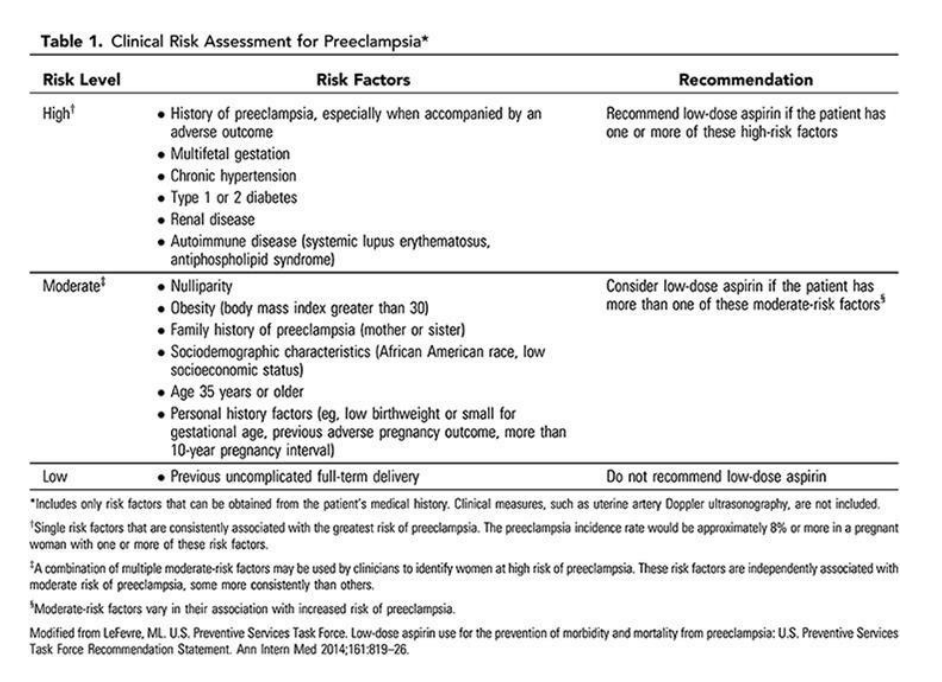
***LOOK OVER***
What preeclampsia risk factors would constitute the use of low dose aspirin? (High risk factors)
History of preeclampsia, especially when accompanied by an adverse outcome
Multifetal gestatio
Chronic HTN
Type 1 or 2 diabetes
Renal disease
Autoimmune disease (SLE, antiphospholipid syndrome)
How do we manage asthma in pregnancy?
What is our product of choice?
Pregnancy clinical pearls
Short acting product of choice → Albuterol
ICS preferred – budesonide (category B) and all others (category C) but can be used
Montelukast preferred over others in class bc more info
Systemic steroids – highest risk of fetal abnormality (cleft palate) during wks 0-9 ➔ prednisone is preferred steroid
What are risk factors for VTE in pregnancy?
Physiologic changes during pregnancy
Personal history of VTE (DVT or PE)
Obesity
Age
Hypertension
Smoking
How do VTEs complicate pregnancy?
Pregnancy is considered a hypercoagulable state
Increased clotting factors (VII, VIII, IX, X, and XII)
Decreased antithrombin III, protein S
Increased platelet function
Venous stasis
What’s our drug of choice for VTE management?
1st line: LMWH and unfractionated heparin (do not cross placenta)
LMWH (category B) preferred < 36wga and preferred in outpatient setting
Enoxaparin
Prophylaxis – 40mg SC once daily
Intermediate dosing (often 40mg SC q12h)
Therapeutic – 1mg/kg SC q12h
BID dosing preferred when possible, because of PK
Heparin (category C) preferred if ≥36 wga
What do we generally AVOID for VTEs in pregnancy?
Avoid warfarin
May use in 2nd/3rd trimester for mechanical valves
How do we monitor LWMH in pregnancy?
Consider monitoring anti-factor Xa levels
Draw peak 4-6 hrs after last dose
Prophylaxis – may check every 1-3 months
Treatment – check monthly; may consider weight based dose adjustments
What levels of LMWH do we look for in pregnancy?
Levels for prophylaxis → 0.1-0.6 International units/mL
Levels for treatment → 0.6-1 International units/mL
How do thyroid disorders complicate pregnancy?
↑ thyroid binding globulin (TBG)
↓ iodide levels
hCG and placental changes
hCG structurally similar to TSH
What are maternal/fetal complications of hyperthyroidism?
Maternal risk: HF, pre-E, PTD
Fetal risk: still birth, cleft lip, hydrops, craniosynostosis, etc
What are maternal/fetal complications of hypothyroidism?
Maternal risk: HTN, pre-E, PTD, placental abruption
Fetal risk: spontaneous abortion, LBW, low IQ, cretinism
What agents do we use for hyperthyroidism in pregnancy?
1st trimester
Propylthiouracil (D)
FR: fetal hypothyroidism, goiter
2nd/3rd Trimester
Methimazole (D)
FR: fetal hypothyroidism, goiter
What agents do we use for hypothyroidism in pregnancy?
Levothyroxine (A)
Typically requires ~30% higher dose, may require titration through pregnancy
What do we monitor for thyroid disrorders?
Symptoms c/w hyper/hypothyroidism
Labs – trimester specific goals (per AAFP guidelines)
TSH
1st trimester = 0.1 – 2.5
2nd Trimester = 0.2 - 3
3rd trimester = 0.3 – 3.0 respectively
Should see gradual return to pre-pregnancy TSH goals
Free T4
1st trimester = 0.8-1.2
2nd Trimester = 0.6-1.0
3rd trimester = 0.5-0.8
What’s the physiology of lactation?
Primarily controlled by prolactin (PRL)
PRL concentrations gradually increase during pregnancy
Lactogenesis inhibited by high estrogen and progestin concentrations during pregnancy
Lactation triggered by decrease in progestin following delivery
Once established, milk production is regulated by infant demand
Breastfeeding provides maternal and infant health benefits
What are the Lactation Safety Categories?
L1 - Safest
Drug taken by a large amount of lactating women and not shown ADR
Controlled studies in lactation do not show ADR
L2- Safer
Drug studied in a limited number of lactating women and not shown ADR
Evidence shows risk for harm is remote
L3 - moderately safe
No controlled studies in breastfeeding women OR controlled studies show only minimal nonthreatening risk
Risk is possible
Give if benefit outweighs risk
L4 - possibly hazardous
Risk to breastfed infant or breastmilk but benefits may outweigh risks to infant (life-threatening situation, safer drugs cannot be used as alternative)
L5 - hazardous
Studies documents significant risk or high risk medication with known infant damage.
Risk outweighs benefit.
Medication is contraindicated for breastfeeding.
How is medication transferred to milk during lactation?
Simple Diffusion – most common method of transfer
Ionization
Lipophilic
Protein binding
Molecular weight
Milk/Plasma ratio – Drugs excreted in breast milk
>1-5 indicates high level in milk
<1 indicates low levels in milk
What are some things to consider during lactation?
Consider dose/route/frequency and duration of maternal use
In general - <1% of maternal dose will get to infant
Infant specific considerations
Compare to usual dose if medication used for pediatrics
Age
Days postpartum
Feeding intervals
Relative infant dose
RID = Infant dose / maternal dose (in mg/kg/d)
<10% is generally safe
How can we minimize infant exposure to medicaitons?
Evaluate duration of treatment
Avoid extended release formulations/medications with long half lives
Consider feeding times