3001: Vitamins and Cholesterol
 Call Kai
 Learn
Learn Practice Test
 Spaced Repetition
 Match
Match Flashcards
 Knowt Play
1/63

There's no tags or description
Looks like no tags are added yet.
Name | Mastery | Learn | Test | Matching | Spaced | Call with Kai | Chat |
|---|
No analytics yet
Send a link to your students to track their progress
64 Terms
How are fat-soluble vitamins digested, absorbed, and transported?
Their digestion, absorption, and transport are high when ingested with lipids.
Stomach lipase contributes little; digestion occurs mostly in the small intestine, and absorption occurs in the proximal small intestine.
What does “vitamin A” refer to?
Vitamin A refers to the all-trans-retinol molecule and is also a generic term for related compounds with retinol-like activity, including retinal, retinyl esters, and all-trans-retinoic acid.
Retinoids: Vitamin A compounds and synthetic analogues with similar structures or functions are called retinoids
Examples: (A) Preformed vitamin A, (B) Provitamin A carotenoids and (C) Preformed vitamin A and Provitamin A carotenoids in mother’s milk
What are the main physiological roles of vitamin A?
Vitamin A supports vision, immune function, development, reproduction, tissue growth and differentiation, and epithelial integrity; carotenoids also have antioxidant effects.
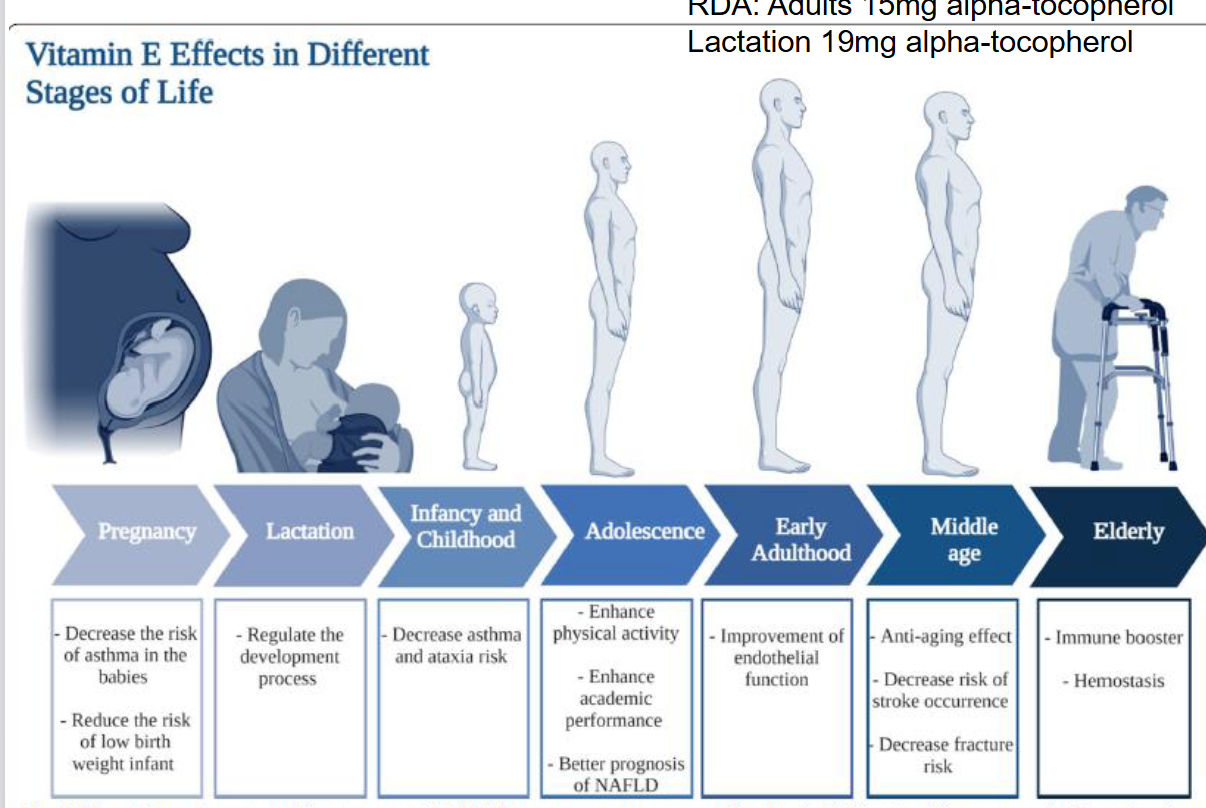
Pay attention to stages of life image

What are carotenoids in relation to vitamin A?
Carotenoids are yellow and orange plant pigments.
Some are metabolized to produce retinol and act as provitamin A precursors, but not all carotenoids can be converted to vitamin A.
Are vitamin A and its derivatives water- or fat-soluble?
They are fat-soluble.
What is beta-carotene?
Beta-carotene is a provitamin A carotenoid.
Examples: breast milk, beef liver, sweet potato, pumpkin, spinach, carrots

How does absorption of vitamin A compare with carotenoids?
Vitamin A is relatively well absorbed at about 70–90%, while carotenoids have a lower absorption efficiency of about 20–50%.
Carotenoid absorption depends on the type of food, preparation method, and amount of dietary fat.
Why is dietary fat important for vitamin A absorption, and how much dietary fat does the slide suggest to facilitate it?
Dietary fat helps vitamins enter enterocytes and allows optimal formation of chylomicrons to transport vitamin A.
At least 10 g of fat, or about 2–2.5 teaspoons, at each meal to facilitate vitamin A absorption

What happens to vitamin A in the liver, and how is it transported, stored, and eliminated?
Retinol was esterified to retinyl esters
In the liver, retinyl esters are hydrolyzed to retinol.
Retinol can bind RBP4 for transport to other tissues, and the retinol-RBP4 complex associates with transthyretin to help prevent kidney filtration.
The liver is the main site of vitamin A metabolism and storage, and vitamin A is eliminated slowly, mainly through the bile duct.

What are the vitamin A RDA equivalents and recommended intakes?
1 µg RAE = 1 µg retinol = 12 µg beta-carotene = 24 µg alpha-carotene = 24 µg beta-cryptoxanthin.
1 IU vitamin A = 0.3 µg retinol = 0.3 µg RAE.
RDA: Men 900 µg RAE; Women 700 µg; Pregnancy 770 µg; Lactation 900 µg. Upper limit: 3000 µg RAE (10,000 IU).
What are the different forms of vitamin E and what is it mainly recognized for?
Vitamin E occurs as α-, β-, γ-, and δ-tocopherol, as well as tocotrienols. γ-tocopherol is the most widespread in foods, while α-tocopherol is considered the most active form.
Its mainly recognized for its antioxidant action, protecting cells from reactive oxygen and nitrogen species.
Examples: wheat germ oil (the most), sunflower oil/seeds, almonds
How do natural and synthetic forms of vitamin E compare?
Natural d-alpha-tocopherol is absorbed more efficiently and has higher activity than some synthetic forms, such as dl-alpha-tocopherol.
Describe the structure of tocopherol

How are natural versus synthetic forms of vitamin E digested and absorbed?
Natural forms in foods do not require digestion. They are emulsified into lipid droplets in the stomach and packaged into micelles in the intestine.
Synthetic alpha-tocopherol acetate must be digested to alpha-tocopherol by pancreatic esterase in the lumen and duodenal esterase at the brush border.
Vitamin E is absorbed mainly in the jejunum, generally by passive diffusion, and requires bile salts and dietary fat.
What factors affect vitamin E absorption?
Vitamin E bioavailability depends on the food matrix and fat quality and is higher when consumed with long-chain polyunsaturated fatty acids.
SR-B1 and other cholesterol transporters also participate, and the slide suggests at least 3 g of fat for optimal tocopherol absorption.
How is vitamin E transported, stored, and excreted?
Synthetic α-tocopheryl acetate is de-esterified by esterases to α-tocopherol, then vitamin E is incorporated into micelles with bile acids and pancreatic secretions and absorbed in the intestine. It is packaged into chylomicrons, transported through the lymph and blood, and later carried in VLDL, LDL, and HDL.
Entry into cells is mostly mediated by LDL receptors.

What are the functions of vitamin E?
Membrane integrity and protection from oxidation
Prevent oxidation of polyunsaturated fatty acids
Prevent oxidation of LDL and protect from CVD
Improve immunity and prevent infections
Involved in signal transduction and gene expression regulation
How does vitamin E act as an antioxidant and prevent lipid peroxidation?
Vitamin E quenches singlet molecular oxygen (1O2) and…
Scavenges free radicals, helping stop the chain reaction of lipid peroxidation. It donates hydrogen to lipid radicals, terminating the reaction and reducing cellular damage.

What is the recommended intake for vitamin E?
The RDA is 15 mg alpha-tocopherol for adults and 19 mg during lactation.
What is vitamin K, and what are the main forms (K1/K2) and sources of vitamin K?
Vitamin K is a fat-soluble family of compounds with a common 2-methyl-1,4-naphthoquinone structure.
Vitamin K1 (phylloquinone) is mainly found in green leafy plants and is the major circulating form.
Vitamin K2 (menaquinones) is mainly found in animal and fermented foods and is also produced by gut bacteria.
Examples: kale, broccoli, spinach, Swiss chard, and salad greens.
How is vitamin K absorbed and transported?
Phylloquinone (K1) is absorbed in the jejunum with micelles, while menaquinones (K2) are absorbed by passive diffusion from the ileum and colon.
Vitamin K is transported by chylomicrons to the liver and by VLDL/LDL to extrahepatic tissues.
Where is vitamin K found in the body and how is it excreted?
The liver retains only a small amount. Vitamin K is found mainly in cell membranes of the lungs, kidneys, bone marrow, and adrenal glands.
Excretion occurs mostly through feces with bile and urine.
What are the main functions and adequate intake of vitamin K?
Vitamin K functions in blood clotting, bone mineralization, cell growth, and signal transduction.
Adequate intake is 120 μg/day for men and 90 μg/day for women, based on coagulation functions.

How do vitamins A, E, K, and D interact?
Vitamins A and E antagonize vitamin K, and excess vitamin A can interfere with vitamin K absorption.
Vitamin K-dependent proteins interact with calcium, which also functions with vitamin D, so vitamin K may work with vitamin D in calcium transport.
Sterols are essential molecules in eukaryotes. They share a waxy consistency, four fused rings, and a 3β-hydroxyl group, but differ in double-bond positions and side-chain carbons.
Fungi → ergosterol;
Plants → phytosterols;
Animals/humans → cholesterol.
It gives membranes a liquid-ordered state and rigidity and reduces permeability by filling gaps between phospholipids.
Lipid rafts are proposed nanoscale membrane assemblies involved in cell signalling and trafficking, and cholesterol is an important component of them.
Cholesterol regulates some integral membrane proteins, is a precursor for steroid hormones, and is converted into bile acids in the liver.
How is cholesterol balance maintained in the body?
Cholesterol from diet and endogenous synthesis is balanced by conversion into bile acids and biliary cholesterol excretion.
The body wants to maintain balance between input and excretion

About 400–800 mL/day:
85% water and 15% other components, including about 72% bile acids,
19% phospholipid, and
9% cholesterol.
How much bile acid and cholesterol circulates, and how much is lost?
About 4–5 g circulates, while about 0.5 g of combined bile acid and cholesterol is excreted and must be replaced by synthesis.
Rates of cholesterol absorption vary widely from 25% to around 80%, and average about 50%

Where are dietary and endogenous lipids absorbed or reabsorbed? How does this absorption compare in humans versus other animals
From the duodenum to the ileum.
Cholesterol synthesis rates are lower in humans compared to many other animals
Important sites include the intestines and skin, but nearly every organ requires cholesterol for membranes and steroid production.
Mainly from lipoproteins such as LDL, supplemented by de novo synthesis.
The brain relies entirely on de novo cholesterol synthesis, as circulating lipoproteins cannot cross the blood-brain barrier
It follows a diurnal cycle, peaking in the early morning and decreasing during the day.
What does ACAT (Acetyl-CoA C-acetyltransferase)/thiolase do?
catalyzes the condensation of two acetyl-CoA molecules to form
acetoacetyl-CoA
Which ACAT should not be confused with ACAT (Acetyl-CoA C-acetyltransferase)/thiolase?
Acyl-CoA acyltransferase, also called ACAT, which esterifies cholesterol with fatty acyl-CoA to form cholesteryl esters.
What does HMG-CoA synthase (3-Hydroxy-3-Methylglutaryl-CoA Synthase) do?
catalyzes the reaction that converts acetoacetyl-CoA and another acetyl-CoA molecule into HMG-CoA
catalyzes the rate-limiting step in cholesterol biosynthesis, converting HMG-CoA into mevalonate
Druggable interference with cholesterol synthesis (& metabolism) (statins)
They are measurable blood intermediates in cholesterol synthesis.
Lanosterol (steroid) follows either the Kandutsch–Russell (C24-saturated sterols) or Bloch (C24-unsaturated sterols) pathway
Zymosterol is the common transfer point between these pathways, termed the “modified Kandutsch–Russell pathway.”
What does sex glands and 7-dehydrocholesterol convert cholesterol into?
7-dehydrocholesterol is an immediate cholesterol precursor and can be converted into vitamin D.
Sex glands can be converted to sex hormones
Adrenal glands can be converted to
Cholesterol and be converted directly into bile salts

What are Ergosterol and β-sitosterol?
Ergosterol is the cholesterol equivalent in yeast, and β-sitosterol is a major phytosterol.
24,25-epoxycholesterol is an oxysterol produced through a cholesterol-synthesis shunt pathway.
24S-hydroxycholesterol is produced mainly in the brain and helps with neuronal cholesterol turnover and transport across the blood-brain barrier.
How is excess cholesterol stored in the cell in the LDL receptor pathway?
Cholesterol is transferred to the Golgi, esterified with ACAT, and stored in the cell.

What are SREBPs and what do they regulate?
SREBPs = Sterol Regulatory Element-Binding Proteins. They are transcription factors involved in regulating lipid and cholesterol metabolism. Their DNA-binding region is a basic helix-loop-helix (bHLH) domain.
SREBP-1a, SREBP-1c, and SREBP-2 (just focus on SREBP) regulate genes involved in de novo lipogenesis, cholesterol synthesis, and cholesterol uptake. SREBP is associated with SCAP and INSIG in the ER membrane.

How does low cellular cholesterol increase cholesterol synthesis through SREBP?
INSIG, SCAP (sterol cleavage-activating protein), and SREBP are attached when there is cholesterol (red shown in image). INSIG prevents SREBP from getting cleaved.
When cholesterol is low, INSIG detaches from SCAP, cahnging SCAPs conformation, and SCAP carries SREBP from the ER to the Golgi.
If there is still some cholesterol around, SCAP and SREBP and held together and stays in Golgi.
If no cholesterol in the Golgi, S1P (site 1 protease), cleaves SREBP, which then recruits S2P to also cleave SREBP. This then releases its N-terminal active portion.
Active SREBP enters the nucleus and gives a signal to increase HMG-CoA reductase gene expression, increasing cholesterol synthesis.

How do transcription factors and nuclear receptors increase gene transcription, and how does this relate to SREBP?
A classic transcription factor moves into the nucleus and uses its DNA-binding domain to bind DNA at a promoter/regulatory region and increase transcription. A nuclear receptor also has a DNA-binding domain but additionally has a ligand-binding domain.
SREBP acts like a classic transcription factor: once activated, it moves into the nucleus, binds DNA through its bHLH DNA-binding domain at the SRE, and increases transcription of genes such as HMG-CoA reductase.

Describe the step 1 of cholesterol synthesis: how is HMG-CoA formed and location
The first stage takes place in the cytoplasm.
This set of reactions starts with the formation of 3- hydroxy-3-methylglutaryl CoA (HMG-CoA) from acetyl CoA and acetoacetyl CoA.
This is the rate-limiting step and is driven by HMG-CoA reductase

Describe the step 2 of cholesterol synthesis: Formation of squalene
ATP-dependent phosphorylation:
Mevalonate kinase (MVK) and phosphomevalonate kinase (PMVK) use ATP to sequentially phosphorylate mevalonic acid, forming mevalonate-P and then mevalonate-PP.
Decarboxylation:
Diphosphomevalonate decarboxylase (MVD) converts mevalonate-PP into isopentenyl-PP.
Isoprenoid condensation and flexibility:
Isoprenoid intermediates like geranyl-PP and farnesyl-PP can either form squalene (with NADPH) (a cholesterol precursor) or be diverted for other uses.

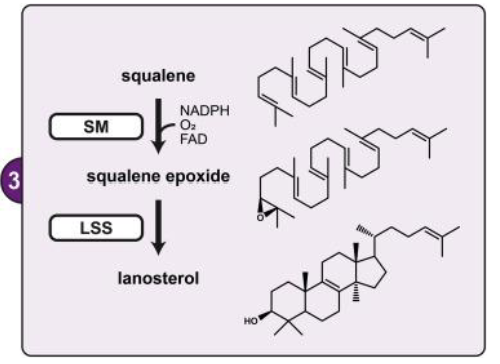
Describe the step 3 of cholesterol synthesis: Formation of lanosterol
Squalene monooxygenase (SM):
SM is the second rate-controlling step in cholesterol synthesis, introducing an epoxide group onto squalene using O₂, FAD, and NADPH. This oxygen later becomes the beta-hydroxyl group in cholesterol.
Regulation by cholesterol-sensitive proteolysis:
SM serves as a flux-controlling enzyme and is regulated by proteolysis sensitive to cholesterol levels, adjusting cholesterol synthesis as needed.
Lanosterol synthase (LSS):
LSS catalyzes the cyclization of squalene epoxide into lanosterol, an essential step involving one of the most complex molecular rearrangements performed by a single enzyme.
Describe the step 4 of cholesterol synthesis: Two different pathways
Two cholesterol synthesis pathways:
After lanosterol, cholesterol biosynthesis can proceed through either the Bloch pathway or the Kandutsch–Russell pathway, and these two pathways are not mutually exclusive.
DHCR24
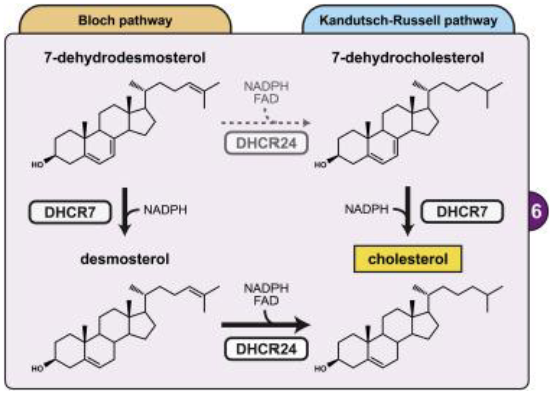
(24-Dehydrocholesterol reductase) reduces the C-24 double bond in sterol intermediates, and completes production of cholesterol inside the cell.
Role in pathway crossover:
DHCR24 can shuttle intermediates from the Bloch pathway into the Kandutsch–Russell pathway, intertwining both routes.
Pathway preference varies with physiology:
The Bloch pathway is predominant in the brains of young mice, while the Kandutsch–Russell pathway becomes more prominent with aging. The main branching point often occurs at zymosterol, leading to a “modified Kandutsch– Russell pathway.”

Describe the step 5 of cholesterol synthesis: 7-dehydrodesmosterol or 7- dehydrocholesterol of both pathways
Role of Δ14-sterol reductases:
The product of lanosterol demethylase (LDM) serves as a substrate for 14-dehydrocholesterol reductase (DHCR14) or lamin-B receptor (LBR), both of which are Δ14-sterol reductases requiring NADPH for their activity.
Sequential methyl group removal:
Methylsterol monooxygenase 1 (SC4MOL), sterol-4-alpha-carboxylate 3-dehydrogenase (NSDHL), and 3-keto-steroid reductase (HSD17B7) work in succession to remove two C4-methyl groups from sterol intermediates, resulting in the formation of zymosterol (Bloch pathway) or zymostenol (Kandutsch–Russell pathway).
Conversion of 7-dehydrocholesterol to vitamin D:
Zymosterol and zymostenol are further processed into 7-dehydrodesmosterol (Bloch) or 7- dehydrocholesterol (Kandutsch–Russell), with the latter being converted to vitamin D upon exposure to ultraviolet B light in skin cells, transforming it into cholecalciferol (vitamin D3)

Describe the step 6 of cholesterol synthesis: Formation of cholesterol and functional roles of both pathways
Final Enzymes in Pathways:
In the Kandutsch–Russell pathway, the final enzyme, DHCR7 (7- dehydrocholesterol reductase), is NADPH-dependent and converts 7- dehydrocholesterol into cholesterol.
In the Bloch pathway, 7-dehydrodesmosterol is first converted to desmosterol by DHCR7, which is then reduced to cholesterol by DHCR24.
Functional Roles:
Both pathways ultimately contribute to cholesterol production, but they utilize different intermediates, and the enzymes involved are crucial for proper metabolic function
What is the genetic deficiencies involved in step 6 (final step) of cholesterol synthesis
A deficiency in either DHCR24 or DHCR7 leads to severe developmental abnormalities, highlighting the critical role these enzymes play in cholesterol synthesis and overall development.
Where does intestinal cholesterol come from and what happens if it is not absorbed?
Intestinal cholesterol comes from the diet and bile. Cholesterol that is not absorbed is excreted.
What happens to cholesterol after it enters an enterocyte?
Some cholesterol can enter enterocyte membranes, but the majority is esterified in preparation for transport out of the cell as part of chylomicrons.
What transporter brings cholesterol and phytosterols into intestinal cells?
NPC1L1 (Niemann-Pick C1-Like 1) transports cholesterol and phytosterols from the intestinal lumen into the enterocyte.
Foods and supplements enriched with phytosterols effective at reducing blood cholesterol concentration by 10% or more
Describe intestinal sterol absorption.
NPC1L1 transports sterols from the intestinal lumen into the enterocyte.
Some sterols are transported back into the lumen by ABCG5/G8, regulated by LXRα (liver X-receptor).
Inside the enterocyte, ACAT2 esterifies cholesterol.
MTP helps package the sterol with ApoB-48 into chylomicrons.
Chylomicrons are released into the lymph.
