lab 2 exam practice
 Call Kai
 Learn
Learn Practice Test
 Spaced Repetition
 Match
Match Flashcards
 Knowt Play
1/21

There's no tags or description
Looks like no tags are added yet.
Name | Mastery | Learn | Test | Matching | Spaced | Call with Kai | Chat |
|---|
No analytics yet
Send a link to your students to track their progress
22 Terms

What insect is this?
Order: Collembola (springtails), Family:
Wingless, minute to small •
Ventral side of abdomen often has a forked jumping organ called a furcula •
Retinaculum, part of jumping apparatus •
Collophore, tube-like structure on underside of abdomen

What insect is this?
Zygentoma (silverfish and firebrats)
• Wingless
• Long flattened body
• Antennae long and slender
• 2 or 3 long ‘tails’ at tip of abdomen
• Ametabolous development

What insect is this?
EPHEMEROPTERA (mayflies)
• Short bristle-like antennae
• 2 or 3 long ‘tails’ at tip of abdomen
• Wings triangular in shape with numerous veins
• Wings held vertically above abdomen when
insect is at rest
• Hemimetabolous development

What insect is this?
ODONATA (damselflies, dragonflies)
• Body long and slender
• Long narrow wings about the same length
with numerous veins
• Hemimetabolous development
• Minute bristle-like antennae

What insect is this?
PLECOPTERA (stoneflies)
• Long slender antennae
• 2 long tails at tip of abdomen
• Wings fold horizontally and overlap above
body when at rest
• Chewing mouthparts, may be poorly
developed or vestigial
• Hemimetabolous development

What insect is this?
DERMAPTERA (earwigs)
• 2 pairs of wings
o Front wings are short, leathery,
veinless
o Hind wings, membranous and
rounded
• Forceps like cerci
• Chewing mouthparts
• Hemimetabolous development

What insect is this?
ORTHOPTERA (grasshoppers, crickets and katydids)
• Winged or wingless
• Front wings narrowed, thickened (or leathery), called tegmina (tegmen = singular)
• Hind wings larger than front wings, membranous, folded fan-wise at rest
• Chewing mouthparts
• Hind legs (femur) often modified for jumping
• Hemimetabolous development

What insect is this?
BLATTODEA (cockroaches (& termites))
• Front wings leathery and veined
• Hind wings larger than front wings,
membranous, folded fan-like at rest
• Chewing mouthparts
• Hind femur not enlarged (see Orthoptera)
• Hemimetabolous development

What insect is this?
BLATTODEA (termites (& cockroaches))
• Small, soft bodied
• Winged or wingless
o If winged, 4
wings, equal in
size, with few
veins held at rest
over back
• Chewing mouthparts
• Abdomen broadly joined to thorax
• Antennae moniliform (beadlike) or filiform (threadlike)
• Hemimetabolous development

What insect is this?
PSOCODEA (Chewing lice specifically, sucking, bark and book lice)
• Wingless
• Dorso-ventrally compressed
• Broad head, wider than prothorax
• Front legs shorter than other legs
• Chewing mouthparts
• Hemimetabolous development

What insect is this?
THYSANOPTERA (thrips)
• Small (2-5 mm)
• Most winged
• Long narrow wings, fringed
with hairs, few or no veins
• Asymmetrical punch and suck
mouthparts
• Hemimetabolous development
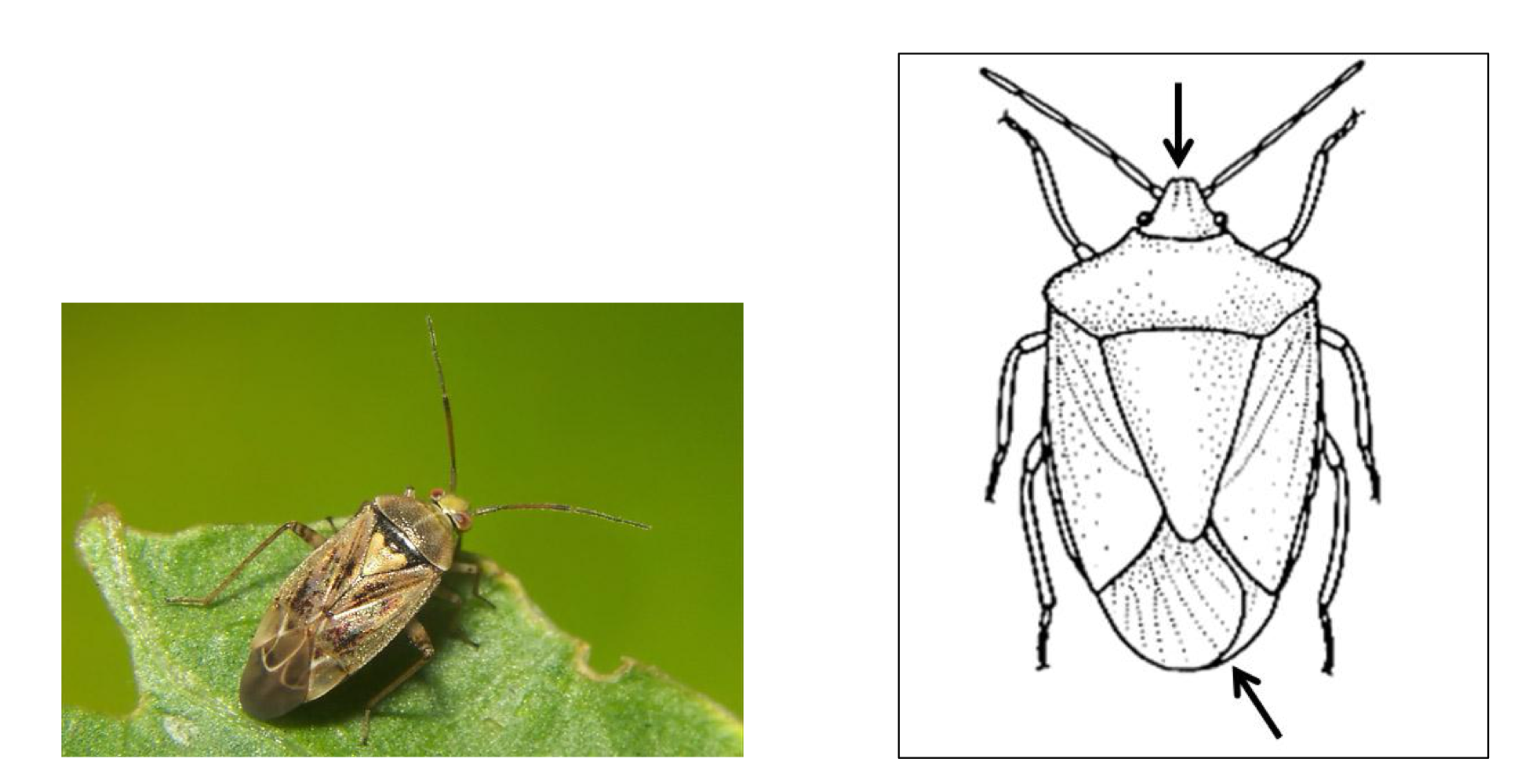
What insect is this?
HEMIPTERA (true bugs, cicada, hoppers, aphids, whiteflies, psyllids, mealybugs and
scale insects)
Suborder Heteroptera
• Front wings usually thickened or leathery at
base and membranous at tip (Hemelytron)
• Fore wing tips overlap when wings at rest,
hind wings membranous
• Piercing-sucking mouthparts
• Beak arises from front of head
• Hemimetabolous development

What insect is this?
HEMIPTERA (true bugs, cicada, hoppers, aphids, whiteflies, psyllids, mealybugs and
scale insects)
Suborder Auchenorrhyncha and Sternorrhyncha
• Front wings uniform in texture and thickness (may or may not be thickened)
• Wings held tent-like over body when at rest
• Piercing-sucking mouthparts
• Beak arises at back of head on underside
• Hemimetabolous development

What insect is this?
NEUROPTERA (lacewings, antlions and owlflies)
• Antennae long, multi-segmented
• Wings held tent-like over body at rest
• Fore and hind wings similar in shape and venation
• “Twigging” veins fork near wing edge
• Chewing mouthparts
• Holometabolous development

What insect is this?
MEGALOPTERA (alderflies, dobsonflies and fishflies)
• Antennae long, multi-segmented, pectinate in some species/sexes
• Wings held tent-like over body at rest
• Hind wing features anal fold
• Chewing mouthparts
• Holometabolous development

What insect is this?
COLEOPTERA (beetles)
• Front wings (elytra) have no veins and are thickened, leathery or brittle and usually meet in a
straight line down the middle of the back
• Hind wings are long and membranous, folded under front wings at rest
• Chewing mouthparts
• Holometabolous development

What insect is this?
DIPTERA (true flies)
• Adults have one pair of membranous wings (some are wingless)
• Hind wings are represented by a pair of knobbed structures (halteres)
• Mouthparts vary from vestigial to sponging to piercing-sucking
• Holometabolous development

What insect is this?
MECOPTERA (scorpionflies, hangingflies)
• Mouthparts at end of beak-like structure far from eyes
• Elongated face
• Holometabolous development

What insect is this?
SIPHONAPTERA (fleas)
• Body compressed laterally
• Wingless
• Body covered with backward
projecting spines
• Legs long, stout, for jumping
• Holometabolous development

What insect is this?
TRICHOPTERA (caddisflies)
• Moth-like in appearance
• 4 membranous wings, partially or entirely covered in hairs (no scales)
• Antennae as long as body or longer
• Wings held tent-like over body at rest
• Holometabolous developmen

What insect is this?
LEPIDOPTERA (moths, butterflies and skippers)
• 4 wings covered with overlapping scales
• Most of body and legs also covered in scales
• Sucking mouthparts (usually form coiled tube)
• Antennae form varies between groups (butterflies = clubbed, skippers = hooked end, moths =
variable but not clubbed)
• Holometabolous developmen

What insect is this?
HYMENOPTERA (sawflies, ants, bees and wasps)
• Usually 2 pairs of membranous wings, when present
• Front wings larger than hind wings, held together by hooks (hamuli) on anterior margin of the
hind pair
• Mouthparts primarily chewing, may be adapted to sucking and lapping
• Abdomen constricted at the base and it’s first segment is fused with thorax (excludes sawflies)
• Holometabolous development